

Kirjahaku
Etsi kirjoja tekijän nimen, kirjan nimen tai ISBN:n perusteella.
1000 tulosta hakusanalla Ellis David Ellis

A USA TODAY Bestseller Bestselling and award-winning author David Ellis delivers a fast-paced, twisty thriller that will surprise readers at every turn. Leo Balanoff is a crusading attorney with unthinkable skeletons in his closet. He's also a diagnosed pathological liar. When a predatory gangster with a long list of victims is found dead and Leo's fingerprints show up on the murder weapon, no one believes a word he says in his defense. But he might be the FBI's only shot at taking down the gangster's even more lethal boss. Risk his life going undercover for the feds or head straight to prison for murder? Leo accepts the FBI's offer--but it comes with a price, including a collision course with his ex, Andi Piotrowski, a former cop and "the one who got away." Anyone else forced to walk this tightrope between an ambitious FBI agent and a cruel, calculating crime boss would fail. But this isn't Leo's first balancing act, and he still has a few tricks up his sleeve...

This is the first book devoted entirely to Lawrence's nonfictional writings. It focuses on a selection of representative texts, each of which is placed in an appropriate literary or historical context. These include the 'Study of Thomas Hardy', the two books about the Unconscious, the travel-writing - primarily Twilight in Italy and Sea and Sardinia - the largely autobiographical 'Introduction to Memoirs of the Foreign Legion by M. M' and the late 'thoughts in verse' called Pansies. David Ellis and Howard Mills challenge the automatic relegation to secondary status suffered by these works in the past and suggest a radical reassessment of Lawrence's literary profile of how his writings relate to one another and of where his greatest power and originality lie.

The passages in Wordsworth's Prelude known as the 'spots of time' have always been regarded as important and impressive but have seldom been satisfactorily explained. Whilst there is general agreement about how well they are written, there is none at all about what they might mean. David Ellis sets out to resolve this paradox and, since the passages which concern him deal with very private moments in Wordsworth's life and have an interest which is largely psychological, he considers how far a knowledge of Freud might be relevant to their understanding. His attempt to clarify what is at once the most intriguing and baffling aspect of Wordsworth's great autobiographical poem leads Ellis to make challenging suggestions about how the whole work should be read. This is a book for the student and general reader of Wordsworth as well as for specialists. It should also appeal to those with an interest in the nature of autobiography or the use (and the misuse) of psych-analytic concepts in literary interpretation.

D.H. Lawrence's Non-Fiction Art, Thought, and Genre
David Ellis; Howard Mills
Cambridge University Press
1988
sidottu
This is the first book devoted entirely to Lawrence's nonfictional writings. It focuses on a selection of representative texts, each of which is placed in an appropriate literary or historical context. These include the 'Study of Thomas Hardy', the two books about the Unconscious, the travel-writing - primarily Twilight in Italy and Sea and Sardinia - the largely autobiographical 'Introduction to Memoirs of the Foreign Legion by M. M' and the late 'thoughts in verse' called Pansies. David Ellis and Howard Mills challenge the automatic relegation to secondary status suffered by these works in the past and suggest a radical reassessment of Lawrence's literary profile of how his writings relate to one another and of where his greatest power and originality lie.

Since he has been living on the beach in City Island, David Ellis has not stopped writing about the beautiful place that he loves. Many of the poems in this book are on display around City Island written on canvas and driftwood.
Featured in the New York Times for his haiku poetry that he paints on driftwood and first poetry book Beach in City Island, David Ellis has been working in Harlem as a teacher for almost two decades. David fell in love with Harlem the moment he entered. "I feel the souls of those that were here before I was born, especially when I walk down Lenox Avenue." Most of the poems written in this poetry book are on display at many restaurants and cafes in Harlem, hand painted on canvas and written in frames.


Trial by Fired, You Bear Witness: How Faith and Family Helped Me Defeat a Corporate Goliath
David Ellis
MR.David Ellis
2014
nidottu
David Ellis played by the rules. He worked hard, started a family, and set out on a straight and narrow path towards his own version of the American dream. But darker forces were at work to sabotage that dream. People within his own company were determined, because of jealousy and racism, to see him fail. He was accused without proof, fired without reason, and maligned without cause. Destroy a man's livelihood and you take away his ability to support his family. Without family, you take away his life. This is the story of one man's fight for truth, justice, and the American dream. Growing up in the inner city with a strong mother and an absent father, David eventually went to work for The Company, one of the largest rapid transit systems in the United States, serving millions of people in multiple states. For fourteen years, he worked his way up from custodian to 1st class painter, with never a black mark on his record, but when the powers that be within The Company began to resent the life he'd built for his family, steps were taken to destroy that life and show him just who was boss. This is the story of how one man went up against a giant employer, and with the help of his faith and his family, came through the fire with his soul intact.David fought Goliath, and won.

Given the increasing number of old people, the proliferation of books about old age is hardly surprising. Most of these come from cultural historians or social scientists and, when those with a literary background have tackled the subject, they have largely done so through what are known as period studies. In Blasted with Antiquity, David Ellis provides an alternative. Skipping nimbly from Cicero to Shakespeare, and from Wordsworth to Dickens and beyond, he discusses various aspects of old age with the help of writers across European history who have usually been regarded as worth listening to. Eschewing extended literary analyses, Ellis addresses retirement, physical decay, sex in old age, the importance of family, legacy, wills and nostalgia, as well of course as dying itself. While remaining alert to current trends, his approach is consciously that of the old way of teaching English rather than the new. Whether 'blasted with antiquity' like Falstaff in Henry IV Part Two, or with the 'shining morning face' of an unwilling student, his accessible and witty style will appeal to young and old alike.
Popular though biography is, it has as yet received very little critical attention. What nearly all biographies offer is an understanding of their subjects and an explanation of their behaviour. In this book David Ellis, author of the acclaimed third volume of the Cambridge biography of D H Lawrence, meditates on the nature of biography and the way biographers habitually explain their subjects' lives by reference to psychology, ancestry, childhood experience, social relations, the body or illness. Packed with examples and written in a lively, engrossing style, the aim of the book is to uncover the principles which biographers adopt in their efforts to make sense of others' lives whilst at the same time ensuring that their own narratives remain coherent. In exploring the methods of literary biographers and the ways in which they interpret the material they accumulate - from Dr Johnson to Jean-Paul Sartre - David Ellis is able to make challenging and highly valuable comments on biography in general. Although he chiefly draws on recent lives of writers such as Dickens, Henry James, Flaubert, Virginia Woolf, Sylvia Plath, Graham Greene, George Orwell, W B Yeats and Hemingway, Professor Ellis also considers the biographies of such compelling, non-literary figures as Mozart, Picasso and Cezanne. With their focus on the understanding of other people as the main feature of biography, the informed and often humorous discussions in this book provide the ideal context for appreciating this fascinating literary form.

A polemical attack on the ways recent Shakespeare biographers have disguised their lack of information. How can biographies of Shakespeare continue to appear when so little is known about him? And when what is known has been in the public domain for so long? Why have the majority of the biographies published in the last decade been written by distinguished Shakespeareans who ought to know better? To solve this puzzle, David Ellis looks at the methods that Shakespeare's biographers have used to hide their lack of knowledge. At the same time, by exploring efforts to write a life of Shakespeare along traditional lines, it asks what kind of animal 'biography' really is and how it should be written. Key Features * An expose of the Shakespeare biography industry showing that books which are marketed as biographies of Shakespeare are nothing of the kind. * From this book, the reader can learn all that is directly known about Shakespeare * Asks the reader to think about how we acquire our knowledge of other people and what we ought therefore to expect of biographies

This is a polemical attack on how recent Shakespeare biographers have disguised their lack of information. How is it that biographies of Shakespeare can continue to appear when so little is known about him, and what is known has been in the public domain for so long? Why is it that a majority of the biographies published in the last decade have been written by distinguished Shakespeareans who ought to know better? This book attempts to solve this puzzle by examining the methods the biographers have used to hide their lack of knowledge. At the same time, by exploring efforts to write a life of Shakespeare along traditional lines, it asks what kind of beast biography really is and how it can ethically be approached. From this book, the reader can learn all that is directly known about Shakespeare. It exposes the lie of the Shakespeare biography industry where books marketed as biographies are nothing of the kind. It questions how we acquire our knowledge of other people and what an ethical expectation of a biography could be.


Most experts believe that innovation in every aspect of patient care will be nothing less than astonishing as we move into the next century. Technology and the Future of Health Care brings together a remarkable group of health care visionaries who have identified and begun to analyze which trends and technological advances will likely shape and inform the next generation of medicine. From fundamental advances in computing and administration, research, nursing, and patient care delivery to noninvasive surgery, biomolecular therapies, bionics, and beyond, this ground-breaking book offers professional, executive-level insight into topics that until recently existed only in the realm of science fiction.
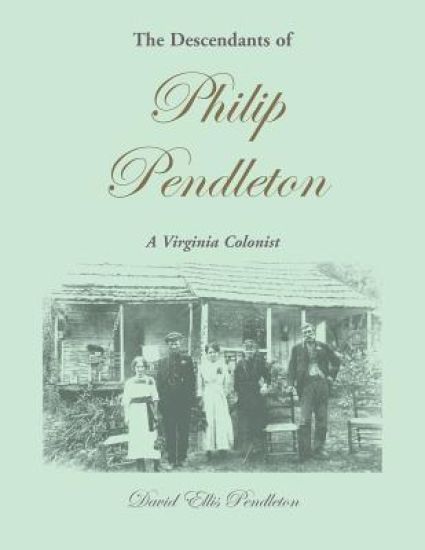
The Descendants of Philip Pendleton, A Virginia Colonist
David Ellis Pendleton
Heritage Books
2013
pokkari
This book contains the most complete genealogy of the Pendleton family to date. It includes all known descendants (with the Pendleton surname) of Philip Pendleton, the immigrant, and his wife, Elizabeth Hurt, whose descendents now number in the tens of thousands and are scattered throughout the United States. The family is considered from its known beginnings around 1500 in Manchester, England, through about 1920. The origin of the Pendleton name as well as historical perspectives that link thirteen generations of the bearers of this surname to their place and time are provided. Included are maps that show where Philip Pendleton (who came to Virginia from Norwich, England, in 1674) resided, as well as the home counties of the generations that followed. There is a wealth of vital and biographical information on thirteen generations of this Pendleton family and a complete full name index, with over 6,000 entries, that will allow the reader to easily trace a particular branch.

'The man with whom I was dining was a killer. And he was now feeling at ease, courtesy of a fake interview with a federal prosecutor, in which my fake legal memorandum, used to perpetrate a fraud, was being used to exonerate the two of us. I didn't know whom I could trust.' Trust no one. Jason Kolarich is investigating the murder of Ernesto Ramirez, a key witness in a criminal case that he tried. Jason had been pushing him for information, but all he got was the guy's death on his conscience. Who murdered Ramirez, and why? When the evidence leads to an obscure agency in state government, Jason is hood-winked into being a federal informant. The feds are desperate to build their case against the government, but Jason's got his own agenda. Will he be an asset to their case, or will he prove to be a live wire? In this riveting thriller Ellis relies on his experience and expertise to deliver a gritty tale of political corruption and murder at the highest levels of government.



Behavior of the Golden Eagle
David Ellis; John N. Schmitt
HANCOCK HOUSE PUBLISHERS LTD ,CANADA
2017
pokkari