Kirjojen hintavertailu. Mukana 11 244 527 kirjaa ja 12 kauppaa.

Kirjahaku

Etsi kirjoja tekijän nimen, kirjan nimen tai ISBN:n perusteella.

1000 tulosta hakusanalla Ellis Goodman

Ellis Island

Ellis Island

Barry Moreno

Arcadia Publishing (SC)
2003
nidottu
The United States is considered the world's foremost refuge for foreigners, and no place in the nation symbolizes this better than Ellis Island.Through Ellis Island's halls and corridors more than twelve million immigrants-of nearly every nationality and race-entered the country on their way to new experiences in North America. With an astonishing array of nineteenth- and twentieth-century photographs, Ellis Island leads the reader through the fascinating history of this small island in New York harbor from its pre-immigration days as one of the harbor's oyster islands to its spectacular years as the flagship station of the U.S. Bureau of Immigration to its current incarnation as the National Park Service's largest museum.
Ellis Peters' Shropshire

Ellis Peters' Shropshire

Ellis Peters

Sutton Publishing Ltd
2007
pokkari
Shropshire is Ellis Peters' county, the world of her medieval mysteries. In this book she takes the reader into the heart of the county, describing the Roman Road and revealing her connections with the town of Shrewsbury and the setting of the Benedictine Abbey featured in the Cadfael novels. She traces the history of the country through its border castles, Georgian country houses and old Elizabethan town houses, old monasteries and the modern office blocks of the town. In doing so, she recounts her personal connection with the county of her birth, from her childhood spent near Coalbrookdale to her later years in Madeley, Telford.
Ellis Johnson Might Be Famous

Ellis Johnson Might Be Famous

Shawn Amos

Little, Brown Books for Young Readers
2023
sidottu
This joyful and heartfelt sequel to the NAACP Image Award-winning Cookies & Milk is a story of fame, self-confidence, and second chances, based on author Shawn Amos's memories of growing up the son of Wally "Famous" Amos. After the overnight mega success of his dad's cookie store, twelve-year-old Ellis Johnson is on top of the world. He's met celebrities, strangers stop "the Cookie Kid" on the street, and he's even headed to NYC to be in the Macy's Thanksgiving Day Parade with his dad. Ellis is ready for his star turn, playing harmonica on national television--until his big break turns into the most embarrassing moment of his life. Ellis is sure everyone at home is judging him, and he can barely stand to show his face in school. To make matters worse, his dad is going gaga for a new girlfriend, and DJ Wishbone goes from being pushed out of his radio station ... to taking over Ellis's place in the store. Ellis's only bright spot is the loyal friends who have stayed by his side--and who, along with some new faces, might just be able to help Ellis with a daring plan to get his groove back. This charming, semi-autobiographical novel proves that anything is possible with good music, good friends, loving family, and great cookies. Don't miss Ellis's first adventure in Cookies and Milk
Ellis' Handbook of Mental Deficiency, Psychological Theory and Research

Ellis' Handbook of Mental Deficiency, Psychological Theory and Research

Routledge Member of the Taylor and Francis Group
1996
sidottu
In the 16 years since the publication of the second edition of this volume, psychological theory and research in mental retardation has continued to expand and extend scientific, theoretical, and clinical understanding of this most complex and challenging human condition. Explicit effort has been made to translate theory and research into useful and efficacious assessment, intervention, prevention, and policy actions. This third edition provides an opportunity to critique major conceptual developments and empirical research in an effort to stimulate further behavioral research of practical, social importance. The Handbook presents work by prominent contributors to a major scientific endeavor that has grown dramatically during the last three decades. The challenge for each author was to identify important theoretical and empirical issues, provide a critical, selective review of exemplary research, and discuss the questions that remain unanswered in each area. In short, the goal for this third edition was to consolidate the knowledge gained during the past 30 years and to present a blueprint for future research in mental retardation, the broader field of learning disabilities, and other developmental disorders such as autism. Providing totally different coverage and direction from the previous edition, this text fills a crucial instructional need in graduate courses related to the psychology of mental retardation. With its emphasis on psychological research and theory, it offers an important alternative to many available texts that primarily emphasize the application of research.
Ellis Island

Ellis Island

Georges Perec

NEW DIRECTIONS PUBLISHING CORPORATION
2021
nidottu
Georges Perec, employing lyrical prose meditations, lists, and inventories, conjures up the sixteen million people who, between 1890 to 1954, arrived as foreigners and stayed on to become Americans. Perec (who by the age of nine was an orphan: his father was killed by a German bullet, and his mother perished in Auschwitz) is wide-awake to the elements of chance in immigration and survival: "To me Ellis Island is the ultimate place of exile. That is, the place where place is absent, the non-place, the nowhere. Ellis Island belongs to all those whom intolerance and poverty have driven and still drive from the land where they grew up." Ellis Island is a slender Perec masterwork, unique among his many singular works. The acclaimed poet and scholar M nica de la Torre contributes an afterword that keeps Perec's writing front and center while situating Ellis Island in the context of America's current fierce battles over immigration.
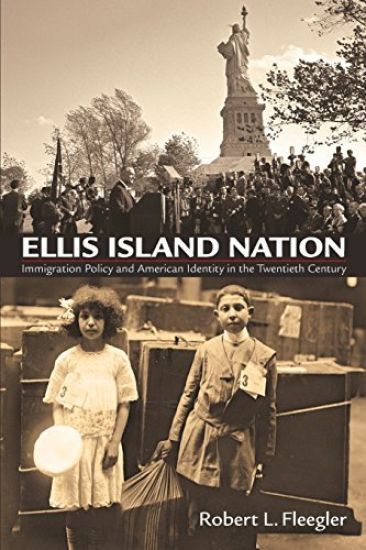
Ellis Island Nation

Ellis Island Nation

Robert L. Fleegler

University of Pennsylvania Press
2015
pokkari
Though debates over immigration have waxed and waned in the course of American history, the importance of immigrants to the nation's identity is imparted in civics classes, political discourse, and television and film. We are told that the United States is a "nation of immigrants," built by people who came from many lands to make an even better nation. But this belief was relatively new in the twentieth century, a period that saw the establishment of immigrant quotas that endured until the Immigrant and Nationality Act of 1965. What changed over the course of the century, according to historian Robert L. Fleegler, is the rise of "contributionism," the belief that the newcomers from eastern and southern Europe contributed important cultural and economic benefits to American society. Early twentieth-century immigrants from southern and eastern Europe often found themselves criticized for language and customs at odds with their new culture, but initially found greater acceptance through an emphasis on their similarities to "native stock" Americans. Drawing on sources as diverse as World War II films, records of Senate subcommittee hearings, and anti-Communist propaganda, Ellis Island Nation describes how contributionism eventually shifted the focus of the immigration debate from assimilation to a Cold War celebration of ethnic diversity and its benefits-helping to ease the passage of 1960s immigration laws that expanded the pool of legal immigrants and setting the stage for the identity politics of the 1970s and 1980s. Ellis Island Nation provides a historical perspective on recent discussions of multiculturalism and the exclusion of groups that have arrived since the liberalization of immigrant laws.
Ellis Island

Ellis Island

Loretto Dennis Szucs

Ancestry.com
2000
pokkari
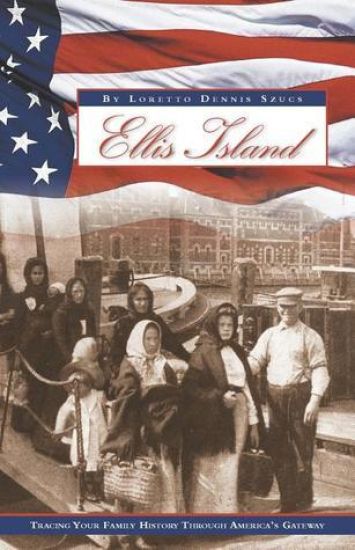
Almost half of all Americans have at least one ancestor who entered the United States through Ellis Island (also called America's Gateway""). In Ellis Island: Tracing Your Family History Through America's Gateway, leading family history author and researcher Loretto Dennis Szucs explains how you can find out if your relatives were among the millions who were processed for entry at this historic landmark. This book details the immigrant experience at Ellis Island and teaches you about the records that are available to help you trace your ancestors' entry into the New World.""
Ellis Island and Angel Island: The History and Legacy of America's Most Famous Immigration Stations
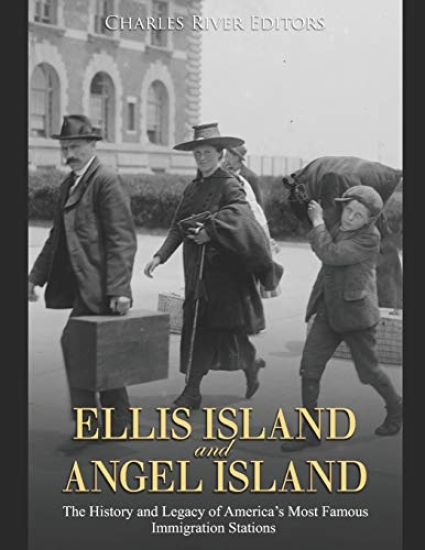
*Includes pictures*Includes contemporary accounts*Includes a bibliographyOn New Year's Day 1892, a young Irish girl named Annie Moore stepped off the steamship Nevada and landed on a tiny island that once held a naval fort. As she made her way through the large building on that island, Annie was processed as the first immigrant to come to America through Ellis Island. Like so many immigrants before her, she and her family settled in an Irish neighborhood in the city, and she would live out the rest of her days there. Thanks to the opening of Ellis Island near the end of the 19th century, immigration into New York City exploded, and the city's population nearly doubled in a decade. By the 1900s, 2 million people considered themselves New Yorkers, and Ellis Island would be responsible not just for that but for much of the influx of immigrants into the nation as a whole over the next half a century. To this day, about a third of the Big Apple's population is comprised of immigrants today, making it one of the most diverse cities in the world. Angel Island, the largest island in San Francisco Bay at about 740 acres, was originally named when Don Juan Manuel Ayala sailed into San Francisco Bay. Supposedly, the island was named "Angel" because the land mass appeared to him as an angel guarding the bay, and when Ayala made a map of the Bay, on it he marked Angel Island as, "Isla de Los Angeles." This would remain the island's name ever since, even as the use of the island would certainly change over time. The island is currently a large state park with beautiful views of the San Francisco Bay and skyline, but the most noteworthy part of the park is the immigration museum. That site is what makes Angel Island so famous today, as it remains best known for being the entry point for Asian immigrants to the United States from 1910-1940. There is no way to know for sure how many people actually passed through Angel Island because of the destruction of most of the historical documentation in a fire, but historians estimate that it was between 100,000 and 500,000 people. Angel Island is often referred to the Ellis Island of the West, but many argue that they are extremely different in their preservation of immigrant histories. For one, Angel Island took much longer to preserve, and the preservation of Ellis Island focuses on the positive reception of European immigrants on the East Coast, which plays well to corporate sponsors and the American story. Historian John Bodnar explained that Ellis Island represents "the view of American history as a steady succession progress and uplift for ordinary people." Ellis Island fits nicely into the narrative of the American Dream, because even though the immigrants who came through there were subject to racism, they were predominantly white. Angel Island was a much more multiracial experience, and when recounting its history, the tensions of exclusiveness and xenophobia that existed in the late 19th century and early 20th century are laid bare for all to see. After a fire in 1940, Angel Island went from being an immigration station to being used for military purposes. At first, it was used as POW holding facility during World War II, and then finally as a Nike missile base between 1954 and 1962. After a long fight to preserve the island's history as an immigration station and a huge pillar of Asian-American history, the island was declared a landmark in 1996, and the museum opened with a fully restored immigration station in 2009. Today, the island can be visited by the public via a ferry from San Francisco, and countless people hike and bike the island, as well as taking tours of the immigration station. Ellis Island and Angel Island: The History and Legacy of America's Most Famous Immigration Stations examines how these islands became immigration inspection centers, and what life was like for those who landed in each place.
Ellis Island and Angel Island: The History and Legacy of America's Most Famous Immigration Stations
*Includes pictures*Includes contemporary accounts*Includes a bibliographyOn New Year's Day 1892, a young Irish girl named Annie Moore stepped off the steamship Nevada and landed on a tiny island that once held a naval fort. As she made her way through the large building on that island, Annie was processed as the first immigrant to come to America through Ellis Island. Like so many immigrants before her, she and her family settled in an Irish neighborhood in the city, and she would live out the rest of her days there. Thanks to the opening of Ellis Island near the end of the 19th century, immigration into New York City exploded, and the city's population nearly doubled in a decade. By the 1900s, 2 million people considered themselves New Yorkers, and Ellis Island would be responsible not just for that but for much of the influx of immigrants into the nation as a whole over the next half a century. To this day, about a third of the Big Apple's population is comprised of immigrants today, making it one of the most diverse cities in the world. Angel Island, the largest island in San Francisco Bay at about 740 acres, was originally named when Don Juan Manuel Ayala sailed into San Francisco Bay. Supposedly, the island was named "Angel" because the land mass appeared to him as an angel guarding the bay, and when Ayala made a map of the Bay, on it he marked Angel Island as, "Isla de Los Angeles." This would remain the island's name ever since, even as the use of the island would certainly change over time. The island is currently a large state park with beautiful views of the San Francisco Bay and skyline, but the most noteworthy part of the park is the immigration museum. That site is what makes Angel Island so famous today, as it remains best known for being the entry point for Asian immigrants to the United States from 1910-1940. There is no way to know for sure how many people actually passed through Angel Island because of the destruction of most of the historical documentation in a fire, but historians estimate that it was between 100,000 and 500,000 people. Angel Island is often referred to the Ellis Island of the West, but many argue that they are extremely different in their preservation of immigrant histories. For one, Angel Island took much longer to preserve, and the preservation of Ellis Island focuses on the positive reception of European immigrants on the East Coast, which plays well to corporate sponsors and the American story. Historian John Bodnar explained that Ellis Island represents "the view of American history as a steady succession progress and uplift for ordinary people." Ellis Island fits nicely into the narrative of the American Dream, because even though the immigrants who came through there were subject to racism, they were predominantly white. Angel Island was a much more multiracial experience, and when recounting its history, the tensions of exclusiveness and xenophobia that existed in the late 19th century and early 20th century are laid bare for all to see. After a fire in 1940, Angel Island went from being an immigration station to being used for military purposes. At first, it was used as POW holding facility during World War II, and then finally as a Nike missile base between 1954 and 1962. After a long fight to preserve the island's history as an immigration station and a huge pillar of Asian-American history, the island was declared a landmark in 1996, and the museum opened with a fully restored immigration station in 2009. Today, the island can be visited by the public via a ferry from San Francisco, and countless people hike and bike the island, as well as taking tours of the immigration station. Ellis Island and Angel Island: The History and Legacy of America's Most Famous Immigration Stations examines how these islands became immigration inspection centers, and what life was like for those who landed in each place.