
![English Pastoral Poetry: [by] William Empson](/covers/9781014238207.jpg)
Kirjahaku
Etsi kirjoja tekijän nimen, kirjan nimen tai ISBN:n perusteella.
137 tulosta hakusanalla Empson Edward Middleton
![English Pastoral Poetry: [by] William Empson](/covers/9781015043688.jpg)

William Empson: Prophet Against Sacrifice provides the most coherent account of Empson's diverse career to date. While exploring the richness of Empson's comic genius, Paul H. Fry serves to discredit the appropriation of his name in recent polemic by the conflicting parties of deconstruction and politicized cultural criticism. He argues that Empson is a larger, more important figure than the orthodox in either camp can acknowledge, deserving to be considered alongside such versatile critics as Walter Benjamin, Kenneth Burke and Roland Barthes.
William Empson
Routledge
2016
sidottu
This volume of commemorative and celebratory essays, first published in 1974, concentrates on William Empson – the critic, the poet and friend. The papers range from the biographical to the academic, but what every one suggests is the impossibility of separating the man from his work and the ‘life’ from the ‘thought’. This book constitutes an important study of Empson, his work and his impact upon people and literary studies of our time.
William Empson
Routledge
2018
nidottu
This volume of commemorative and celebratory essays, first published in 1974, concentrates on William Empson – the critic, the poet and friend. The papers range from the biographical to the academic, but what every one suggests is the impossibility of separating the man from his work and the ‘life’ from the ‘thought’. This book constitutes an important study of Empson, his work and his impact upon people and literary studies of our time.
William Empson and the Philosophy of Literary Criticism
Christopher Norris
Bloomsbury Academic
2013
sidottu
Following the publication of Seven Types of Ambiguity in 1930 William Empson was quickly recognised as a critic of great originality and unique creative gifts and he has inspired a whole new method and style of approach in literary criticism. But this is the first full-length study of his work and it is an important part of Dr Norris’s purpose to account for the gulf that has emerged between Empson’s viewpoint and the development of his ideas by others, especially the American New Critics, and for the consequent failure of Empson’s later books to generate the informed discussion they demand and deserve. Here particular attention is given to his critical summa, The Structure of Complex Words. To understand Empson’s work as a consistent whole, Dr Norris argues, one must relate it to his philosophy of humanistic rationalism. This is to give a new perspective not only to his practical criticism but also to his differences with Eliot and Leavis and to his anti-Christian polemic.
Some Versions of Empson
Oxford University Press
2007
sidottu
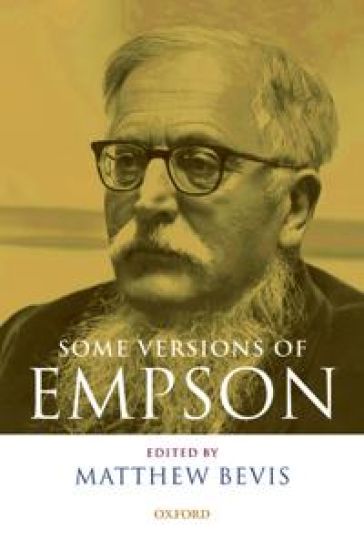
William Empson was one of the most important poet-critics of the twentieth century, and continues to influence and inspire writers from many divergent critical traditions. Following on recent scholarly developments, this timely collection of essays provides a fully-rounded examination of Empson's life, work, inheritance, and influence. This is the first volume of critical essays on Empson to be published in over a decade, and the first to consider the full range of his work, studying his poetry alongside his criticism in order to reassess the scale of his achievement. It also includes the first publication of a substantial interview with Empson in 1970, in which he looks back over his career and discusses the composition and reception of his work. The collection examines Empson's oeuvre from a variety of angles - aesthetic, philosophical, psychological, linguistic, scientific, socio-political, religious, and sexual - and features essays from an outstanding line-up of emerging and established scholars. Some Versions of Empson demonstrates the poet-critic's continuing importance for literary and cultural criticism, and sets the agenda for studies of his work in the twenty-first century.

Selected Letters of William Empson
Oxford University Press
2006
sidottu
This edited collection of letters by William Empson (1906-1984), one of the foremost writers and literary critics of the twentieth century, ranges across the entirety of his career. Parts of the correspondence record the development of ideas that were to come to fruition in seminal texts including Seven Types of Ambiguity, The Structure of Complex Words, and Milton's God. The topics of other letters range from Shakespeare's Dark Lady to Marvell's marriage and Byron's bisexuality. Empson relished correspondence that was combative, if not downright aggressive. As a result, parts of this edition take the form of a serial disputation with other critics of the period, including Frank Kermode, Helen Gardner, Philip Hobsbaum, and I. A. Richards. Other notable correspondents include A. Alvarez, Bonamy Dobrée, Leslie Fiedler, Graham Hough, C. K. Ogden, George Orwell, Kathleen Raine, John Crowe Ransom, Christopher Ricks, Laura Riding, A. L. Rowse, Stephen Spender, E. M. W. Tillyard, Rosemond Tuve, John Wain, and G. Wilson Knight. All readers of literary history and criticism will stand to benefit from this edition. Empson is universally credited as the man who 'invented' modern literary criticism, so that all of his writings make a signal addition to the canon of his works. This selection provides a context for the evaluation of Empson's total literary output; and in many letters Empson seeks to defend his ideas against both published and personal attacks. This volume not only fills in all the missing links, it adds up to a completely new volume of critical writings by Empson.

Selected Letters of William Empson
Oxford University Press
2009
nidottu
This edited collection of letters by William Empson (1906-1984), one of the foremost writers and literary critics of the twentieth century, ranges across the entirety of his career. Parts of the correspondence record the development of ideas that were to come to fruition in seminal texts including Seven Types of Ambiguity , The Structure of Complex Words , and Milton's God . The topics of other letters range from Shakespeare's Dark Lady to Marvell's marriage and Byron's bisexuality. Empson relished correspondence that was combative, if not downright aggressive. As a result, parts of this edition take the form of a serial disputation with other critics of the period, including Frank Kermode, Helen Gardner, Philip Hobsbaum, and I. A. Richards. Other notable correspondents include A. Alvarez, Bonamy Dobr?e, Leslie Fiedler, Graham Hough, C. K. Ogden, George Orwell, Kathleen Raine, John Crowe Ransom, Christopher Ricks, Laura Riding, A. L. Rowse, Stephen Spender, E. M. W. Tillyard, Rosemond Tuve, John Wain, and G. Wilson Knight. All readers of literary history and criticism will stand to benefit from this edition. Empson is universally credited as the man who 'invented' modern literary criticism, so that all of his writings make a signal addition to the canon of his works. This selection provides a context for the evaluation of Empson's total literary output; and in many letters Empson seeks to defend his ideas against both published and personal attacks. This volume not only fills in all the missing links, it adds up to a completely new volume of critical writings by Empson.

Reprint of the original, first published in 1871.

Reprint of the original, first published in 1871.



CCNA 200-301 Portable Command Guide is filled with valuable, easy-to-access information–and it’s portable enough to use whether you’re in the server room or the equipment closet. The guide summarizes all CCNA certification-level Cisco IOS Software commands, keywords, command arguments, and associated prompts, providing you with tips and examples of how to apply the commands to real-world scenarios. Throughout, configuration examples give you a better understanding of how these commands are used in simple network designs. This book has been completely updated to cover topics in the new 200-301 exam. Use this quick reference resource to help you memorize commands and concepts as you work to pass the CCNA certification exam. Coverage includes Network Fundamentals: IPv4 addressing, subnetting, VLSM, route summarization, IPv6 addressing, cables/connections, CLILAN Switching Technologies: Switch configuration, VLANs, VLAN trunking protocol, inter-VLAN communication, STP, EtherChannel, CDP, LLDPRouting Technologies: Router configuration, static routing, OSPFIP Services: DHCP, NAT, NTPSecurity Fundamentals: Layer 2 security, ACL traffic management, device monitoring and hardeningWireless Technologies: Configuring and securing a WLAN APIncludes quick access to all CCNA commands for research and solutions. Logical how-to topic groupings for a one-stop resourceGreat for review before CCNA certification examsCompact size makes it easy to carry with you wherever you go“Create Your Own Journal” section with blank, lined pages enables you to personalize the book for your needsThis book is part of the Cisco Press Certification Self-Study Product Family, which offers readers a self-paced study routine for Cisco certification exams. Titles in the Cisco Press Certification Self-Study Product Family are part of a recommended learning program from Cisco that includes simulation and hands-on training from authorized Cisco Learning Partners and self-study products from Cisco Press.


Empson has long been applauded for the dazzling intelligence and emotional passion of his poems. Praised in his lifetime by the likes of T.S. Eliot, Dylan Thomas and John Betjeman, his reputation contines to be high. His poems take a wide range of themes from metaphysics to melancholy, social climbing to political satire, and from love to loss.

Who will be crowned the most beautiful of all at the Jungle Jamboree? Lion, Leopard, Hippo, Zebra? The jungle creatures all try to change themselves in this beautiful book, bursting with wild splashes of colour and hilarious animal antics. But Fly has a surprise in store - soon the animals learn that they are lovely just the way they are, and that kindness is the most beautiful thing of all.
Professional organizations—such as accounting and consulting firms, law firms, and investment banks—are fundamental to the functioning of the global economy. Yet many of the most powerful are notoriously private. This book uncovers the complex, messy, and surprisingly emotional challenges of leading professional organizations—revealing the realities that lies beneath the 'professional' surface which these organizations present to the outside world. Individual professionals—highly educated, highly intelligent, and highly opinionated—are generally reluctant to see themselves as followers and may be equally reluctant to put themselves forward as leaders. They value their autonomy and confer authority on their leaders on a highly contingent basis. How does a professional come to be seen as a leader within a professional organization? How do leaders maintain their position once they have reached the top of their organization? How do they navigate the complex power relationships among their professional colleagues and actually get things done? Leading Professionals: Power, Politics, and Prima Donnas analyses the complex power dynamics and interpersonal politics that lie at the heart of leadership in professional organizations. It is based on Laura Empson's scholarly research into the world's leading professional organizations across a range of sectors, including interviews with over 500 senior professionals in 16 countries. It draws on the latest organizational and leadership theory to analyse in detail exactly how professionals come together to create 'leadership'. It identifies how change happens within professional organizations and explains why their leaders so often fail.

Professional organizations—such as accounting and consulting firms, law firms, and investment banks—are fundamental to the functioning of the global economy. Yet many of the most powerful are notoriously private. This book uncovers the complex, messy, and surprisingly emotional challenges of leading professional organizations—revealing the realities that lies beneath the 'professional' surface which these organizations present to the outside world. Individual professionals—highly educated, highly intelligent, and highly opinionated—are generally reluctant to see themselves as followers and may be equally reluctant to put themselves forward as leaders. They value their autonomy and confer authority on their leaders on a highly contingent basis. How does a professional come to be seen as a leader within a professional organization? How do leaders maintain their position once they have reached the top of their organization? How do they navigate the complex power relationships among their professional colleagues and actually get things done? Leading Professionals: Power, Politics, and Prima Donnas analyses the complex power dynamics and interpersonal politics that lie at the heart of leadership in professional organizations. It is based on Laura Empson's scholarly research into the world's leading professional organizations across a range of sectors, including interviews with over 500 senior professionals in 16 countries. It draws on the latest organizational and leadership theory to analyse in detail exactly how professionals come together to create 'leadership'. It identifies how change happens within professional organizations and explains why their leaders so often fail.
Taking up a teaching appointment in Tokyo in 1931, the English poet and literary critic William Empson found himself captivated by the Buddhist sculptures of ancient Japan, and spent the years that followed in search of similar examples all over Korea, China, Cambodia, Burma, India, and Ceylon, as well as in the great museums of the West. Compiling the results of these wide-ranging travels into what he considered to be one of his most important works, Empson was heartbroken when he mislaid the sole copy of the manuscript in the wake of the Second World War. 'The Face of the Buddha' remained one of the great lost books until its surprise rediscovery sixty years later, and is published here for the first time. The book provides an engaging record of Empson's reactions to the cultures and artworks he encountered during his travels, and presents experimental theories about Buddhist art that many authorities of today have found to be remarkably prescient. It also casts important new light on Empson's other works, highlighting in particular the affinities of his thinking with that of the religious and philosophical traditions of Asia. Edited by the global culture historian Rupert Arrowsmith, this edition comes with a comprehensive introduction that makes 'The Face of the Buddha' as accessible to the general reader as it is to the professional scholar, and is fully illustrated throughout with Empson's original photographs.