Kirjojen hintavertailu. Mukana 12 595 353 kirjaa ja 12 kauppaa.

Kirjahaku

Etsi kirjoja tekijän nimen, kirjan nimen tai ISBN:n perusteella.

364 tulosta hakusanalla Erasmo Leiva-Merikakis

España En La Órbita de Erasmo: Tradición Clásica Y Cristiana En El Humanismo (Siglos XVI-XVII)
Este libro es m s que una antolog a, es una contribuci n a los estudios sobre Humanismo y Tradici n Cl sica. Con la selecci n de textos y autores aqu contenidos se pretende analizar y definir algunas de las identidades del movimiento humanista, fundamentalmente a partir de la tradici n cl sica grecolatina y de la cristiana, es decir, la b blica y la de los Padres de la Iglesia. Por ello, se prestar especial atenci n en esta Antolog a a la fusi n de las dos concepciones del saber, la pagana y la cristiana, en el llamado "Humanismo cristiano". La selecci n se ha estructurado en tres bloques. El primero y el m s extenso es el de Erasmo y el erasmismo en Espa a: textos y contextos, donde se incluye a Juan de Maldonado y Luis de Carvajal. El segundo bloque, el m s heterog neo, contiene textos compuestos en lat n y en espa ol en el siglo XVI: desde el a o Antonio de Nebrija hasta lvarez de Miraval, pasando por Pedro Ciruelo, (Juan de vila y Francisco Vall s. La reflexi n teol gica, b blica y filos fica es el centro de las disquisiciones de estos autores. Con el tercer bloque se da paso ya al siglo XVII, en el ocaso del Humanismo, a trav s de un autor de la oratoria eclesi stica, Lorenzo de Zamora, que sirve de puente con el Barroco.
Familiaria colloquia, oper? Christophori Helvici D. & Professoris Giessensis olim, ex Erasmo Roterodamo, Ludovico Vive, & Schottenio Hasso selecta. Editio decima septima ad pristina exemplaria denu? recognita.
The 18th century was a wealth of knowledge, exploration and rapidly growing technology and expanding record-keeping made possible by advances in the printing press. In its determination to preserve the century of revolution, Gale initiated a revolution of its own: digitization of epic proportions to preserve these invaluable works in the largest archive of its kind. Now for the first time these high-quality digital copies of original 18th century manuscripts are available in print, making them highly accessible to libraries, undergraduate students, and independent scholars.Western literary study flows out of eighteenth-century works by Alexander Pope, Daniel Defoe, Henry Fielding, Frances Burney, Denis Diderot, Johann Gottfried Herder, Johann Wolfgang von Goethe, and others. Experience the birth of the modern novel, or compare the development of language using dictionaries and grammar discourses. ++++The below data was compiled from various identification fields in the bibliographic record of this title. This data is provided as an additional tool in helping to insure edition identification: ++++Bodleian Library (Oxford)N009644Selections adapted from Erasmus' 'Colloquia', first published in 1519.Londini: excusa; & venales prostant apud J. & B. Sprint, A. Bettesworth, J. Osborn, J. Batley, & A Ward, 1727. 192p.; 18
Catonis disticha de moribus. Cum scholiis Des. Erasmi. Adjecta sunt dicta Græca sapientum, interprete Erasmo Eadem per Ausonium, cum Erasmi doctissima enarratione. Mimi Publiani, ex ejusdem Erasmi restitutione
The 18th century was a wealth of knowledge, exploration and rapidly growing technology and expanding record-keeping made possible by advances in the printing press. In its determination to preserve the century of revolution, Gale initiated a revolution of its own: digitization of epic proportions to preserve these invaluable works in the largest archive of its kind. Now for the first time these high-quality digital copies of original 18th century manuscripts are available in print, making them highly accessible to libraries, undergraduate students, and independent scholars.The Age of Enlightenment profoundly enriched religious and philosophical understanding and continues to influence present-day thinking. Works collected here include masterpieces by David Hume, Immanuel Kant, and Jean-Jacques Rousseau, as well as religious sermons and moral debates on the issues of the day, such as the slave trade. The Age of Reason saw conflict between Protestantism and Catholicism transformed into one between faith and logic -- a debate that continues in the twenty-first century.++++The below data was compiled from various identification fields in the bibliographic record of this title. This data is provided as an additional tool in helping to insure edition identification: ++++Bodleian Library (Oxford)T194406The disticha, wrongly attributed to Marcus Porcius Cato, in fact date from imperial times.Londini: typis S. Gilbert, impensis Societatis Stationariorum, 1717. 2],78p.; 12
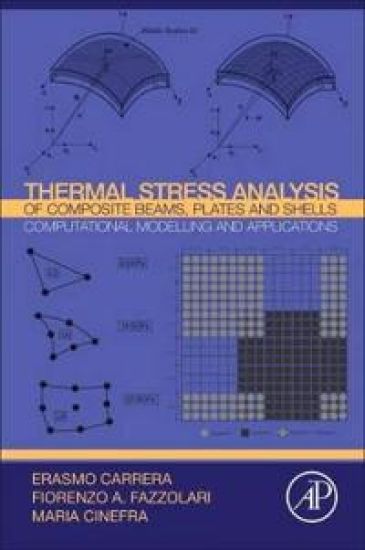
Thermal Stress Analysis of Composite Beams, Plates and Shells

Thermal Stress Analysis of Composite Beams, Plates and Shells

Erasmo Carrera; Fiorenzo A. Fazzolari

Academic Press Inc
2016
nidottu
Thermal Stress Analysis of Composite Beams, Plates and Shells: Computational Modelling and Applications presents classic and advanced thermal stress topics in a cutting-edge review of this critical area, tackling subjects that have little coverage in existing resources. It includes discussions of complex problems, such as multi-layered cases using modern advanced computational and vibrational methods. Authors Carrera and Fazzolari begin with a review of the fundamentals of thermoelasticity and thermal stress analysis relating to advanced structures and the basic mechanics of beams, plates, and shells, making the book a self-contained reference. More challenging topics are then addressed, including anisotropic thermal stress structures, static and dynamic responses of coupled and uncoupled thermoelastic problems, thermal buckling, and post-buckling behavior of thermally loaded structures, and thermal effects on panel flutter phenomena, amongst others.
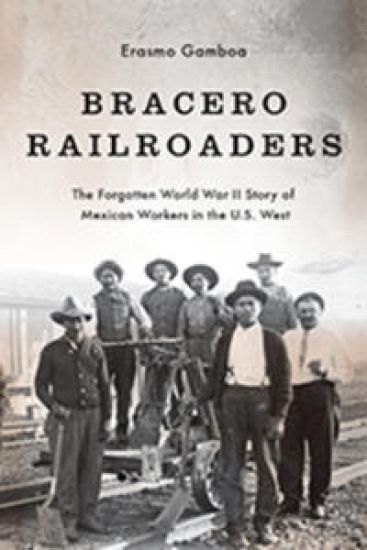
Bracero Railroaders

Bracero Railroaders

Erasmo Gamboa

University of Washington Press
2018
pokkari
Desperate for laborers to keep the trains moving during World War II, the U.S. and Mexican governments created a now mostly forgotten bracero railroad program that sent a hundred thousand Mexican workers across the border to build and maintain railroad lines throughout the United States, particularly the West. Although both governments promised the workers adequate living arrangements and fair working conditions, most bracero railroaders lived in squalor, worked dangerous jobs, and were subject to harsh racial discrimination. Making matters worse, the governments held a percentage of the workers' earnings in a savings and retirement program that supposedly would await the men on their return to Mexico. However, rampant corruption within both the railroad companies and the Mexican banks meant that most workers were unable to collect what was rightfully theirs.Historian Erasmo Gamboa recounts the difficult conditions, systemic racism, and decades-long quest for justice these men faced. The result is a pathbreaking examination that deepens our understanding of Mexican American, immigration, and labor histories in the twentieth-century U.S. West.
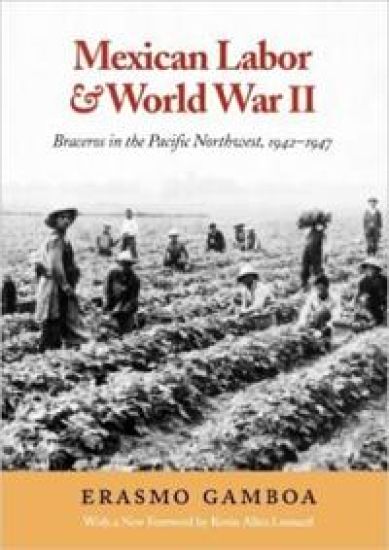
Mexican Labor and World War II

Mexican Labor and World War II

Erasmo Gamboa; Kevin Leonard

University of Washington Press
2000
pokkari
"Although Mexican migrant workers have toiled in the fields of the Pacific Northwest since the turn of the century, and although they comprise the largest work force in the region's agriculture today, they have been virtually invisible in the region's written labor history. Erasmo Gamboa's study of the bracero program during World War II is an important beginning, describing and documenting the labor history of Mexican and Chicano workers in Oregon, Washington, and Idaho and contributing to our knowledge of farm labor."—Oregon Historical Quarterly
Bracero Railroaders

Bracero Railroaders

Erasmo Gamboa

University of Washington Press
2016
sidottu
Desperate for laborers to keep the trains moving during World War II, the U.S. and Mexican governments created a now mostly forgotten bracero railroad program that sent a hundred thousand Mexican workers across the border to build and maintain railroad lines throughout the United States, particularly the West. Although both governments promised the workers adequate living arrangements and fair working conditions, most bracero railroaders lived in squalor, worked dangerous jobs, and were subject to harsh racial discrimination. Making matters worse, the governments held a percentage of the workers' earnings in a savings and retirement program that supposedly would await the men on their return to Mexico. However, rampant corruption within both the railroad companies and the Mexican banks meant that most workers were unable to collect what was rightfully theirs.Historian Erasmo Gamboa recounts the difficult conditions, systemic racism, and decades-long quest for justice these men faced. The result is a pathbreaking examination that deepens our understanding of Mexican American, immigration, and labor histories in the twentieth-century U.S. West.
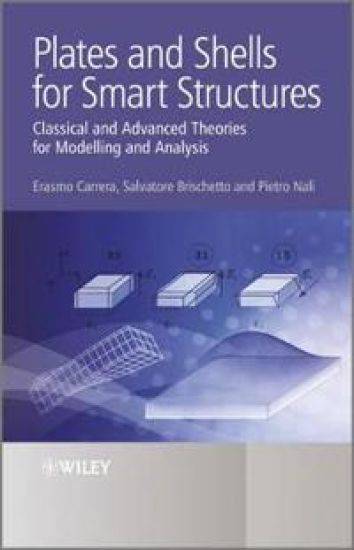
Plates and Shells for Smart Structures

Plates and Shells for Smart Structures

Erasmo Carrera; Salvatore Brischetto; Pietro Nali

John Wiley Sons Inc
2011
sidottu
Smart structures that contain embedded piezoelectric patches are loaded by both mechanical and electrical fields. Traditional plate and shell theories were developed to analyze structures subject to mechanical loads. However, these often fail when tasked with the evaluation of both electrical and mechanical fields and loads. In recent years more advanced models have been developed that overcome these limitations. Plates and Shells for Smart Structures offers a complete guide and reference to smart structures under both mechanical and electrical loads, starting with the basic principles and working right up to the most advanced models. It provides an overview of classical plate and shell theories for piezoelectric elasticity and demonstrates their limitations in static and dynamic analysis with a number of example problems. This book also provides both analytical and finite element solutions, thus enabling the reader to compare strong and weak solutions to the problems. Key features: compares a large variety of classical and modern approaches to plates and shells, such as Kirchhoff-Love , Reissner-Mindlin assumptions and higher order, layer-wise and mixed theoriesintroduces theories able to consider electromechanical couplings as well as those that provide appropriate interface continuity conditions for both electrical and mechanical variablesconsiders both static and dynamic analysisaccompanied by a companion website hosting dedicated software MUL2 that is used to obtain the numerical solutions in the book, allowing the reader to reproduce the examples given as well as solve problems of their own The models currently used have a wide range of applications in civil, automotive, marine and aerospace engineering. Researchers of smart structures, and structural analysts in industry, will find all they need to know in this concise reference. Graduate and postgraduate students of mechanical, civil and aerospace engineering can also use this book in their studies. www.mul2.com
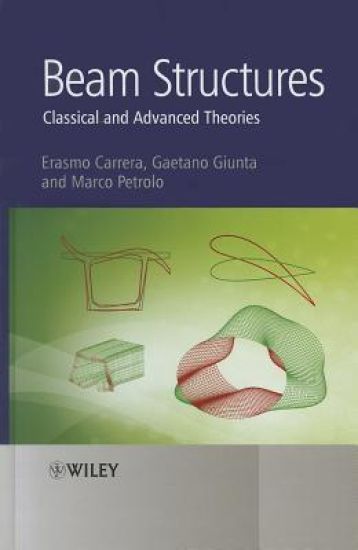
Beam Structures

Beam Structures

Erasmo Carrera; Gaetano Giunta; Marco Petrolo

John Wiley Sons Inc
2011
sidottu
Beam theories are exploited worldwide to analyze civil, mechanical, automotive, and aerospace structures. Many beam approaches have been proposed during the last centuries by eminent scientists such as Euler, Bernoulli, Navier, Timoshenko, Vlasov, etc. Most of these models are problem dependent: they provide reliable results for a given problem, for instance a given section and cannot be applied to a different one. Beam Structures: Classical and Advanced Theories proposes a new original unified approach to beam theory that includes practically all classical and advanced models for beams and which has become established and recognised globally as the most important contribution to the field in the last quarter of a century. The Carrera Unified Formulation (CUF) has hierarchical properties, that is, the error can be reduced by increasing the number of the unknown variables. This formulation is extremely suitable for computer implementations and can deal with most typical engineering challenges. It overcomes the problem of classical formulae that require different formulas for tension, bending, shear and torsion; it can be applied to any beam geometries and loading conditions, reaching a high level of accuracy with low computational cost, and can tackle problems that in most cases are solved by employing plate/shell and 3D formulations. Key features: compares classical and modern approaches to beam theory, including classical well-known results related to Euler-Bernoulli and Timoshenko beam theoriespays particular attention to typical applications related to bridge structures, aircraft wings, helicopters and propeller bladesprovides a number of numerical examples including typical Aerospace and Civil Engineering problemsproposes many benchmark assessments to help the reader implement the CUF if they wish to do soaccompanied by a companion website hosting dedicated software MUL2 that is used to obtain the numerical solutions in the book, allowing the reader to reproduce the examples given in the book as well as to solve other problems of their own www.mul2.com Researchers of continuum mechanics of solids and structures and structural analysts in industry will find this book extremely insightful. It will also be of great interest to graduate and postgraduate students of mechanical, civil and aerospace engineering.