

Kirjahaku
Etsi kirjoja tekijän nimen, kirjan nimen tai ISBN:n perusteella.
1000 tulosta hakusanalla Eric W. Hansen


From adolescence and alcohol to yelling, your room, and you yourself, How to Live with Parents and Teachers offers help to teenagers when they need it. Eric Johnson provides answers in plain language to the everyday problems that all young people experience.


Sievers draws on his experience of Central Asia to take on the task of explaining the remarkable economic declines of the post-Soviet Central Asian states (Kazakhstan, Kyrgystan, Tajikistan, Turkmenistan and Uzbekistan) in the past decade, and the turn of these states towards despotism.

Great Britain's economic blockade of Germany in World War I was one of the key elements to the victory of the Entente. Though Britain had been the leading exponent of blockades for two centuries, the World War I blockade was not effective at the outbreak of hostilities. Pre-war changes had led to the Admiralty supplanting the Royal Navy's leadership role in favour of direction from the civilian branch of government on the basis of international law. The struggle between the primacy of international law and military expediency lasted for nearly two years, as the British tried to reconcile their pre-war stance as champion of neutral rights with measures necessary for a successful blockade. Not until 1916 did the operation have the potential to be a decisive factor in the defeat of Germany, when pressure from France, the Royal Navy, Parliament, British popular opinion, and the Admiralty forced the British government to abandon its defence of neutral rights over the interests of the state. The arrival of the United States as an ally in April 1917 initiated the final evolution of the blockade. The Entente and the United States tightened the blockade with crushing effect on Germany, and by November 1918, it was evidently one of the chief factors behind the victory. This knowledge reinforced the decision to retain the blockade in the months following the armistice in order to force favourable terms from Germany. In both the war and in the peace, the economic blockade performed a critical role in World War I.

Ritual and ceremonial, as formal modes of conduct, are equally ubiquitous appearing in everything from modes of talk and rules of politeness to elaborate protocols for events of state. Ritual and rite, ceremonial and ceremony are symbolic social actions, modes of communication that implicate individuals in the social order, creating realities whilst expressing ideas and attitudes about them. This book combines bibliographic essay and theory construction to provide a unique perspective on ritual as a special and powerful form of communication.

Sager and Panting describe in detail the growth of the shipping industry and the economic context in which the shipping merchants operated. Shipowning and shipbuilding were a central part of the mercantile economy of the Atlantic colonies of British North America. But, following a slow and incomplete transition in the region from commercial to industrial capitalism, the shipping industry collapsed: by 1900 the local fleets were a third of their size a mere two decades earlier. The shipowners of the region, Sager and Panting argue, were merchants first: they shifted their investments to landward enterprises because they believed Confederation offered new and better possibilities for commercial exchange. Canadian capital and the Canadian state acted together to build transcontinental railways but gave little support for a Canadian merchant navy. Maritimers became Canadians and turned away from their seaward past, thereby relinquishing control and management of the industrial economy that followed the age of wood, wind, and sail. Drawing upon both the data base of the Atlantic Canada Shipping Project and important secondary sources, Sager and Panting show that the merchant class, in failing to maintain a merchant marine built and owned in their region, contributed in no small way to the Maritimes' present state of underdevelopment.
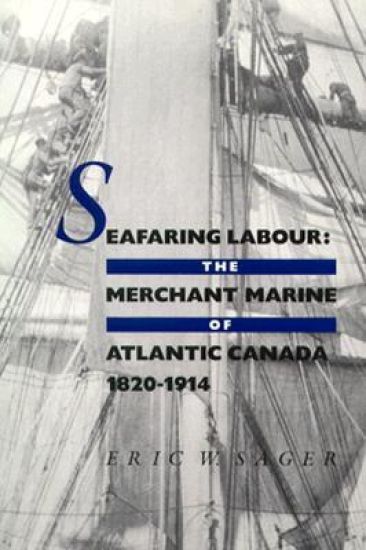
Sager argues that sailors were not misfits or outcasts but were divorced from society only by virtue of their occupation. The wooden ships were small communities at sea, fragments of normal society where workers lived, struggled, and often died. With the coming of the age of steam, the sailor became part of a new division of labour and a new social hierarchy at sea. Sager shows that the sailor was as integral to the transition to industrial capitalism as any land worker.

Canada is a great maritime nation. Although ships and the sea havebeen part of its history for centuries, very little is known about themen and women who have worked in its coastal and lake fleets. Shipsand Memories is a fascinating account of life at sea during theage of steam. In it, seafarers tell ther own stories and remember thegood times as well as the bad, in peace and war and during thedepression. Eric Sager draws on interviews with master mariners, engineers, ableseamen, cooks, stewards, and many others who worked aboard steamshipsfrom 1920 to 1950.

This volume includes two writings dealing with the plight of the common person who Luther felt had become a victim of the ecclesiastical establishment. These are followed by treatises taken from Luther's literary feud with three staunch supporters of Rome: Augustine Alveld, Jerome Emser [the "Leipzig goat"], and Albrecht of Mainz. The final treatise contains Luther's argument for congregational authority.

Conflict between the church of Rome and the reformers reached its most violent peak in the five years before the Council of Trent in 1545, a council the pope had been delaying for years. Luther had not only given up hope for a "free, Christian council," but had also come to the conclusion that the authority of such a council was limited to reaffirming the ancient faith of the apostles. This radical departure from Rome's interpretation of its own authority forms the basis of Luther's new doctrine of the church -- and also of his advice to Protestant princes on the problems of ecclesiastical property. It is this doctrine of the church which is the theme of the three treatises written during this period and included in this volume.


A helpful and accessible guide to Lutheranism's history and central tenets, with numerous photos and illustrations.

Rejected in the sixteenth century by both Protestants and Catholics, yet hailed by Marxist historians as a forerunner of the Marxist revolution, this volume tells M?ntzer's story and offers a critical assessment of him in light of his extant works, with particular attention to the religious foundations of his revolutionary program.

G.K. Chesterton long ago observed that real Christianity had in some ways never really been tried. Eric Gritsch, a renowned historian, a pastor, and a theologian for half a century, offers Christianity a reality check, exposing four historical movements that have weakened and abused the core of the Christian tradition. These movements represent wayward views on the relationships between Christians and Jews; between the authority of Scripture and tradition; between the church and worldy power; and between faith and morals. Readers encounter these wayward traditions in their historical trajectories, in the ways these traditions have diminished the gospel, and in the ways they have been impediments of an effective contemporary Christian witness. They represent the enduring temptation to be "like God" (Gen. 3:5), a temptation marked by a zeal for secure, unchanging, and ultimate Christian life on Earth. The author confronts these wayward traditions with the enduring challenge of faithful, cruciform, penultimate discipleship in the time between the first and second advent of Christ.

Eric Gritsch's unique and ambitious work, the first-ever attempt at a history of global Lutheranism, is now in a new edition.In a clear, nontechnical way, this noted Reformation historian tells the story of how the nascent reforming and confessional movement sparked and led by Martin Luther survived its first battles with religious and political authorities to become institutionalized in its religious practices and teachings. Gritsch then traces the emergence of genuine consensus at the end of the sixteenth century, followed by the age of Lutheran Orthodoxy, the great Pietist reaction, Lutheranism's growing diversification during the Industrial Revolution, its North American expansion, and its increasingly global and ecumenical ventures in the last century.From Wittenberg to Tanzania, from Spalatin to Spener to Schmucker, Gritsch tells the story with clarity and verve. This new edition updates all the chapters with fresh research, adds a chapter on new global developments and issues, and adds a rich array of graphics and other teaching tools.