
Kirjahaku
Etsi kirjoja tekijän nimen, kirjan nimen tai ISBN:n perusteella.
1000 tulosta hakusanalla Eugene S. Bagger


Prince Eugene's War in Hungary 1716 - 1718
Frederick Schmettau
Winged Hussar Publishing
2023
sidottu
Prince Eugene's War in Hungary is a detailed account of the great general's campaign against the Ottoman's culminating in his great victory at Belgrade. Using primary sources available at the time his was writing this, the author provides orders of battles and insight into the great leader's thinking. This edition also includes maps, illustrations and short biographies of the major players in these campaigns.
![Nominations of William S. [i.e. W.] Ginsberg, Richard T. Moore, Jesse L. White, Jr., and Eugene S. Witherspoon](/covers/9781379154068.jpg)
Nominations of William S. [i.e. W.] Ginsberg, Richard T. Moore, Jesse L. White, Jr., and Eugene S. Witherspoon
Palala Press
2018
pokkari
This work has been selected by scholars as being culturally important, and is part of the knowledge base of civilization as we know it. This work was reproduced from the original artifact, and remains as true to the original work as possible. Therefore, you will see the original copyright references, library stamps (as most of these works have been housed in our most important libraries around the world), and other notations in the work.This work is in the public domain in the United States of America, and possibly other nations. Within the United States, you may freely copy and distribute this work, as no entity (individual or corporate) has a copyright on the body of the work.As a reproduction of a historical artifact, this work may contain missing or blurred pages, poor pictures, errant marks, etc. Scholars believe, and we concur, that this work is important enough to be preserved, reproduced, and made generally available to the public. We appreciate your support of the preservation process, and thank you for being an important part of keeping this knowledge alive and relevant.

In this insightful and incisive essay, Eugene Ferguson demonstrates that good engineering is as much a matter of intuition and nonverbal thinking as of equations and computation. He argues that a system of engineering education that ignores nonverbal thinking will produce engineers who are dangerously ignorant of the many ways in which the real world differs from the mathematical models constructed in academic minds.
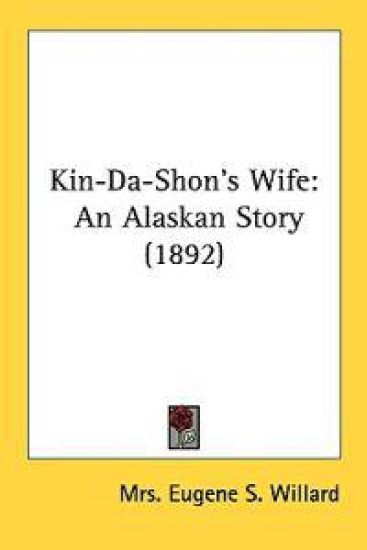

From Libau to Tsushima: A Narrative of the Voyage of Admiral Rojdestvensky's Fleet to Eastern Seas, Including A Detailed Account of the Dogger
Eugene S. Politovsky
Createspace Independent Publishing Platform
2016
nidottu

A Walk Across Dirty Water And Straight Into Murderer's Row
Eugene S. Robinson
FERAL HOUSE,U.S.
2023
nidottu
A rollicking no-holds barred memoir from journalist and musician Eugene S. Robinson that takes readers along through the story of his life."A weird rollicking ride" frames how author Eugene S. Robinson views his journey from a Brooklyn kid with decidedly offbeat punk rock proclivities to the realities of California hardcore and dark detours into shows, tours, drugs, porn, guns, MMA fighting, an Ivy League-esque education and his eventual entry into the US Defense industry just in time to see his boss dragged into Contragate.Robinson's writing mirrors his fighting style intensity, ferocity, and brutal truth. He knows exactly who he is and how he is perceived by the white people and white culture that surrounds him. Robinson challenges accepted norms. He fights against easy answers and safe passages. He says: "No one who ever gets a life sentence for just about anything really expects it to last a lifetime. Even if the modifier is "without the possibility of parole." Hope springs eternal but there's always the undiscussed other option. The one where the fate is chosen, freely, and the protagonist has about as much interest in escaping as he does of being almost anywhere else at all. Which is to say: not at all."A Walk Across Dirty Water is Robinson's memoir of growing up in Brooklyn during the 1970s, playing in punk bands and touring the world during the eighties, taking a break to attend Stanford, and accidentally becoming a famous television personality in Germany.
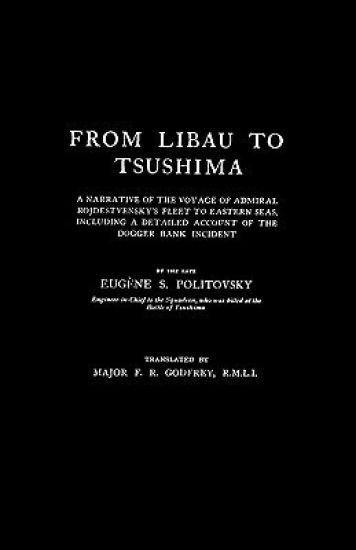
FROM LIBAU TO TSUSHIMAA Narrative of the Voyage of Admiral Rojdestvensky's Fleet to Eastern Seas
Eugene S Politovsky
Naval Military Press Ltd
2010
pokkari

The mighty Columbia River cuts a deep gash through the Miocene basalts of the Columbia Plateau, coursing as well through the lives of the Indians who live along its banks. Known to these people as Nch'i-Wana (the Big River), it forms the spine of their land, the core of their habitat.At the turn of the century, the Sahaptin speakers of the mid-Columbia lived in an area between Celilo Falls and Priest Rapids in eastern Oregon and Washington. They were hunters and gatherers who survived by virtue of a detailed, encyclopedic knowledge of their environment. Eugene Hunn's authoritative study focuses on Sahaptin ethnobiology and the role of the natural environment in the lives and beliefs of their descendants who live on or near the Yakima, Umatilla, and Warm Springs reservations.
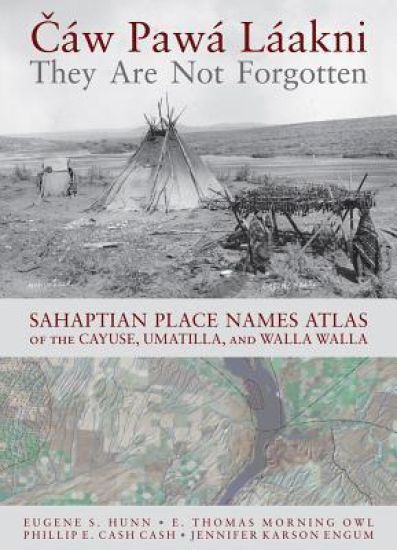
Cáw Pawá Láakni / They Are not Forgotten
Eugene S. Hunn; E. Thomas Morning Owl; Phillip E. Cash Cash; Jennifer Karson Engum
University of Washington Press
2015
pokkari
Cáw Pawá Láakni / They Are Not Forgotten is a book like none other. This ethnogeographic atlas of Native place names presents a compelling account of interactions between a homeland and its people. A project of the Tamástslikt Cultural Institute at the Confederated Tribes of the Umatilla Indian Reservation - composed of the Cayuse, Umatilla, and Walla Walla Tribes in eastern Oregon - Cáw Pawá Láakni documents and describes more than four hundred place names. The full-color, detailed maps and the narrative that introduces and supports them paint a picture of a way of life. This meticulous assemblage of memory and meaning echoes cultural and geographical information that has all but disappeared from common knowledge.To create this historical and cultural atlas of the Cayuse, Umatilla, and Walla Walla homeland, which spans the Columbia River and its tributaries from southeastern Washington to northeastern Oregon, ethnographic, traditional, and institutional knowledge was gathered together and incorporated into a GIS database to produce customized maps that present this knowledge. Many of the accounts are from the individuals who traveled on horseback, lived in and saw these places, and possessed knowledge that can no longer be replicated. In presenting these place-names, the Tribes strive to ensure the vitality of this communal knowledge into the future.In Cáw Pawá Láakni, places named in Indian languages are juxtaposed with sites that are central to the colonial period in the West, such as those described by the Lewis and Clark Expedition and those given to fur-trading posts, missions, and places on the Oregon Trail. The atlas adds a needed and vivid Native perspective to the written history and geography of Oregon and the West.

Energy Density Functional Theory of Many-Electron Systems
Eugene S. Kryachko; Eduardo V. Ludeña
Springer
1990
sidottu
I would like to present to a wide circle of the readers working in quantum chem- istry and solid-state physics, as ,,*ell as in other fields of many-body physics and its interfaces, this book deyoted to density functional theory written by my colleagues Eugene S. Kryachko and Eduardo Y. Ludena. Their ways to this theory are rather different although basically both of them are quantum chemical. Eugene S. Kryachko came to energy density functional theory from the theory of reduced density matrices, and Eduardo \'. Ludena dewloped earlier the concept of loges in quantum chemistry. Neyertheless, their earlier interests giw the possibility to consolidate and formulate energy density functional theory in a unified and consistent way, in my opinion. Raymond Daudel Paris ACKNOWLEDGMENTS The authors are indebted to Carl Almbladh, Victor Va. Antonchenko, John Avery, Richard F. W. Bader, Ulf \'on Barth, Jean-Louis Calais, A. John Coleman, Jens P. Dahl, Robert Donnelly, Harold Englisch, Robert 1\1. Erdahl, Oswaldo Goscinski, John E. Harriman, Gintas Kamuntavichius, Illja G. Kaplan, Jaime Keller, \'alentin Khart- siev, Toshikatsu Koga, Per-Olov Lo\ydin, T. Tung Nguyen-Dang, Ivan Zh. Petkov, Jerome K. Percus, l\lary Beth Ruskai, John R. Sabin, Zdenek Slanina, \'ladimir Shi- rokov, l\lario V. Stoitsov, Yoram Tal, and \Vaitao Yang, who in one way or another, either through their kind support, help, discussions or valuable comments created the human and intellectual background which made this book possible.

A Zapotec Natural History describes the people of a small town in Mexico and their remarkable knowledge of the natural world in which they live. San Juan Gbëë is a Zapotec Indian community located in the state of Oaxaca, a region of surprising biological diversity. Eugene S. Hunn is a well-known anthropologist and ethnobiologist who has spent many years working in San Juan Gbëë, studying its residents and their knowledge of the local environment. Here Hunn writes sensitively and respectfully about the rich understanding of local flora and fauna that village inhabitants have acquired and transmitted over many centuries.


The Inimitable Sounds of Love: A Threesome in Four Acts
Eugene S. Robinson
Southern Records/Studios
2013
nidottu
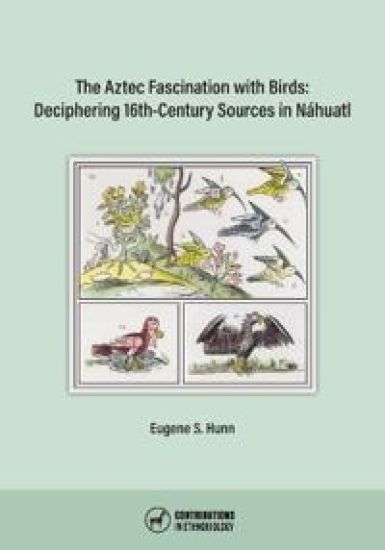
The Aztec empire was established in the Valley of Mexico in the 14th century, eventually dominating a vast region from a base on their island capital city, Tenochtitl n. Hern n Cort s sacked Tenochtitl n for Spain in 1521. Missionary friars arrived soon after to begin the Christianization of the Mesoamerican population. To facilitate their conversion, Franciscan scholars trained the descendants of the Aztec nobility in alphabetic writing. Indigenous students/colleagues soon mastered written Latin and learned to write their native N huatl. Fray Bernardino de Sahag n organized a complex ethnographic enterprise employing Indigenous colleagues to compile an encyclopedia of Indigenous Aztec knowledge. This work survived in Spanish translation as the Historia General de las Cosas de Nueva Espa a and was subsequently published with parallel N huatl and English texts as the Florentine Codex. Book 11 of the Codex is devoted to "Earthly Things" of which the "Second Chapter, ...telleth of all the different kinds of birds." Over 130 are named and described and illustrated in varying detail. However, establishing the correspondence of these birds with our contemporary ornithological inventory of Mexican birds has been a challenge. The Mexican biologist Mart n del Campo published an analysis based on the Spanish version in 1940, and his suggested identifications have been treated as definitive. I have reviewed the evidence in light of contemporary knowledge and offer here a refined analysis of the probable identities of the birds named in the Codex with a detailed rationale. This material offers rich insights into a Mesoamerican traditional natural history.

This work has been selected by scholars as being culturally important and is part of the knowledge base of civilization as we know it.This work is in the public domain in the United States of America, and possibly other nations. Within the United States, you may freely copy and distribute this work, as no entity (individual or corporate) has a copyright on the body of the work.Scholars believe, and we concur, that this work is important enough to be preserved, reproduced, and made generally available to the public. To ensure a quality reading experience, this work has been proofread and republished using a format that seamlessly blends the original graphical elements with text in an easy-to-read typeface.We appreciate your support of the preservation process, and thank you for being an important part of keeping this knowledge alive and relevant.

This work has been selected by scholars as being culturally important and is part of the knowledge base of civilization as we know it.This work is in the public domain in the United States of America, and possibly other nations. Within the United States, you may freely copy and distribute this work, as no entity (individual or corporate) has a copyright on the body of the work.Scholars believe, and we concur, that this work is important enough to be preserved, reproduced, and made generally available to the public. To ensure a quality reading experience, this work has been proofread and republished using a format that seamlessly blends the original graphical elements with text in an easy-to-read typeface.We appreciate your support of the preservation process, and thank you for being an important part of keeping this knowledge alive and relevant.
This work has been selected by scholars as being culturally important and is part of the knowledge base of civilization as we know it.This work is in the public domain in the United States of America, and possibly other nations. Within the United States, you may freely copy and distribute this work, as no entity (individual or corporate) has a copyright on the body of the work.Scholars believe, and we concur, that this work is important enough to be preserved, reproduced, and made generally available to the public. To ensure a quality reading experience, this work has been proofread and republished using a format that seamlessly blends the original graphical elements with text in an easy-to-read typeface.We appreciate your support of the preservation process, and thank you for being an important part of keeping this knowledge alive and relevant.