Kirjojen hintavertailu. Mukana 11 244 527 kirjaa ja 12 kauppaa.

Kirjahaku

Etsi kirjoja tekijän nimen, kirjan nimen tai ISBN:n perusteella.

1000 tulosta hakusanalla Frederick C. Beiser

The Berlin Antisemitism Controversy

The Berlin Antisemitism Controversy

Frederick C. Beiser

TAYLOR FRANCIS LTD
2024
nidottu
After a long struggle, Jewish emancipation was formally completed in Germany in 1871, when Wilhelm I abolished religious discrimination across the entire Reich. Yet the very same decade witnessed a new wave of antisemitism, one more vicious and virulent than anything before. At its centre was what is known as ‘The Berlin Antisemitism Controversy’. How can this rise of antisemitism be explained when further liberal reform was expected? Can it help us understand the tide of antisemitism that was to engulf Germany fifty years later?In this outstanding book by a leading scholar of German philosophy, Frederick C. Beiser argues that to understand modern antisemitism we must go back in history. Beginning with the background of the controversy and examining the most important antisemitic thinkers of the 1870s and 1880s, he brilliantly analyses the beginnings of modern antisemitism in Germany. Beiser challenges received scholarship that the rise of antisemitism was caused by a failure of the Jews to assimilate and criticises the view, held by Hannah Arendt, that antisemitism was at its peak when Jews were perceived to be powerless and had lost their roles in government and finance. He argues instead that it was fuelled by a fear of Jewish domination that took multiple forms. Exploring antisemitism from both a historical and philosophical perspective, he situates antisemitism in relation to such fundamental questions as the conditions for citizenship in the modern state, what is meant by nationality and what role religion should play in the state. He also vividly and expertly analyses the writings and arguments of those involved in the antisemitism crisis of the 1870s, including Wilhelm Marr, Constantin Frantz and Adolf Treitschke and thinkers who are here examined in English for the first time.The Berlin Antisemitism Controversy sheds much-needed light on an episode whose shockwaves resonate today. It is a superb account of a crucial period of not only German but also European and Jewish history and essential reading for anyone interested in the causes and roots of antisemitism in Germany and beyond.
The Berlin Antisemitism Controversy

The Berlin Antisemitism Controversy

Frederick C. Beiser

TAYLOR FRANCIS LTD
2024
sidottu
After a long struggle, Jewish emancipation was formally completed in Germany in 1871, when Wilhelm I abolished religious discrimination across the entire Reich. Yet the very same decade witnessed a new wave of antisemitism, one more vicious and virulent than anything before. At its centre was what is known as ‘The Berlin Antisemitism Controversy’. How can this rise of antisemitism be explained when further liberal reform was expected? Can it help us understand the tide of antisemitism that was to engulf Germany fifty years later?In this outstanding book by a leading scholar of German philosophy, Frederick C. Beiser argues that to understand modern antisemitism we must go back in history. Beginning with the background of the controversy and examining the most important antisemitic thinkers of the 1870s and 1880s, he brilliantly analyses the beginnings of modern antisemitism in Germany. Beiser challenges received scholarship that the rise of antisemitism was caused by a failure of the Jews to assimilate and criticises the view, held by Hannah Arendt, that antisemitism was at its peak when Jews were perceived to be powerless and had lost their roles in government and finance. He argues instead that it was fuelled by a fear of Jewish domination that took multiple forms. Exploring antisemitism from both a historical and philosophical perspective, he situates antisemitism in relation to such fundamental questions as the conditions for citizenship in the modern state, what is meant by nationality and what role religion should play in the state. He also vividly and expertly analyses the writings and arguments of those involved in the antisemitism crisis of the 1870s, including Wilhelm Marr, Constantin Frantz and Adolf Treitschke and thinkers who are here examined in English for the first time.The Berlin Antisemitism Controversy sheds much-needed light on an episode whose shockwaves resonate today. It is a superb account of a crucial period of not only German but also European and Jewish history and essential reading for anyone interested in the causes and roots of antisemitism in Germany and beyond.
The Philosophy of Georg Simmel

The Philosophy of Georg Simmel

Frederick C. Beiser

TAYLOR FRANCIS LTD
2025
nidottu
In this ground-breaking work, Frederick Beiser argues that Georg Simmel was one of the foremost yet overlooked philosophers of the late nineteenth and early twentieth centuries. Whilst Simmel’s work was crucial in laying foundations for sociology, his several books, including The Philosophy of Money, were deeply philosophical. Simmel's doctorate was on Kant's philosophy and that his intellectual outlook was greatly influenced by his lifelong love of philosophy.It is this philosophical Simmel that Frederick C. Beiser, a renowned scholar of German philosophy, explores in this fascinating and important book. Beginning with a helpful overview of Simmel's early intellectual life, Beiser considers the formation of Simmel's sociology and his views on ethics, before examining his theories of historical knowledge; the arguments contained in his most important work, The Philosophy of Money; the role of Kant's philosophy in his thinking; his critique of pessimism and his philosophy of religion. The second part of the book explores the deeper philosophical importance of Simmel's work, by considering his theories of the method and essence of philosophy, the philosophy of life and his important work on aesthetics.An outstanding and path-breaking book, The Philosophy of Georg Simmel will be of interest to students and researchers in philosophy and sociology alike, particularly those studying nineteenth century philosophy and the history of sociology.
The Philosophy of Georg Simmel

The Philosophy of Georg Simmel

Frederick C. Beiser

TAYLOR FRANCIS LTD
2025
sidottu
In this ground-breaking work, Frederick Beiser argues that Georg Simmel was one of the foremost yet overlooked philosophers of the late nineteenth and early twentieth centuries. Whilst Simmel’s work was crucial in laying foundations for sociology, his several books, including The Philosophy of Money, were deeply philosophical. Simmel's doctorate was on Kant's philosophy and that his intellectual outlook was greatly influenced by his lifelong love of philosophy.It is this philosophical Simmel that Frederick C. Beiser, a renowned scholar of German philosophy, explores in this fascinating and important book. Beginning with a helpful overview of Simmel's early intellectual life, Beiser considers the formation of Simmel's sociology and his views on ethics, before examining his theories of historical knowledge; the arguments contained in his most important work, The Philosophy of Money; the role of Kant's philosophy in his thinking; his critique of pessimism and his philosophy of religion. The second part of the book explores the deeper philosophical importance of Simmel's work, by considering his theories of the method and essence of philosophy, the philosophy of life and his important work on aesthetics.An outstanding and path-breaking book, The Philosophy of Georg Simmel will be of interest to students and researchers in philosophy and sociology alike, particularly those studying nineteenth century philosophy and the history of sociology.
Schiller as Philosopher

Schiller as Philosopher

Frederick Beiser

Oxford University Press
2008
nidottu
Fred Beiser, renowned as one of the world's leading historians of German philosophy, presents a brilliant new study of Friedrich von Schiller (1759-1805), rehabilitating him as a philosopher worthy of serious attention. Beiser shows, in particular, that Schiller's engagement with Kant is far more subtle and rewarding than is often portrayed. Promising to be a landmark in the study of German thought, Schiller as Philosopher will be compulsory reading for any philosopher, historian, or literary scholar engaged with the key developments of this fertile period.
Hegel

Hegel

Frederick Beiser

Routledge
2005
sidottu
Hegel (1770-1831) is one of the major philosophers of the nineteenth century. Many of the major philosophical movements of the twentieth century - from existentialism to analytic philosophy - grew out of reactions against Hegel. He is also one of the hardest philosophers to understand and his complex ideas, though rewarding, are often misunderstood. In this magisterial and lucid introduction, Frederick Beiser covers every major aspect of Hegel's thought. He places Hegel in the historical context of nineteenth-century Germany whilst clarifying the deep insights and originality of Hegel's philosophy.A masterpiece of clarity and scholarship, Hegel is both the ideal starting point for those coming to Hegel for the first time and essential reading for any student or scholar of nineteenth century philosophy.Additional features:glossarychapter summarieschronologyannotated further reading.
Hegel

Hegel

Frederick Beiser

Routledge
2005
nidottu
Hegel (1770-1831) is one of the major philosophers of the nineteenth century. Many of the major philosophical movements of the twentieth century - from existentialism to analytic philosophy - grew out of reactions against Hegel. He is also one of the hardest philosophers to understand and his complex ideas, though rewarding, are often misunderstood. In this magisterial and lucid introduction, Frederick Beiser covers every major aspect of Hegel's thought. He places Hegel in the historical context of nineteenth-century Germany whilst clarifying the deep insights and originality of Hegel's philosophy.A masterpiece of clarity and scholarship, Hegel is both the ideal starting point for those coming to Hegel for the first time and essential reading for any student or scholar of nineteenth century philosophy.Additional features:glossarychapter summarieschronologyannotated further reading.
John H. Burdakin and the Grand Trunk Western Railroad

John H. Burdakin and the Grand Trunk Western Railroad

Mary Sharp; Frederick J. Beier

Michigan State University Press
2016
sidottu
John H. Burdakin and the Grand Trunk Western Railroad provides a look at the principles and personal values that guided John H. Burdakin through a long, successful career as a top manager at three railroads—the Pennsylvania, the Penn Central, and finally the Grand Trunk Western, where he was president of the regional carrier from 1974 to 1986. The book, written from interviews with Burdakin before his death in 2014, gives real-life examples of how Burdakin’s management principles and personal qualities helped him solve labor- management problems, update railroad technology, protect worker safety, and improve employee morale while managing a four thousand–person workforce. It introduces colorful characters who were involved in American railroads, as well as the serious, life-threatening issues that confronted railroads in the last half of the twentieth century in America. This book will provide insights for managers of any business as well as for those seeking to balance a successful career and a rewarding home life.
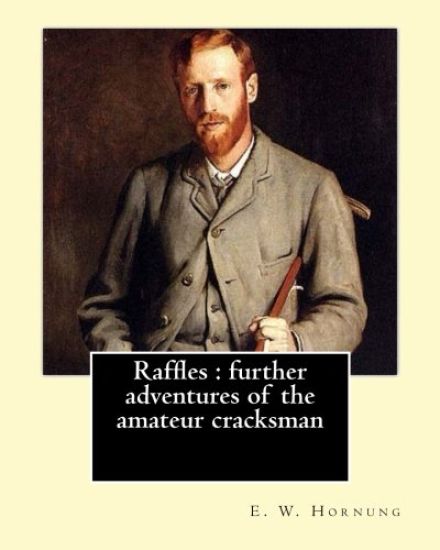
Raffles: further adventures of the amateur cracksman By: E. W. Hornung, illustrated By: F.(Frederick) C. Yohn (February 8, 1875
Ernest William Hornung (7 June 1866 - 22 March 1921) was an English author and poet known for writing the A. J. Raffles series of stories about a gentleman thief in late 19th-century London. Hornung was educated at Uppingham School; as a result of poor health he left the school in December 1883 to travel to Sydney, where he stayed for two years. He drew on his Australian experiences as a background when he began writing, initially short stories and later novels. In 1898 he wrote "In the Chains of Crime", which introduced Raffles and his sidekick, Bunny Manders; the characters were based partly on his friends Oscar Wilde and his lover, Lord Alfred Douglas, and also on the characters of Sherlock Holmes and Dr. Watson, created by his brother-in-law, Arthur Conan Doyle. The series of Raffles short stories were collected for sale in book form in 1899, and two further books of Raffles short stories followed, as well as a poorly received novel. Aside from his Raffles stories, Hornung was a prodigious writer of fiction, publishing numerous books from 1890, with A Bride from the Bush to his 1914 novel The Crime Doctor. The First World War brought an end to Hornung's fictional output. His son, Oscar, was killed at the Second Battle of Ypres in July 1915. Hornung joined the YMCA, initially in England, then in France, where he helped run a canteen and library. He published two collections of poetry during the war, and then, afterwards, one further volume of verse and an account of his time spent in France, Notes of a Camp-Follower on the Western Front. Hornung's fragile constitution was further weakened by the stress of his war work. To aid his recuperation, he and his wife visited the south of France in 1921. He fell ill from influenza on the journey, and died on 22 March 1921, aged 54. Although much of Hornung's work has fallen into obscurity, his Raffles stories continued to be popular, and have formed numerous film and television adaptations. Hornung's stories dealt with a wider range of themes than crime: he examined scientific and medical developments, guilt, class and the unequal role played by women in society. Two threads that run through a sizeable proportion of his books are Australia and cricket; the latter was also a lifelong passion. Frederick Coffay Yohn (February 8, 1875 - June 6, 1933), often recognized only by his initials, F. C. Yohn, was an artist and magazine illustrator.
The Pooh Perplex

The Pooh Perplex

Frederick C. Crews

University of Chicago Press
2003
nidottu
In this devastatingly funny classic, Frederick Crews skewers the ego-inflated pretensions of the schools and practitioners of literary criticism popular in the 1960s, including Freudians, Aristotelians, and New Critics. Modelled on the "case-books" often used in freshman English classes at the time, "The Pooh Perplex" contains 12 essays written in different critical voices, complete with ridiculous footnotes, tongue-in-cheek "questions and study projects" and hilarious biographical notes on the contributors. With incisive essays such as "A Bourgeois Writer's Proletarian Fables" and "A la recherche du Pooh perdu", by distinguished authors such as Duns C. Penwiper and P.R. Honeycomb, "The Pooh Perplex" is sure to delight everyone who has ever had to suffer through a freshman English class - and many of their teachers, too. This edition contains a new preface by the author that compares literary theory then and now and identifies the real-life critics who were spoofed in certain chapters.
A History of Medieval Philosophy

A History of Medieval Philosophy

Frederick C. Copleston

University of Notre Dame Press
1990
nidottu
In this classic work, Frederick C. Copleston, S.J., outlines the development of philosophical reflection in Christian, Islamic, and Jewish thought from the ancient world to the late medieval period. A History of Medieval Philosophy is an invaluable general introduction that also includes longer treatments of such leading thinkers as Aquinas, Scotus, and Ockham.
A History of Medieval Philosophy

A History of Medieval Philosophy

Frederick C. Copleston

UNIVERSITY OF NOTRE DAME PRESS
2021
sidottu
In this classic work, Frederick C. Copleston, S.J., outlines the development of philosophical reflection in Christian, Islamic, and Jewish thought from the ancient world to the late medieval period. A History of Medieval Philosophy is an invaluable general introduction that also includes longer treatments of such leading thinkers as Aquinas, Scotus, and Ockham.
Napoleon's Italian Campaigns

Napoleon's Italian Campaigns

Frederick C. Schneid

Praeger Publishers Inc
2002
sidottu
The French Revolutionary and Napoleonic wars raged in Italy for 23 years. In that time, no fewer than eight campaigns involving hundred of thousands of troops were mounted in the Italian peninsula, as France and Austria struggled over this secondary, but still vitally important theater of war. As Frederick Schneid demonstrates in this groundbreaking work, control of Italy was rightly seen by Napoleon as an important means of applying strategic pressure on the Austrians, while simultaneously providing security for France's vulnerable southern flank. As the first in-depth consideration of the struggle for strategically key region, this book places the Italian campaigns into their proper historical context. Beginning with a geo-strategic overview of the Italian peninsula and its place in French and Austrian calculations, Schneid moves on to a careful consideration of the major campaigns that began in 1805, 1809, and 1813. These include studies of the battles at Caldiero, Wagram, and Mincio. The book also provides appendices with complete orders of battle for each campaign.
Napoleon's Conquest of Europe

Napoleon's Conquest of Europe

Frederick C. Schneid

Praeger Publishers Inc
2005
sidottu
Poised to strike at England in the summer of 1805, Napoleon found himself facing a coalition of European powers determined to limit his territorial ambitions. Still, in less than one hundred days, Napoleon's armies marched from the English Channel to Central Europe, crushing the armies of Austria and Russia—the first step in his conquest of Europe. In this telling new account, Schneid demonstrates how this was possible. Schneid details how Napoleon's victory over the Third Coalition was the product of years of diplomatic preparation and the formation of French alliances. He played upon the prevailing conditions of the European state system and the internal politics of the Holy Roman Empire to improve France's strategic position. This war must be understood in the context of the French Revolution and its influence on major and minor European states. In some cases, Napoleonic diplomacy returned to France's traditional and historic relationships; in others, he capitalized upon longstanding competition and animosities to gather allies and create wedges. Schneid approaches the campaign from a broad diplomatic, economic, and military perspective, including not only the French perspective, but the points of view of the other powers involved as well. This telling account reveals that the road to Vienna was paved long before Napoleon's armies marched upon the enemies arrayed against them.
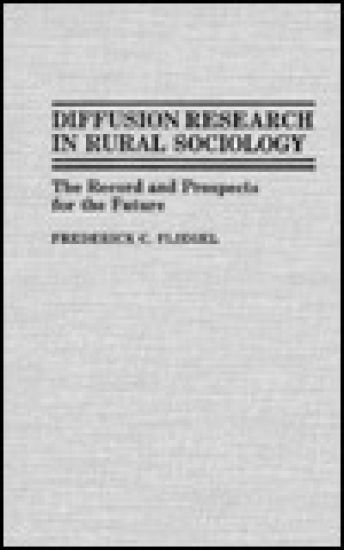
Diffusion Research in Rural Sociology

Diffusion Research in Rural Sociology

Frederick C. Fliegel

Praeger Publishers Inc
1992
sidottu
Fliegel overviews and summarizes research on the spread of innovations through rural populations. The volume begins with a look at the discovery of diffusion as a patterned process in the 1940s and examines the creation of the classical model to explain diffusion as a transfer of information. Fliegel then notes how the classical model changed to accommodate the particular socioeconomic condition when the model was applied to developing countries after 1945. He concludes by commenting on the revival of interest in diffusion research, the further development and refinement of the classical model, and the modern emphasis on conservation-oriented innovations rather than on innovations that enhance production.Fliegel overviews and summarizes research on the spread of innovations through rural populations. The volume gives detailed attention to the development and utilization of diffusion research from the 1940s to 1970 and traces the creation of the classical model for explaining the spread of innovations. Because the classical model seemed inadequate when applied to the diffusion of innovations in lesser-developed countries after World War II, the model changed to accommodate new research. The book notes the role of diffusion research in developing countries after the second world war, the change of the classical model to include socioeconomic conditions peculiar to these countries, and the growth and development of diffusion research to the present day.The first part of the book provides an historical survey of diffusion research through 1970. The chapters in this section discuss the discovery of diffusion as a patterned process, the development of the classical model to explain diffusion as an information transfer, and the implementation of diffusion research in developing countries after 1945. The second part, devoted to recent trends, includes chapters on the further development and refinement of the classical model, the revival of interest in diffusion research, and the modern emphasis on conservation-oriented innovations rather than on ones that enhance production. An extensive bibliography concludes this comprehensive study.