Kirjojen hintavertailu. Mukana 11 343 410 kirjaa ja 12 kauppaa.

Kirjahaku

Etsi kirjoja tekijän nimen, kirjan nimen tai ISBN:n perusteella.

1000 tulosta hakusanalla G. Atkins

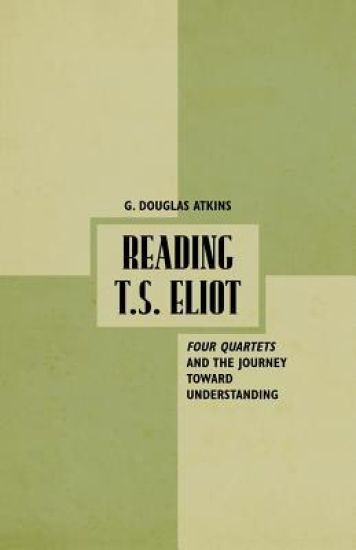
Reading T.S. Eliot

Reading T.S. Eliot

G. Atkins

Palgrave Macmillan
2012
nidottu
This book offers an exciting new approach to T.S. Eliot's Four Quartets as it shows why it should be read both closely and in relation to Eliot's other works, notably the poems The Waste Land, 'The Hollow Men,' and Ash-Wednesday.
E. B. White

E. B. White

G. Atkins

Palgrave Macmillan
2012
nidottu
This is the first book-length critical study of E.B. White, the American essayist and author of Stuart Little, Charlotte's Web, The Trumpet of the Swan . G. Douglas Atkins focuses on White and the writing life, offering detailed readings of the major essays and revealing White's distinctiveness as an essayist.
On the Familiar Essay

On the Familiar Essay

G. Atkins

Palgrave Macmillan
2009
nidottu
Rooted in close reading of texts, including the essays of E.B. White, this comprehensive assessment of the oft-slighted subform of the literary essay situates the familiar at the heart of the essay as form.
Encyclopedia of the Inter-American System

Encyclopedia of the Inter-American System

G. Pope Atkins

Greenwood Press
1997
sidottu
"Multidisciplinary, scholarly work by well-known political scientist and specialist of inter-American relations. Foremost reference in the field. More comprehensive and up-to-date than Sheinin's or Stoetzer's. Lengthy entries describe in historical perspective the major events and facets of the inter-American system (IAS) at all levels: national, regional, sub-regional, institutional (OAS, IDB, NAFTA, etc.), and personal/personnel. Each entry followed by section with leading, relevant sources in English and Spanish. Also includes useful bibliographic essay (p. 533-536) and extensive index (p. 536-561). Chronology and appendices include IAS membership, nine structural charts, and texts of OAS Charter and Rio Treaty"--Handbook of Latin American Studies, v.57.http://www.loc.gov/hlas/
Latin America In The International Political System
More than a decade has passed since the publication of the first edition of Latin America in the International Political System. Since then, significant events have occurred in the region, and the nature of Latin America’s international relations has changed considerably. Although the purpose of this text is unchanged—that of providing stude
Arms and Politics in the Dominican Republic
This chronicle and interpretation of recent military and political events in the Dominican Republic analyzes the political behavior of the countryfs armed forces and scrutinizes policies put in action since the nation’s civil war and the subsequent U.S. intervention of 1965. Dr. Atkins covers the course of Joaquin Balaguer’s lengthy presidency, the remarkable events surrounding the 1978 election of President Antonio Guzman, and the first months of Guzman’s administration, with particular attention being given to the role of the armed forces in political processes. In describing the Dominican experience with arms and politics, Dr. Atkins notes that it is a case of noninstitutionalized civil-military relations revolving around the president, his key associates, and the officers of the military.
Handbook Of Research On The International Relations Of Latin America And The Caribbean
The study of Latin American and Caribbean international relations has a long evolution both within the development of international relations as a general academic undertaking and in terms of the particular characteristics that distinguish the approaches taken by scholars in the field. This handbook provides a thorough multidisciplinary reference guide to the literature on the various elements of the international relations of Latin America and the Caribbean. Citing over 1600 sources that date from the nineteenth century to the present, with emphasis on recent decades, the volume's analytic essays trace the evolution of research in terms of concepts, issues, and themes. The Handbook is a companion volume to Atkins' Latin America and the Caribbean in the International System, Fourth Edition, but also serves as an invaluable stand-alone reference volume for students, scholars, researchers, journalists, and practitioners, both official and private.
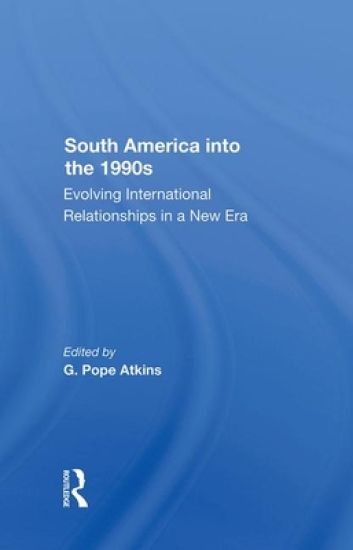
South America Into The 1990s

South America Into The 1990s

G. Pope Atkins

Routledge
2019
sidottu
This book undertakes a multifaceted examination of South American international relations, emphasising on the continent's new era of domestic and international politics and the implications of the evolving environment for the policies of the many actors participating in the region's politics.
South America Into The 1990s

South America Into The 1990s

G. Pope Atkins

TAYLOR FRANCIS LTD
2024
nidottu
This book undertakes a multifaceted examination of South American international relations, emphasising on the continent's new era of domestic and international politics and the implications of the evolving environment for the policies of the many actors participating in the region's politics.
Geoffrey Hartman

Geoffrey Hartman

G. Douglas Atkins

Routledge
1990
sidottu
`The critic explicitly acknowledges his dependence on prior words that make his word a kind of answer. He calls to other texts "that they might answer him."'Geoffrey Hartman is the first book devoted to an exploration of the `intellectual poetry' of the critic who, whether or not he `represents the future of the profession', is a unique and major voice in twentieth-century criticism.Professor Atkins explains clearly Hartman's key ideas and places his work in the contexts of Romanticism and Judaism on which he has written extensively. In Geoffrey Hartman he provides a valuable introduction to a major critical voice who has called into question our assumptions about the distinction between commentary and imaginative literature.
Handbook Of Research On The International Relations Of Latin America And The Caribbean
The study of Latin American and Caribbean international relations has a long evolution both within the development of international relations as a general academic undertaking and in terms of the particular characteristics that distinguish the approaches taken by scholars in the field. This handbook provides a thorough multidisciplinary reference guide to the literature on the various elements of the international relations of Latin America and the Caribbean. Citing over 1600 sources that date from the nineteenth century to the present, with emphasis on recent decades, the volume's analytic essays trace the evolution of research in terms of concepts, issues, and themes. The Handbook is a companion volume to Atkins' Latin America and the Caribbean in the International System, Fourth Edition, but also serves as an invaluable stand-alone reference volume for students, scholars, researchers, journalists, and practitioners, both official and private.
Latin America And The Caribbean In The International System
The fourth edition of this widely praised text has been thoroughly revised to reflect the evolving characteristics of the current international system that have had a dramatic effect on every aspect of international relations of Latin America and the Caribbean. The original purpose of this book is unchanged: It continues to provide a topically current and analytically integrated survey of the region's role in the world. Still organized around the idea of Latin America and the Caribbean as a separate subsystem within the global international system, the discussion gives special emphasis to complex interstate and transnational structures and processes. Within this framework, Atkins analyzes the foreign policies of the Latin American states themselves and those of the United States and other countries toward Latin America and the Caribbean. He also looks closely at the nature and role of transnational actors in the region, such as the multinational corporations, the Holy See, Protestant Churches, transnational political parties, international labor, nongovernmental organizations, and others. He gives special attention to Latin American participation in international institutions at all levels.
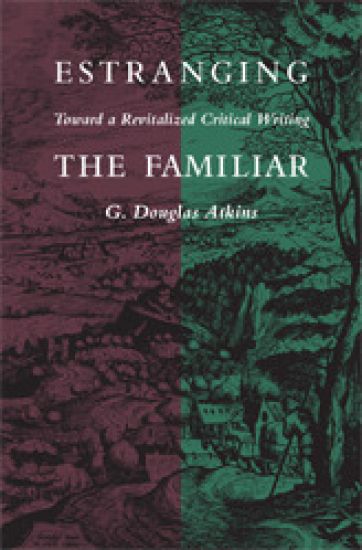
Estranging the Familiar

Estranging the Familiar

G. Douglas Atkins

University of Georgia Press
2008
pokkari
In Estranging the Familiar, G. Douglas Atkins addresses the often lamented state of scholarly and critical writing as he argues for a criticism that is at once theoretically informed and personal. The revitalized critical writing he advocates may entail—but is not limited to—a return to the essay, the form critical writing once took and the form that is now enjoying a resurgence of popularity and excellence.Atkins contends that to reach a general audience, criticism must move away from the impersonality of modern criticism and contemporary theory without embracing the old-fashioned essay. "The venerable familiar essay may remain the basis," Atkins writes, "but its conventional openness, receptivity, and capaciousness must extend to theory, philosophy, and the candor that seems to mark the tail-end of the twentieth century." In noting the timeliness, if not the necessity, of a return to the essay, Atkins also considers our culture's parallel "return to the personal." When the essay combines good writing with the concerns of the personal, Atkins says, it becomes a form of criticism that is readable, vital, and potentially attractive to a large readership.Atkins hopes critics will tap into the revitalized interest the essay now enjoys without ignoring the considerable insights and advances of contemporary theory. He argues that despite claims to the contrary there is no inherent incompatibility between the essay and modern theory. As Atkins considers various experiments in critical writing from Plato to the present, notably feminist interest in the personal and autobiographical, he contends that these attempts, although undeniably important, fall short of the desired goal when they emphasize the merely expressive and neglect the artful quality good writing can bring to personal criticism.The final third of the book consists of a series of experiments in critical writing that represent the author's own attempts to bridge the gap between theory and popular criticism, between an academic and a general audience. In essays that illustrate the rhetorical power of the form, Atkins describes the reciprocal relationship between his life experience and a reading of The Odyssey, explains the role that theory has played in his personal development, and chronicles his attempts to find a voice as a writer.
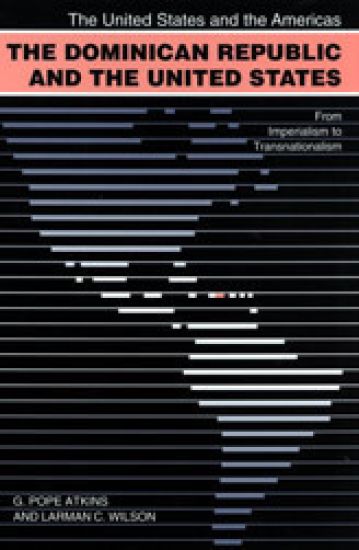
The Dominican Republic and the United States

The Dominican Republic and the United States

G. Pope Atkins; Larman C. Wilson

University of Georgia Press
1998
pokkari
This study of the political, economic, and sociocultural relationship between the Dominican Republic and the United States follows its evolution from the middle of the nineteenth century to the mid-1990s. It deals with the interplay of these dimensions from each country's perspective and in both private and public interactions.From the U.S. viewpoint, important issues include interpretation of the rise and fall of the Dominican Republic's strategic importance, the legacy of military intervention and occupation, the problem of Dominican dictatorship and instability, and vacillating U.S. efforts to "democratize" the country. From the Dominican perspective, the essential themes involve foreign policies adopted from a position of relative weakness, ambivalent love-hate views toward the United States, emphasis on economic interests and the movement of Dominicans between the two countries, international political isolation, the adversarial relationship with neighboring Haiti, and the legacy of dictatorship and the uneven evolution of a Dominican-style democratic system.The Dominican Republic and the United States is the eleventh book in The United States and the Americas series, volumes suitable for classroom use.
Tracing the Essay

Tracing the Essay

G. Douglas Atkins

University of Georgia Press
2005
pokkari
The essay, as a notably hard form of writing to pin down, has inspired some unflattering descriptions: It is a “greased pig,” for example, or a “pair of baggy pants into which nearly anything and everything can fit.” In Tracing the Essay, G. Douglas Atkins embraces the very qualities that have moved others to accord the essay second-class citizenship in the world of letters.Drawing from the work of Montaigne and Bacon and recent practitioners such as E. B. White and Cynthia Ozick, Atkins shows what the essay means—and how it comes to mean. The essay, related to assaying (attempting), mines experience for meaning, which it then carefully weighs. It is a via media creature, says Atkins, born of and embracing tension. It exists in places between experience and meaning, literature and philosophy, self and other, process and product, form and formlessness. Moreover, as a literary form the essay is inseparable from a way of life requiring wisdom, modesty, and honesty. “The essay was, historically,” notes Atkins, “the first form to take the experience of the individual and make it the stuff of literature.”Atkins also considers the essay’s basis in Renaissance (and Reformation) thinking and its participation in voyages of exploration and discovery of that age. Its concern is “home-cosmography,” to use a term from seventeenth-century writer William Habington. Responding to influential critiques of the essay’s supposed self-indulgence, lack of irony, and absence of form, Atkins argues that the essay exhibits a certain “sneakiness” as it proceeds in, through, and by means of the small and the mundane toward the spiritual and the revelatory.
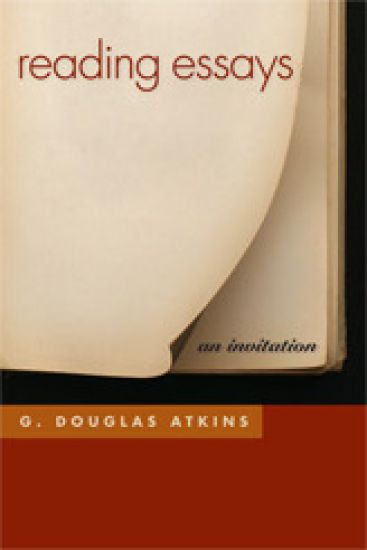
Reading Essays

Reading Essays

G. Douglas Atkins

University of Georgia Press
2008
pokkari
Approaches abound to help us beneficially, enjoyably read fiction, poetry, and drama. Here, for the first time, is a book that aims to do the same for the essay. G. Douglas Atkins performs sustained readings of more than twenty-five major essays, explaining how we can appreciate and understand what this currently resurgent literary form reveals about the “art of living.”Atkins’s readings cover a wide spectrum of writers in the English language—and his readings are themselves essays, gracefully written, engaged, and engaging. Atkins starts with the earliest British practitioners of the form, including Francis Bacon, John Dryden, Alexander Pope, and Samuel Johnson. Transcendentalist writers Henry David Thoreau and Ralph Waldo Emerson are included, as are works by Americans James Baldwin, Zora Neale Hurston, and E. B. White. Atkins also provides readings of a number of contemporary essayists, among them Annie Dillard, Scott Russell Sanders, and Cynthia Ozick.Many of the readings are of essays that Atkins has used successfully in the classroom, with undergraduate and graduate students, for many years. In his introduction Atkins offers practical advice on the specific demands essays make and the unique opportunities they offer, especially for college courses. The book ends with a note on the writing of essays, furthering the author’s contention that reading should not be separated from writing.Reading Essays continues in the tradition of such definitive texts as Understanding Poetry and Understanding Fiction. Throughout, Atkins reveals the joy, delight, grace, freedom, and wisdom of “the glorious essay.”