Kirjojen hintavertailu. Mukana 12 518 470 kirjaa ja 12 kauppaa.

Kirjahaku

Etsi kirjoja tekijän nimen, kirjan nimen tai ISBN:n perusteella.

1000 tulosta hakusanalla Geoffrey M. Stephenson

Economics and Utopia

Economics and Utopia

Geoffrey M Hodgson

Routledge
1998
nidottu
Since the fall of the Berlin Wall we have been told that no alternative to Western capitalism is possible or desirable. This book challenges this view with two arguments. First, the above premise ignores the enormous variety within capitalism itself. Second, there are enormous forces of transformation within contemporary capitalisms, associated with moves towards a more knowledge-intensive economy. These forces challenge the traditional bases of contract and employment, and could lead to a quite different socio-economic system. Without proposing a static blueprint, this book explores this possible scenario.
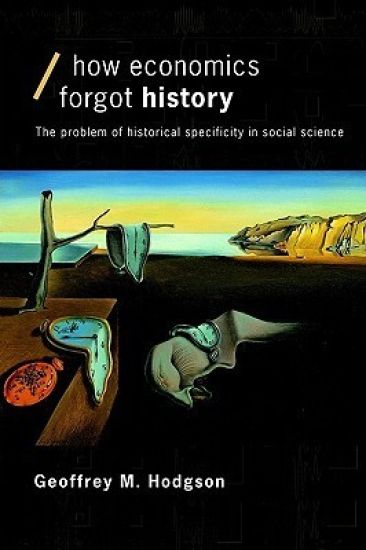
How Economics Forgot History

How Economics Forgot History

Geoffrey M Hodgson

Routledge
2001
sidottu
In arguably his most important book to date, Hodgson calls into question the tendency of economic method to try and explain all economic phenomena by using the same catch-all theories and dealing in universal truths. He argues that you need different theories to analyze different economic phenomena and systems and that historical context must be taken into account. Hodgson argues that the German Historical School was key in laying the foundations for the work of the pioneer institutional economists, who themselves are gaining currency today; and that the growing interest in this school of thought is contributing to a more complete understanding of socio-economic theory.
How Economics Forgot History

How Economics Forgot History

Geoffrey M Hodgson

Routledge
2001
nidottu
In arguably his most important book to date, Hodgson calls into question the tendency of economic method to try and explain all economic phenomena by using the same catch-all theories and dealing in universal truths. He argues that you need different theories to analyze different economic phenomena and systems and that historical context must be taken into account. Hodgson argues that the German Historical School was key in laying the foundations for the work of the pioneer institutional economists, who themselves are gaining currency today; and that the growing interest in this school of thought is contributing to a more complete understanding of socio-economic theory.
The Evolution of Institutional Economics

The Evolution of Institutional Economics

Geoffrey M Hodgson

Routledge
2004
sidottu
This exciting new book from Geoffrey Hodgson is eagerly awaited by social scientists from many different backgrounds. This book charts the rise, fall and renewal of institutional economics in the critical, analytical and readable style that Hodgson's fans have come to know and love, and that a new generation of readers will surely come to appreciate.
The Evolution of Institutional Economics

The Evolution of Institutional Economics

Geoffrey M Hodgson

Routledge
2004
nidottu
This exciting new book from Geoffrey Hodgson is eagerly awaited by social scientists from many different backgrounds. This book charts the rise, fall and renewal of institutional economics in the critical, analytical and readable style that Hodgson's fans have come to know and love, and that a new generation of readers will surely come to appreciate.
Extraordinary Groups

Extraordinary Groups

Geoffrey M. Bellman; Kathleen D. Ryan

John Wiley Sons Inc
2009
sidottu
Two leading experts present a new approach to help teams nurture extraordinary experiences and excel Occasionally we participate in a group that inspires us to describe the experience as "powerful" or simply "wow." Why are some teams described in such exceptional terms, while most are not? Bellman and Ryan argue that an extraordinary group emerges when a group experience satisfies two or more core needs that members intuitively bring to any group they join. Based on extensive research, the book presents the Group Needs Model to help anyone nurture extraordinary experiences in their groups and achieve outstanding results. Introduces a new approach for creating extraordinary experiences and results in teamsIdentifies the key characteristics that define exceptional teamsDescribes the Group Needs Model for encouraging extraordinary experiences and team successA timely resource for anyone who leads groups including HR and OD professionals, managers, executives, nonprofit managers and directors, virtual teams leaders, and trainers
Introduction to the Design and Analysis of Experiments

Introduction to the Design and Analysis of Experiments

Geoffrey M. Clarke; Robert E. Kempson

John Wiley Sons Inc
1996
nidottu
The design and analysis of experiments is typically taught as part of a second level course in statistics. Many different types and levels of students will require this information in order to progress with their studies and research. This text is thus offered as an introduction to this wide ranging and important subject. It has the advantage of explaining in an accessible way the basic principles behind good experimental thinking, planning and action. The authors have used their experience in teaching related courses to separate out what seem to be the essential basic contents for everyone, and to combine with these some of the most useful additional topics in biological, industrial, medical, and environmental experimentation.
A Basic Course in Statistics

A Basic Course in Statistics

Geoffrey M. Clarke; D. Cooke

John Wiley Sons Inc
2004
nidottu
Expanded and revised to include new computing exercises using actual data along with tips, solutions and a set of updated questions. Computer use is encouraged to facilitate analysis of data sets too large to be done by hand; to assist in the drawing of diagrams, histograms and scatter plots; to simulate probability models in order to illustrate probability and statistical theory. Explains how to tackle computing exercises using the statistical package MINITAB.
Identity through History

Identity through History

Geoffrey M. White

Cambridge University Press
1991
sidottu
For people who live in small communities transformed by powerful outside forces, narrative accounts of culture contact and change create images of collective identity through the idiom of shared history. How may we understand the processes that make such accounts compelling for those who tell them? Why do some narratives acquire a kind of mythic status as they are told and retold in a variety of contexts and genres? Identity Through History attempts to explain how identity formation developed among the people of Santa Isabel in the Solomon Islands who were victimised by raiding headhunters in the nineteenth century, and then embraced Christianity around the turn of the century. Making innovative use of work in psychological and historical anthropology, Geoffrey White shows how these significant events were crucial to the community’s view of itself in shifting social and political circumstances.
Identity through History

Identity through History

Geoffrey M. White

Cambridge University Press
2003
pokkari
For people who live in small communities transformed by powerful outside forces, narrative accounts of culture contact and change create images of collective identity through the idiom of shared history. How may we understand the processes that make such accounts compelling for those who tell them? Why do some narratives acquire a kind of mythic status as they are told and retold in a variety of contexts and genres? Identity Through History attempts to explain how identity formation developed among the people of Santa Isabel in the Solomon Islands who were victimised by raiding headhunters in the nineteenth century, and then embraced Christianity around the turn of the century. Making innovative use of work in psychological and historical anthropology, Geoffrey White shows how these significant events were crucial to the community’s view of itself in shifting social and political circumstances.
The Wealth of a Nation

The Wealth of a Nation

Geoffrey M. Hodgson

PRINCETON UNIVERSITY PRESS
2023
sidottu
How the development of legal and financial institutions transformed Britain into the world’s first capitalist countryModern capitalism emerged in England in the eighteenth century and ushered in the Industrial Revolution, though scholars have long debated why. Some attribute the causes to technological change while others point to the Protestant ethic, liberal ideas, and cultural change. The Wealth of a Nation reveals the crucial developments in legal and financial institutions in the seventeenth and eighteenth centuries that help to explain this dramatic transformation.Offering new perspectives on the early history of capitalism, Geoffrey Hodgson describes how, for the emerging British economy, pressures from without were as important as evolution from within. He shows how intensive military conflicts overseas forced the state to undertake major financial, administrative, legal, and political reforms. The resulting institutional changes not only bolstered the British war machine—they fostered the Industrial Revolution. Hodgson traces how Britain’s war capitalism led to an expansion of its empire and a staggering increase in the slave trade, and how the institutional innovations that radically transformed the British economy were copied and adapted by countries around the world.A landmark work of scholarship, The Wealth of a Nation sheds light on how external factors such as war gave rise to institutional arrangements that facilitated finance, banking, and investment, and offers a conceptual framework for further research into the origins and consolidation of capitalism in England.
The Wealth of a Nation

The Wealth of a Nation

Geoffrey M. Hodgson

PRINCETON UNIVERSITY PRESS
2025
pokkari
How the development of legal and financial institutions transformed Britain into the world’s first capitalist countryModern capitalism emerged in England in the eighteenth century and ushered in the Industrial Revolution, though scholars have long debated why. Some attribute the causes to technological change while others point to the Protestant ethic, liberal ideas, and cultural change. The Wealth of a Nation reveals the crucial developments in legal and financial institutions in the seventeenth and eighteenth centuries that help to explain this dramatic transformation.Offering new perspectives on the early history of capitalism, Geoffrey Hodgson describes how, for the emerging British economy, pressures from without were as important as evolution from within. He shows how intensive military conflicts overseas forced the state to undertake major financial, administrative, legal, and political reforms. The resulting institutional changes not only bolstered the British war machine—they fostered the Industrial Revolution. Hodgson traces how Britain’s war capitalism led to an expansion of its empire and a staggering increase in the slave trade, and how the institutional innovations that radically transformed the British economy were copied and adapted by countries around the world.A landmark work of scholarship, The Wealth of a Nation sheds light on how external factors such as war gave rise to institutional arrangements that facilitated finance, banking, and investment, and offers a conceptual framework for further research into the origins and consolidation of capitalism in England.
Behemoth Teaches Leviathan

Behemoth Teaches Leviathan

Geoffrey M. Vaughan

Lexington Books
2007
nidottu
Did Hobbes's political philosophy have practical intentions? There exists no "Hobbist" school of thought; no new political order was inspired by Hobbesian precepts. Yet in Behemoth Teaches Leviathan Geoffrey M. Vaughan revisits Behemoth to reveal hitherto unexplored pedagogic purpose to Hobbes's political philosophy. The work demonstrates Hobbes's firm commitment to government and his attempts to create a system of political education to underpin his commitment to sovereignty. Vaughan explore Hobbes's political education in detail and in an epilogue considers the resurgence of political education in contemporary liberal theory. He discovers that contemporary political education has far more in common with Hobbes's system than it does with early liberalism.
Economics and Institutions

Economics and Institutions

Geoffrey M. Hodgson

Polity Press
1989
nidottu
Traditionally, economists have attributed consistency and rational calculation to the action of ‘economic man’. In a powerful challenge to orthodox thinking, Geoffrey Hodgson maintains that social institutions play a central and essential role in molding preferences and guiding action: institutions are regarded as enabling action rather than merely providing constraints. From this perspective, the author takes on the ‘free marketers’ such as Milton Friedman and the ‘new institutionalism’ of Oliver Williamson. He argues against the neo-classical and Austrian views of the operation of markets, offering instead a convincing new synthesis of the work of Keynes, Veblen, Simon and Marx. Taking up the implications of his argument, Hodgson calls for a radically new policy perspective based on structural reform and institutional intervention. This work will be required reading for economics students in their second and third years and will be of interest to students and academics throughout the social sciences.
The Consultant's Calling

The Consultant's Calling

Geoffrey M. Bellman

Jossey-Bass Inc.,U.S.
2001
nidottu
A classic revised and updated for the twenty-first-century consultant Revised and updated for consulting in the twenty-first century, this new edition is for anyone who wants to know what consulting is really like as a career, as a living, and as a life. Geoffrey Bellman reveals how to make the job rewarding both financially and personally as he examines the practical issues of managing time, clients, and money as well as such broader concerns as how to balance work with family life. At once practical and personal, this book is for all types of consultants, all those who work with consultants, and all those who dream of being consultants. Geoffrey M. Bellman (Seattle, WA) has consulted to organizations of all sizes, from the inside and outside, including numerous Fortune 500 companies. He is the author of several well-received books, including Getting Things Done When You re Not in Charge the bestselling book that has sold more than 80,000 copies.
Research in Educational Settings

Research in Educational Settings

Geoffrey M. Maruyama; Stanley Deno

SAGE Publications Inc
1992
nidottu
With a frank and discursive style, the authors address both the problems of access and the problems of researcher control. The result is a readable but realistic guide to the strategies required for valid investigations in educational settings. . . . The book is practical and useable. It gives a case study at the start, provides exercises after each chapter and is clearly written. --School Psychology International To date little material has been written about the pitfalls of conducting research in schools--until now. Research in Educational Settings helps prospective educational researchers plan their research more carefully in K-12 schools. This welcome addition to the research field focuses on the following issues: access and credibility in the school; traditional issues of designing research; questions that emerge as the design is imposed on the school culture and setting, particularly in regards to school staff and student assessment; the length of interventions and whether or not to schedule follow-up studies; and, how to interpret and communicate findings to schools and policymakers. Using personal experiences from their field research to illustrate key concepts, the authors also include a research project to clarify the practical issues of school research. Professionals and students of research methods, evaluation, education, psychology, and sociology will readily welcome this much awaited volume.
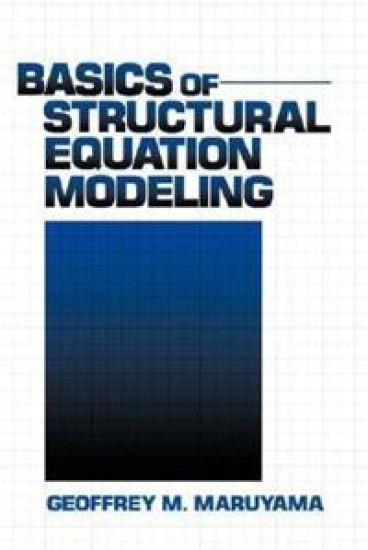
Basics of Structural Equation Modeling

Basics of Structural Equation Modeling

Geoffrey M. Maruyama

SAGE Publications Inc
1997
nidottu
With the availability of software programs such as LISREL, EQS, and AMOS modeling techniques have become a popular tool for formalized presentation of the hypothesized relationships underlying correlational research and for testing the plausibility of hypothesizing for a particular data set. The popularity of these techniques, however, has often led to misunderstandings of them, particularly by students being exposed to them for the first time. Through the use of careful narrative explanation, Basics of Structural Equation Modeling describes the logic underlying structural equation modeling (SEM) approaches, describes how SEM approaches relate to techniques like regression and factor analysis, analyzes the strengths and shortcomings of SEM as compared to alternative methodologies, and explores the various methodologies for analyzing structural equation data.