This is a collection of the key articles written by renowned Wittgenstein scholar, G.P. Baker, on Wittgenstein’s later philosophy, published posthumously. Following Baker’s death in 2002, the volume has been edited by collaborator and partner, Katherine Morris. Contains articles previously only available in other languages, and one previously unpublished paper. Completely distinct from the widely-known work Baker did with P.M.S. Hacker in the Analytical Commentary on the Philosophical Investigations (Blackwell Publishing, 1980-1996).
This is a collection of the key articles written by renowned Wittgenstein scholar, G.P. Baker, on Wittgenstein’s later philosophy, published posthumously. Following Baker’s death in 2002, the volume has been edited by collaborator and partner, Katherine Morris. Contains articles previously only available in other languages, and one previously unpublished paper. Completely distinct from the widely-known work Baker did with P.M.S. Hacker in the Analytical Commentary on the Philosophical Investigations (Blackwell Publishing, 1980-1996).
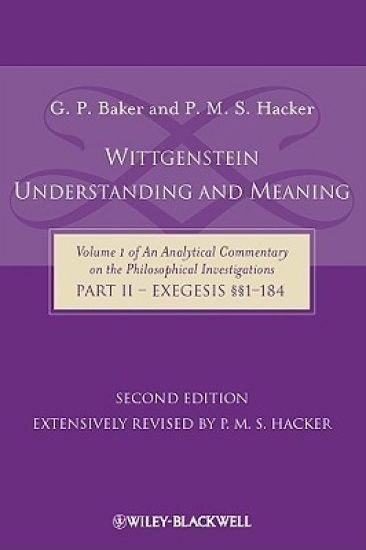
This is a much revised and extended new edition of Part I of the first volume of the monumental four-volume Analytical Commentary on the Philosophical Investigations. Takes into account much new material that was unavailable when the first edition was writtenFollowing Baker’s death in 2002, P.M.S. Hacker has rewritten many essays completelyPart I: Essays now includes two completely new essays: 'Meaning and Use' and 'The Recantation of a Metaphysician'; the essays: ‘The Augustinian Conception of Language’, ‘The Language-Game Method’, ‘Contextual Dicta and Contextual Principles’, ‘Philosophy’, ‘Surveyability and Surveyable Representations’, and ‘Truth and the General Propositional Form’ are redrafted and expanded, incorporating new source materials and new arguments, as well as taking into account debates of the last quarter of a centuryThe accompanying Part II: Exegesis §§1-184 - has been thoroughly revised in the light of the electronic publication of Wittgenstein’s Nachlass, and includes many new interpretations of the remarks, a history of the composition of the Philosophical Investigations and an overview of its structure.The revisions will ensure that this remains the definitive reference work on Wittgenstein’s masterpiece for the foreseeable future
This is a much revised and extended new edition of Part II of the first volume of the monumental four-volume Analytical Commentary on the Philosophical Investigations. Takes into account much new material that was unavailable when the first edition was writtenFollowing Baker’s death in 2002, P.M.S. Hacker has rewritten many sections of exegesis completelyPart II: Exegesis §§1-184 has been thoroughly revised in the light of the electronic publication of Wittgenstein’s Nachlass, and includes many new interpretations of the remarks, a history of the composition of the Philosophical Investigations and an overview of its structureThe accompanying Part I: Essays now includes two completely new essays: 'Meaning and Use' and 'The Recantation of a Metaphysician'; the essays: ‘The Augustinian Conception of Language’, ‘The Language-Game Method’, ‘Contextual Dicta and Contextual Principles’, ‘Philosophy’, ‘Surveyability and Surveyable Representations’, and ‘Truth and the General Propositional Form’ are redrafted and expanded, incorporating new source materials and new arguments, as well as taking into account debates of the last quarter of a centuryThe revisions will ensure that this remains the definitive reference work on Wittgenstein’s masterpiece for the foreseeable future
How does a human being degenerate into someone willingly perpetrating acts of exceptional violence upon others? How does Jesus Christ reach past the rejections and damage of this world to claim, transform, and repurpose such a human life? A life not only swept into the dustbin of incarceration, but one who did everything they could to get themself there?Rather than attempting to answer these questions from a scriptural or theological basis, I present to you the life story of Pastor Jose Luis Hernandez Roman, entitled 'From Psycho to Christ'.
This textbook is designed to help students and professionals understand the intimate connection between music and physics. The reader does not need prior background in music or physics, as the concepts necessary for understanding this connection are developed from scratch, using nothing more sophisticated than basic algebra which is reviewed for the reader. The focus is on connecting physics to the creation of music and its effect on humans. The reader will learn about the basic structure of music in relation to acoustics concepts, different musical instrument groups, how the room affects sound, and how sound travels from instruments to human ears to evoke an emotional reaction. Replete with exercises to hone students’ understanding, this book is ideal for a course on the physics of music and will appeal to STEM students as well as students, professionals, and enthusiasts in any field related to music and sound engineering.
Et liv i fisk handler ikke om hvordan man fanger fisk, men mere om hvorfor vi fanger dem: eventyr, oplevelser, fællesskaber, udfordringer, kammeratskaber, mental sundhed og tid til ro og fordybelse. Og ikke mindst muligheden for at få den friskeste, dejligste råvare med hjem til spisebordet. Der er inspiration til fiskeeventyr rundt omkring i Danmark – ved fjorde og kyster, på søer og på havet – såvel som en masse dejlige opskrifter der kan laves på fisketurene eller hjemme i køkkenet. Størstedelen af opskrifterne er Gordons, men flere af hans fiskekammerater, bl.a. kokkene Simon Jul, Thomas Rode og Francis Cardenau, byder også ind med deres lækkerier. Med Columbus Leths mange inspirerende og flotte fotos er bogen en hyldest til lystfiskerlivet og alt hvad det har at byde på – uanset om man er erfaren fisker eller nybegynder. Gordon P. Henriksen fangede sin første fisk som syvårig i Lake Butler i Florida. Siden da kan man roligt sige at hans liv er gået i fisk. Han er Danmarks mest kendte lystfisker, og hans selvstændige lystfiskerkarriere inkluderer et hav af radio-og tv-programmer, YouTube-serier, foredrag, events og artikler som har inspireret mange til at komme ud i den danske natur med en fiskestang i hånden.
Ha’ det for vildt handler om alle de oplevelser man kan have med et gevær, en fiskestang eller en køkkenkniv i hånden – i skoven, ved kysten eller på fjeldet. Den fortæller om hvordan vi får en tættere og mere meningsfuld forbindelse med naturen når vi fisker, jager og tilbereder de vilde råvarer. Og om hvordan man kan ha’ det for vildt samtidig med at man bliver klogere på sig selv. Ligesom Et liv i fisk, Gordons første bog, er kammeratskabet og fællesskabet i centrum. Det skinner igennem i Columbus Leths fantastiske fotos og i de lækre og inspirerende opskrifter hvor det handler om eventyr med kammeraterne og om at lave mad til familie og venner – nu også med vildt. Michelinkokken Christian F. Puglisi og smørrebrødskongen Adam Aamann bidrager med opskrifter inspireret af naturoplevelser de har haft med Gordon. Der er masser af inspiration at hente til nye jagtformer, fiskemetoder og ikke mindst tilberedning af fangsten og byttet for både nybegyndere og de mere erfarne jægere og fiskere. Gordon P. Henriksen er en af Danmarks mest erfarne formidlere af lystfiskeri og lever af at dele sin passion gennem foredrag, bøger, tv, radio, podcast, events og artikler. I 2019 fik han jagttegn, og siden har jagt og mad med vildt fyldt mere og mere i hans liv. Denne bog er et håndgribeligt bevis på at man sagtens kan blande sine passioner og inspirere andre til bare at ha’ det for vildt.
The process of making decisions is integral to life. We make decisions every day, from what to have for breakfast to critical issues of life and business. When two or more people are involved in making those decisions, the process often involves "compromise" and can be complicated by the basic give-and-take and trade-offs that are associated with this approach. Webster's New Twentieth Century Dictionary of the English Language defines compromise in this way: A settlement in which each side gives up some demands or makes concessions An adjustment of opposing principles, systems, etc., in which part of each is given up The result of such an adjustment or settlement Something midway between different things A laying open to danger, suspicion, or disrepute, as a compromise of one's good name, or; to surrender or give up (one's interest, principles, etc.) Compromise necessarily, then, leads to a result that has the great risk of being suboptimal because the concessions made can easily preclude consideration of alternatives and important viewpoints. One of the factors that those who promote compromise as a means of making decisions use as justification is that each side gives up something they want, and thus each side can "live with" the result. In reality, neither side will give up something critically important to them while expecting the other to do just that. The end result is often that either no decision or agreement can be reached or one or both of the parties is unhappy with the result. Too frequently, the ultimate result is failure because one or both parties do not fully support the agreement, which becomes more likely if one party feels it gave more than the other or had to give up something related to its principles or best interest. In an increasingly complex world, compromise is not the best way to reach decisions. An approach that fully and objectively examines all points of view and ideas is needed to arrive at workable solutions to problems and issues as diverse as those we see in the world today. Anyone who has worked inside any company, large or small, knows that it is often very challenging to make decisions. Different personalities, diverse interactions, company politics, and even social, political, and economic philosophies present barriers to agreement. Add to that the basic competitive nature of human beings and the result can be a bubbling stewpot of rancor, foxhole-digging, foot-dragging, backbiting, criticism, individual conflict, and an attitude of an "I win, you lose" zero-sum game that leads to, at best, nonoptimal decisions and at worst, paralysis and no decisions at all. This description applies to virtually any type of organization, not just the corporate setting. It can be seen in organizations, nonprofits, politics, families, churches, schools, and any other setting in which a group of people, whether it be two or many, must meet and make decisions on any topic. All of us have seen the results of committee deliberations aimed at making decisions in a number of these seemingly different settings. Quite often, when we watch the process, we understand the saying that "A committee is a cul-de-sac down which ideas are lured and then quietly strangled." The three authors have worked in a variety of different companies and noncorporate settings, including small local companies (fewer than 10 employees) to very large multinational corporations; they have been a part of boards of directors and trustees of nonprofits, school and church groups, neighborhood organizations, and others. They have all had the (mis)fortune of serving on committees charged with making decisions ranging from purchasing equipment to basic corporate strategy for international product development.