

Kirjahaku
Etsi kirjoja tekijän nimen, kirjan nimen tai ISBN:n perusteella.
1000 tulosta hakusanalla Graham Clark
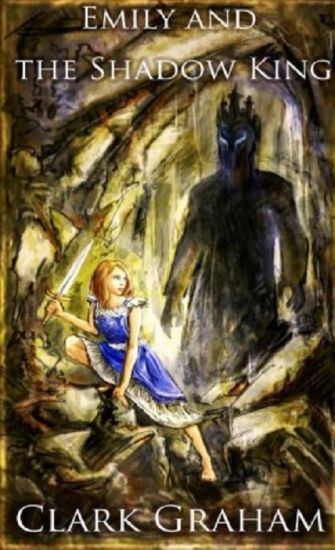
Fire and FearEmily finds herself alone as she watches the evil men burn down her home. Her parents have been taken and she is having to escape from the enemy that is chasing her. In he stuggle to find her family she gets captured by Dwarves, encounters monstrous sounding beasts in the forest and has to cross into hostile lands.Then she must go against the Shadow King. Follow Emily's quest to reunite with her loved ones.
Jason dreams every night that he is transported to a dark and foreboding land where evil prevails and good struggles. It is a land of swords and sorcery, with castles and roaming monsters.Each night the dream is just of continuation of the last. Jason can keep it to himself until he gets hurt in the dream world and wakes up bleeding His teachers worry that he is being abused by the parents, the parents think he is sleep walking and getting hurt and his school counselor is just trying to get to the bottom of it.Meanwhile Jason must deal with an evil king that wants him dead, monsters attacking him and a massive wall of ice that he must scale. Will Jason find someone that will believe him before it is too late?
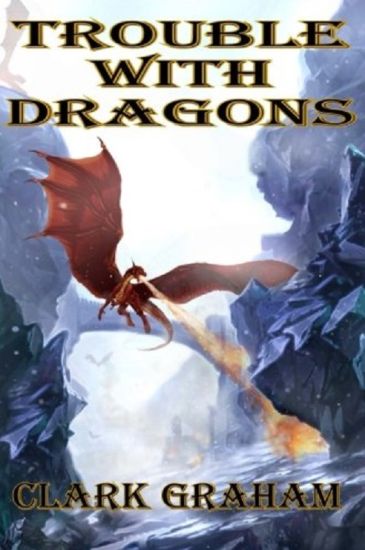
Jason stood in front of the gravestone of Coach Mossberg. The coach had been a mentor and protector to him. His sudden loss effected the whole community. Chills went down Jason's spine. It was an eerie feeling, like someone was looking at him.A voice from behind him said, "He's not here you know."Jason turned to see a short, straight backed man standing there."Talcott? Is that you? What are you doing here?""I've come to bring you back."Jason shook his head vigorously. "I don't want to go back."The wizard's face reddened and his eyes flashed with anger. "You are the hero of the land, and the land needs you. You have no choice."Jason stepped back. He hadn't wanted to upset Talcott. He was just speaking the truth.Taking a deep breath, Talcott relaxed his shoulders. "There are dragons in the land. Coach Mossberg tried to help, but he's been captured by them and now sits behind bars in the dungeon. The evil king is free and sits again on the throne.""What happened, I thought the coach was dead?""He is very much alive, but you need to save him and slay the dragons.""Dragons?" Jason's thought his heart would burst out of his chest it was beating so hard."Fear not, you are the hero. The slayer of the Osgarth.""I'm just a high school kid."Talcott heaved a large sigh. "I thought you might come willingly this time. It matters not, you will still come." Then he turned and walked away, leaving Jason alone.Dejected, Jason walked home. I can't kill dragons. What am I going to do?
Weave Room Calculations, a Practical Treatise of Cotton Yarn and Cloth Calculations for the Weave Room, Especially Applicable to Southern Mills
W. A. Graham (William Alexande Clark
Hassell Street Press
2021
sidottu
Weave Room Calculations, a Practical Treatise of Cotton Yarn and Cloth Calculations for the Weave Room, Especially Applicable to Southern Mills
W. A. Graham (William Alexande Clark
Hassell Street Press
2021
nidottu

Though it is 50 years since he gained his two Formula 1 World Championship titles, the interest in Jim Clark has not waned. The Scotsman is still regarded as one of the best Grand Prix drivers ever. In the 1960s, Clark and his mentor, Colin Chapman, conquered the very pinnacles of single-seater racing with Clark winning the F1 World Championship twice and the Indy 500 once. All in all, he claimed more than one hundred victories at the wheel of a Lotus. This 400-page book from McKlein does not just tell the story of Clark's extraordinary racing career, it also portrays his personal life from A to Z. Author Graham Gauld followed the career of the Scotsman right from its very beginning. He has fi lled the roles of friend, photographer and reporter, and thus spent innumerable hours with Clark. This lavishly illustrated book contains many rare images from various well-known archives thus helping to complete an intimate portrait of a true sporting champion.
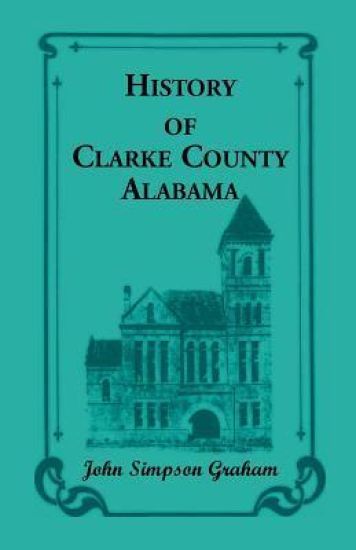
By: John S. Graham, Pub. 1923, Reprinted 2015, 354 pages, New Index, Soft Cover, ISBN #0-89308-693-2.Clarke County is located between the Alabama and Tombigbee Rivers and was initially carved from Washington County in 1812. When Alabama became a Territory in 1817, Clark County was substantially enlarged. This history is similar to most county histories done in this time period in that it covers all the usual topics such as education, newspapers, population, Indian skirmishes, mineral wealth, schools and community leaders. It is especially rich in biographical sketches and has various lists of soldiers including the war records on many men living in the community who had served in the Confederate Army during the Civil War. It is filled with biographical sketches of individuals with detailed genealogies on many of the early pioneer families of the county such as: Adams, Anderson, Ball, Barnes, Bedsole, Bolen, Boroughs, Boyles, Caller, Carlton, Chapman, Davis, Frazier, Garrett, Gillis, Graham, Grant, Gross, Hicks, Jones, Johnson, Kimbell, Kimbrough, Langford, Mathews, McDuffie, McGowan, McLeod, Murphy, Newman, Nichols, Pugh, Rivers, Savage, Stewart, Taylor, Tucker, Turner, Wilson, Wing, and the mention of vast numbers of other pioneer settlers.
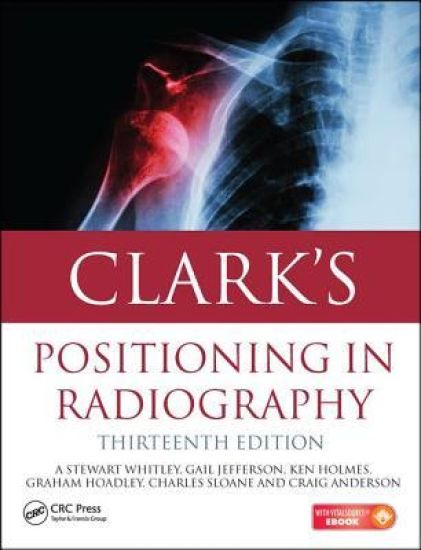
Clark's Positioning in Radiography 13E
A. Stewart Whitley; Gail Jefferson; Ken Holmes; Charles Sloane; Craig Anderson; Graham Hoadley
Routledge
2015
sidottu
First published in 1939, Clark’s Positioning in Radiography is the preeminent text on positioning technique for diagnostic radiographers.Whilst retaining the clear and easy-to-follow structure of the previous edition, the thirteenth edition includes a number of changes and innovations in radiographic technique. The text has been extensively updated, including a new section on evaluating images, The 10-point plan, which is linked throughout to a listing of Essential image characteristics for each procedure. The section on digital imaging has been expanded not only to elaborate more extensively on the technology but to demonstrate its various clinical applications.New sections also include imaging informatics and its role in the modern world of medical imaging, holistic approaches to patient care and discussion of the important aspect of the patient journey.Students will also benefit from more detailed reference to positioning errors and how to avoid mistakes, as well as a greater emphasis on standard radiation protection measures and guidance on the most recent radiation dose reference levels for specific examinations.Clark’s Positioning in Radiography continues to be the definitive work on radiographic technique for all students on radiography courses, radiographers in practice and trainee radiologists.
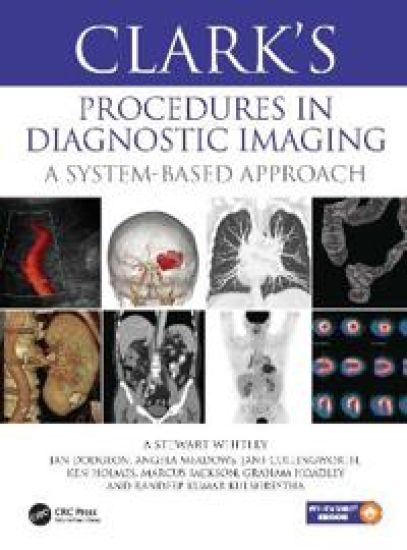
Clark’s Procedures in Diagnostic Imaging
A Stewart Whitley; Jan Dodgeon; Angela Meadows; Jane Cullingworth; Ken Holmes; Marcus Jackson; Graham Hoadley; Randeep Kulshrestha
Routledge
2020
sidottu
Bringing together conventional contrast media studies, computed tomography, ultrasound, magnetic resonance imaging, radionuclide imaging including hybrid imaging using SPECT-CT and PET-CT, DXA studies and digital interventional procedures into one volume, this definitive book is the essential source of information on the use and application of these imaging modalities in radiography. Taking a systemic anatomical approach, carefully designed to be clear and consistent throughout and mirroring that in the popular and established textbook Clark’s Positioning in Radiography, each chapter is highly illustrated and contains sections detailing anatomy, pathologic considerations, procedure methodology, and an evaluation of recommended imaging modalities.Reflecting the latest clinical imaging pathways and referral guidelines including IR(ME)R 2017, the Map of Medicine and RCR iRefer (8E), Clark’s Diagnostic Imaging Procedures will quickly become established as the standard textbook for students of radiography and radiographer assistant trainees and an invaluable desk reference for practising radiologists.
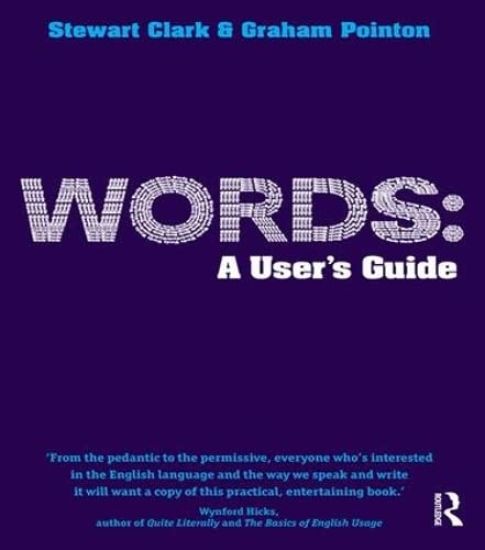
Words: A User's Guide is an accessible and invaluable reference that is ideal for students, business people and advanced learners of English. The book is structured in groups of words that may be confused because they sound alike, look alike or seem to have similar meanings, and this approach makes it much more intuitive and easy to use than a dictionary.Contrasting over 5000 words (such as habitable and inhabitable, precipitation and rainfall, reigns and reins), Words: a User’s Guide provides examples of usage adapted from large national databases of contemporary English, and illustrates each headword in typical contexts and phrases.This book gives you straightforward answers, and helps with pronunciation, spelling, style and levels of formality. For those working internationally it presents international standards and compares usage in Britain and the USA. Words: A User’s Guide is an excellent resource for anyone who wants to communicate well in written and spoken English. "At last! A book about the use of words that clarifies and de-mystifies in an eminently usable way. I would recommend it to anyone who wants to write well. It is a book to keep."Sandy Gilkes, Head of the Centre for Academic Practice, University of Northampton"Rigorous, fresh, intriguing and downright useful, it deserves a place on every properly stocked reference shelf." Brian Cathcart, Professor of Journalism, Kingston University "From the pedantic to the permissive, everyone who’s interested in the English language and the way we speak and write it will want a copy of this practical, entertaining book."Wynford Hicks(author of Quite Literally and The Basics of English Usage)
The Routledge Student Guide to English Usage is an invaluable A–Z guide to the appropriate use of English in academic contexts.The first part of the book covers approximately 4000 carefully selected words, focusing on groups of confusable words that sound alike, look alike or are frequently mixed up. The authors help to solve academic dilemmas, such as correct usage of the apostrophe and the crucial difference between infer and imply. Examples of good usage are drawn from corpora such as the British National Corpus and the Corpus of Contemporary American English.The second part covers the key characteristics of formal English in a substantial reference section, comprising:• stylistic features• punctuation• English grammar• the use of numbers• email writing.This is the essential reference text for all students working on improving their academic writing skills. Visit the companion website for a range of supporting exercises: www.routledge.com/cw/clark.