Kirjojen hintavertailu. Mukana 12 083 983 kirjaa ja 12 kauppaa.

Kirjahaku

Etsi kirjoja tekijän nimen, kirjan nimen tai ISBN:n perusteella.

1000 tulosta hakusanalla Gregory Lang

Language and Logics

Language and Logics

Howard Gregory

Edinburgh University Press
2015
sidottu
Taking linguistics students beyond the classical forms often taught in introductory courses, Language and Logics offers a comprehensive introduction to the wide variety of useful non-classical logics that are commonly used in research. Including a brief review of classical logic and its major assumptions, this textbook provides a guided tour of modal, many valued and substructural logics. The textbook starts from simple and intuitive concepts, clearly explaining the logics of language for linguistics students who have little previous knowledge of logic or mathematics. Issues are presented and discussed clearly before going on to introduce symbolic notation.While not avoiding technical detail, the book focuses throughout on helping students develop an intuitive understanding of the field, with particular attention to conceptual questions and to the tailoring of logical systems to thinking about different applications in linguistics and beyond. This is an ideal introductory volume for advanced undergraduates and beginning postgraduate students in linguistics, and for those specializing in semantics.
Language and Logics

Language and Logics

Howard Gregory

Edinburgh University Press
2015
nidottu
This is a non specialist introduction to substructural logic. This book will take linguistics students beyond the classical logic used in introductory courses into the variety of non standard logics that are commonly used in research. It embraces a wide variety of material, including modal logic, partial logic, situation semantics and the growing area of the substructural logics, starting with simple and intuitive concepts. Prior knowledge of mathematical logic is not required as issues are introduced and discussed in clear and precise English before symbolic notation is introduced. The variety of material is organised around one central thread: the tailoring of logical systems to reasoning about different applications in linguistics and beyond. It does not presuppose any background in logic or mathematics. It is flexible enough to be used for several possible courses. It's self contained: introductory sections give a good grounding in the prerequisites of the course. It also includes suggestions for discussion aimed at more advanced students.
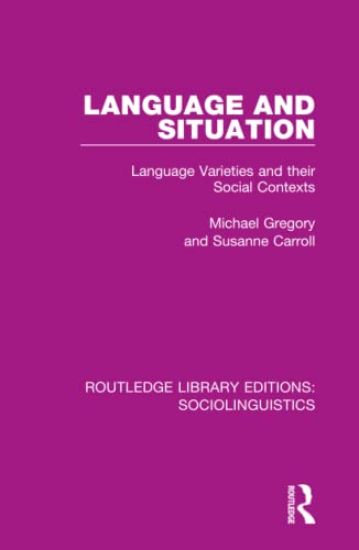
Language and Situation

Language and Situation

Michael Gregory; Susanne Carroll

Routledge
2018
sidottu
Originally published in 1978. This book provides and explains a framework for understanding and describing variations of style of language in relation to the social context in which it is used. Constant features of language users, such as their temporal, geographical. and social origins, their range of intelligibility, and their individualities, are related to concepts of dialects, but dialects are not the only kind of language variety. There are features of language situations that yield others; the medium used, the roles of the users and their relationships, as well as recurring situations and cultural habits, all relate to the style employed. Variety in language can be seen in terms of the major functions of language, as 'content' as 'inter-action' and as 'texture'. Studying variety in language from sociological and linguistic aspects this book is also interesting for psycholinguistics and literary study.
Language and Situation

Language and Situation

Michael Gregory; Susanne Carroll

Routledge
2020
nidottu
Originally published in 1978. This book provides and explains a framework for understanding and describing variations of style of language in relation to the social context in which it is used. Constant features of language users, such as their temporal, geographical. and social origins, their range of intelligibility, and their individualities, are related to concepts of dialects, but dialects are not the only kind of language variety. There are features of language situations that yield others; the medium used, the roles of the users and their relationships, as well as recurring situations and cultural habits, all relate to the style employed. Variety in language can be seen in terms of the major functions of language, as 'content' as 'inter-action' and as 'texture'. Studying variety in language from sociological and linguistic aspects this book is also interesting for psycholinguistics and literary study.
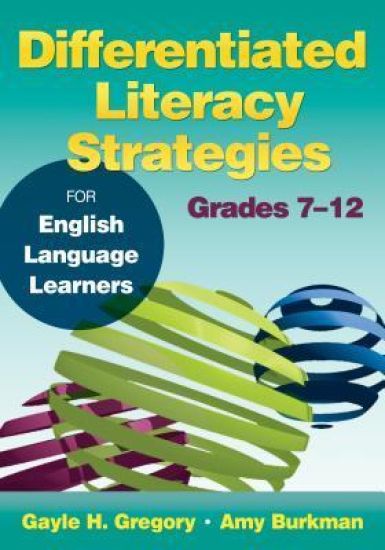
Differentiated Literacy Strategies for English Language Learners, Grades 7–12

Differentiated Literacy Strategies for English Language Learners, Grades 7–12

Gregory Gayle H.; Burkman Amy J.

SAGE Publications Inc
2011
nidottu
This book is an adaptation of Gregory's bestselling book Differentiated Literacy Strategies for Student Growth and Achievement in Grades 7-12, revised'' to address the specific needs of English Language Learners. This is a ''versatile handbook for middle school and high school educators who need ''to differentiate literacy instruction for adolescent and teen ELL ''students at different stages of development along the literacy ''continuum. Covering the relevant brain research and specific ''instructional and assessment strategies for teens, this book pays ''special attention to hooks that appeal to older learners with varying ''degrees of skills and competencies. Written for classroom teachers, ''reading specialists, curriculum developers, and instructional leaders, ''this one-stop source provides an expert guide to working with all of ''today's adolescent and teen English Language Learners.
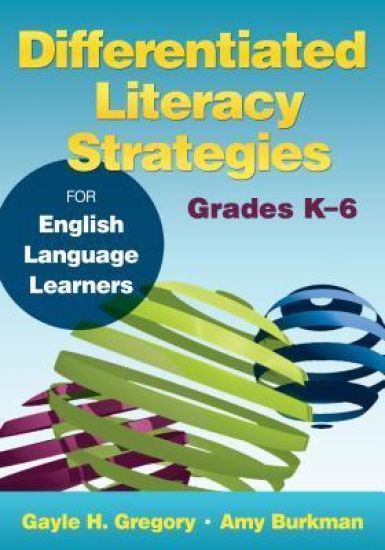
Differentiated Literacy Strategies for English Language Learners, Grades K–6

Differentiated Literacy Strategies for English Language Learners, Grades K–6

Gregory Gayle H.; Burkman Amy J.

SAGE Publications Inc
2011
nidottu
This is a versatile handbook for elementary educators who need to differentiate literacy instruction for ELL students. This resource gives teachers an instructional and assessment framework designed to promote the multiple competencies their learners need: functional literacy for phonics, spelling, and reading; content-area literacy for vocabulary, concept attainment, and comprehension; technological literacy for information searching, evaluation, and synthesis; and innovative literacy for creativity, growth, and life-long learning. With more than 100 planning models, matrixes, rubrics, and checklists included, this book is the ideal resource for all elementary teachers who want to close the achievement gap for emerging learners and insure the growth and development of ELL students.
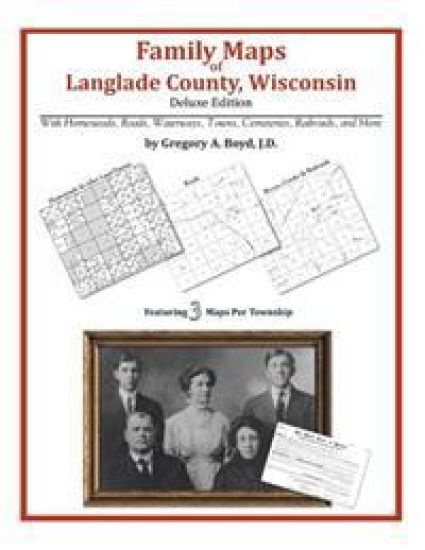
Family Maps of Langlade County, Wisconsin

Family Maps of Langlade County, Wisconsin

Gregory a. Boyd J. D.

Arphax Publishing Co.
2014
nidottu
300 pages with 74 total maps Locating original landowners in maps has never been an easy task-until now. This volume in the Family Maps series contains newly created maps of original landowners (patent maps) in what is now Langlade County, Wisconsin, gleaned from the indexes of the U.S. Bureau of Land Management. But it offers much more than that. For each township in the county, there are two additional maps accompanying the patent map: a road map and a map showing waterways, railroads, and both modern and many historical city-centers and cemeteries. Included are indexes to help you locate what you are looking for, whether you know a person's name, a last name, a place-name, or a cemetery. The combination of maps and indexes are designed to aid researchers of American history or genealogy to explore frontier neighborhoods, examine family migrations, locate hard-to-find cemeteries and towns, as well as locate land based on legal descriptions found in old documents or deeds. The patent-maps are essentially plat maps but instead of depicting owners for a particular year, these maps show original landowners, no matter when the transfer from the federal government was completed. Dates of patents typically begin near the time of statehood and run into the early 1900s. What's Mapped in this book (that you'll not likely find elsewhere) . . . 3289 Parcels of Land (with original landowner names and patent-dates labeled in the relevant map) 20 Cemeteries plus . . . Roads, and existing Rivers, Creeks, Streams, Railroads, and Small-towns (including some historical), etc. What YEARS are these maps for? Here are the counts for parcels of land mapped, by the decade in which the corresponding land patents were issued: DecadeParcel-count 1850s2 1860s200 1870s904 1880s1768 1890s270 1900s130 1910s13 1920s1 What Cities and Towns are in Langlade County, Wisconsin (and in this book)? Antigo, Bavaria, Bryant, Choate, Deerbrook, Elcho, Elmhurst, Elton, Four Corners, Freeman, Hollister, Kempster, Koepenick, Langlade, Lily, Markton, Neva, Neva Corners, Ormsby, Parrish, Pearson, Phlox, Pickerel, Polar, Post Lake, Sherry Junction, Summit Lake, White Lake
C++ A Core Language

C++ A Core Language

Gregory Satir

O'Reilly Media, Inc, USA
1995
nidottu
A first book for C programmers transitioning to C++, an object-oriented enhancement of the C programming language. Designed to get readers up to speed quickly, this book thoroughly explains the important concepts and features and gives brief overviews of the rest of the language. It covers features common to all C++ compilers, including those on UNIX, WIndows, NT, DOS and Macs.
The Knights Hospitaller of the English Langue 1460-1565

The Knights Hospitaller of the English Langue 1460-1565

Gregory O'Malley

Oxford University Press
2005
sidottu
The Knights of St John of Jerusalem, also known as the Hospitallers, were a military religious order, subject to monastic vows and discipline but devoted to the active defence of the Holy Land. After evacuating the Holy Land at the beginning of the fourteenth century, they occupied Rhodes, which they held into the sixteenth century, when their headquarters moved to Malta. Branches of the order existed throughout Europe, and it is the English branch in the fifteenth and sixteenth centuries that is examined here. Among the major subjects researched by O'Malley are the recruitment of members of the Hospital and their family ties; the operation of the order's career structure; the administration of its estates; its provision of spiritual and charitable services; and the publicity and logistical support it provided for the holy war carried on by its headquarters against the Ottoman Turks. It is argued that the English Hospitallers in particular took their military and financial duties to the order very seriously, making a major contribution to the Hospital's operations in the Mediterranean as a result. They were able to do so because they were wealthy, had close family and other ties with gentle and mercantile society, and above all because their activities had royal support. Where this was lacking or ineffective, as in Ireland, the Hospital might become the plaything of local interests eager to exploit its estates, and its wider functions might be neglected. Consequently the heart of the book lies in an extended discussion of the relationship between senior Hospitaller officers and the governing authorities of Britain and Ireland. It is concluded that rulers were generally supportive of the order's activities, but within strict limits, particularly in matters concerning appointments, the size of payments to the east, and the movement and foreign allegiances of senior brethren. When these limits were breached, or at times of political or religious sensitivity such as the 1460s and 1530s, the Hospital's personnel and estates would suffer. In addition, more general areas of historical debate are illuminated such as those concerning the relationship between late medieval societies and the religious orders; 'British' attitudes to Christendom and holy war, and the rights of rulers over their subjects. This is the first such book to be based on archival records in both Britain and Malta, and will make a major contribution to understanding the order's European network, its place in the ordering of Latin Christendom, and in particular its role in late medieval British and Irish society.
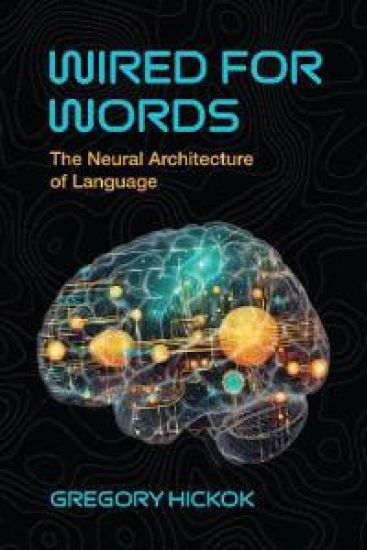
Wired for Words: The Neural Architecture of Language
A critical synthesis of over 150 years of research on the brain's networks that enable us to communicate through language. The neural architecture of language has been a hotly debated topic in neurology, cognitive neuroscience, linguistics, and philosophy since the early 1800s. Is language separable from intelligence? Is it enabled by dedicated and localizable neural networks? Do we speak and understand with our left hemisphere? How did language emerge? Is language grounded in sensorimotor systems, or is it abstract and amodal? Will we ever have a clear picture of how syntax, the pinnacle of human linguistic prowess, is organized neurologically? Wired for Words answers these questions and more. Gregory Hickok tells the stories behind the big ideas, revealing the source of both modern progress and persistent myths. Drawing on decades of research using tools and insights from neurology, functional imaging, neurosurgery, linguistics, psychology, and engineering, Hickok builds a new understanding of the neural architecture--the components and connection patterns--of the brain's language system from sound to meaning to speech.
Ernst Cassirer and the Autonomy of Language

Ernst Cassirer and the Autonomy of Language

Gregory S. Moss

Lexington Books
2014
sidottu
Ernst Cassirer and the Autonomy of Language examines the central arguments in Cassirer’s first volume of the Philosophy of Symbolic Forms. Gregory Moss demonstrates both how Cassirer defends language as an autonomous cultural form and how he borrows the concept of the “concrete universal” from G. W. F. Hegel in order to develop a concept of cultural autonomy. While Cassirer rejected elements of Hegel’s methodology in order to preserve the autonomy of language, he also found it necessary to incorporate elements of Hegel’s method to save the Kantian paradigm from the pitfalls of skepticism. Moss advocates for the continuing relevance of Cassirer’s work on language by situating it within in the context of contemporary linguistics and contemporary philosophy. This book provides a new program for investigating Cassirer’s work on the other forms of cultural symbolism in his Philosophy of Symbolic Forms, by showing how the autonomy of culture is one of the leading questions motivating Cassirer’s philosophy of culture. With a thorough comparison of Cassirer’s theory of symbolism to other dominant theories from the twentieth century, including Heidegger and Wittgenstein, this book provides valuable insight for studies in philosophy of language, semiotics, epistemology, pyscholinguistics, continental philosophy, Neo-Kantian philosophy, and German idealism.
Appleton & Lange Outline Review: Clinical Chemistry

Appleton & Lange Outline Review: Clinical Chemistry

Robert Christenson; Linda Gregory; Lisa Johnson

McGraw-Hill Medical
2001
nidottu
Publisher's Note: Products purchased from Third Partysellers are not guaranteed by the publisher for quality, authenticity, oraccess to any online entitlements included with the product.A comprehensive overview of clinical chemistry in straightforward, high yield fact formatThis is the first book in a series that serves the dual purpose of preparing students of CLS programs for certification exams and giving cross training skills to established clinical lab scientists who now find themselves called on to work in other areas of the lab. This book uses a building block approach to convey the material in a logical fashion. Starting with an overview of medicine and the medical laboratory's relationship, the text proceeds to the diagnostic value of those analytes normally associated with clinical chemistry, on to technologies of analysis, quality assurance, and statistical analysis of laboratory data. A&L Outline Review of Clinical Chemistry makes it easy to optimize your study sessions and use your time efficiently, and helps you quickly locate key concepts. This PREP guide provides pretests to help you identify areas for extra attention,and gives you what you need to know in an easy-to-remember format, packed with study-enhancing devices such as illustrations and learning objectives.
Learning to Read in a New Language

Learning to Read in a New Language

Eve Gregory

SAGE Publications Inc
2008
sidottu
'[This book] is a helpful edition to a field where there is a limited amount of good literature to support teachers dealing with second language acquisition in the classroom' - ESCalate `Gregory's book is an important and timely contribution to the literature on literacy, biliteracy, second language learning and early childhood education, synthesizing cutting-edge research, perspectives and teaching approaches in a clear and accessible way. Overall, it is a terrific resource' - Dinah Volk Across the world, an increasing number of young children are learning to read in languages different from their mother tongue, and there is a clear need for a book which addresses the ways in which these children should be taught. Eve Gregory's book is unique in doing so. Building upon the ideas proposed in Making Sense of a New World, this second edition widens its scope, arguing for the limitations of policies designed for 'monolingual minds' in favour of methodologies which put plurilingualism at the centre of literacy tuition. This book offers a practical reading programme -- an 'Inside-Out' (starting from experience) and 'Outside-In' (starting from literature) approach to teaching which can be used with individuals, small groups and whole classes. It uses current sociocultural theory, while drawing on examples of children from America, Australia, Britain, China, France, Singapore, South Africa and Thailand who are engaged in learning to read nursery rhymes and songs, storybooks, letters, the Bible and the Qur'an as well as school texts, in languages they do not speak fluently. Gregory argues that, in order for literacy tuition to be successful, reading must make sense -- children must feel part of a community of readers. There is no common method which they use to learn, but rather a shared aim to which they aspire: making sense of a new world through new words. Eve Gregory is Professor of Language and Culture in Education at Goldsmiths, University of London.
Learning to Read in a New Language

Learning to Read in a New Language

Eve Gregory

SAGE Publications Inc
2008
nidottu
'[This book] is a helpful edition to a field where there is a limited amount of good literature to support teachers dealing with second language acquisition in the classroom' - ESCalate `Gregory's book is an important and timely contribution to the literature on literacy, biliteracy, second language learning and early childhood education, synthesizing cutting-edge research, perspectives and teaching approaches in a clear and accessible way. Overall, it is a terrific resource' - Dinah Volk Across the world, an increasing number of young children are learning to read in languages different from their mother tongue, and there is a clear need for a book which addresses the ways in which these children should be taught. Eve Gregory's book is unique in doing so. Building upon the ideas proposed in Making Sense of a New World, this second edition widens its scope, arguing for the limitations of policies designed for 'monolingual minds' in favour of methodologies which put plurilingualism at the centre of literacy tuition. This book offers a practical reading programme -- an 'Inside-Out' (starting from experience) and 'Outside-In' (starting from literature) approach to teaching which can be used with individuals, small groups and whole classes. It uses current sociocultural theory, while drawing on examples of children from America, Australia, Britain, China, France, Singapore, South Africa and Thailand who are engaged in learning to read nursery rhymes and songs, storybooks, letters, the Bible and the Qur'an as well as school texts, in languages they do not speak fluently. Gregory argues that, in order for literacy tuition to be successful, reading must make sense -- children must feel part of a community of readers. There is no common method which they use to learn, but rather a shared aim to which they aspire: making sense of a new world through new words. Eve Gregory is Professor of Language and Culture in Education at Goldsmiths, University of London.
Heidegger's Path to Language

Heidegger's Path to Language

Wanda Torres Gregory

Lexington Books
2016
sidottu
With the recent publication of works from Heidegger’s Collected Edition, it has become evident that language occupied a central place in his thought “from early on,” as he claimed in his later years. Heidegger’s Path to Language takes on the timely task of guiding us through the development of his reflections on language from his younger years as a doctoral student to the later period of being-historical thinking. Wanda Torres Gregory argues that Heidegger continually pursued the question concerning the essence of language in what he later called his “background” discussions. She proposes that the clue lies in his often implicit use of Aristotle’s definition of logos—in terms of apophansis, synthesis, and phone—as the guideword for his thoughts on language. Torres Gregory uncovers three different stages of this buried path of logos that she correlates with his key philosophical principles at each step: the ideal of a pure logic, the existential analytic in the project of fundamental ontology, and the meditations on the appropriating-event. Her analysis of the constants and changes in Heidegger’s way to language via logos continues with a systematic comparison of his different answers to age-old philosophical problems concerning how language relates to reality, thought, meaning, and truth. Torres Gregory concludes with a critique that unveils the later Heidegger’s dogmas and inconsistencies and challenges his concept of the mysterious language of Er-eignis with an alternative (bio-linguistic) model of its appropriating force. Heidegger’s Path to Language contributes to the scholarship in Heidegger, continental philosophy, philosophy of language, comparative literature, German studies, and linguistics. It is intended primarily for specialists in those fields and will thus be of interest mainly to college professors and graduate students.
Heidegger's Path to Language

Heidegger's Path to Language

Wanda Torres Gregory

Lexington Books
2018
nidottu
With the recent publication of works from Heidegger’s Collected Edition, it has become evident that language occupied a central place in his thought “from early on,” as he claimed in his later years. Heidegger’s Path to Language takes on the timely task of guiding us through the development of his reflections on language from his younger years as a doctoral student to the later period of being-historical thinking. Wanda Torres Gregory argues that Heidegger continually pursued the question concerning the essence of language in what he later called his “background” discussions. She proposes that the clue lies in his often-implicit use of Aristotle’s definition of logos in terms of apophansis, synthesis, and phone as the guideword for his thoughts on language. Torres Gregory uncovers three different stages of this buried path of logos that she correlates with his key philosophical principles at each step: the ideal of a pure logic, the existential analytic in the project of fundamental ontology, and the meditations on the appropriating-event. Her analysis of the constants and changes in Heidegger’s way to language via logos continues with a systematic comparison of his different answers to age-old philosophical problems concerning how language relates to reality, thought, meaning, and truth. Torres Gregory concludes with a critique that unveils the later Heidegger’s dogmas and inconsistencies and challenges his concept of the mysterious language of Er-eignis with an alternative (bio-linguistic) model of its appropriating force. Heidegger’s Path to Language contributes to the scholarship in Heidegger, continental philosophy, philosophy of language, comparative literature, German studies, and linguistics. It is intended primarily for specialists in those fields and will thus be of interest mainly to college professors and graduate students.
How to Co-Create Using the Secret Language of the Universe
Do you ever wonder what your purpose is and why you are here? This book looks at the most mysterious and deepest part of your astrological birthchart that is connected to your soul's journey and its purpose in your life. It is a part of you that may be hard to articulate, but acts as an undertow to pull you towards growth and fulfillment. However if you're not aware of this deep insight as to who you really are, you can override its message and never really feel satisfied in your life. This book will take you through the simple steps of downloading your own unique birthchart free from my website (you need to know your birthtime for this), then identifying your own `secret purpose', and the practical steps you can take to achieve that understanding. Even if you currently know nothing about astrology, this book will take you on a very special journey.