
Kirjahaku
Etsi kirjoja tekijän nimen, kirjan nimen tai ISBN:n perusteella.
1000 tulosta hakusanalla Hamid Yusof
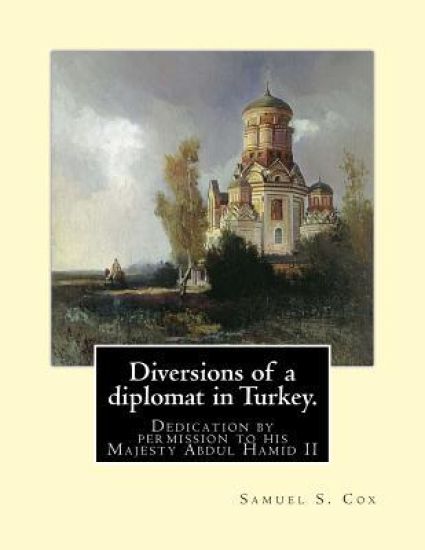
Diversions of a diplomat in Turkey. By: Samuel S. Cox (illustrated): Dedication by permission to his Majesty Abdul Hamid II ( 21 September 1842 - 10 F
Abdul Hamid II; Samuel S. Cox
Createspace Independent Publishing Platform
2016
nidottu
Samuel Sullivan "Sunset" Cox (September 30, 1824, Zanesville, Ohio - September 10, 1889, New York City) was an American Congressman and diplomat. He represented both Ohio and New York in the United States House of Representatives, and also served as United States Ambassador to the Ottoman Empire.Cox was the grandson of New Jersey Congressman James Cox. He was named for his maternal grandfather, Samuel Sullivan, who was Ohio State Treasurer in 1820-1823. 1] Cox attended Ohio University and Brown University, graduating from Brown in 1846. He practiced law in Zanesville and became the owner and editor of the Ohio Statesman, a newspaper in Columbus, Ohio. In 1855, he was secretary of the U.S. legation to Peru. Cox was elected to Congress as a Democrat in 1856, and served three terms representing Ohio's 12th congressional district and one representing the 7th district. After giving an impassioned speech in 1864 denouncing Republicans for allegedly supporting miscegenation (see miscegenation hoax), he was defeated for reelection and moved to New York City, where he resumed law practice. "As slavery was already dead by the bullet, I figured it would be better to stop the bloodshed," he told a crowd seven years later. That mattered more than "there mere empty, abstract ceremonial of burying the dead corpse of slavery." He returned to Congress after winning election in 1868 to New York's 6th congressional district. He served two terms, was defeated by Lyman Tremain in the New York state election, 1872, running for Congress at-large on the state ticket, but was elected to the vacant Congressional seat of the late James Brooks in 1873. Cox was then re-elected six times. In May 1885, Cox resigned his Congressional seat to accept appointment by President Grover Cleveland as U.S. Ambassador to the Ottoman Empire, succeeding Lew Wallace. After serving for a year as Ambassador, he ran for Congress yet again, in a special election to fill the term of Joseph Pulitzer, who had resigned his seat; Cox was once again elected and served from the lower west side of Manhattan until his death on September 10, 1889. During his last term, he was chairman of the House Democratic Caucus..... Abdul Hamid II (21 September 1842 - 10 February 1918) was the 34th Sultan of the Ottoman Empire and the last Sultan to exert effective autocratic control over the fracturing state.He oversaw a period of decline in the power and extent of the Ottoman Empire, including widespread pogroms and government-sanctioned massacres of Armenians and Bulgarians, as well as an assassination attempt, ruling from 31 August 1876 until he was deposed shortly after the 1908 Young Turk Revolution, on 27 April 1909. In accordance with an agreement made with the republican Young Ottomans, he promulgated the first Ottoman constitution of 1876 on 23 December 1876, which was a sign of progressive thinking that marked his early rule. Soon, however, he claimed Western influence on Ottoman affairs and citing disagreements with Parliament, 4] Abdul Hamid suspended both the short-lived constitution and Parliament in 1878 and seized absolute power, ending the first constitutional era of the Ottoman Empire. Abdul Hamid's 1909 removal from the throne was hailed by most Ottoman citizens, who welcomed the return to constitutional rule after three decad

Nasr Hamid Abu Zayd on Tafsir, Ta'wil, Quranic Hermeneutic Discourses
Ferry Muhammadsyah Siregar
LAP Lambert Academic Publishing
2011
pokkari

Abdul Hamid II
VDM Publishing House
2010
nidottu
Observera att förlaget som ger ut denna produkt baserar innehållet i sina produkter på fria källor som Wikipedia. Boken är med stor sannolikhet endast ett utdrag ur dessa informationskällor, alltså inte en vanlig bok i den bemärkelsen.

Zaid Hamid
VDM Publishing House
2010
nidottu
Observera att förlaget som ger ut denna produkt baserar innehållet i sina produkter på fria källor som Wikipedia. Boken är med stor sannolikhet endast ett utdrag ur dessa informationskällor, alltså inte en vanlig bok i den bemärkelsen.

Nasr Hamid Abu Zaid - Ein Leben Mit Dem Islam
Verlag Herder
2015
nidottu
Einer der herausragendsten Kopfe der islamischen Welt, der den gefahrlichen Versuch unternahm, den Koran fur die Moderne zu offnen, erzahlt sein Leben. Von der Kindheit in einem islamischen Dorf bis zur Flucht ins Exil vor der lebensbedrohenden Fatwa.
An Analysis of Hamid Dabashi's Theology of Discontent
Magdalena C. Delgado; Bryan Gibson
Macat International Limited
2017
nidottu
Hamid Dabashi’s 1997 work Theology of Discontent reveals a creative thinker capable not only of understanding how an argument is built, but also of redefining old issues in new ways. The Iranian Revolution of 1978–9 was front-page news in the West, and in some ways remains so today. Though it was an uprising against authoritarian royal rule, with a coalition of modernisers and Islamists, the revolution saw the birth of a new Islamic Republic that seemed to reject pro-Western democracy. Dabashi wanted to analyze the real reasons for this change, while examining how Islamic ideologies contributed to the revolution and the republic that followed. Theology of Discontent examines different Islamic thinkers, analyzing how views with seemingly little in common contributed to the modern Iranian belief system. Beyond its insightful analytical dissection of these eight thinkers, Theology of Discontent also shows Dabashi’s creative thinking skills. Reframing the debates about Iran’s relationship with the West, he traced the ways in which Iranian identity formed in reactive opposition to Western ideas. In many ways, Dabashi suggested, Iran was trapped in a cycle of deliberately asserting its difference from the West, a process that was fundamental to the development of its own unique brand of revolutionary Islamism.

Hamid Dabashi’s 2007 Iran: A People Interrupted is simultaneously subtle, passionate, polarizing and polemical. A concise account of Iranian history from the early 19th-century onward, Dabashi’s book uses his incisive analytical skills as a basis for creating a persuasive argument against the views of Iran that predominate in the West. In Dabashi’s view, Western approaches to Iran have been colored time and time again by the assumption that it is somehow trapped between regressive ‘tradition,’ and progressive ‘modernity.’ The reality, he argues, is quite the opposite: Iran has its own distinctive ideology of modernity, which is nevertheless opposed to many Western ideals. In order to prove his point, Dabashi draws on a lifetime’s experience of literary criticism to analyse the relationship between Iran’s intellectual and political elites over two centuries. His analysis provides the key evidence for his reasoning by teasing out the implicit assumptions that underly the texts and people he examines. Looking beneath the surface of the evidence, Dabashi finds – time and time again – the traces of a uniquely Iranian notion of modernity that is quite at odds with its Western counterpart.


Exploring Mohsin Hamid's "The Reluctant Fundamentalist" as a Postcolonial Bildungsroman
Anonym
GRIN Verlag
2019
nidottu
Identität stiftende Elemente in Hamid Sadrs "Der Gedächtnissekretär"
Rubina Mirfattahi
Grin Publishing
2011
pokkari

Imam Yahya Hamid Ad-Din Und Die Juden in Sana'a (1904-1948): Die Dimension Von Schutz (Dhimma) in Den Dokumenten Der Sammlung Des Rabbi Salim B. Said
Kerstin Hünefeld
Klaus Schwarz
2011
nidottu
Keine ausf hrliche Beschreibung f r "Imam Yahya Hamid ad-Din und die Juden in Sana'a (1904-1948)" verf gbar.

En un pueblo de la costa catalana hay un incendio. Enseguida la gente del pueblo cree que el autor del incendio es un inmigrante marroquí: Alí Hamid. El protagonista y sus amigos quieren ayudar a su hermano, Abú Hamid, e intentan conocer la verdad sobre el incendio. La novela juvenil Un pueblo contra los Hamid trata un tema muy actual en España: el número cada vez mayor de inmigrantes con los problemas de racismo que está originando. El autor, Oriol Vergés, escribe aquí una historia de ambiente realista y crítica social sobre la Cataluña que él tan bien conoce. Easy Readers er bearbejdede og forkortede udgaver af romaner og noveller. De findes på niveau A, B, C og D, hvor A er lettest. Niveauerne relaterer til Common European Framework of Reference for Languages (level A2 til B2).

Denna titel är utgående men säljs så länge lagret räcker.Resan hit består av fyra lättlästa böcker, i två nivåer, om hur olika personer kom till Sverige. Böckerna är avsedda för elever med kort eller ingen utbildningsbakgrund på sfi studieväg 1 och på språkintroduktion. Resan hit har som syfte att engagera eleverna med berättelser som de lätt kan relatera till. Bilderna förstärker förståelsen och engagemanget och därmed väcks lusten att lära mer. Textböckerna kan även användas utan övningsböcker som ett första steg mot skönlitterär läsning. Resan hit - Hamid Textbok A-B handlar om homosexualitet och om att inte passa in i samhällets och familjens normer. Resan hit - Hamid Textbok A-B finns också som onlinebok.