Kirjojen hintavertailu. Mukana 12 390 323 kirjaa ja 12 kauppaa.

Kirjahaku

Etsi kirjoja tekijän nimen, kirjan nimen tai ISBN:n perusteella.

1000 tulosta hakusanalla Helen A. Harrison

A Community of Witches

A Community of Witches

Helen A. Berger

University of South Carolina Press
1999
sidottu
A Community of Witches explores the beliefs and practices of Neo-Paganism and Witchcraft - generally known to scholars and practitioners as Wicca. While the words "magic," "witchcraft," and "paganism" evoke images of the distant past and remote cultures, this book shows that Wicca has emerged as part of a new religious movement that reflects the era in which it developed. Imported to the United States in the late 1960s from the United Kingdom, the religion absorbed into its basic fabric the social concerns of the time: feminism, environmentalism, self-development, alternative spirituality, and mistrust of authority. Helen A. Berger's ten-year participant observation study of Neo-Pagans and Witches on the eastern seaboard of the United States and her collaboration on a national survey of Neo-Pagans form the basis for exploring the practices, structures, and transformation of this nascent religion. Responding to scholars who suggest that Neo-Paganism is merely a pseudoreligion or a cultural movement because it lacks central authority and clear boundaries, Berger contends that Neo-Paganism has many of the characteristics that one would expect of a religion born in late modernity: the appropriation of rituals from other cultures, a view of the universe as a cosmic whole, an emphasis on creating and re-creating the self, an intertwining of the personal and the political, and a certain playfulness.

A Community of Witches

A Community of Witches

Helen A. Berger

University of South Carolina Press
2013
nidottu
A Community of Witches explores the beliefs and practices of Neo-Paganism and Witchcraft—generally known to scholars and practitioners as Wicca. While the words ""magic,"" ""witchcraft,"" and ""paganism"" evoke images of the distant past and remote cultures, this book shows that Wicca has emerged as part of a new religious movement that reflects the era in which it developed. Imported to the United States in the later 1960s from the United Kingdom, the religion absorbed into its basic fabric the social concerns of the time: feminism, environmentalism, self-development, alternative spirituality, and mistrust of authority.Helen A. Berger's ten-year participant observation study of Neo-Pagans and Witches on the Eastern Seaboard of the United States and her collaboration on a national survey of Neo-Pagans form the basis for exploring the practices, structures, and transformation of this nascent religion. Responding to scholars who suggest that Neo-Paganism is merely a pseudo religion or a cultural movement because it lacks central authority and clear boundaries, Berger contends that Neo-Paganism has many of the characteristics that one would expect of a religion born in late modernity: the appropriation of rituals from other cultures, a view of the universe as a cosmic whole, an emphasis on creating and re-creating the self, an intertwining of the personal and the political, and a certain playfulness.Aided by the Internet, self-published journals, and festivals and other gatherings, today's Neo-Pagans communicate with one another about social issues as well as ritual practices and magical rites. This community of interest—along with the aging of the original participants and the growing number of children born to Neo-Pagan families—is resulting in Neo-Paganism developing some of the marks of a mature and established religion.
Understanding Einstein, a Border Collie Who Talked
"Out " Who said that? Einstein, a brilliant Border Collie (aren't all of them very smart?), has told his family he wants to go outside. He hit a prominent button with his paw that triggered this recorded message. The button is one of many buttons on a board that he can use to communicate and talk. "Food," "water," "come," "dog," "cat," "fire," "yes," "no," "help " and many more are in different sizes and shapes, giving him a limited, but valuable vocabulary after laborious training, as described by Christine Hunger in her ground-breaking documentary book, How Stella Learned to Talk. Einstein becomes a working dog -- a Therapy Dog --- having an important job and a knack for making himself understood even in a crisis. A crisis does arise. There is no romance for Einstein, but some humans seem likely to pair off once they get over some initial misunderstandings.A firebug generates too much warmth. Much happens in Riverview Christine Hunger's path-breaking work on training her dog, Stella, to communicate by hitting buttons on small recording devices opens the way to improved understanding between us and our dogs, many of whom have the intellectual abilities of young children. Border Collies, Shepherds, Poodles, and Retrievers are among the brightest breeds.Helen Bemis has enjoyed working with dogs all her life. She is grateful for the opportunity to help others understand these loving companions. Helen Bemis has enjoyed working with dogs all her life. She is grateful for the opportunity to help others understand these loving companions. She grew up on a dairy farm in Upper New York State. She obtained a college degree at SUNY Adirondack, earned the Certified Professional Dog Trainer international certification, and has a successful business, K-9 Karing. Helen has published almost twenty novels in her UNDERSTANDING... series.She loves to hear people say, "Helen has gone to the dogs."
The Corpse is Indignant: (A Golden-Age Mystery Reprint)

The Corpse is Indignant: (A Golden-Age Mystery Reprint)

Douglas Stapleton; Helen a. Carey

COACHWHIP PUBLICATIONS
2018
nidottu
Judge Massie would prefer to find the most comfortable chair for some well-earned reeeelaxin', but a corpse that disappears (and may or may not actually be dead) is just the tip of the mystery that keeps him and his young assistant, Willie, on their toes.Additional golden-age detective fiction and classic mysteries are available from CoachwhipBooks.com.
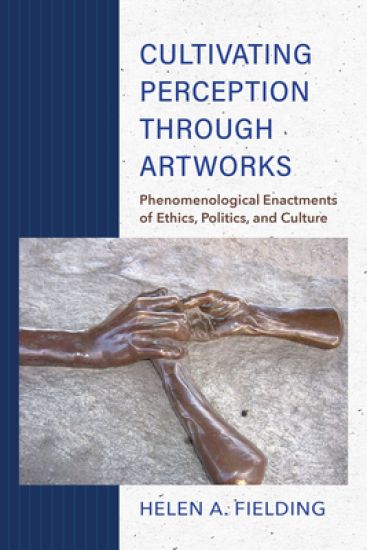
Cultivating Perception Through Artworks

Cultivating Perception Through Artworks

Helen A. Fielding

Indiana University Press
2021
pokkari
What are the ethical, political and cultural consequences of forgetting how to trust our senses? How can artworks help us see, sense, think, and interact in ways that are outside of the systems of convention and order that frame so much of our lives? In Cultivating Perception through Artworks, Helen Fielding challenges us to think alongside and according to artworks, cultivating a perception of what is really there and being expressed by them. Drawing from and expanding on the work of philosophers such as Luce Irigaray and Maurice Merleau-Ponty, Fielding urges us to trust our senses and engage relationally with works of art in the here and now rather than distancing and systematizing them as aesthetic objects. Cultivating Perception through Artworks examines examples as diverse as a Rembrandt painting, M. NourbeSe Philip's poetry, and Louise Bourgeois' public sculpture, to demonstrate how artworks enact ethics, politics, or culture. By engaging with different art forms and discovering the unique way that each opens us to the world in a new and unexpected ways, Fielding reveals the importance of our moral, political, and cultural lives.
Cultivating Perception Through Artworks

Cultivating Perception Through Artworks

Helen A. Fielding

Indiana University Press
2021
sidottu
What are the ethical, political and cultural consequences of forgetting how to trust our senses? How can artworks help us see, sense, think, and interact in ways that are outside of the systems of convention and order that frame so much of our lives? In Cultivating Perception through Artworks, Helen Fielding challenges us to think alongside and according to artworks, cultivating a perception of what is really there and being expressed by them. Drawing from and expanding on the work of philosophers such as Luce Irigaray and Maurice Merleau-Ponty, Fielding urges us to trust our senses and engage relationally with works of art in the here and now rather than distancing and systematizing them as aesthetic objects. Cultivating Perception through Artworks examines examples as diverse as a Rembrandt painting, M. NourbeSe Philip's poetry, and Louise Bourgeois' public sculpture, to demonstrate how artworks enact ethics, politics, or culture. By engaging with different art forms and discovering the unique way that each opens us to the world in a new and unexpected ways, Fielding reveals the importance of our moral, political, and cultural lives.
Fulbe Voices

Fulbe Voices

Helen A. Regis

Routledge
2019
sidottu
Fulbe Voices is based on everyday conversations in the West African village of Domaayo, Cameroon, where men and women struggle with the multiple cultural contradictions and social tensions emerging from their varied perspectives as farmers and entrepreneurs, schoolboys and elders, married and free women, rulers and ruled, Muslim scholars a
Flavonoid Metabolism

Flavonoid Metabolism

Helen A. Stafford

CRC Press Inc
1990
sidottu
This comprehensive review discusses the biosynthesis and catabolism of flavonoids and their regulation in plants. This interesting work approaches the subject matter from both a historical and methodological point of view. It places emphasis on key regulatory enzymic steps in the two pathways leading to the flavonoid basic units as well as the overall pathway within the flavonoid group. This special volume focuses on the known cell-free enzymology at the C15 level, as well as isotopic tracer studies involving the still unknown enzymic steps. This up-to-date text is an excellent resource for all plant physiologists, biological chemists, phytochemists and chemical ecologists.
Why Bank Regulation Failed

Why Bank Regulation Failed

Helen A. Garten

Praeger Publishers Inc
1991
sidottu
As the United States banking system enters the 1990s, the industry and its regulators face a crisis of major proportions. Successive problems have plagued various lending markets, bank failure rates have increased, and traditional regulatory techniques of risk control have proved unsuccessful. In this work, Helen A. Garten examines the current crisis in bank regulation and the regulatory response. In addition, she provides a series of recommendations for reforming the system so that regulatory failure will not occur again.Garten begins her study with a strategic view of bank regulation as a response to financial crises in the banking business. Just as the bank failures of the 1930s led to a radical shift in bank regulatory technique, recent competitive pressures and technological innovations that have lessened the profitability of the deposit-lending business are leading to a shift in regulatory strategy today. Although some deregulation has taken place, Garten contends that more significant changes are occurring in the regulation that remains. Regulators are experimenting with a new approach to risk control that will create economic incentives for banks to adopt more successful investment strategies. Garten compares these new regulatory initiatives to the disciplinary techniques of the typical corporate equityholder and shows how they differ from the debtholder's techniques of traditional post-Depression bank regulation. She concludes that the new regulatory strategy may not be enough to help the banking industry emerge from its current difficulties. This work will be an essential resource for lawyers and bankers involved with regulatory policy, as well as for economists and scholars of finance and administrative law.