Kirjojen hintavertailu. Mukana 11 244 527 kirjaa ja 12 kauppaa.

Kirjahaku

Etsi kirjoja tekijän nimen, kirjan nimen tai ISBN:n perusteella.

1000 tulosta hakusanalla Helmut Bonheim

Helmut Schmid Typography

Helmut Schmid Typography

LARS MULLER PUBLISHERS
2023
sidottu
The Austrian typographer Helmut Schmid was a master of his craft. He put his own spin on Emil Ruder’s teachings at the Basel School of Design while remaining faithful to the principles of clarity, simplicity and elegance. Blending eastern and western influences, Schmid honed his skills and put them into practice in the fields of editorial design, packaging of ethical drugs and visual identity of brands such as Pocari Sweat sports drink (Otsuka Pharmaceutical), Maquillage (Shiseido) and IPSA. He also produced independent publications in parallel, such as Typographic Reflections. Helmut Schmid Typography explores the typographer’s oeuvre in its entirety. The book’s generous design allows each image to breathe, and the accompanying texts narrate Schmid’s life and career in an informative but pleasant manner. Complementing the publications Weingart: Typography and Ruder Typography, Ruder Philosophy, this bilingual monograph completes the Basel school of typographic thought.
Helmut Jahn

Helmut Jahn

Birkhauser
2012
sidottu
Comprehensive monograph Helmut Jahn is world-famous for buildings like Frankfurter Messeturm (1985-1991), Sony Center with the Bahntower, Berlin (1993-2000), airport Bangkok-Suvarnabhumi (1995-2005) and the Veer Towers, Las Vegas (2006-2010). In a luxury edition this book shows in large scale and high-quality photos by the well-known photographer Rainer Viertlböck the increasing international reach of Helmut Jahn’s oeuvre, starting in Chicago and the United States in the 1980s and expanding initially to South Africa, then to Europe, with the focus on Germany, and from there via the Middle East to China, Singapore, Japan and Korea.The photos are combined with a comprehensive collection of Helmut Jahn’s impressive design sketches. They provide inspiring insights into the development of the buildings and the underlying design process. The drawings present the buildings in their overall context of urban surroundings, the structural features, the proportions and ideas on the materials, not to forget just as clearly outlines of the engineering required for the facade technology and construction work.An essay by architecture historian Franz Schultz explains the meaning of Jahn’s oeuvre within the contemporary architecture. An text by Helmut Jahn himself comments the philosophy behind his buildings. Luxury editionSketches by the architect give insight into the design processLarge scale, informative photographs
Helmut Thielicke und die 'Zeitschrift für Evangelische Ethik'
Friedrich Wilhelm Graf skizziert die Biographie des in den 1950er und 1960er Jahren überaus einflussreichen Hamburger Systematischen Theologen Helmut Thielicke, um dann dessen Aktivitäten zur Gründung einer Zeitschrift für Theologische Ethik zu rekonstruieren. Dabei untersucht er auch Thielickes Kontakte zu dem amerikanischen Theologen Reinhold Niebuhr und zu Paul Tillich.Vorgestellt werden die von Thielicke zunächst in den Blick genommenen Herausgeber, seine Programmentwürfe zu Aufgabe und Profil der seit Januar 1957 erscheinenden Zeitschrift für Evangelische Ethik und das tatsächliche Herausgebergremium, dem neben Thielicke protestantische Universitätstheologen wie Heinz-Dietrich Wendland, Hendrik van Oyen, Wolfgang Schweitzer sowie der kirchlich vielfältig engagierte rheinische Unternehmer Friedrich Karrenberg und der spätere WDR-Intendant Klaus von Bismarck angehörten. Durch die dichte Analyse der in den ersten Jahrgängen der Zeitschrift für Evangelische Ethik geführten Kontroversen über die atomare Bewaffnung sowie den Institutionenbegriff zeigt Friedrich Wilhelm Graf, dass die ZEE primär ein Organ innerprotestantischer Verständigung sein und zugleich die politisch-soziale Gestaltungskraft des bundesdeutschen Protestantismus stärken sollte. Trotz ihres dezidiert internationalen Anspruchs wurde die Zeitschrift schon bald zu einem Organ, in dem hauptsächlich nur noch deutschsprachige protestantische Theologen publizierten.
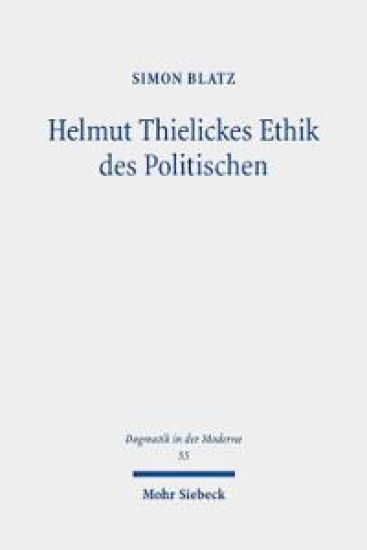
Helmut Thielickes Ethik des Politischen
Helmut Thielicke (1908-1986) gehört zu einer Generation akademischer Theologen, deren Denken sich in größten politischen Umbrüchen herausbildet. Simon Blatz untersucht Thielickes Ethik des Politischen im Horizont seiner theologischer Gesamtkonzeption, angefangen bei seinen Qualifikationsschriften in den frühen 30er Jahren bis hin zum Hauptwerk der Theologischen Ethik in der frühen Bundesrepublik. Im Licht damaliger Debatten zu Schöpfungsordnung, Kirche und Öffentlichkeit, Säkularisierung, Indikativ und Imperativ, Naturrecht, Kompromiss und Obrigkeit wird ein Denker erkennbar, der bei allem Defizit und aller Zeitgebundenheit in seinem Potential noch nicht erschöpft ist.
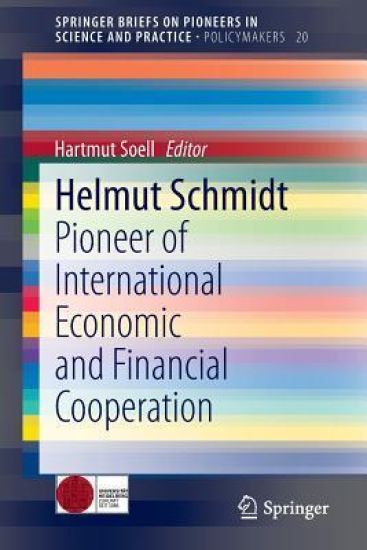
Helmut Schmidt

Helmut Schmidt

Springer International Publishing AG
2014
nidottu
On the occasion of the 95th birthday of Helmut Schmidt, West German Chancellor 1974–1982, his biographer Hartmut Soell, Professor of History at Heidelberg University and former member of the German Parliament (1980–1994), presents H. Schmidt as a Pioneer of International Economic and Financial Cooperation. Influenced by the catastrophes of the early 20th century (global economic crisis, dictatorship and war), Schmidt entered politics as a trained economist and was one of the most innovative policymakers from the 1960s to the 1980s. As minister of defense, economy and finance and as Chancellor he was able to implement many of his ideas for closer cooperation between Western industrial states on currency issues and energy policy during the 1970s. Together with French President Valéry Giscard d’Estaing he launched the G7 summits in 1975 and his proposals for a European currency system (1978–79) paved the way for the European economic and currency union. As editor of Die Zeit, he would later become an influential commentator.