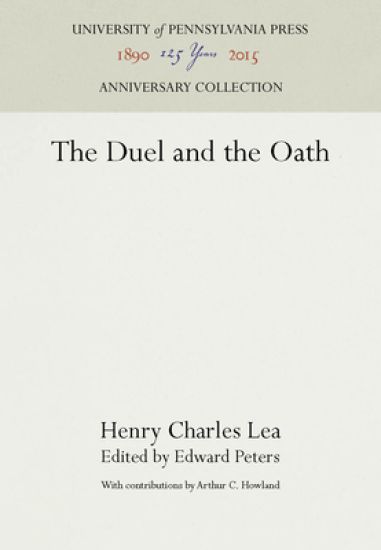
Henry Charles Lea was one of the first American historians to use what would later be termed comparative and anthropological approaches to history. Under his pen, the study of the medieval ordeal becomes a study in cultural history. Reprinted here from the fourth revised edition of 1892, the book begins by tracing the role of the ordeal in non-Western and ancient societies, showing the mental world to which it belongs: a limited trust in the public order and purely human methods of inquiry, and a larger faith in divine intervention and immanent justice. The work then describes the uses of the institution through the European Middle Ages to its final abolition, and in the process offers a rich typology of ordeals. Additional documents included in this edition present formulas and descriptions of some of the ordeals most frequently used: the ordeal by boiling water, by hot water, by cold water, by hot iron and water, by glowing plowshares, by fire, and the ordeal of the cross.
Originally published as parts I and II of Lea's major historical work Superstition and Force, this volume discusses the limitations in the Middle Ages of what modern jurists would term private law, or civil cases, and the concept of imminent justice through divine intervention in determining the verdict.
This work has been selected by scholars as being culturally important and is part of the knowledge base of civilization as we know it.This work is in the public domain in the United States of America, and possibly other nations. Within the United States, you may freely copy and distribute this work, as no entity (individual or corporate) has a copyright on the body of the work.Scholars believe, and we concur, that this work is important enough to be preserved, reproduced, and made generally available to the public. To ensure a quality reading experience, this work has been proofread and republished using a format that seamlessly blends the original graphical elements with text in an easy-to-read typeface.We appreciate your support of the preservation process, and thank you for being an important part of keeping this knowledge alive and relevant.