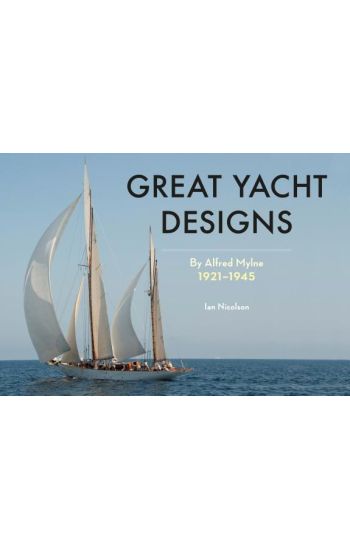
Alfred Mylne the First designed exciting, beautiful yachts, which have won many races over the past 120 years – some are still collecting prizes. They have also cruised far and wide. Many still traverse the oceans, braving the blasting breeze with the confidence of their strong construction. Each chapter of this book is about one of these famous craft, or about a class of boats. The text reveals what is so special about each design. With a fascinating set of illustrations from the Mylne archives, each boat is accompanied by reproductions of Mylne’s original plans and drawings. This is the second book about Alfred Mylne the First’s very special designs, being a sequel to Ian Nicolson’s recent Alfred Mylne The Leading Yacht Designer: 1896-1920. Writing with expertise and enthusiasm, the author has worked in the yacht industry for seventy-one years, including twenty years with Alfred Mylne the Second.
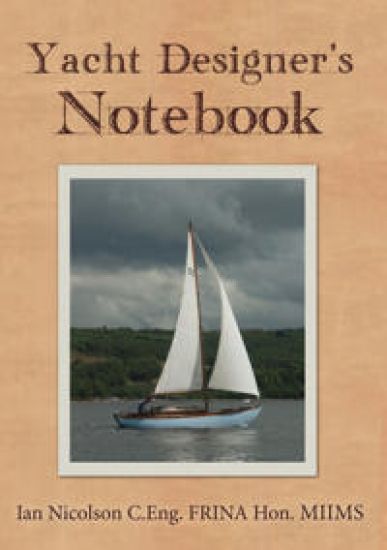
This fully revised third edition of a classic manual is a mine of information for yachtsmen to customise their boats. An abundance of clear illustrations accompanied by concise explanations cover the following subjects: hull construction and repairs; keels, floors and decks; rudders, tillers and steering gear; cabin tops and cockpits; hatches and ventilation; cabin furniture; chainplates; deck and cockpit fittings; pulpits, stanchions and guardrails; spars, mast fittings and steps; sails and rigging; engines and electrics; tanks, piping and plumbing; yacht tenders, dinghies and liferafts; anchors, chains and warps; fitting out and laying up. Ian Nicolson is one of the most prolific yachting writers. He has written twenty-four books on yachting and his articles since 1947 number several thousand. He is a Fellow of the Royal Institution of Naval Architects, a previous partner in A. Mylne & Co., he founded Nicolson-Hughes Sails and is visiting lecturer at four universities. He lives in Scotland, has three children and four grandchildren, who all sail ... a lot.
This book is a must for the amateur who wants to be convinced that he can confidently approach the prospect of building his own dream boat. With the support of many diagrams and sketches, Ian Nicolson teaches all the skills necessary to create anything from a small cruiser to an impressive 75-foot yacht.
Adam Nicolson; Gracy Olmstead; Christian Wiman; Kelsey Osgood; John Kempf; Leah Libresco Sargeant; Ian Marcus Corbin; Iván Bernal Marín; Phil Klay; Edmund Waldstein; Alfred Nicol
When we read the book of nature, what do we read there? “All things bright and beautiful, all creatures great and small, all things wise and wonderful, the Lord God made them all,” says a well-known hymn. This issue of Plough celebrates the creatures of our planet – plant, animal, and human – and the implications of humankind’s relationship to nature. But if nature can be read as a book that reveals the wisdom of its Creator, it also reveals things less lovely than stars and singing birds – a world of desperate competition for survival, mass extinctions, and deadly viruses. Is such a world a convincing argument for the Creator’s goodness? Turns out Christians and skeptics alike have been asking such questions since long before Darwin added a twist. Are we moderns out of practice at reading the book of nature? And if we forget how, will we fail to read human nature as well – what rights or purposes our Creator may have endowed us with? What then is there to limit the bounds of technological manipulation of humankind? This issue of Plough explores these and other fascinating questions about the natural world and our place in it. In this issue: - Sussex farmer Adam Nicholson evokes centuries of handwork that shaped the landscape of the Weald. - Gracy Olmstead revisits the land her forebears farmed in Idaho. - Ian Marcus Corbin tries walking phoneless to better note the beauty of the natural world. - Amish farmer John Kempf, a leader in regenerative agriculture, foresees a healthier future for farming. - Leah Libresco Sargeant offers a feminist critique of society’s war on women’s bodies. - Iván Bernal Marín visits Panama City’s traditional fishermen. - Maureen Swinger recalls to triumphs of second grade in forest school. - Edmund Waldstein questions head transplants and the limits of medical science. - Kelsey Osgood says it’s natural to fear death, and to transcend that fear through faith. - Tim Maendel lifts the veil on urban beekeeping along the Manhattan skyline. You’ll also find: - An essay by Christian Wiman on the poetry of doubt and faith - New poems by Alfred Nicol - A profile of Amazon activist nun Dorothy Stang - An appreciation of Keith Green’s songs - Insights on creation from Blaise Pascal, Julian of Norwich, Francis of Assisi, Mechthild of Magdeburg, Christopher Smart, Augustine of Hippo, The Book of Job, and Sadhu Sundar Singh - Reviews of The Opening of the American Mind, and Kazuo Ishiguro’s Klara and the Sun Plough Quarterly features stories, ideas, and culture for people eager to put their faith into action. Each issue brings you in-depth articles, interviews, poetry, book reviews, and art to help you put Jesus’ message into practice and find common cause with others.
How to Build a Digital Library reviews knowledge and tools to construct and maintain a digital library, regardless of the size or purpose. A resource for individuals, agencies, and institutions wishing to put this powerful tool to work in their burgeoning information treasuries. The Second Edition reflects developments in the field as well as in the Greenstone Digital Library open source software. In Part I, the authors have added an entire new chapter on user groups, user support, collaborative browsing, user contributions, and so on. There is also new material on content-based queries, map-based queries, cross-media queries. There is an increased emphasis placed on multimedia by adding a "digitizing" section to each major media type. A new chapter has also been added on "internationalization," which will address Unicode standards, multi-language interfaces and collections, and issues with non-European languages (Chinese, Hindi, etc.). Part II, the software tools section, has been completely rewritten to reflect the new developments in Greenstone Digital Library Software, an internationally popular open source software tool with a comprehensive graphical facility for creating and maintaining digital libraries.
◆ He never meant to fall in love with his best friend's sister ◆Ian MacKeefe is haunted by the demons in his head, taunting him of his tarnished past. On All Hallows' Eve he sees the face of a man in the fire. It is the image of an enemy he's killed and buried three years earlier. It is a disturbing thought since this is the night when supposedly the veil between two worlds is the thinnest and the dead can come back to life.Kyla has taken a liking to Ian, but she is his best friend's sister. They've grown up together, but now she is a woman and has caught his eye, or at least she hopes she has. Ian shouldn't be having feelings for Kyla and it scares him. If Aidan finds out, he'll have Ian's head. Meaning to frighten the girl off the way he's done in the past, Ian kisses Kyla, but it only makes things worse since she seems to be attracted to him as well.When Ian is asked to escort Kyla home, his past comes back to haunt him. He hears rumors that Tearlach MacTavish, the man he killed, has come back to life and is looking for an alliance with the MacKeefes in the form of a bride. No one, especially a man who should be dead, is going to take Kyla away from Ian. He will give his life to protect her. That is, if his past doesn't stop him first.Can Ian face his past before it's too late, now that he realizes Kyla is so much more to him than just his best friend's wee sister? Will true love give him the strength to set things right, and this time keep his dead enemies in the ground where they belong?
Tuckers bluff isn't done playing matchmaker for the Farradays. Welcome to Ian, book 9 in the Farraday Country series set in cattle-ranching west Texas, with all the friends, family and fun that fans have come to expect from USA TODAY Bestselling author Chris Keniston. For Texas Ranger Ian Farraday, nothing beats catching bad guys, except family time in Tuckers Bluff. When fate steps in and brings him face-to-face with one curvy-and unforgettable-damsel in distress, all it takes is a stray puppy and a few missing cows to turn his ranch vacation upside down. Attending a wedding isn't supposed to land Kelly Morgan in jail. Lucky for her, the Farraday men are always ready to save the day-especially one long, tall Texan. Too bad the embarrassing mishap turns out to be the least of her worries. After all, every woman needs a knight in shining armor once-or twice-in a lifetime. Praise for the Farraday Series: "Loved it. Fast moving and fun." Jodi Thomas, New York Times Bestselling Author on DECLAN "My kind of read Spend an afternoon with a great romance story, a feisty heroine, and one unforgettable hero." Lindsay McKenna, New York Times Bestselling Author on ADAM "Chris Keniston gives us a world you'll never want to leave." Emily March, New York Times Bestselling Author of Eternity Springs series on FARRADAY COUNTRY SERIES "Spellbinding " Lori Wilde, New York Times Bestselling Author on ETHAN More Books in the Farraday Country Series: Adam - Book 1 Brooks - Book 2 Connor - Book 3 Declan - Book 4 Ethan - Book 5 Finn - Book 6 Grace - Book 7 Hannah - Book 8 Ian - Book 9 Jamison Book 10 - arriving in 2018 For more on Chris and her other series check out her website Or follow her on facebook Chris Keniston Author
Voted the greatest English cricketer of the 20th century by the fans, Sir Ian Botham is the English game's one true living legend and his story both on and off the pitch reads like a Boy's Own rollercoaster ride.Born with a natural genius for cricket, Botham began breaking records with bat and ball from a young age and soon became the man English cricket expected most from. After a troubled period as England's captain, Botham rose once again to become a national hero with his display in the Miracle Ashes of 1981. But, with his confrontational nature and wild streak, he began regularly making the wrong kind of headlines. With accusations of drink and drugs, affairs and ball-tampering, he became hounded by the tabloid pack, never sure whether they wanted him to triumph or implode. Now a Knight and just as famous for his tireless charity work, Beefy gives us the definitive story of his never-dull life and times in his own no-nonsense words.
Before his masterpiece The Rise of the Novel made him one of the most influential post-war British literary critics, Ian Watt was a soldier, a prisoner of war of the Japanese, and a forced labourer on the notorious Burma-Thailand Railway. Both an intellectual biography and an intellectual history of the mid-century, this book reconstructs Watt's wartime world: these were harrowing years of mass death, deprivation, and terror, but also ones in which communities and institutions were improvised under the starkest of emergency conditions. Ian Watt: The Novel and the Wartime Critic argues that many of our foundational stories about the novel—about the novel's origins and development, and about the social, moral, and psychological work that the novel accomplishes—can be traced to the crises of the Second World War and its aftermath.