Kirjojen hintavertailu. Mukana 11 244 527 kirjaa ja 12 kauppaa.

Kirjahaku

Etsi kirjoja tekijän nimen, kirjan nimen tai ISBN:n perusteella.

1000 tulosta hakusanalla Isabelle Drake

Isabelle

Isabelle

Annette Kobak

Virago Press Ltd
2006
nidottu
Isabelle Eberhardt (1877-1904) was born the daughter of a Russian emigres and raised in a climate of aristocratic anarchism. She reinvented herself as a desert Arab and a devout Muslim. She was a woman who preferred dressing like a boy and whose adventures - as a mystic, a connoiser of drugs, and a rumoured participant in sexual orgies - scandalised Europeans at the turn of the century. During her brief life she was a source of worried speculation to the French authorities in North Africa. After her death she became a legend: 'the amazon of the Sahara'.
Isabelle

Isabelle

Michelle-Catherine-Joséphine Tarbé Des Sablons

Hachette Livre - BNF
2013
pokkari
Isabelle, par Mme Tarbe Des SablonsDate de l'edition originale: 1846Ce livre est la reproduction fidele d'une oeuvre publiee avant 1920 et fait partie d'une collection de livres reimprimes a la demande editee par Hachette Livre, dans le cadre d'un partenariat avec la Bibliotheque nationale de France, offrant l'opportunite d'acceder a des ouvrages anciens et souvent rares issus des fonds patrimoniaux de la BnF.Les oeuvres faisant partie de cette collection ont ete numerisees par la BnF et sont presentes sur Gallica, sa bibliotheque numerique.En entreprenant de redonner vie a ces ouvrages au travers d'une collection de livres reimprimes a la demande, nous leur donnons la possibilite de rencontrer un public elargi et participons a la transmission de connaissances et de savoirs parfois difficilement accessibles.Nous avons cherche a concilier la reproduction fidele d'un livre ancien a partir de sa version numerisee avec le souci d'un confort de lecture optimal. Nous esperons que les ouvrages de cette nouvelle collection vous apporteront entiere satisfaction.Pour plus d'informations, rendez-vous sur www.hachettebnf.fr
Isabelle

Isabelle

Lawrence C. Paulson

Springer-Verlag Berlin and Heidelberg GmbH Co. K
1994
nidottu
As a generic theorem prover, Isabelle supports a variety of logics. Distinctive features include Isabelle's representation of logics within a meta-logic and the use of higher-order unification to combine inference rules. Isabelle can be applied to reasoning in pure mathematics or verification of computer systems. This volume constitutes the Isabelle documentation. It begins by outlining theoretical aspects and then demonstrates the use in practice. Virtually all Isabelle functions are described, with advice on correct usage and numerous examples. Isabelle's built-in logics are also described in detail. There is a comprehensive bebliography and index. The book addresses prospective users of Isabelle as well as researchers in logic and automated reasoning.
Isabelle in the Afternoon

Isabelle in the Afternoon

Douglas Kennedy

Arrow Books
2020
pokkari
'A touching exploration of passion untested by domesticity' Mail on SundayBefore Isabelle I knew nothing of sex. Before Isabelle I knew nothing of freedom. Before Isabelle I knew nothing of life. Paris in the early Seventies.
Isabelle in the Afternoon

Isabelle in the Afternoon

Douglas Kennedy

Random House UK
2020
nidottu
Before Isabelle I knew nothing of sex. Before Isabelle I knew nothing of freedom. Before Isabelle I knew nothing of life. Paris in the early Seventies. Sam, an American student, meets a woman in a bookshop. Isabelle is enigmatic, beautiful, older and, unlike Sam, experienced in love's many contradictions. Sam is instantly smitten - but wary of the wedding ring on her finger. What begins as a regular arrangement in Isabelle's tiny Parisian apartment transforms into a true affair of the heart, and one which lasts for decades to come. Isabelle in the Afternoon is a novel that questions what we seek, what we find, what we settle for - and shows how love, when not lived day in, day out, can become the passion of a lifetime.
Isabelle of France

Isabelle of France

Sean L. Field

University of Notre Dame Press
2006
nidottu
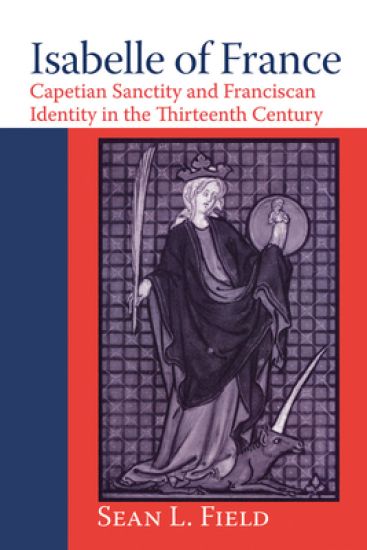
As the only daughter of Blanche of Castile, one of France's most powerful queens, and as the sister of the Capetian saint Louis IX, Isabelle of France (1225-1270) was situated at the nexus of sanctity and power during a significant era of French culture and medieval history. In this ground-breaking examination of Isabelle's career, Sean Field uses a wealth of previously unstudied material to address significant issues in medieval religious history, including the possibilities for women's religious authority, the creation and impact of royal sanctity, and the relationship between men and women within the mendicant orders. Field reinterprets Isabelle's career as a Capetian princess. Isabelle was remarkable for choosing a life of holy virginity and for founding and co-authoring a rule for the Franciscan abbey of Longchamp. Isabelle did not become a nun there, but remained a powerful lay patron, living in a modest residence on the abbey grounds. Field maintains that Isabelle was a key actor in creating the aura of sanctity that surrounded the French royal family in the thirteenth century, underscoring the link between the growth of Capetian prestige and power and the idea of a divinely ordained, virtuous, and holy royal family. Her contemporary reputation for sanctity emerges from a careful analysis of the Life of Isabelle of France written by the third abbess of Longchamp, Agnes of Harcourt, and from papal bulls, letters, and other contemporary sources that have only recently come to light. Field also argues that Isabelle had a profound effect on the institutional history of Franciscan women. By remaining outside the official Franciscan and church hierarchies, Isabelle maintained an ambiguous position that allowed her to embrace Franciscan humility while retaining royal influence. Her new order of Sorores minores was eagerly adopted by a number of communities, and her rule for the order eventually spread from France to England, Italy, and Spain. An important study of a medieval woman's agency and power, Isabelle of France explores the life of a remarkable figure in French and Franciscan history.
Isabelle of France

Isabelle of France

Sean L. Field

UNIVERSITY OF NOTRE DAME PRESS
2022
sidottu
As the only daughter of Blanche of Castile, one of France's most powerful queens, and as the sister of the Capetian saint Louis IX, Isabelle of France (1225-1270) was situated at the nexus of sanctity and power during a significant era of French culture and medieval history. In this ground-breaking examination of Isabelle's career, Sean Field uses a wealth of previously unstudied material to address significant issues in medieval religious history, including the possibilities for women's religious authority, the creation and impact of royal sanctity, and the relationship between men and women within the mendicant orders. Field reinterprets Isabelle's career as a Capetian princess. Isabelle was remarkable for choosing a life of holy virginity and for founding and co-authoring a rule for the Franciscan abbey of Longchamp. Isabelle did not become a nun there, but remained a powerful lay patron, living in a modest residence on the abbey grounds. Field maintains that Isabelle was a key actor in creating the aura of sanctity that surrounded the French royal family in the thirteenth century, underscoring the link between the growth of Capetian prestige and power and the idea of a divinely ordained, virtuous, and holy royal family. Her contemporary reputation for sanctity emerges from a careful analysis of the Life of Isabelle of France written by the third abbess of Longchamp, Agnes of Harcourt, and from papal bulls, letters, and other contemporary sources that have only recently come to light. Field also argues that Isabelle had a profound effect on the institutional history of Franciscan women. By remaining outside the official Franciscan and church hierarchies, Isabelle maintained an ambiguous position that allowed her to embrace Franciscan humility while retaining royal influence. Her new order of Sorores minores was eagerly adopted by a number of communities, and her rule for the order eventually spread from France to England, Italy, and Spain. An important study of a medieval woman's agency and power, Isabelle of France explores the life of a remarkable figure in French and Franciscan history.

Isabelle's Boyfriend

Isabelle's Boyfriend

Caroline Hickey

Square Fish
2009
nidottu
All's fair in love and high school Taryn has found the guy of her dreams. Epp is tall, athletic, handsome, and best of all, he likes her, too. There's only one problem: He's dating someone else. Taryn thinks her love life is over, but when she decides to write an article for the school newspaper that just happens to require interviewing Epp, her luck begins to change. Befriended by Epp's beautiful girlfriend, Isabelle, Taryn is suddenly hanging out with a new crowd, going on her first date, and getting her first kiss. Life couldn't get any better, could it? Maybe if Epp wasn't still Isabelle's boyfriend . . .
Isabelle's Perfect Performance #3

Isabelle's Perfect Performance #3

Moss Alexandra

Penguin Putnam Inc
2005
pokkari
Ellie Brown is so excited to be returning to The Royal Ballet Lower School for her second term. She can't wait until classes start--she and her fellow classmates are finally learning to dance on pointe But a new girl, Isabelle Armand, throws everyone off. Isabelle is from France and believes that the French way is the only way--when it comes to clothing, food...and especially ballet. Isabelle is a flawless dancer, but she's terribly unfriendly. How can Ellie and her friends warm to Isabelle when she keeps giving everyone the cold shoulder?
Isabelle Eberhardt and North Africa

Isabelle Eberhardt and North Africa

Lynda Chouiten

Lexington Books
2014
sidottu
As a woman who traversed the North African Orient in male costume, who spoke Arabic as well as French, and who professed Islam while transgressing many of its instructions, Isabelle Eberhardt seems to fit within Mikhail Bakhtin’s definition of the carnivalesque as the impulse to blend that which is usually kept separate by artificial boundaries and hierarchies. Nevertheless, this study demonstrates that her evolution in the Maghreb is carnivalesque only in appearance. Despite her transvestism, the writer left unquestioned the traditional definitions of masculinity and femininity; it is her subscription to the patriarchal equation of maleness with power and womanhood with weakness which makes her borrow a masculine identity. In a similar way, her appropriation of several elements of Oriental culture does not prevent her from reproducing age-old Orientalist stereotypes. As portrayed in her texts, the natives are either aestheticized as picturesque figures from a bygone age or denigrated as uncivilized, dark-minded creatures. And because Orientalism, as Edward Said has famously argued, is but a textual manifestation of colonialism, Eberhardt’s Orientalist texts make her the accomplice of the colonialist project, a project which she also served by acting as a mediator between General Lyautey and native tribes. In discussing Eberhardt’s involvement in the colonial mission and her perpetuation of the patriarchal and Orientalist traditions, this study questions the image of rebel-figure that is usually assigned to her. Instead, it shows the writer’s literary and political gestures to be embedded in a marked quest for empowerment through the double (literary and political) conquest of the Orient.
Isabelle Day Refuses to Die of a Broken Heart

Isabelle Day Refuses to Die of a Broken Heart

St. Anthony Jane

University of Minnesota Press
2015
sidottu
In Milwaukee, Isabelle Day had a house. And she had a father. This year, on Halloween, she has half of a house in Minneapolis, a mother at least as sad as she is, and a loss that’s too hard to think—let alone talk—about. It’s the Midwest in the early 1960s, and dads just don’t die . . . like that. Hovering over Isabelle’s new world are the duplex’s too-attentive landladies, Miss Flora (“a lovely dried flower”) and her sister Miss Dora (“grim as roadkill”), who dwell in a sea of memories and doilies; the gleefully demonic Sister Mary Mercy, who rules a school awash in cigarette smoke; and classmates steady Margaret and edgy Grace, who hold out some hope of friendship. As Isabelle’s first tentative steps carry her through unfamiliar territory—classroom debacles and misadventures at home and beyond, time trapped in a storm-tossed cemetery and investigating an inhospitable hospital—she begins to discover that, when it comes to pain and loss, she might actually be in good company. In light of the elderly sisters’ lives, Grace and Margaret’s friendship, and her father’s memory, she just might find the heart and humor to save herself. With characteristic sensitivity and wit, Jane St. Anthony reveals how a girl’s life clouded with grief can also hold a world of promise.