

Kirjahaku
Etsi kirjoja tekijän nimen, kirjan nimen tai ISBN:n perusteella.
1000 tulosta hakusanalla J. D. Riley
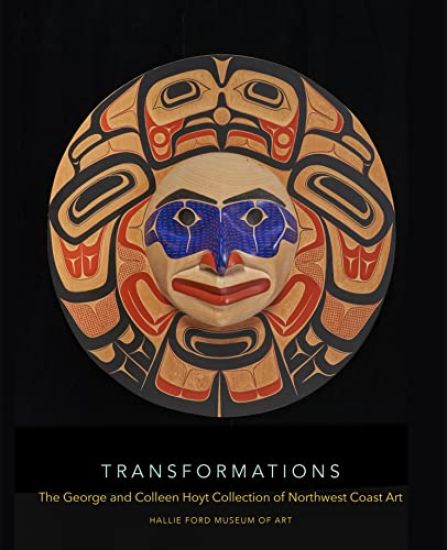
Transformations
Rebecca J. Dobkins; Tasia D. Riley; John Olbrantz
HALLIE FORD MUSEUM OF ART,US
2022
sidottu
Showcases work by dozens of extraordinary Northwest Coast artists from the 1950s to the presentSince the 1980s, Oregon-based art collectors George and Colleen Hoyt have amassed one of the finest private collections of Northwest Coast art in the United States. Transformations traces the history of contemporary Northwest Coast Native art since the 1950s. Included are works by some of the region's foremost Native artists of the past half century, including Robert Davidson, Doug Cranmer, Beau Dick, and Susan Point. The collection of over six hundred prints and carvings by over one hundred artists is a promised gift from George and Colleen Hoyt to the Hallie Ford Museum of Art. Richly illustrated with color photographs, the book features a foreword by John Olbrantz, an essay by Rebecca J. Dobkins, and artist biographies by Tasia Riley.Exhibition dates: Hallie Ford Museum of Art, September 17–December 17, 2022
The Force of Language illustrates how the philosophy of Language, if differently conceived, can directly incorporate questions of political thought and of emotionality, and offers the practical case of defensive strategies against the abusive speech. This follows a broad consideration of the inner voice or inner speech as a test case for a new approach to language, in particular as a way of radically rethinking the usual contrast between inner and outer through furnishing an account of how we internalize speech. The book's core offers a substantial critique of orthodox approaches to the philosophy of language form Chomsky and others; drawing on European political thought from Marx to Deleuze, it will move beyond this inheritance to explain and demonstrate its fresh conception of language at work.

The Force of Language illustrates how the philosophy of Language, if differently conceived, can directly incorporate questions of political thought and of emotionality, and offers the practical case of defensive strategies against the abusive speech. This follows a broad consideration of the inner voice or inner speech as a test case for a new approach to language, in particular as a way of radically rethinking the usual contrast between inner and outer through furnishing an account of how we internalize speech. The book's core offers a substantial critique of orthodox approaches to the philosophy of language form Chomsky and others; drawing on European political thought from Marx to Deleuze, it will move beyond this inheritance to explain and demonstrate its fresh conception of language at work.
A Tribute to the Memory of Rev. Henry J. Ripley, D.D.
Outlook Verlag
2023
pokkari
A Tribute to the Memory of Rev. Henry J. Ripley, D.D.
Outlook Verlag
2023
sidottu

A Tribute to the Memory of Rev. Henry J. Ripley, D.D.
Antigonos Verlag
2025
sidottu

Dell' Ampiezza Delle Romane Catacombe E D'Una Macchina Icnografica Ed Ortografica Per Rilevarne La Piante Ed I Livelli (1860)
Michele Stefano De Rossi; J. L. Ussing; M. Ampere
KESSINGER PUBLISHING, LLC
2010
pokkari
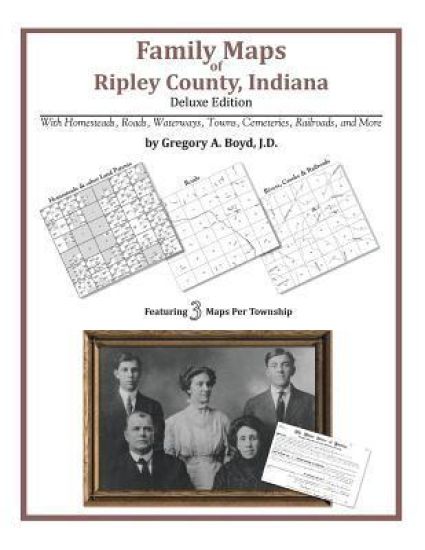
224 pages with 62 total maps Locating original landowners in maps has never been an easy task-until now. This volume in the Family Maps series contains newly created maps of original landowners (patent maps) in what is now Ripley County, Indiana, gleaned from the indexes of the U.S. Bureau of Land Management. But it offers much more than that. For each township in the county, there are two additional maps accompanying the patent map: a road map and a map showing waterways, railroads, and both modern and many historical city-centers and cemeteries. Included are indexes to help you locate what you are looking for, whether you know a person's name, a last name, a place-name, or a cemetery. The combination of maps and indexes are designed to aid researchers of American history or genealogy to explore frontier neighborhoods, examine family migrations, locate hard-to-find cemeteries and towns, as well as locate land based on legal descriptions found in old documents or deeds. The patent-maps are essentially plat maps but instead of depicting owners for a particular year, these maps show original landowners, no matter when the transfer from the federal government was completed. Dates of patents typically begin near the time of statehood and run into the early 1900s. What's Mapped in this book (that you'll not likely find elsewhere) . . . 3054 Parcels of Land (with original landowner names and patent-dates labeled in the relevant map) 58 Cemeteries plus . . . Roads, and existing Rivers, Creeks, Streams, Railroads, and Small-towns (including some historical), etc. What YEARS are these maps for? Here are the counts for parcels of land mapped, by the decade in which the corresponding land patents were issued: DecadeParcel-count 1810s1 1820s100 1830s2484 1840s442 1850s25 1870s1 1920s1 What Cities and Towns are in Ripley County, Indiana (and in this book)? Allen Crossing, Ballstown, Batesville, Behlmer Corner, Benham, Clinton, Correct, Cross Plains, Cross Roads, Dabney, Delaware, Dewberry, Elrod, Friendship, Haney Corner, Holton, Jackson, Jolleyville, Laughery Switch, Laugheryville, Lookout, Milan, Morris, Napoleon, Negangards Corner, New Carrollton, New Marion, Old Milan, Olean, Osgood, Otter Village, Penntown, Pierceville, Prattsburg, Rexville, Saint Magdalen, Spades, Stringtown, Stumpke Corner, Sunman, Versailles

Before J.D. Salinger became famous for his 1951 novel The Catcher in the Rye and infamous as a literary recluse, he was a soldier in World War II. While serving in the U.S. Army's Counter Intelligence Corps (CIC) in Europe, Salinger wrote more than twenty short stories and returned home with a German war bride. Eberhard Alsen, through meticulous archival research and careful analysis of the literary record, corrects mistaken assumptions about the young writer's war years and their repercussions. Though recent biographies and films claim that Salinger regularly participated in combat, Alsen cites military documents showing that his counterintelligence work was well behind the front lines.Alsen, a longtime Salinger scholar who witnessed the Nazi regime firsthand as a child in Germany, tracks Salinger's prewar experiences in the army, his work for the CIC during significant military campaigns, and his reactions to three military disasters that killed more than a thousand fellow soldiers in his Fourth Infantry Division. Alsen also identifies the Nazi death camp where Salinger saw mounds of recently burned bodies. Revealing details shed light on Salinger's outspoken disgust for American military leaders, the personality changes that others saw in him after the war, and his avoidance of topics related to the Holocaust.
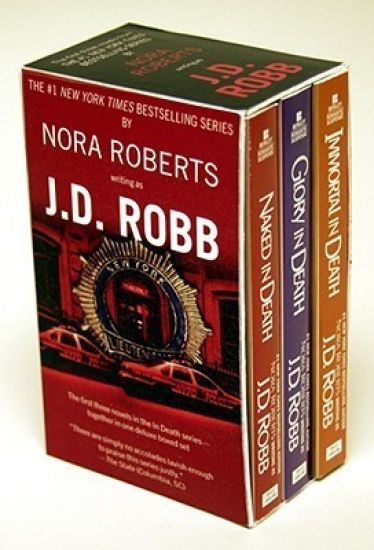
Now available in one extraordinary box set--Naked in Death, Glory in Death, and Immortal in Death--the first three novels in J.D. Robb's #1 New York Times bestselling series featuring Lieutenant Eve Dallas. NAKED IN DEATH Eve Dallas is a New York police lieutenant using her instincts to hunt for a ruthless killer. Breaking every rule, Eve gets involved with Roarke, an Irish billionaire--and a suspect in Eve's murder investigation. But passion and seduction have rules all their own. GLORY IN DEATH Police Lieutenant Eve Dallas has no problem finding connections between two violent crimes. Both victims were beautiful and highly successful women whose intimate relations with men of great power and wealth provide Eve with a long list of suspects--including her own lover, Roarke. IMMORTAL IN DEATH A top model is dead, the victim of a brutal murder. Police Lieutenant Eve Dallas puts her professional life on the line to take the case when suspicion falls on her best friend, the other woman in a fatal love triangle.

NATIONAL BESTSELLER - The inspiration for the major motion picture Rebel in the Rye One of the most popular and mysterious figures in American literary history, the author of the classic Catcher in the Rye, J. D. Salinger eluded fans and journalists for most of his life. Now he is the subject of this definitive biography, which is filled with new information and revelations garnered from countless interviews, letters, and public records. Kenneth Slawenski explores Salinger's privileged youth, long obscured by misrepresentation and rumor, revealing the brilliant, sarcastic, vulnerable son of a disapproving father and doting mother. Here too are accounts of Salinger's first broken heart--after Eugene O'Neill's daughter, Oona, left him--and the devastating World War II service that haunted him forever. J. D. Salinger features this author's dramatic encounters with luminaries from Ernest Hemingway to Elia Kazan, his office intrigues with famous New Yorker editors and writers, and the stunning triumph of The Catcher in the Rye, which would both make him world-famous and hasten his retreat into the hills of New Hampshire. J. D. Salinger is this unique author's unforgettable story in full--one that no lover of literature can afford to miss. Praise for J. D. Salinger: A Life "Startling . . . insightful . . . a] terrific literary biography."--USA Today "It is unlikely that any author will do a better job than Mr. Slawenski capturing the glory of Salinger's life."--The Wall Street Journal "Slawenski fills in a great deal and connects the dots assiduously; it's unlikely that any future writer will uncover much more about Salinger than he has done."--Boston Sunday Globe "Offers perhaps the best chance we have to get behind the myth and find the man."--Newsday " Slawenski has] greatly fleshed out and pinned down an elusive story with precision and grace."--Chicago Sun-Times "Earnest, sympathetic and perceptive . . . Slawenski] does an evocative job of tracing the evolution of Salinger's work and thinking."--The New York Times


J. D. Salinger and the Critics
William Francis Ed Belcher; James Ward Joint Ed Lee
Hassell Street Press
2021
sidottu
This work has been selected by scholars as being culturally important and is part of the knowledge base of civilization as we know it.This work is in the public domain in the United States of America, and possibly other nations. Within the United States, you may freely copy and distribute this work, as no entity (individual or corporate) has a copyright on the body of the work.Scholars believe, and we concur, that this work is important enough to be preserved, reproduced, and made generally available to the public. To ensure a quality reading experience, this work has been proofread and republished using a format that seamlessly blends the original graphical elements with text in an easy-to-read typeface.We appreciate your support of the preservation process, and thank you for being an important part of keeping this knowledge alive and relevant.

J. D. Salinger and the Critics
William Francis Ed Belcher; James Ward Joint Ed Lee
Hassell Street Press
2021
nidottu
This work has been selected by scholars as being culturally important and is part of the knowledge base of civilization as we know it.This work is in the public domain in the United States of America, and possibly other nations. Within the United States, you may freely copy and distribute this work, as no entity (individual or corporate) has a copyright on the body of the work.Scholars believe, and we concur, that this work is important enough to be preserved, reproduced, and made generally available to the public. To ensure a quality reading experience, this work has been proofread and republished using a format that seamlessly blends the original graphical elements with text in an easy-to-read typeface.We appreciate your support of the preservation process, and thank you for being an important part of keeping this knowledge alive and relevant.

J. D. A Lennep In Analogiam Linguae Graecae, Cui Praemissa Ejusdem Viri Docti Oratio De Linguarum Analogia (1779)
Johan Daniel Van Lennep
KESSINGER PUBLISHING, LLC
2009
pokkari

J. D. Fuss Ad J. B. Lycocriticum Epistola (1823)
Jean Dominique Fuss; Christian Konrad Sprengel
KESSINGER PUBLISHING, LLC
2009
nidottu

This work has been selected by scholars as being culturally important, and is part of the knowledge base of civilization as we know it. This work was reproduced from the original artifact, and remains as true to the original work as possible. Therefore, you will see the original copyright references, library stamps (as most of these works have been housed in our most important libraries around the world), and other notations in the work.This work is in the public domain in the United States of America, and possibly other nations. Within the United States, you may freely copy and distribute this work, as no entity (individual or corporate) has a copyright on the body of the work.As a reproduction of a historical artifact, this work may contain missing or blurred pages, poor pictures, errant marks, etc. Scholars believe, and we concur, that this work is important enough to be preserved, reproduced, and made generally available to the public. We appreciate your support of the preservation process, and thank you for being an important part of keeping this knowledge alive and relevant.
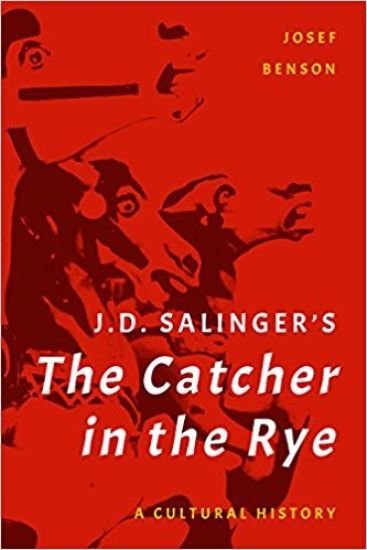
Since its publication in 1951, The Catcher in the Rye has been a cultural phenomenon, not only as an assigned text for English courses, but as a touchstone for generations of alienated youth. As the focus of recent major films and a successful off-Broadway play attest, J.D. Salinger and his novel continue to fascinate an American reading public. But who was J.D. Salinger, and how did he come to write a novel whose impact continues to resonate with millions of readers? In J.D. Salinger’s The Catcher in the Rye: A Cultural History, Josef Benson examines the legacy of an elusive author and his work. After exploring how the novel reflected Salinger’s tortured psyche, the study discusses how the book made an impact on multiple generations of readers—from 1960s counter-culture youth and followers of the Black Power movement of the 1970s to the disenfranchised teens of the Reagan era and the celebrity-fixated masses of the present day. Benson also unravels the mystery behind Salinger’s reclusiveness, the effects the novel had on the reading public who adored it, and why three American assassins cited the novel as an inspiration. The author also considers why this work of fiction has been among the most widely taught—and most frequently banned—books of all time. By looking at the novel as both an artifact of the 1950s as well as a living testament to the turmoil of teenage angst, J.D. Salinger’s The Catcher in the Rye provides a riveting discussion of one of the most enigmatic novels and authors of all time.