It'll take more than medals to mend their relationship.Diabetic gymnast and team alternate Sol Ashvili had one thing on his agenda when the 2016 Rio Olympics wrapped up-confess to his teammate and best friend Tony Thomas that he'd been in love with him for years. But Tony took a major deduction in Sol's heart when he jetted out of Rio and turned his back on an almost-finished college degree, international gymnastics meets... and Sol. The first two Sol could forgive-barely. The last? Not a chance.Tony's crowd-pleasing, no-holds-barred, high-octane gymnastics style stole its nickname from a legendary gymnastics move-the Thomas Flair. After the 2016 Games, he vaulted into a career as an internet celebrity, specializing in extreme sports and risky stunts. When Tony decides to battle his way into competition shape to earn a spot on the 2020 Olympic team, he has to survive the most extreme risk of all: facing Sol again.For the sake of the team and the reputation of US men's gymnastics, Sol and Tony must leave the past behind and get a grip on working together. And as the Games draw closer, they realize that being more than teammates might be the only way they can truly fly high and stick the landing.
Religion is usually thought of as inconsequential to contemporary Canadian politics. Religion and Canadian Party Politics takes a hard look at just how much influence faith continues to have in federal, provincial, and territorial political arenas.Drawing on case studies from across the country, this book explores three important axes of religiously based contention in Canada. Early on, there were the denominational distinctions between Catholics and Protestants that shaped party oppositions. Since the 1960s, a newly politicized divide opened between religious conservatives and political reformers. Then from the 1990s on, sporadic controversy has centred on the recognition of non-Christian religious minority rights. Although the extent of partisan engagement with each of these sources of conflict has varied across time and region, this book shows that religion still matters in shaping party politics .This detailed look at the play of religiously based conflict and accommodation in Canada fills a large gap and pulls us back from overly simplified comparisons with the United States. More broadly, this book also compares the role of faith in politics in Canada to that of other Western industrialized societies.
Religion is usually thought of as inconsequential to contemporary Canadian politics. Religion and Canadian Party Politics takes a hard look at just how much influence faith continues to have in federal, provincial, and territorial political arenas.Drawing on case studies from across the country, this book explores three important axes of religiously based contention in Canada. Early on, there were the denominational distinctions between Catholics and Protestants that shaped party oppositions. Since the 1960s, a newly politicized divide opened between religious conservatives and political reformers. Then from the 1990s on, sporadic controversy has centred on the recognition of non-Christian religious minority rights. Although the extent of partisan engagement with each of these sources of conflict has varied across time and region, this book shows that religion still matters in shaping party politics .This detailed look at the play of religiously based conflict and accommodation in Canada fills a large gap and pulls us back from overly simplified comparisons with the United States. More broadly, this book also compares the role of faith in politics in Canada to that of other Western industrialized societies.
The story is set in the 1830s at Rugby School, a public school for boys. Hughes attended Rugby School from 1834 to 1842. The novel was originally published as being "by an Old Boy of Rugby", and much of it is based on the author's experiences. Tom Brown is largely based on the author's brother George Hughes. George Arthur, another of the book's main characters, is generally believed to be based on Arthur Penrhyn Stanley. The fictional Tom's life also resembles the author's, in that the culminating event of his school career was a cricket match. 3] The novel also features Dr Thomas Arnold (1795-1842), who was the actual headmaster of Rugby School from 1828 to 1841. Tom Brown's School Days has been the source for several film and television adaptations. It also influenced the genre of British school novels, which began in the nineteenth century, and led to fictional depictions of schools such as Billy Bunter's Greyfriars School, Mr Chips' Brookfield, St. Trinian's, and Harry Potter's Hogwarts. A sequel, Tom Brown at Oxford, was published in 1861.Tom Brown is energetic, stubborn, kind-hearted and athletic, rather than intellectual. He follows his feelings and the unwritten rules of the boys. The early chapters of the novel deal with his childhood at his home in the Vale of White Horse. Much of the scene setting in the first chapter is deeply revealing of Victorian England's attitudes towards society and class, and contains a comparison of so-called Saxon and Norman influences on England. This part of the book, when young Tom wanders the valleys freely on his pony, serves as a contrast with the hellish experiences in his first years at school. His first school year is at a local school. His second year starts at a private school, but due to an epidemic of fever in the area, all the school's boys are sent home, and Tom is transferred mid-term to Rugby School. On his arrival, the eleven-year-old Tom Brown is looked after by a more experienced classmate, Harry "Scud" East. Tom's nemesis at Rugby is the bully Flashman. The intensity of the bullying increases, and, after refusing to hand over a sweepstake ticket for the favourite in a horse race, Tom is deliberately burned in front of a fire. Tom and East defeat Flashman with the help of Diggs, a kind, comical, older boy. In their triumph they become unruly........ Edmund Joseph Sullivan (1869-1933), usually known as E. J. Sullivan, was a British book illustrator who worked in a style which merged the British tradition of illustration from the 1860s with aspects of Art Nouveau. Louis John Rhead (November 6, 1857 - July 29, 1926) was an English-born American artist, illustrator, author and angler who was born in Etruria, Staffordshire, England. He emigrated to the United States at the age of twenty-four. William Dean Howells ( March 1, 1837 - May 11, 1920) was an American realist novelist, literary critic, and playwright, nicknamed "The Dean of American Letters". He was particularly known for his tenure as editor of The Atlantic Monthly, as well as for his own prolific writings, including the Christmas story "Christmas Every Day" and the novels The Rise of Silas Lapham and A Traveler from Altruria.... Thomas Hughes QC (20 October 1822 - 22 March 1896) was an English lawyer, judge, politician and author. He is most famous for his novel Tom Brown's School Days (1857), a semi-autobiographical work set at Rugby School, which Hughes had attended. It had a lesser-known sequel, Tom Brown at Oxford (1861). Hughes had numerous other interests, in particular as a Member of Parliament, in the British co-operative movement, and in a settlement in Tennessee reflecting his values.....
Letters of General J. E. B. Stuart to His Wife, 1861 is a collection of personal correspondence written by Confederate General James Ewell Brown Stuart to his wife Flora during the early months of the American Civil War. The letters provide insight into Stuart's thoughts, emotions, and experiences as he served in the Confederate Army and participated in several key battles, including the First Battle of Bull Run. Stuart's letters also offer a glimpse into the daily life of a Confederate soldier and his relationships with fellow officers and soldiers. The book is a valuable primary source for historians and Civil War enthusiasts interested in the personal experiences of Confederate soldiers and their families.This scarce antiquarian book is a facsimile reprint of the old original and may contain some imperfections such as library marks and notations. Because we believe this work is culturally important, we have made it available as part of our commitment for protecting, preserving, and promoting the world's literature in affordable, high quality, modern editions, that are true to their original work.
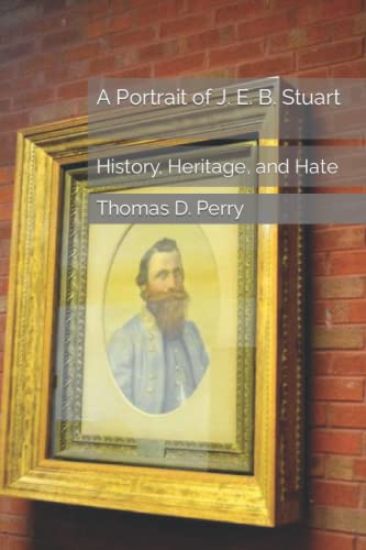
Historian Thomas D. "Tom" Perry tells the story of James Ewell Brown "Jeb" Stuart, both from Patrick County, Virginia, and the controversy in 2015 when the portrait of Stuart was taken down from the Patrick County Courthouse. The ensuing controversy brought media attention and a discussion of the history relating to Confederate History and the Civil War. The portrait eventually found its way to the Wall of Honor in the Patrick County Administration Building in Stuart, Virginia. This book continues with the controversies surrounding J. E. B. Stuart High School in Fairfax, Virginia, and the controversy surrounding J. E. B. Stuart's statue on Monument Avenue in Richmond. This book is a portrait of the man who was James Ewell Brown "Jeb" Stuart and the modern times that reflect on the history he embodies.
Historian Thomas D. "Tom" Perry tells the story of Civil War General James Ewell Brown "Jeb" Stuart's ancestors who fought in the American Revolution. Alexander Stuart fought at the Battle of Guilford Courthouse with Nathaniel Greene. William Letcher lost his life at the hands of Tories on the Laurel Hill Farm in Ararat, Patrick County, Virginia, where over fifty years later J. E. B. Stuart was born. The Laurel Hill Farm known as Stuart's Birthplace is part of a 75 acre park preserving the history of the family that has fought in almost every war this country has participated.




![Account of the Centennial Celebration of the Town of West Springfield, Mass. ... with the Historical Address of Thomas E. Vermilye ... the Poem of Mrs. Ellen P. Champion, Etc. [With Plates, Including Portraits.]](/covers/9781241435417.jpg)