
Kirjahaku
Etsi kirjoja tekijän nimen, kirjan nimen tai ISBN:n perusteella.
1000 tulosta hakusanalla J.M. Coetzee

J.M. Coetzee's Disgrace. A Realistic Criticism of 'New' South-Africa?
Niklas Manhart
Grin Publishing
2012
nidottu
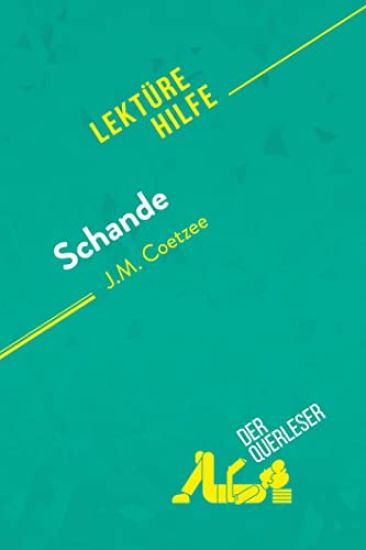
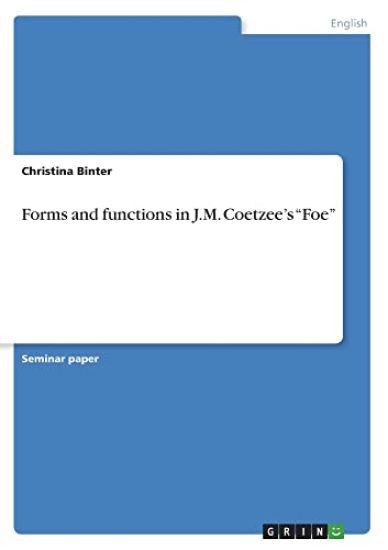

Seminar paper from the year 2006 in the subject English Language and Literature Studies - Literature, grade: 1,0, University of Vienna (Institut f r Anglistik und Amerikanistik), course: Introductory Seminar Literature (year 2), 32 entries in the bibliography, language: English, abstract: The main aim of this paper is to discuss metafiction in J. M. Coetzee's Foe (1986), which is a rewriting of Daniel Defoe's literary classic Robinson Crusoe (1719). I shall deal with the intersection of postcolonialism and postmodernism in Coetzee's works, give (a) brief definition(s) of metafiction and consider the origins of this term and its general functions. I will finally take a rather detailed look at metafiction and the discourse of power in Coetzee's deconstruction of the Crusoe myth.

"Schande" als Schlüsselwort in J.M. Coetzees Roman "Disgrace"
Lea Lorena Jerns
Grin Publishing
2014
pokkari
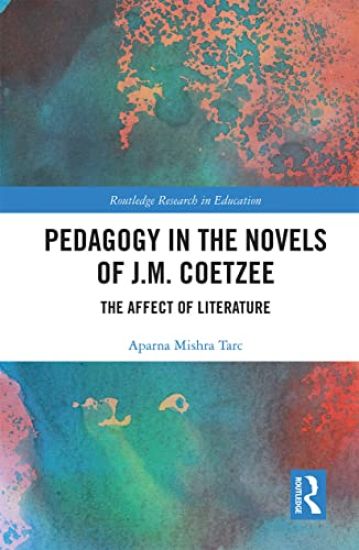
Critically analyzing the representation of pedagogy in the novels of J.M. Coetzee, this insightful text illustrates the author’s profound conception of learning and personal development as something which takes place well beyond formal education.Bringing together critical and educational theory, Pedagogy in the Novels of J.M. Coetzee examines depictions of pedagogy in novels including Age of Iron, Elizabeth Costello, Disgrace, and Childhood of Jesus. Engaging with Coetzee’s varied literary use of pedagogical themes such as motherhood, maternal love, and the importance of childhood interactions, reading, and experiences, chapters demonstrate how Coetzee foregrounds pedagogy as intrinsic to the formation of human actors, society, and civilization. The text thereby aptly explores and broadens our understanding of education - what it is, what it achieves, and how it can affect and shape human existence. This text will be of great interest to graduate and postgraduate students, academics, researchers and professionals in the fields of pedagogy, postcolonial studies, educational theory and philosophy, and English literature.

Critically analyzing the representation of pedagogy in the novels of J.M. Coetzee, this insightful text illustrates the author’s profound conception of learning and personal development as something which takes place well beyond formal education.Bringing together critical and educational theory, Pedagogy in the Novels of J.M. Coetzee examines depictions of pedagogy in novels including Age of Iron, Elizabeth Costello, Disgrace, and Childhood of Jesus. Engaging with Coetzee’s varied literary use of pedagogical themes such as motherhood, maternal love, and the importance of childhood interactions, reading, and experiences, chapters demonstrate how Coetzee foregrounds pedagogy as intrinsic to the formation of human actors, society, and civilization. The text thereby aptly explores and broadens our understanding of education - what it is, what it achieves, and how it can affect and shape human existence. This text will be of great interest to graduate and postgraduate students, academics, researchers and professionals in the fields of pedagogy, postcolonial studies, educational theory and philosophy, and English literature.

Re-imagining the Animal in J.M. Coetzee's 'The Lives of Animals'. Unsettling Boundaries of Representation
Amy Wattam
GRIN Verlag
2021
nidottu
In this volume, Nashef looks at J.M. Coetzee's concern with universal suffering and the inevitable humiliation of the human being as manifest in his novels. Though several theorists have referred to the theme of human degradation in Coetzee’s work, no detailed study has been made of this area of concern especially with respect to how pervasive it is across Coetzee’s literary output to date. This study examines what J.M. Coetzee's novels portray as the circumstances that contribute to the humiliation of the individual--namely the abuse of language, master and slave interplay, aging and senseless waiting--and how these conditions can lead to the alienation and marginalization of the individual.
In this volume, Nashef looks at J.M. Coetzee's concern with universal suffering and the inevitable humiliation of the human being as manifest in his novels. Though several theorists have referred to the theme of human degradation in Coetzee’s work, no detailed study has been made of this area of concern especially with respect to how pervasive it is across Coetzee’s literary output to date. This study examines what J.M. Coetzee's novels portray as the circumstances that contribute to the humiliation of the individual--namely the abuse of language, master and slave interplay, aging and senseless waiting--and how these conditions can lead to the alienation and marginalization of the individual.
Literary Spaces in the Selected Works of J.M. Coetzee
Katarzyna Karwowska
Peter Lang AG
2014
sidottu
This book closely examines the processes governing the construction of literary spaces in the selected works of J.M. Coetzee, focusing in particular on the writer’s subversive and destructive treatment of traditional modes of representation which participated in the imperial enterprise and served to overcome the ontological insecurity of colonisers. This strategy results in the formation of heterogenous, fluid and open locations which can be deciphered along the postmodern spatial theories of Foucault, Augé, Deleuze and Guattari. The transformation of topographies not only cleanses them of the conventional residue in preparation for alternative spatial rearrangements, but also initiates processes which reverse the colonising project by breaching the gap between the other and the self.
Virtue Rewarded - The Development of Moral Behaviour in J.M. Coetzee's 'Disgrace' and Henry Mackenzie's 'The Man of Feeling'
Claudia Jahn
Grin Publishing
2009
pokkari

Kompromiss im Grauen - Zur Differenzierung der Kolonialismuskritik in J.M. Coetzees Romanen "Waiting for the Barbarians", "Foe" und "Disgrace"
Sofie Renner
Grin Publishing
2008
pokkari

Revisiting the South Africa of half a century ago, the author writes about his childhood and interior life, evoking the tensions, delights and terrors of childhood with startling, haunting immediacy. 'Boyhood is a deeply-felt and utterly compelling account of a South African childhood: the narrative style is as spare and lean as the Karoo flatlands which form its backdrop' Daily Telegraph
Reissue in Vintage. A specialist in pyschological warefare is driven to braekdown and madness by the stressed of a project of macabre ingenuity to win the war in Vietnam. A meglomaniac Boer frontiersman wreaks hideous vengence on a Hottentot tribe for undermining the 'natural' order of his universe with their anarchic rival order,mocking him and subjecting him to the humiliations of his own all too palpable flesh. Both the 18th century Jacobus Coetzee and the 20ht century Euguene Dawn are in the business of pushing back the frontiers of knowledge and are dealers in death who denounce their own humanity and spurn their feelings of guilt. With immense power and economy in these two narratives,coetzee has crystalized in their absurdity and horror,the extremes of scientific evangelism and heroic exploration.
Winner of the 1999 Booker Prize. Paperback edition. After years teaching Romantic poetry at the Technical University of Cape Town, David Lurie, middle-aged and twice divorced has an impulsive affair with a student. The affair sours; he is denounced and summoned before a committee of inquiry. Willing to admit his guilt, but refusing to yield to pressure to repent publicly, he resigns and retreats to daughter Lucy’s isolated smallholding. For a time, his daughter’s influence and the natural rhythms of the farm promise to harmonise his discordant life. But the balance of power in the country is shifting. He and Lucy become victims of a savage and disturbing attack which brings into relief all the faultlines in their relationship.

J. M. Coetzee is, without question, one of the world's greatest novelists. This volume gathers together for the first time in book form twenty-nine pieces on books, writing, photography and the 1995 Rugby World Cup in South Africa. Stranger Shores opens with 'What is a Classic?' in which Coetzee explores the answer to his own question - 'What does it mean in living terms to say that the classic is what survives?' - by way of TS Eliot, JS Bach and Zbigniew Herbert. His subjects range from eighteenth and nineteenth century writers Daniel Defoe, Samuel Richardson and Ivan Turgenev, to the great German modernists Rilke, Kafka, and Musil, to the giants of late twentieth century literature, among them Harry Mulisch, Joseph Brodsky, Jorge Luis Borges, Salman Rushdie, Amos Oz, Naguib Mahfouz, Nadine Gordimer and Doris Lessing.

Youth's narrator, a student in 1950s South Africa, has long been plotting an escape from his native country. Studying mathematics, reading poetry, saving money, he tries to ensure that when he arrives in the real world he will be prepared to experience life to its full intensity, and transform it into art.