Kirjojen hintavertailu. Mukana 11 244 527 kirjaa ja 12 kauppaa.

Kirjahaku

Etsi kirjoja tekijän nimen, kirjan nimen tai ISBN:n perusteella.

1000 tulosta hakusanalla JOHN DAVIES

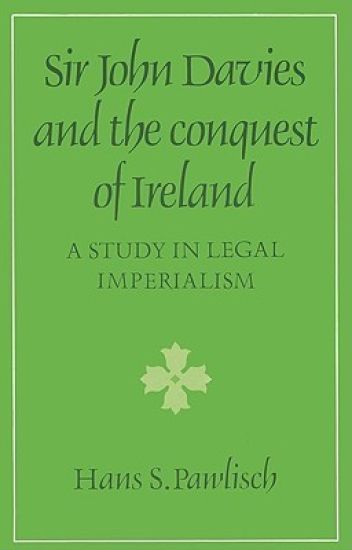
Sir John Davies and the Conquest of Ireland

Sir John Davies and the Conquest of Ireland

Hans S. Pawlisch

Cambridge University Press
2002
pokkari
This study examines the Law Reports of Sir John Davies and litigation pleaded before the central Irish courts during the period in which Davies served in Ireland as solicitor-general (1603–6) and attorney-general (1606–19). The author’s main concern is to explicate the legal and jurisprudential issues involved and to draw out their deeper political implications. He argues that, in the absence of a malleable parliament, judge-made law became the instrument by which the Jacobean regime consolidated the Tudor conquest. The book also touches on the influence of the implementation of the law on the Irish coinage, Gaelic tenurial customs and religious conformity. More controversial themes include the origins of precedent in the Anglo-American legal tradition, the use of continental civil law in common law litigation and the relationship of early modern Ireland to the development of an imperial jurisprudence.
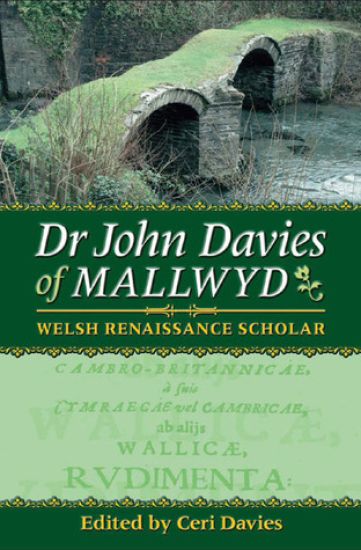
Dr John Davies of Mallwyd

Dr John Davies of Mallwyd

University of Wales Press
2004
sidottu
Dr John Davies of Mallwyd (c. 1567-1644) was the greatest scholar of the later Renaissance period in Wales. He was an industrious collector and copyist of manuscripts and his work in preserving bardic vocabulary established the basis for a scientific study of the Welsh language. This book, whose publication coincides with the 400th anniversary of John Davies's installation as rector of Mallwyd, examines his varied and remarkably rich contribution - as biblical translator and pastor, as grammarian and lexicographer, and as one who strove to promote the standing and dignity of the language and literary heritage of his native Wales within the context of a wider Renaissance humanism.
Shakespeare, 'A Lover's Complaint', and John Davies of Hereford
When Shakespeare's Sonnets were published in 1609 a poem called A Lover's Complaint was included by the publisher, Thomas Thorpe, who was notorious for several irregular publications. Many scholars have doubted its authenticity, but recent editions of the Sonnets have accepted it as Shakespeare's work. Now Vickers, in this text, the first full study of the poem, shows it to be un-Shakespearian both in its language and in its attitude to women. It is awkwardly constructed and uses archaic Spenserian diction, including many unusual words that never occur in Shakespeare. It frequently repeats stock phrases and rhymes, distorts normal word order far more often and more clumsily than Shakespeare did, while its attitude to female frailty is moralizing and misogynistic. By close analysis Vickers attributes the poem to John Davies of Hereford (1565–1618), a famous calligrapher and writing-master who was also a prolific poet. Vickers' book will re-define the Shakespeare canon.
Shakespeare, 'A Lover's Complaint', and John Davies of Hereford
When Shakespeare's Sonnets were published in 1609 a poem called A Lover's Complaint was included by the publisher, Thomas Thorpe, who was notorious for several irregular publications. Many scholars have doubted its authenticity, but recent editions of the Sonnets have accepted it as Shakespeare's work. Now Vickers, in this text, the first full study of the poem, shows it to be un-Shakespearian both in its language and in its attitude to women. It is awkwardly constructed and uses archaic Spenserian diction, including many unusual words that never occur in Shakespeare. It frequently repeats stock phrases and rhymes, distorts normal word order far more often and more clumsily than Shakespeare did, while its attitude to female frailty is moralizing and misogynistic. By close analysis Vickers attributes the poem to John Davies of Hereford (1565–1618), a famous calligrapher and writing-master who was also a prolific poet. Vickers' book will re-define the Shakespeare canon.
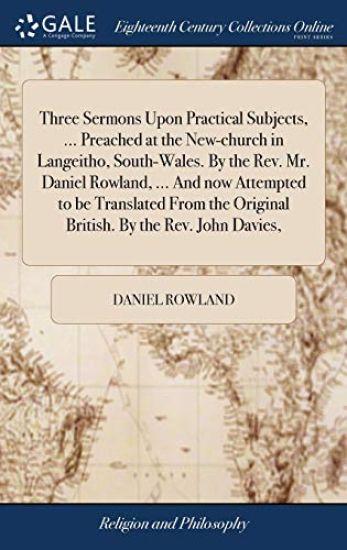
Three Sermons Upon Practical Subjects, ... Preached at the New-church in Langeitho, South-Wales. By the Rev. Mr. Daniel Rowland, ... And now Attempted to be Translated From the Original British. By the Rev. John Davies,
The 18th century was a wealth of knowledge, exploration and rapidly growing technology and expanding record-keeping made possible by advances in the printing press. In its determination to preserve the century of revolution, Gale initiated a revolution of its own: digitization of epic proportions to preserve these invaluable works in the largest archive of its kind. Now for the first time these high-quality digital copies of original 18th century manuscripts are available in print, making them highly accessible to libraries, undergraduate students, and independent scholars.The Age of Enlightenment profoundly enriched religious and philosophical understanding and continues to influence present-day thinking. Works collected here include masterpieces by David Hume, Immanuel Kant, and Jean-Jacques Rousseau, as well as religious sermons and moral debates on the issues of the day, such as the slave trade. The Age of Reason saw conflict between Protestantism and Catholicism transformed into one between faith and logic -- a debate that continues in the twenty-first century.++++The below data was compiled from various identification fields in the bibliographic record of this title. This data is provided as an additional tool in helping to insure edition identification: ++++British LibraryT091019London: printed for the editor, Thomas Davies: sold also by J. Buckland; W. Watts; J. Mathews; and T. Vallance; also in Bristol by Mills, Powell, and Hill; Crawford, Dublin; and by most booksellers in town and country, 1778. 2],98p.; 12