Kirjojen hintavertailu. Mukana 11 244 527 kirjaa ja 12 kauppaa.

Kirjahaku

Etsi kirjoja tekijän nimen, kirjan nimen tai ISBN:n perusteella.

1000 tulosta hakusanalla James C. Blocker

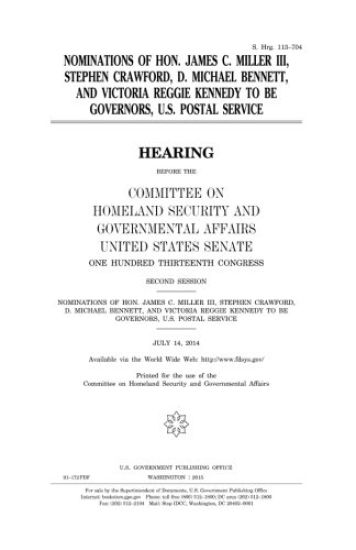
Nominations of Hon. James C. Miller, III, Stephen Crawford, D. Michael Bennett, and Victoria Reggie Kennedy to be Governors, U.S. Postal Service

Nominations of Hon. James C. Miller, III, Stephen Crawford, D. Michael Bennett, and Victoria Reggie Kennedy to be Governors, U.S. Postal Service

United States Senate; Committee on Homeland Secu Governmental; United States Congress

Createspace Independent Publishing Platform
2017
nidottu
Nominations of Hon. James C. Miller, III, Stephen Crawford, D. Michael Bennett, and Victoria Reggie Kennedy to be Governors, U.S. Postal Service: hearing before the Committee on Homeland Security and Governmental Affairs, United States Senate, One Hundred Thirteenth Congress, second session: nominations of Hon. James C. Miller, III, Stephen Crawford, D. Michael Bennett, and Victoria Reggie
Preaching the Psalms / J. Clinton Mccann, Jr. & James C. Howell.
This book is designed to help preachers find and use the riches of the Psalms for preaching. The authors address the perception that the Psalms often go neglected in preparing for one of the central acts of worship: preaching. McCann and Howell demonstrate that the Psalms offer the preacher broad, rich possibilities for the congregation s engagement with the Scripture. Each chapter concludes with a brief sample."
James's Will-To-Believe Doctrine

James's Will-To-Believe Doctrine

James C.S. Wernham

McGill-Queen's University Press
1997
sidottu
In 1896 William James published an essay entitled The Will to Believe, in which he defended the legitimacy of religious faith against the attacks of such champions of scientific method as W.K. Clifford and Thomas Huxley. James's work quickly became one of the most important writings in the philosophy of religious belief. James Wernham analyses James's arguments, discusses his relation to Pascal and Renouvier, and considers the interpretations, and misinterpretations, of James's major critics. Wernham shows convincingly that James was unaware of many destructive ambiguitities in his own doctrines and arguments, although clear and consistent in his view that our obligation to believe in theism is not a moral but a prudential obligation -- a foolish-not-to-believe doctrine, rather than a not-immoral-to-believe one. Wernham also shows that the doctrine is best read as affirming the wisdom of gambling that God exists, a notion which James failed to distinguish from believing and which, among other things, he explicitly identified with faith. James's pragmatism, a theory concerning the meaning of truth, is shown to be quite distinct from the doctrine of The Will to Believe. In concentrating on a careful analysis of this doctrine of the will-to-believe, Wernham not only makes a major contribution to understanding James's philosophy, but also clarifies issues in the philosophy of religion and in the analysis of belief and faith.