Kirjojen hintavertailu. Mukana 11 699 587 kirjaa ja 12 kauppaa.

Kirjahaku

Etsi kirjoja tekijän nimen, kirjan nimen tai ISBN:n perusteella.

1000 tulosta hakusanalla James T. Culbertson

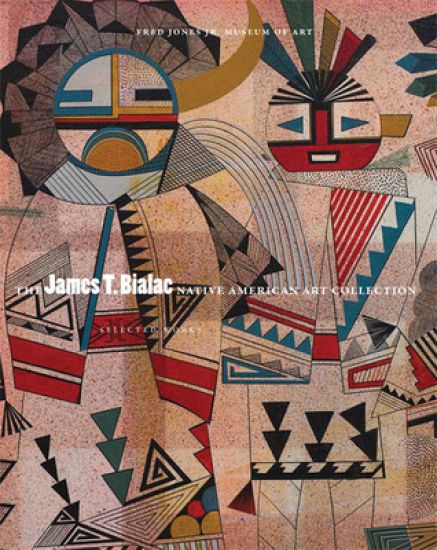
The James T. Bialac Native American Art Collection

The James T. Bialac Native American Art Collection

Fred Jones Jr. Museum of Art

University of Oklahoma Press
2012
nidottu
One of the most important collections of modern Native American art assembled by one individual, the James T. Bialac Native American Art Collection is an encyclopedic compilation of easel paintings and three-dimensional works. Showcased in this stunning catalogue, the collection comprises nearly four thousand items, including drawings, sculptures, prints, kachinas, jewelry, ceramics, rattles, baskets, and textiles.James T. Bialac began collecting art in the 1950s, when he was a student at the University of Arizona School of Law. It was then that he purchased the first of what would develop into a collection of more than one thousand kachina dolls. In 1964 he acquired his first painting, Robert Chee's Moccasin Game, and he went on to expand his collection to reflect the diversity of Native American art forms. Inspired by his connections with other collectors, Bialac learned the importance of documenting, cataloging, and preserving his collection. In 2010 he bequeathed the collection to the University of Oklahoma, where the art will be displayed at the Fred Jones Jr. Museum of Art, as well as at other locations, including Bialac's native Arizona.The Bialac Collection represents indigenous cultures across North America, especially the Pueblos of the Southwest, Navajos, Hopis, and many of the tribes of the Great Plains. It encompasses such important and innovative artists as Fred Kabotie, Alfonso Roybal, Fritz Scholder, Joe Hilario Herrera, Allan Houser, Jerome Tiger, Tonita Peña, Helen Hardin, Pablita Velarde, George Morrison, Walter Richard ""Dick"" West, and Patrick DesJarlait, all of whose work is featured in this volume.Along with its rich sampling of works from the Bialac Collection, this catalogue offers informative essays by art historians, who draw on their areas of expertise to explain the significance of the artwork. The volume also features a foreword by David L. Boren, President of the University of Oklahoma, a preface by Ghislain d'Humières, Director of the Fred Jones Jr. Museum of Art, and an introduction by Mary Jo Watson, Director of the School of Art and Art History.Published in cooperation with the Fred Jones Jr. Museum of Art, University of Oklahoma.
The Diary of James T. Ayers

The Diary of James T. Ayers

Louisiana State University Press
1999
nidottu
A white Kentuckian, itinerant Methodist preacher, and antislavery spokesman, James T. Ayers moved to Illinois before the Civil War and, though nearly fifty-seven years old, enlisted in an Illinois regiment in 1862. In February 1864, he was dispatched as a recruiter for the U.S. Colored Troops in the Tennessee Valley and began this diary recounting his experiences, including his recruiting tactics, the difficulties he en-countered in enemy territory, and the lack of interest on the part of many slaves and freedmen in joining the U.S. Colored Troops.Edited by John Hope Franklin, who conducted impressive research in then little-used sources at the National Archives, Ayers's diary documents more than the black recruiting process. It also candidly reveals the complex attitudes of a northern white preacher regarding the war, race, and the Confederacy. For this edition, Franklin provides a preface and John David Smith offers a new introduction, explaining why Ayers's poignant text remains a telling and important source in contemporary scholarship.
A Bibliography of James T. Farrell's Writings, 1921-1957

A Bibliography of James T. Farrell's Writings, 1921-1957

Edgar M. Branch

University of Pennsylvania Press
1959
sidottu
"I need an audience--so watch out!" With these James T. Farrell announced his intention of becoming a writer. He was to realize this ambition in manifold ways through his prolificacy, versatility, and his achieved recognition as a formidable figure in American literature. The material contained in this book grew out of initial research for a critical study which disclosed the chaotic state of Farrell's literary affairs and the urgent need for a bibliography. The task was not to be an easy one, for many of Farrell's writings were printed in obscure publications both in the United States and abroad. Edgar M. Branch has ferreted out, producing his compilation with enthusiasm and accuracy. This book is a definitive guide to Farrell's writings published in newspapers, magazines, pamphlets, and books, from the time of his high­school days through 1957. It includes both the fiction (novels, short stories, one poem, and one play) and the nonfiction (essays, articles, statements, manifestoes, newspaper columns, etc.), and in many cases descriptions of these writing are appended when deemed necessary. As a further aid to students and researchers, Branch has listed many reprints and dates of writing for the individual short stories and has provided two appendices giving foreign editions of books and tape recordings of unpublished speeches. This detailed bibliography, the first on Farrell ever printed, is supplemented by a preface by Farrell and a foreword by the author. Edgar Branch has directed his attention to the more inaccessible of Farrell's writings and to the clarification of the voluminous abundance of written material that Farrell has produced. Through this book it is possible to trace Farrell's fluctuating status as a writer, his shifting position among editors, critics, and readers. The data included other clues to the evolution and growth of his ideas and relationships with his contemporaries, providing insight into his changing political affiliations and the motivation and development of his fiction. A Bibliography of ]ames T. Farrell's Writings will be a valuable practical aid to scholars and students of literature and Americana, for it makes available a scholarly compilation of the extensive list of writings by one of America's most distinguished and controversial contemporary writers.
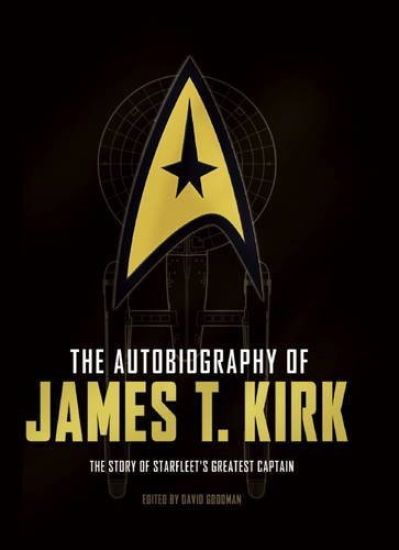
The Autobiography of James T. Kirk

The Autobiography of James T. Kirk

David A. Goodman

Titan Books Ltd
2015
sidottu
The Autobiography of James T. Kirk chronicles the greatest Starfleet captain's life (2233-2371), in his own words. From his youth spent on Tarsus IV, his time in the Starfleet Academy, his meteoric raise through the ranks of Starfleet, and his illustrious career at the helm of the Enterprise, this in-world memoir uncovers Captain Kirk in a way Star Trek fans have never seen.
The Autobiography of James T. Kirk

The Autobiography of James T. Kirk

David A. Goodman

Titan Books Ltd
2016
pokkari
The Autobiography of James T. Kirk chronicles the greatest Starfleet captain's life (2233-2293), in his own words. From his birth on the U.S.S. Kelvin, his youth spent on Tarsus IV, his time in the Starfleet Academy, his meteoric raise through the ranks of Starfleet, and his illustrious career at the helm of the Enterprise, this in-world memoir uncovers Captain Kirk in a way Star Trek fans have never seen.
America Stabbed James T Kirk in the Arm with a #2 Pencil

America Stabbed James T Kirk in the Arm with a #2 Pencil

Jeanette Powers

Kung Fu Treachery Press
2018
nidottu
A brutal and funny poetic journey about the pain of state and womanhood, political and personal revolving around the itinerary of corporate America. The book centers (barely) on an episode of Star Trek entitled "Journey to Babel". This is not a fan-book though, it is a staggeringly triggering anarcho-feminist manifesto.This is Jeanette Powers' 8th book of poetry. Previous titles include "Don't Lose Your Head" by EMP Books 2017, "Perfectly Good Muses: the collected apologies of Jeanette Powers" by Spartan Press 2017, and "Gasconade" by NightBallet Press 2018. Visit their website at jeanettepowers.com
2 Short Stories for Your Coffee Break: Jean-Marie LeClair and James T. Kirk
Jean-Marie Leclair was an unsolved murder mystery of the 18th century. He should not have been known for that. He founded the French school of violin. But he was stabbed in the back and neck 3 times, killed in the vestibule of his own home in 1764. He was a great violinist and composer for King Louis XV of France. No one was ever arrested, not Louise Roussel, his ex-wife, who did the engraving of his compositions for him, and not the envious nephew, Guillaume-Fran ois Vial, who wanted his uncle to promote him to the KIng. Nobody was ever brought to justice. In the meantime, fast forward to the year 2328, and the task which Captain James T. Kirk has been assigned to bring back to the future 6 of the best violinists of all time to have a fiddle contest at the Hollywood Bowl. The slight hitch is that the Captain with Montgomery Scott's help needs to go back to 1901 and borrow H. G. Wells' Time Machine. One of the contenders in the Battle of the Violins is, of course, Jean-Marie Leclair
For, from, About James T.Whitehead
When James T. Whitehead (or 'Big Jim', as friends knew him) passed away in 2003, Fayetteville and the University of Arkansas lost one of its finest poets and beloved teachers. In 1965, Whitehead joined with his friend William Harrison to found the University's Creative Writing Program. He taught in that nationally prestigious program for the next thirty-four years, from 1965 to 1999. He was a recipient of a Guggenheim Fellowship in fiction and a Robert Frost Fellowship in poetry. Whitehead's novel, ""Joiner"" (University of Arkansas Press), was listed among the ""New York Times""' Noteworthy Books of 1971. His many poetry collections include ""Domains"" (1967), ""Local Men"" (1979), and ""Near at Hand"" (1993). With his untimely passing, Whitehead left a large body of work unpublished. In this anthology of original poetry, short fiction, essays, and remembrances, twenty-four of Whitehead's colleagues, students, and friends join in celebrating the man's life and contribution to American letters. Included are posthumous works by Whitehead himself: six poems, an excerpt of creative nonfiction, and a draft-excerpt from ""Coldstream"", projected sequel to ""Joiner"".
Stories I Tell My Family and Friends: The Memoirs of U.S. Senator James T. Broyhill
The personal memoirs of U.S. Senator James T. Broyhill (R-NC) recounting stories from his 95 years of family life and public life of service to the citizens of North Carolina and the nation as a U.S. Congressman and Senator for 24 years from 1963-1984 and thereafter as Secretary of Commerce for the State of North Carolina. He recounts in first-person about growing up in Lenoir, working jobs after school and weekends, going off to the University of North Carolina where he met Louise Robbins, his bride of 73 years. He shares about his work life at Broyhill Furniture Industries, his introduction to politics and his experiences in Washington, D. C, and abroad across two-and-a-half decades of public service. He shares his thoughts on Statesmanship, Friendship, and presents in delightful detail a talk he enjoyed presenting, "Presidents I Have Known." Added to his reminiscences and commentary are recollections and appreciations from those who worked with him and for him. As well, this volume includes the eulogies delivered at his funeral and published tributes at his passing which confirm that Senator James T. Broyhill left a legacy of service to his constituents which set him apart notably from other elected officials and explain why he, as a leader in the Republican Party, was lauded and loved by many, and most especially by his extensive family of children, grandchildren, and great-grandchildren.
A Dog Lover's Retirement Rescue: Salvation For Those Who Didn't Bury Enough Bones
For sure you would be a lot further along with your retirement plans if only the earning process, along with the discipline of saving retirement dollars was as much fun as just playing around with a litter of happy, cuddly, joyful puppies. Well, it can be. If you are a dog lover, and believe that life begins at retirement, then here is a book that explains in detail not only how simple it is to operate a small one- or- two- dog breeding kennel, but accounts for how easy it is to apply these revenues to supplement the financial security of your senior years. Income from the breeding and selling of cute little bundles of warmth and love soon translate into dollars and cents to be cashed for those senior years. If you are like most Americans, you haven't buried enough bones to support your retirement years; so your choices are to continue the steady grind, retire and flip burgers part time, win the lottery or enjoy your golden years with your favorite pal...your dog.