In July 1953, U.S. and North Korean military officials signed an armistice at Panmunjom ending hostilities-but without a permanent peace on the Korean peninsula. Demobilization of the armed forces began almost immediately, following much the same pattern shortly after World War II. This military decrease was across the board and keenly felt by the Navy Medical Department.The authorized ratio of medical officers to active duty troop strength was cut in half. Between 1953 And 1954, the Navy lost more than 1,000 physicians-an astonishing 25 percent reduction. For the fleet, reductions meant that battleships went from two medical officers to one; aircraft carriers, from three medical officers to two; and LST (landing ship tank) squadrons, from two physicians to one. Besides personnel cuts, peacetime also meant disestablishing many naval hospitals or, at the very least, downgrading them from hospitals to infirmaries.Despite this retrograde movement in Navy medical personnel and facilities, the Cold War continued. Indochina replaced Korea as the number one hot spot. When French colonial rule in Indochina came to a chaotic end in 1954, following the climactic defeat at Dien Bien Phu, the U.S. Navy helped evacuate 721 French troops and transport them back to their homes in France and North Africa. These pitiful soldiers suffered not only from wounds but also from a variety of jungle diseases and malnutrition. The hospital ship Haven (AH 12), which had already seen action in World War II and four tours during the Korean War, was again pressed into service for the trip. When one of the Legionnaires died en route, "they off -loaded the body in a casket with the French flag draped over it," Navy nurse Anna Corcoran recalled. "That was very, very emotional to watch. Of course, at that time, we didn't know how many of our own would be going home that way from Vietnam. We couldn't have imagined back in 1954 that 10 years later we would be involved just like the French were."
As the Vietnam War reached its tragic climax in the last days of April 1975, a task force of U.S. Navy ships cruised off South Vietnam’s coast. Their mission was to support the evacuation of American embassy personnel and military advisers from Saigon as well as to secure the safety of the South Vietnamese whose lives were in endangered by the North Vietnamese victory. The Lucky Few recounts the role of the USS Kirk in the rescue of remnants of the South Vietnamese fleet and the refugees on board. The story of the Kirk reflects one of America’s few shining moments at the end of the Vietnam War. Now in paperback in time for the 40th anniversary of the end of the war, The Lucky Few brings to life the heroism of Captain Paul Jacobs and the crew of the USS Kirk.
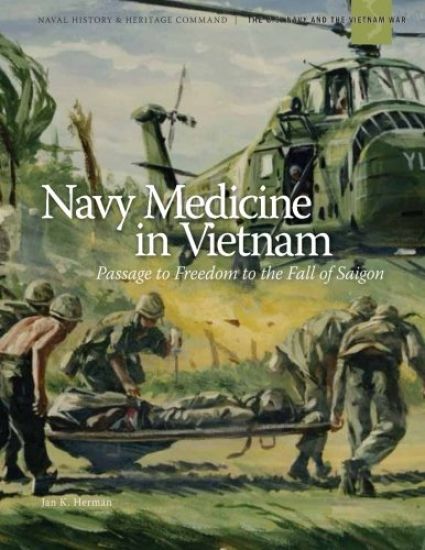
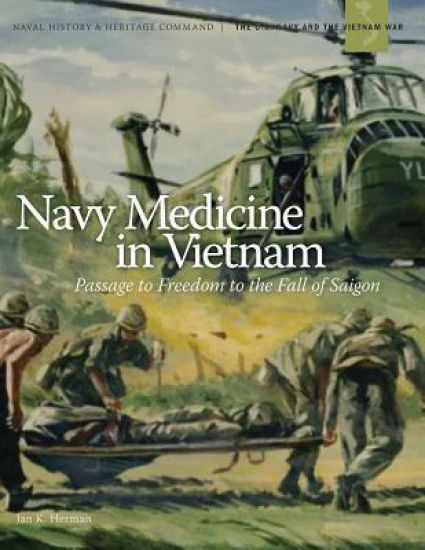
"Navy Medicine "begins and ends with a humanitarian operation---the first, in 1954, after the French were defeated, when refugees fled to South Vietnam to escape from the communist regime in the North; and the second, in 1975, after the fall of Saigon and the final stage of America's exit that entailed a massive helicopter evacuation of American staff and selected Vietnamese and their families from South Vietnam. In both cases Navy provided medical support to avert the spread of disease and tend to basic medical needs. Between those dates, Navy medical personnel responded to the buildup and intensifying combat operations by taking a multi-pronged approach in treating casualties. From medical battalions, which set up combat hospitals in the field, to a new advanced emergency hospital with specialized medicine in Danang, to the floating hospital ships offshore, and to the one individual the Marines counted on most to save them--the corpsman, this story covers them all. Helicopter medical evacuations, triaging, and a system of moving casualties from short-term to long-term care meant higher rates of survival and targeted care. Poignant recollections of the medical personnel serving in Vietnam are a reminder of the great sacrifices these men and women made for their country and their patients.
What do successful assessments look like? According to this team of authors, they provide meaningful assessment data that inform your instruction to help your students reach proficiency in priority standards. With the help of this practical guide, learn how to successfully integrate assessment with the standards-based teaching and learning process to improve student performance and evaluate instructional efficacy. This book will help K-12 teachers and assessment coordinators: Gain clarity on the different roles of assessment throughout the instructional cycle Determine the timing and format of assessments to best support student learning Address test validity, reliability, and fairness Understand collaborative techniques for assessment consistency Access numerous sample assessments from the field Contents: Introduction Chapter 1: The Role and Purpose of Classroom Assessment Chapter 2: Assessment Throughout the Instructional Cycle Chapter 3: Assessment Practices for Consistency and Collaboration Chapter 4: Technical Quality Chapter 5: The Process of Scoring Assessments Chapter 6: The Use of Data From Assessments Chapter 7: Feedback to Students Epilogue References and Resources Index
Discover a clear path for creating and utilizing high-quality proficiency scales. Through this practical handbook, you will gain access to a comprehensive toolkit of strategies, methods, and examples for a variety of content areas and grade levels. The author also outlines an array of accommodations and modifications to support students with disabilities, English learners, and gifted and talented students. Benefits: Understand how to create and use proficiency scales to clearly frame classroom instruction and assessments. Learn how to write high-quality proficiency scales and review how to enrich student learning opportunities. Recognize the various ways teachers, students, and parents can use proficiency scales. Access rubrics, criteria checklists, and pacing guides that you can use in concert with proficiency scales to provide valuable feedback to students. Contents: Introduction Chapter 1: The What and Why of Proficiency Scales Chapter 2: Proficiency Scale Development Chapter 3: Score 4.0--Complex Content Chapter 4: The Use of Proficiency Scales in the Classroom Chapter 5: Scales and Related Tools Chapter 6: Using Scales With Exceptional Learners Chapter 7: Scales for Behaviors That Promote Academic Success Epilogue Appendix A: Example Scales Appendix B: Common Scale Templates With Examples Appendix C: Scale Development Checklists Appendix D: Score 4.0 Examples Appendix E: Scales With Sample Assessments References Index
Die Diskussion um Quotenregelungen fur Hoerfunk- und Fernsehprogramme fuhrt regelmassig zu einer klaren ideologischen Spaltung zwischen Befurwortern und Gegnern dieses in Europa insbesondere in Frankreich erprobten Instruments zur Rundfunkregulierung. Das Grundprinzip der Quote besteht in der Festlegung von einzuhaltenden Mindestanteilen am Rundfunkprogramm nach bestimmten Foerderkriterien zur Erhaltung und Sicherung diesbezuglicher kultureller Vielfalt in der Rundfunklandschaft. Kehrseite hiervon ist die Einflussnahme des Staates in die Programmautonomie der Rundfunkveranstalter. Der Autor geht den Fragen nach, ob Quotenregelungen aufgrund der aktuellen konvergenzbedingten Entwicklungstendenzen des Rundfunks noch ein sinnvolles Instrument zur Erreichung der damit bezweckten wirtschaftlichen und kulturellen Zielsetzungen sind und inwieweit die Einfuhrung einer nationalen Quotenregelung in Deutschland unter Berucksichtigung der Vorgaben aus voelkerrechtlichen Vertragen sowie dem nationalen und europaischen Recht moeglich ist.
Die rezeptionsasthetisch angelegte Studie vergleicht vier fruhneuzeitliche tschechische Ubersetzungen deutscher Erzahltexte mit ihren Vorlagen ('Melusine', 'Florio und Bianceffora', 'Ritter Galmy', 'Faustbuch'), um der Poetik der 'Zielform' Prosaroman nachzugehen. Dabei wird eine wirkungsorientierte Asthetik identifiziert, die sich am impliziten Leser und seiner Urteilskraft orientiert und mit der allmahlichen Stabilisierung von Grundkategorien fiktionaler literarischer Kommunikation einhergeht. Es lasst sich beobachten, wie sich der Ubersetzer zu einer unsichtbaren Instanz der Textvermittlung entwickelt, wie sich die Erzahlerstimme als abstrakte Grosse hinter dem Erzahltext verselbststandigt und vom 'Autor' emanzipiert, wie sinnstiftende Angebote in Paratexte verbannt und damit unverbindlich gesetzt werden, schliesslich wie durch die Etablierung dieser Instanzen der Roman zu einer Gattung wird, die Ambiguitaten inszenieren kann, welche der Urteilskraft des Lesers uberlassen werden konnen.
Nan Webster's summer hasn't started out very well and, given her disenchantment with life in general, she isn't holding out much hope for more. There just doesn't seem to be anything good about being 12, especially since she's now old enough to take care of her little sister, Kara. If that isn't enough, her best friend, Jack, is hanging out with Millie Medlin, the one girl in the whole world that Nan can't stand. Things get a little more interesting, however, when Nan takes Kara to visit Jack's pot-bellied pig, Chubbs. It turns out that there's a new boy in town. His name is Ace Emerson, and he just happens to be Jack's new stepbrother. Given the alternative of spending more time alone with Kara in their stuffy apartment, Nan decides she has nothing to lose As the summer progresses, Nan and her friends (and Chubbs, of course) find themselves on an urgent quest to save Millie's home. Because Millie always seems to get what she wants, Nan assumed she was rich. But looks can be deceiving when it comes to money and wealth.As the adventure unfolds, 5-year-old Kara uncovers the "stepping stones to wealth", which take them on an altogether different journey. As they move through their summer, Nan and the others deepen their bonds in family and friendship and learn that they are indeed rich in the deepest sense of the word.Rocks to Riches is a treasure hunts with a twist and appropriate for ages 9-14.Authors' Note: The foundation of this story is inspired by the philosophies espoused in Napoleon Hill's "Think and Grow Rich".
Standards-based learning is a great step forward for schools, but it must be implemented correctly to ensure the best educational experience possible. In this comprehensive implementation guide, the authors outline a research-backed, five-phase plan for leading transition to a standards-based grading system. Use this book to take full advantage of academic standards and criterion-referenced forms of education: Develop a strong standards-based curriculum. Align instruction and reliable assessments to the standards. Change outdated grading and reporting practices to promote student learning and growth. Share knowledge with and seek feedback from teachers, students, families, and other stakeholders. Achieve a sustainable standards-based learning system that benefits all students in a school or district. Study implementation examples from real teachers, leaders, and schools. Contents: Introduction Chapter 1: Phase 1--Curriculum, Assessment, and Communication Chapter 2: Phase 2--Capacity Building Chapter 3: Phase 3--Implementation Chapter 4: Phase 4--Implementation Chapter 5: Phase 5--Monitoring Epilogue Appendix A: Additional Resources for Chapter 1 Appendix B: Additional Resources for Chapter 2 Appendix C: Additional Resources for Chapter 3 Appendix D: Additional Resources for Chapter 4 Appendix E: Additional Resources for Chapter 5
This book provides an innovative exploration into the realm of artificial intelligence (AI) by developing personalities for large language models (LLMs) using psychological principles. Aimed at making AI interactions feel more human-like, the book guides you through the process of applying psychological assessments to AIs, enabling them to exhibit traits such as extraversion, openness, and emotional stability. Perfect for developers, researchers, and entrepreneurs, this work merges psychology, philosophy, business, and cutting-edge computing to enhance how AIs understand and engage with humans across various industries like gaming and healthcare. The book not only unpacks the theoretical aspects of these advancements but also equips you with practical coding exercises and Python code examples, helping you create AI systems that are both innovative and relatable. Whether you’re looking to deepen your understanding of AI personalities or integrate them into commercial applications, this book offers the tools and insights needed to pioneer this exciting frontier.
This textbook provides semester-length coverage of pattern recognition/classification, accessible to everyone who would like to understand how pattern recognition and machine learning works. It explores the most commonly used classification methods in an intelligible way. Unlike other books available for this course, this one explains from top to bottom each method with all needed details. Every method described is explained with examples in Python. The presentation is designed to be highly accessible to students from a variety of disciplines, with no experience in machine learning. Each chapter contains easy to understand code samples, as well as exercises to consolidate and test knowledge.