Kirjojen hintavertailu. Mukana 11 699 587 kirjaa ja 12 kauppaa.

Kirjahaku

Etsi kirjoja tekijän nimen, kirjan nimen tai ISBN:n perusteella.

1000 tulosta hakusanalla Jean McCusker

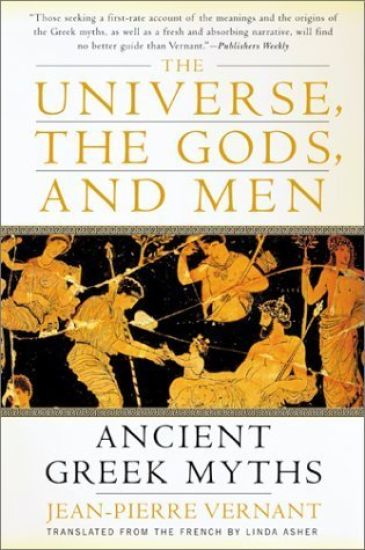
The Universe, the Gods, and Men: Ancient Greek Myths Told by Jean-Pierre Vernant
In this enchanting retelling of Greek myth, Jean-Pierre Vernant combines his deep knowledge of the subject with an original storytelling style. Beginning with the creation of Earth out of Chaos, Vernant continues with the castration of Uranus, the war between the Titans and the Olympian gods, the wily ruses of Prometheus and Zeus, and the creation of Pandora, the first woman. His narrative takes readers from the Trojan War to the voyage of Odysseus, from the story of Dionysus to the terrible destiny of Oedipus, to Perseus's confrontation with the Gorgons.Jean-Pierre Vernant has devoted himself to the study of Greek mythology. In recounting these tales, he unravels for us their multiple meanings and brings to life the beloved figures of legend whose narratives lie at the origin of our civilization.
Jean Sibelius's Violin Concerto

Jean Sibelius's Violin Concerto

Ramnarine Tina K.

Oxford University Press Inc
2020
sidottu
Jean Sibelius's Violin Concerto is the story of Sibelius as performer and composer, of violin performing traditions, of histories of musical transmission, and of virtuosity itself. It investigates the history and legacy of one of the most recorded concertos in the violin repertoire. Sibelius, a celebrated and influential composer of the late 19th and 20th centuries, was an accomplished violinist, whose enduring interest in the instrument has been paralleled by the broad success of the only concerto in his oeuvre: his violin concerto (premiered in 1904 and revised in 1905). Considering how violinists engage with the work, author Tina K. Ramnarine discusses technology's central role in the concerto's transmission from Jascha Heifetz's seminal 1935 recording to contemporary online performances, gender issues in violin solo careers, and nature-based musical aesthetics that lead to thinking about the ecology of virtuosity in an era of environmental crisis. Beginning with Sibelius's early training as a violinist and his aspirations as a performer, Ramnarine traces the dramatic historical context of the violin concerto. It was composed as Finland underwent a period of heightened self-determination, nationalism, and protest against Russian imperial policies, and it heralded intense political dynamics relating to Europe's East-West border that have extended to the present. This story of the violin concerto points to the notion of Sibelius - and the virtuoso more generally - as a political figure.
Jean Sibelius's Violin Concerto

Jean Sibelius's Violin Concerto

Ramnarine Tina K.

Oxford University Press Inc
2020
nidottu
Jean Sibelius's Violin Concerto is the story of Sibelius as performer and composer, of violin performing traditions, of histories of musical transmission, and of virtuosity itself. It investigates the history and legacy of one of the most recorded concertos in the violin repertoire. Sibelius, a celebrated and influential composer of the late 19th and 20th centuries, was an accomplished violinist, whose enduring interest in the instrument has been paralleled by the broad success of the only concerto in his oeuvre: his violin concerto (premiered in 1904 and revised in 1905). Considering how violinists engage with the work, author Tina K. Ramnarine discusses technology's central role in the concerto's transmission from Jascha Heifetz's seminal 1935 recording to contemporary online performances, gender issues in violin solo careers, and nature-based musical aesthetics that lead to thinking about the ecology of virtuosity in an era of environmental crisis. Beginning with Sibelius's early training as a violinist and his aspirations as a performer, Ramnarine traces the dramatic historical context of the violin concerto. It was composed as Finland underwent a period of heightened self-determination, nationalism, and protest against Russian imperial policies, and it heralded intense political dynamics relating to Europe's East-West border that have extended to the present. This story of the violin concerto points to the notion of Sibelius - and the virtuoso more generally - as a political figure.
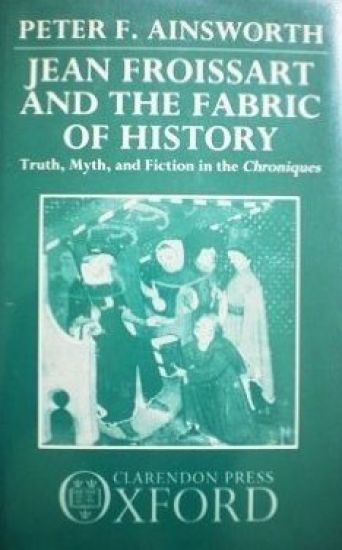
Jean Froissart and the Fabric of History

Jean Froissart and the Fabric of History

Peter F. Ainsworth

Clarendon Press
1990
sidottu
Why do Froissart's Chroniques still find enthusiastic readers six hundred years after they were written? In this fresh reading Peter Ainsworth shows that their strength lies as much in their textual richness and complexity as in their appealing subject matter: the exploits of French and English noblemen during the Hundred Years War. A record of international chivalry that pretends to the title of `history', the Chroniques are in fact neither history nor romance, though they partake a little of both and are still valued by scholars as a historical source. Rather they constitute a variegated and enthralling narrative of vast proportions, veering from the historical to the outrageously fictional, from the journalistic travelogue to the moral tale, from self-effacement in the service of impartiality to unshamed self-celebration.
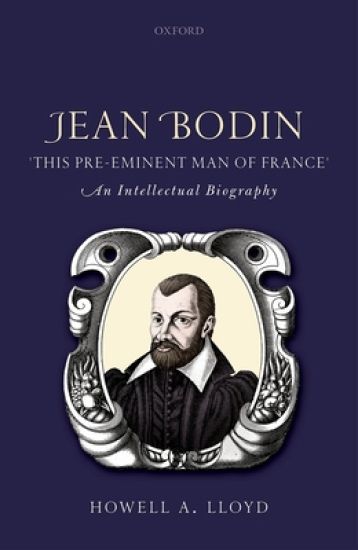
Jean Bodin, 'this Pre-eminent Man of France'

Jean Bodin, 'this Pre-eminent Man of France'

Howell A. Lloyd

Oxford University Press
2017
sidottu
Jean Bodin was a figure of great importance in European intellectual history, known as a jurist, associate of kings and courtiers in sixteenth-century France, and author of influential works in the fields of constitutional and social thought, historical writing, witchcraft, and a great deal else besides. Best known for his contribution to formulating the modern doctrine of sovereignty, Bodin was a scholar of exceptional range, whose works provoked controversy in his own time and have continued to do so down the centuries. Hugh Trevor-Roper described him as 'the Aristotle, the Montesquieu of the sixteenth century, the prophet of comparative history, of political theory, of the philosophy of law, of the quantitative theory of money, and of so much else'. Much has been written on Bodin and his ideas, but in this new intellectual biography, Howell A. Lloyd presents the first rounded treatment of the thinker and his times, his writings (major and minor), and his ideas in their contemporary context, as well as in that of broader intellectual traditions.
Conversations with Jean Piaget

Conversations with Jean Piaget

Jean-Claude Bringuier; Jean Piaget

University of Chicago Press
1989
nidottu
"What is most impressive about this book is its intelligence, its sophistication, and its charm. . . . This book presents Piaget's work and his person better than anything else that I know about."—David Elkind, Tufts University"The tone is one of constant movement from the most ordinary to the most abstruse. There are 14 conversations with 'le Patron,' some in 1969, some in 1975, and several more with co-workers in various fields. . . . In Mr. Bringuier's book, in a pleasant informal way, we see a sophisticated non-scientist exploring Piaget's domain with the master. Some of Piaget's best-known findings about children as explained along the way, but Mr. Bringuier has ways of bringing out the relation of this psychological work to the whole of Piaget's enterprise, and we get a good sense of the man and his work."—Howard E. Gruber, New York Times Book Review