Kirjojen hintavertailu. Mukana 11 244 527 kirjaa ja 12 kauppaa.

Kirjahaku

Etsi kirjoja tekijän nimen, kirjan nimen tai ISBN:n perusteella.

1000 tulosta hakusanalla John F. Perry M. D.

John F. Kennedy

John F. Kennedy

Jason K. Duncan

Routledge
2013
nidottu
Half a century after his assassination, John F. Kennedy continues to evoke widespread fascination, looming large in America’s historical memory. Popular portrayals often show Kennedy as a mythic, heroic figure, but these depictions can obscure the details of the president’s actual achievements and challenges. Despite the short length of his time in office, during his presidency, Kennedy dealt with many of the issues that would come to define the 1960s, including the burgeoning Cold War and the growing Civil Rights movement.In John F. Kennedy: The Spirit of Cold War Liberalism, Jason K. Duncan explains Kennedy’s significance as a political figure of the 20th century in U.S. and world history. Duncan contextualizes Kennedy’s political career through his personal life and addresses the legacy the president left behind. In a concise narrative supplemented by primary documents, including presidential speeches and critical reviews from the left and right, Duncan builds a biography that elucidates the impact of this iconic president and the history of the 1960s.
John F. Kennedy and the Politics of Faith

John F. Kennedy and the Politics of Faith

Patrick Lacroix

University Press of Kansas
2021
sidottu
In John F. Kennedy and the Politics of Faith Patrick Lacroix explores the intersection of religion and politics in the era of Kennedy's presidency. In doing so Lacroix challenges the established view that the postwar religious revival disappeared when President Eisenhower left office and that the contentious election of 1960, which carried John F. Kennedy to the White House, struck a definitive blow to anti-Catholic prejudice. Where most studies on the origins of the Christian right trace its emergence to the first battles of the culture wars of the late 1960s and early 1970s, echoing the Christian right's own assertion that the 'secular sixties' were a decade of waning religiosity in which faith-based groups largely eschewed political engagement, Lacroix persuasively argues for the Kennedy years as an important moment in the arc of American religious history. Lacroix analyzes the numerous ways in which faith-based engagement with politics and politicians' efforts to mobilize denominational groups did not evaporate in the early 1960s. Rather, the civil rights movement, major Supreme Court rulings, events in Rome, and Kennedy's own approach to recurrent religious controversy reshaped the landscape of faith and politics in the period.Kennedy lived up to the pledge he made to the country in Houston in 1960 with a genuine commitment to the separation of church and state with his stance on aid to education, his willingness to reverse course with the Peace Corps and the Agency for International Development, and his outreach to Protestant and Jewish clergy. The remarks he offered at the National Prayer Breakfast and in countless other settings had the cumulative effect of diminishing long-standing anxieties about Catholic power. In his own way, Kennedy demanded of Protestants that they live up to their own much-vaunted commitment to church-state separation. This principle could not mean one thing for Catholics and something entirely different for other people of faith. American Protestants could not consistently oppose public funding for religious schools-because those schools were overwhelmingly Catholic-while defending religious exercises in public schools.Lacroix reveals how close the country came, during the Kennedy administration, to a satisfactory solution to the fundamental religious challenge of the postwar years-the public accommodation of pluralism-as Kennedy came to embrace a nascent 'religious left' that supported his civil rights bill and the nuclear test ban treaty.
John F. Kennedy in Quotations
John F. Kennedy in Quotations is a compilation of more than 2,000 quotations selected from the speeches and other public addresses that Kennedy delivered to an audience, either in person or in a radio or television broadcast, during his term as president, and earlier, between Kennedy's January 2, 1960, announcement of his intention to seek the Democratic Party's nomination for president and the November 8 general election. The quotations are organized topically into more than 60 primary subject areas, many with subsections, covering a broad range of both domestic and foreign policy issues, such as Communism and the Cold War, Space Exploration, Nuclear War, the Peace Corps, and Civil Rights. The title and date of the speech from which each quotation was taken, as well as, where appropriate, the speech's venue and audience, are also provided. John F. Kennedy in Quotations is the most comprehensive and accessible collection of Kennedy quotations available, offering new and revealing insights into the mind and heart of the nation's 35th president.
John F. Kennedy

John F. Kennedy

Alan Brinkley

Times Books
2012
sidottu
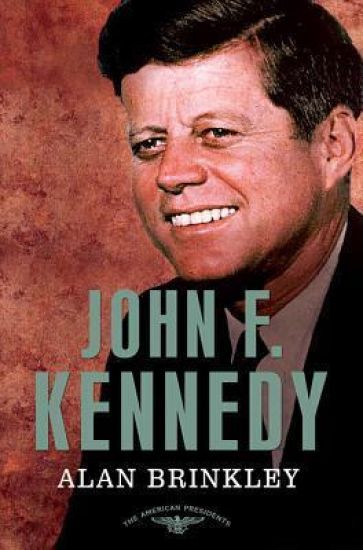
John Fitzgerald Kennedy was a new kind of president. He redefined how Americans came to see the nation's chief executive. He was forty-three when he was inaugurated in 1961 - the youngest man ever elected to the office - and he personified what he called the "New Frontier" as the United States entered the 1960s. But as Alan Brinkley shows in this incisive and lively assessment, the reality of Kennedy's achievements was much more complex than the legend. His brief presidency encountered significant failures - among them the Bay of Pigs fiasco, which cast its shadow on nearly every national-security decision that followed. But Kennedy also had successes, among them the Cuban Missile Crisis and his belated but powerful stand against segregation. Kennedy seemed to live on a knife's edge, moving from one crisis to another - Cuba, Laos, Berlin, Vietnam, Mississippi, Georgia, and Alabama. His controversial public life mirrored his hidden private life. He took risks that would seem reckless and even foolhardy when they emerged from secrecy years later. Kennedy's life, and his violent and sudden death, reshaped our view of the presidency. Brinkley gives us a full picture of the man, his times, and his enduring legacy.
John F. Kennedy and Europe

John F. Kennedy and Europe

Louisiana State University Press
1999
sidottu
When John F. Kennedy was inaugurated as the thirty-fifth president of the United States in January 1961, the cold war was at its height. Although the Soviet Union's menace and reach were global and its best opportunities for expansion lay in the newer, poorer countries of the Third World, Kennedy believed that Europe represented the war's front line. In Eastern Europe, Soviet power was achieving its greatest and most brutal successes; in Western Europe, the United States and its traditional allies had mobilised NATO to discourage a Soviet-led invasion or nuclear attack; and in the heart of Europe, West Berlin presented the single most likely detonator for what Kennedy termed ""mankind's final war."" In this politically volatile climate, Kennedy gave top priority to Europe, recognising that the continent, during his presidency, was the key to America's success, security, and survival in a dangerous world.John F. Kennedy and Europe offers a sterling collection of essays by both participants in and scholars of United States policy toward Europe from 1961 to 1963. Included in the volume are contributions by British historian Alistair Horne, journalist John Newhouse, policymaker Walt W. Rostow, and arms control specialist Carl Kaysen. The essays treat such important topics as Kennedy's relationships with European leaders, his administration's Italian and Portuguese policies, the Limited Test-Ban Treaty of 1963, and the balance-of-payments crisis with Europe. Together, these essays prove to be an indispensable, balanced contribution to cold war historiography and a landmark event in the study of the dynamics of what is still called the Atlantic partnership.
John F. Kennedy on Leadership

John F. Kennedy on Leadership

Barnes John A.

HarperCollins Focus
2018
nidottu
Today’s business leaders have much in common with President Kennedy. They face monumental decisions in unpredictable times; their actions have implications far beyond their own organizations; and they are judged mercilessly and incessantly by both their constituents and the media. Professionals, then, would do well to study the leadership traits that made Kennedy one of the most respected, beloved, and influential world leaders in modern history. John F. Kennedy on Leadership analyzes what made Kennedy, both before and during his Presidency, a unique and dominant force who would serve as the standard by which future leaders would be judged. Readers will learn the value of: * Planning and decision making: Consult widely, then act. * Crisis management: Don’t let events manage you. * Building a team: Find your own "Bobby." * Independence: Don’t follow the crowd. * Mistakes: Learn from them and move on. This timely (and timeless) book will be of interest to anyone involved in leadership.
John F. Kennedy and the Missile Gap

John F. Kennedy and the Missile Gap

Christopher Preble

Northern Illinois University Press
2004
sidottu
John F. Kennedy owed his victorious bid for the presidency—as well as his success in reversing former president Dwight D. Eisenhower's military and economic policies while in office—largely to his ability to exploit fears of an alleged Soviet strategic superiority, famously known as the "missile gap." Capitalizing on American alarms about national security, within months after his inauguration, he won Congressional authorization for two supplemental defense appropriations that collectively increased the defense budget by more than 15 percent. Yet, argues Christopher Preble, the missile gap was a myth. The Kennedy administration perpetuated that myth to justify a massive military buildup that had profound implications for both the domestic economy and for American foreign relations. Eisenhower had warned against excessive military spending, but the missile gap scare shook the confidence of millions of Americans. In the face of presumed Soviet dominance, Eisenhower's New Look programs no longer appeared adequate. By electing Kennedy, U.S. citizens signaled their willingness to bear any burden in exchange for peace of mind. Little did they realize that Kennedy's new military strategy, known as Flexible Response, marked a commitment to a war economy that persisted through the final days of the Cold War. The myth of the missile gap and the policies that followed had a profound impact on U.S.-Soviet relations. But by inducing doubts about America's capacity for world leadership, it also weakened the resolve of the nation's allies. On the home front and in the international arena, the missile gap shaped the outcome of the Cold War.
Servicing Superheterodynes / by John F. Rider

Servicing Superheterodynes / by John F. Rider

John F. (John Francis) B. 1900 Rider

Hassell Street Press
2021
sidottu
This work has been selected by scholars as being culturally important and is part of the knowledge base of civilization as we know it.This work is in the public domain in the United States of America, and possibly other nations. Within the United States, you may freely copy and distribute this work, as no entity (individual or corporate) has a copyright on the body of the work.Scholars believe, and we concur, that this work is important enough to be preserved, reproduced, and made generally available to the public. To ensure a quality reading experience, this work has been proofread and republished using a format that seamlessly blends the original graphical elements with text in an easy-to-read typeface.We appreciate your support of the preservation process, and thank you for being an important part of keeping this knowledge alive and relevant.
Some Genealogical Data Regarding the Flournoy Family / Compiled by John F. Montgomery for the Descendants of Emily Flournoy Montgomery.
This genealogy provides a wealth of information on the Flournoy family, one of the oldest and most prominent families in Virginia. Drawing on a variety of historical records and other sources, the author traces their lineage back through the generations and provides detailed biographical information on the various members of the family tree.This work has been selected by scholars as being culturally important, and is part of the knowledge base of civilization as we know it.This work is in the "public domain in the United States of America, and possibly other nations. Within the United States, you may freely copy and distribute this work, as no entity (individual or corporate) has a copyright on the body of the work.Scholars believe, and we concur, that this work is important enough to be preserved, reproduced, and made generally available to the public. We appreciate your support of the preservation process, and thank you for being an important part of keeping this knowledge alive and relevant.