Kirjojen hintavertailu. Mukana 11 342 296 kirjaa ja 12 kauppaa.

Kirjahaku

Etsi kirjoja tekijän nimen, kirjan nimen tai ISBN:n perusteella.

1000 tulosta hakusanalla Jon M Ketcham

The Debater's Guide

The Debater's Guide

Jon M. Ericson

Southern Illinois University Press
2011
nidottu
Tens of thousands of readers have studied and applied this practical guide to instruction in argumentation and communication since it was first published in 1961. In this fourth edition-the Fiftieth Anniversary Edition-authors Jon M. Ericson, James J. Murphy, and Raymond Bud Zeuschner have made significant revisions to improve the depth, flow, and clarity of this popular debater's handbook.With straightforward explanations and specific applications geared toward contemporary debate practice, this compact volume offers students and teachers clear-cut assistance in resolving the key problem faced by debaters: the need to present arguments forcefully and cogently while reacting effectively to criticism. Beginning with a candid explanation of the basic principles of debate, The Debater's Guide then introduces the steps to building a case, from reviewing strategies for refutation and defense to engaging in cross-examination, solid research, and critical thinking. It advises readers on a wide range of important topics, from budgeting time in a debate to speaking in outline form by using a well-organized series of explanations, specific examples, and graphic presentations related to both policy and value issues. The authors apply these concepts to a variety of formats and situations commonly found in high school and collegiate debating.Avoiding jargon and complex theory discussions, The Debater's Guide offers sound advice on presenting an effective case in oral discourse, helps students build their understanding of how and why debate functions, and provides a solid foundation for success in any format. The expanded contents pages and new subheadings allow for quick reference to any particular aspect of debate, making this new edition an excellent choice for classroom use as well as a valuable hands-on tool during debates.
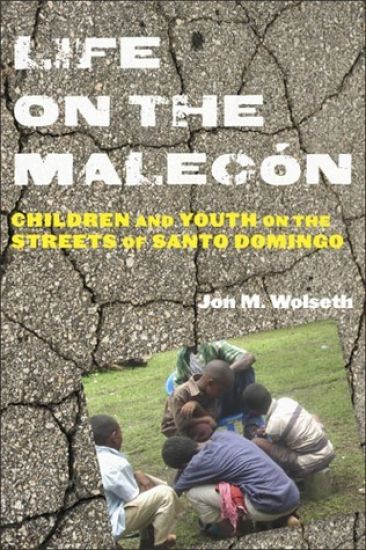
Life on the Malecón

Life on the Malecón

Jon M. Wolseth

Rutgers University Press
2013
nidottu
Life on the Malecón is a narrative ethnography of the lives of street children and youth living in Santo Domingo, Dominican Republic, and the non-governmental organizations that provide social services for them. Writing from the perspective of an anthropologist working as a street educator with a child welfare organization, Jon M. Wolseth follows the intersecting lives of children, the institutions they come into contact with, and the relationships they have with each other, their families, and organization workers.Often socioeconomic conditions push these children to move from their homes to the streets, but sometimes they themselves may choose the allure of the perceived freedoms and opportunities that street life has to offer. What they find, instead, is violence, disease, and exploitation—the daily reality through which they learn to maneuver and survive. Wolseth describes the stresses, rewards, and failures of the organizations and educators who devote their resources to working with this population.The portrait of Santo Domingo’s street children and youth population that emerges is of a diverse community with variations that may be partly related to skin color, gender, and class. The conditions for these youth are changing as the economy of the Dominican Republic changes. Although the children at the core of this book live and sleep on avenues and plazas and in abandoned city buildings, they are not necessarily glue- and solvent-sniffing beggars or petty thieves on the margins of society. Instead, they hold a key position in the service sector of an economy centered on tourism.Life on the Malecón offers a window into the complex relationships children and youth construct in the course of mapping out their social environment. Using a child-centered approach, Wolseth focuses on the social lives of the children by relating the stories that they themselves tell as well as the activities he observes.
Life on the Malecón

Life on the Malecón

Jon M. Wolseth

Rutgers University Press
2013
sidottu
Life on the Malecón is a narrative ethnography of the lives of street children and youth living in Santo Domingo, Dominican Republic, and the non-governmental organizations that provide social services for them. Writing from the perspective of an anthropologist working as a street educator with a child welfare organization, Jon M. Wolseth follows the intersecting lives of children, the institutions they come into contact with, and the relationships they have with each other, their families, and organization workers.Often socioeconomic conditions push these children to move from their homes to the streets, but sometimes they themselves may choose the allure of the perceived freedoms and opportunities that street life has to offer. What they find, instead, is violence, disease, and exploitation—the daily reality through which they learn to maneuver and survive. Wolseth describes the stresses, rewards, and failures of the organizations and educators who devote their resources to working with this population.The portrait of Santo Domingo’s street children and youth population that emerges is of a diverse community with variations that may be partly related to skin color, gender, and class. The conditions for these youth are changing as the economy of the Dominican Republic changes. Although the children at the core of this book live and sleep on avenues and plazas and in abandoned city buildings, they are not necessarily glue- and solvent-sniffing beggars or petty thieves on the margins of society. Instead, they hold a key position in the service sector of an economy centered on tourism.Life on the Malecón offers a window into the complex relationships children and youth construct in the course of mapping out their social environment. Using a child-centered approach, Wolseth focuses on the social lives of the children by relating the stories that they themselves tell as well as the activities he observes.
Nicholas Black Elk

Nicholas Black Elk

Jon M. Sweeney

Liturgical Press
2020
pokkari
Servant of God Nicholas Black Elk (1863—1950) is popularly celebrated for his fascinating spiritual life. How could one man, one deeply spiritual man, serve as both a traditional Oglala Lakota medicine man and a Roman Catholic catechist and mystic? How did these two spiritual and cultural identities enrich his prayer life? How did his commitment to God, understood through his Lakota and Catholic communities, shape his understanding of how to be in the world? To fully understand the depth of Black Elk’s life-long spiritual quest requires a deep appreciation of his life story. He witnessed devastation on the battlefields of Little Bighorn and the Massacre at Wounded Knee, but also extravagance while performing for Queen Victoria as a member of “Buffalo Bill” Cody’s Wild West Show. Widowed by his first wife, he remarried and raised eight children. Black Elk’s spiritual visions granted him wisdom and healing insight beginning in his childhood, but he grew progressively physically blind in his adult years. These stories, and countless more, offer insight into this extraordinary man whose cause for canonization is now underway at the Vatican.
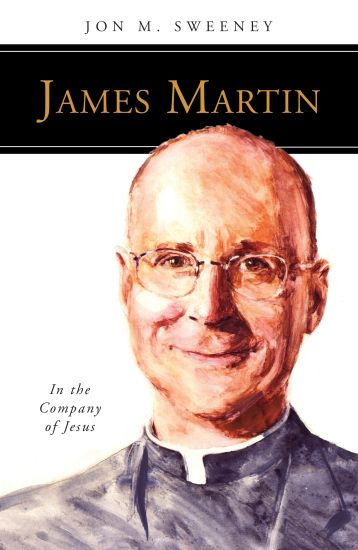
James Martin, SJ

James Martin, SJ

Jon M. Sweeney

Liturgical Press
2020
pokkari
2021 Catholic Media Association Award first place award in best new religious book series 2021 Catholic Media Association Award third place award in biography Fr. James Martin, SJ, is one of the most recognized Catholic priests in the United States. His book My Life with the Saints introduced hundreds of thousands of readers to many saintly heroes. More recently, Building a Bridge called the Catholic Church to more respect and compassion for the LGBT Community—and made Martin not only a friend to LGBT people but a lightning rod for some “traditionalist” Roman Catholics. His articulate and winsome personality has endeared him to millions inside and outside the Church. Now it is time to tell the story of his own life, to explore the experiences that made him the person he is today.And there’s no better narrator for the story than Jon M. Sweeney, an award-winning and highly accomplished writer in his own right. In James Martin, SJ: In the Company of Jesus, Sweeney probes Martin’s early life, his experiences as a corporate executive, his call to religious life, his ministry and spirituality, his feelings about both the adoration and the criticism he receives from so many, and much more. Readers will come away with a much better understanding of one of today’s most interesting and influential Catholics.
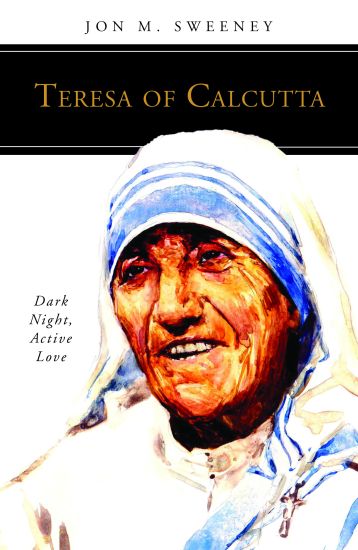
Teresa of Calcutta

Teresa of Calcutta

Jon M. Sweeney

Liturgical Press
2022
pokkari
Most people living in the last quarter of the twentieth century knew Mother Teresa by name and appearance. They could also identify her as the saint of the gutters of Calcutta. Two years after her death, she was still recognized as “the most admired person of the century.” So, what is there still to say about her? Quite a bit, as it turns out. The story of both her public and private lives remains little known, and we continue to grapple with the extraordinary things she did, as well as the way that she interpreted the vocation of any would-be follower of Jesus. This biography shows Mother Teresa as the first great saint of television. We came to know her on the screen, and, as such, we felt we knew her in a way that we could not have known the saints before her. Presented in three parts, this biography looks at the preparation, the call, and the legacy of the extraordinary woman whom Pope Francis named Saint Teresa of Calcutta in 2016.
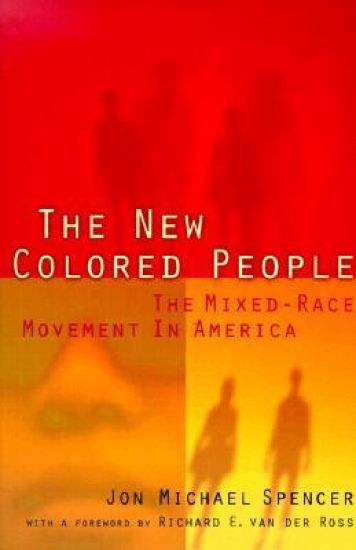
The New Colored People

The New Colored People

Jon M. Spencer; Richard E. Vander Ross

New York University Press
1997
sidottu
With a foreword by Richard E. Vander Ross In recent years, dramatic increases in racial intermarriage have given birth to a generation who refuse to be shoehorned into neat, pre-existing racial categories. Energized by a refusal to allow mixed-race people to be rendered invisible, this movement lobbies aggressively to have the category multiracial added to official racial classifications. While applauding the self-awareness and activism at the root of this movement, Jon Michael Spencer questions its ultimate usefulness, deeply concerned that it will unintentionally weaken minority power. Focusing specifically on mixed-race blacks, Spencer argues that the mixed-race movement in the United States would benefit from consideration of how multiracial categories have evolved in South Africa. Americans, he shows us, are deeply uninformed about the tragic consequences of the former white South African government's classification of mixed-race people as Coloured. Spencer maintains that a multiracial category in the U.S. could be equally tragic, not only for blacks but formultiracials themselves. Further, splintering people of color into such classifications of race and mixed race aggravates race relations among society's oppressed. A group that can attain some privilege through a multiracial identity is unlikely to identify with the lesser status group, blacks. It may be that the undoing of racial classification will come not by initiating a new classification, but by our increased recognition that there are millions of people who simply defy easy classification.
The New Colored People

The New Colored People

Jon M. Spencer; Richard E. Vander Ross

New York University Press
2000
pokkari
With a foreword by Richard E. Vander Ross In recent years, dramatic increases in racial intermarriage have given birth to a generation who refuse to be shoehorned into neat, pre-existing racial categories. Energized by a refusal to allow mixed-race people to be rendered invisible, this movement lobbies aggressively to have the category multiracial added to official racial classifications. While applauding the self-awareness and activism at the root of this movement, Jon Michael Spencer questions its ultimate usefulness, deeply concerned that it will unintentionally weaken minority power. Focusing specifically on mixed-race blacks, Spencer argues that the mixed-race movement in the United States would benefit from consideration of how multiracial categories have evolved in South Africa. Americans, he shows us, are deeply uninformed about the tragic consequences of the former white South African government's classification of mixed-race people as Coloured. Spencer maintains that a multiracial category in the U.S. could be equally tragic, not only for blacks but formultiracials themselves. Further, splintering people of color into such classifications of race and mixed race aggravates race relations among society's oppressed. A group that can attain some privilege through a multiracial identity is unlikely to identify with the lesser status group, blacks. It may be that the undoing of racial classification will come not by initiating a new classification, but by our increased recognition that there are millions of people who simply defy easy classification.
Phyllis Tickle

Phyllis Tickle

Jon M. Sweeney

CHURCH PUBLISHING INC
2018
sidottu
The definitive biography of one of the most beloved and respected figures in American religious life.In this comprehensive biography, Jon Sweeney, official biographer of Tickle’s literary estate, explores every aspect of her life, a more than 50-year legacy of poetry; plays; literary, spiritual, and historical/theological work; and advocacy. Sweeney examines Tickle’s personal and professional roots, from her family, long marriage, and life on The Farm in Lucy, Tennessee, to early academic career and move into book publishing, where her role as founding editor of the Religion Department at Publishers Weekly influenced the growth of spiritual writing and interfaith understanding during the 1990s. Sweeney also looks at pivotal relationships with John Shelby Spong, Marcus Borg, and Brian McLaren, as well as her great influence on the increasing number who adopted fixed-hour prayer, the Episcopal Church as a whole, and the Emerging Church, for which she served as historian, forecaster, and champion. A look at her early, passionate advocacy for the LGBT community, lecture circuit controversies, and projects left unfinished completes the picture.
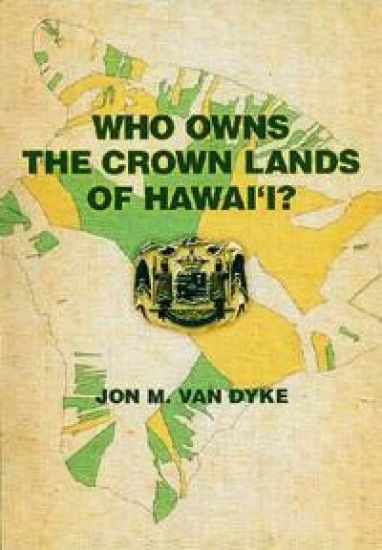
Who Owns the Crown Lands of Hawai'i?

Who Owns the Crown Lands of Hawai'i?

Jon M.Van Dyke

University of Hawai'i Press
2008
sidottu
The 1846 Mahele (division) transformed the lands of Hawai'i from a shared value into private property, but left many issues unresolved. Kauikeaouli (Kamehameha III) agreed to the Mahele, which divided all land among the mo'i (king), the ali'i (chiefs), and the maka'ainana (commoners), in the hopes of keeping the lands in Hawaiian hands even if a foreign power claimed sovereignty over the Islands. The king's share was further divided into Government and Crown Lands, the latter managed personally by the ruler until a court decision in 1864 and a statute passed in 1865 declared that they could no longer be bought or sold by the mo'i and should be maintained intact for future monarchs. After the illegal overthrow of the monarchy in 1893, Government and Crown Lands were joined together, and after annexation in 1898 they were managed as a public trust by the United States. At statehood in 1959, all but 373,720 acres of Government and Crown Lands were transferred to the State of Hawai'i. The legal status of Crown Lands remains controversial and misunderstood to this day. In this engrossing work, Jon Van Dyke describes and analyzes in detail the complex cultural and legal history of Hawai'i's Crown Lands. He argues that these lands must be examined as a separate entity and their unique status recognized. Government Lands were created to provide for the needs of the general population; Crown Lands were part of the personal domain of Kamehameha III and evolved into a resource designed to support the mo'i, who in turn supported the Native Hawaiian people. The question of who owns Hawai'i's Crown Lands today is of singular importance for Native Hawaiians in their quest for recognition and sovereignty, and this volume will become a primary resource on a fundamental issue underlying Native Hawaiian birthrights.
Who Owns the Crown Lands of Hawai'i?

Who Owns the Crown Lands of Hawai'i?

Jon M.Van Dyke

University of Hawai'i Press
2007
nidottu
The 1846 Mahele (division) transformed the lands of Hawai'i from a shared value into private property, but left many issues unresolved. Kauikeaouli (Kamehameha III) agreed to the Mahele, which divided all land among the mo'i (king), the ali'i (chiefs), and the maka'ainana (commoners), in the hopes of keeping the lands in Hawaiian hands even if a foreign power claimed sovereignty over the Islands. The king's share was further divided into Government and Crown Lands, the latter managed personally by the ruler until a court decision in 1864 and a statute passed in 1865 declared that they could no longer be bought or sold by the mo'i and should be maintained intact for future monarchs. After the illegal overthrow of the monarchy in 1893, Government and Crown Lands were joined together, and after annexation in 1898 they were managed as a public trust by the United States. At statehood in 1959, all but 373,720 acres of Government and Crown Lands were transferred to the State of Hawai'i. The legal status of Crown Lands remains controversial and misunderstood to this day. In this engrossing work, Jon Van Dyke describes and analyzes in detail the complex cultural and legal history of Hawai'i's Crown Lands. He argues that these lands must be examined as a separate entity and their unique status recognized. Government Lands were created to provide for the needs of the general population; Crown Lands were part of the personal domain of Kamehameha III and evolved into a resource designed to support the mo'i, who in turn supported the Native Hawaiian people. The question of who owns Hawai'i's Crown Lands today is of singular importance for Native Hawaiians in their quest for recognition and sovereignty, and this volume will become a primary resource on a fundamental issue underlying Native Hawaiian birthrights.
Continuous and Embedded Learning for Organizations

Continuous and Embedded Learning for Organizations

Jon M. Quigley; Shawn P. Quigley

TAYLOR FRANCIS LTD
2023
nidottu
There is considerable connection between growth of the personnel in the organization and the ability for the company to compete over time. Looking outside for help training may be required but looking within for opportunities for enhanced training and growth, will foster a continually improving and growing organization. This book examines the opportunities for learning, within the organization and its’ activities, along with the connection to motivation. Additionally, it provides information on the characteristics of organizations that are able to quickly disseminate, along with approaches for improving this distribution of that learning throughout the organization.
How AI, Metaverses, Crypto, and Cyber will Upend the 21st Century
This book explores the metamorphosis of fundamental social interactions and communal experiences, fuelled by technologies such as artificial intelligence, immersive online environments, augmented reality, blockchain, crypto and FinTech. It examines the competitors, regulators and governments who are locked in a struggle to control the economic and social future shaped by these technologies. Jon M. Garon tracks the evolution of the internet, video games, AI and emerging technologies as they converge into the transformative communications and commercial platform now known as the metaverse. He explains how each transformation in media influences and reshapes culture, and proposes ways in which metaverse platforms could operate in the public sphere. The book also discusses the efforts of governments across China, Europe and the United States to regulate the multinational companies responsible for these technologies, as well as comparing the conflicting views among states on what the metaverse should be. Providing practical guidance on the adoption of regulations in employment and educational settings, this book is essential reading for students, scholars and practitioners of antitrust and competition law, cyberspace law, finance and banking law, internet studies, and regulation and governance.