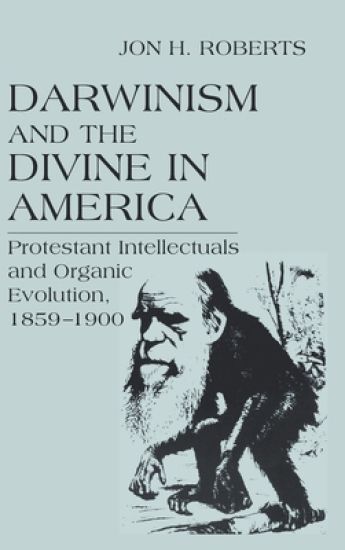
Originally published in 1988, Jon Roberts's book provided the first comprehensive analytical overview of public dialogue among nineteenth-century American Protestant intellectuals who struggled with the theory of organic evolution. Before the publication of Darwin's Origin of Species in 1859, most American Protestant intellectuals valued science, especially natural history, for supplying data that appeared to be invaluable for defending many major tenets of the Christian worldview. Arguments over the scientific merits of Darwin's theory gave way to discussions of its theological implications. Roberts's book reconstructs the course of that conversation from 1875 to 1900.
Originally published in 1988, Jon Roberts's book provided the first comprehensive analytical overview of public dialogue among nineteenth-century American Protestant intellectuals who struggled with the theory of organic evolution. Before the publication of Darwin's Origin of Species in 1859, most American Protestant intellectuals valued science, especially natural history, for supplying data that appeared to be invaluable for defending many major tenets of the Christian worldview. Arguments over the scientific merits of Darwin's theory gave way to discussions of its theological implications. Roberts's book reconstructs the course of that conversation from 1875 to 1900.
American higher education was transformed between the end of the Civil War and the beginning of World War I. During this period, U.S. colleges underwent fundamental changes--changes that helped to create the modern university we know today. Most significantly, the study of the sciences and the humanities effectively dissolved the Protestant framework of learning by introducing a new secularized curriculum. This secularization has long been recognized as a decisive turning point in the history of American education. Until now, however, there has been remarkably little attention paid to the details of how this transformation came about. Here, at last, Jon Roberts and James Turner identify the forces and explain the events that reformed the college curriculum during this era. The first section of the book examines how the study of science became detached from theological considerations. Previously, one of the primary pursuits of "natural scientists" was to achieve an understanding of the workings of the divine in earthly events. During the late nineteenth century, however, scientists reduced the scope of their inquiries to subjects that could be isolated, measured, and studied objectively. In pursuit of "scientific truth," they were drawn away from the larger "truths" that they had once sought. On a related path, social scientists began to pursue the study of human society more scientifically, attempting to generalize principles of behavior from empirically observed events. The second section describes the revolution that occurred in the humanities, beginning in the mid-nineteenth century, when the study of humanities was largely the study of Greek and Latin. By 1900, however, the humanities were much more broadly construed, including such previously unstudied subjects as literature, philosophy, history, and art history. The "triumph of the humanities" represented a significant change in attitudes about what constituted academic knowledge and, therefore, what should be a part of the college curriculum. The Sacred and the Secular University rewrites the history of higher education in the United States. It will interest all readers who are concerned about American universities and about how the content of a "college education" has changed over the course of the last century. "[Jon Roberts and James Turner's] thoroughly researched and carefully argued presentations invite readers to revisit stereotypical generalizations and to rethink the premises developed in the late nineteenth century that underlie the modern university. At the least, their arguments challenge crude versions of the secularization thesis as applied to higher education."--From the foreword by William G. Bowen and Harold T. Shapiro
A detailed study of one theological concept (divine mediation) that was central to the Christological controversy of the early fourth century. By analysing the views of three participants at the Council of Nicaea (325), Jon M. Robertson demonstrates the variety of perspectives in a way that questions popular approaches to the period that see the controversy as having only two sides. His analysis constitutes a new approach to the early Arian controversy, as well as showing the theological backdrop of Athanasius' insight on Christ as mediator. It further demonstrates the contemporary relevance of the issue by giving an Athanasian critique of the modern Christology of Roger Haight.
Insects are the most ecologically important multicellular heterotrophs in terrestrial systems. They play critical roles in ecological food webs, remain devastating agricultural and medical pests, and represent the most diverse group of eukaryotes in terms of species numbers. Their dominant role among terrestrial heterotrophs arises from a number of key physiological traits, and in particular by the developmental and evolutionary plasticity of these traits. Ecological and Environmental Physiology of Insects presents a current and comprehensive overview of how the key physiological traits of insects respond to environmental variation. It forges conceptual links from molecular biology through organismal function to population and community ecology. As with other books in the Series, the emphasis is on the unique physiological characteristics of the insects, but with applications to questions of broad relevance in physiological ecology. As an aid to new researchers on insects, it also includes introductory chapters on the basics and techniques of insect physiology ecology.
Insects are the most ecologically important multicellular heterotrophs in terrestrial systems. They play critical roles in ecological food webs, remain devastating agricultural and medical pests, and represent the most diverse group of eukaryotes in terms of species numbers. Their dominant role among terrestrial heterotrophs arises from a number of key physiological traits, and in particular by the developmental and evolutionary plasticity of these traits. Ecological and Environmental Physiology of Insects presents a current and comprehensive overview of how the key physiological traits of insects respond to environmental variation. It forges conceptual links from molecular biology through organismal function to population and community ecology. As with other books in the Series, the emphasis is on the unique physiological characteristics of the insects, but with applications to questions of broad relevance in physiological ecology. As an aid to new researchers on insects, it also includes introductory chapters on the basics and techniques of insect physiology ecology.
The book provides a comprehensive approach to configuration management from a variety of product development perspectives, including embedded and IT. It provides authoritative advice on how to extend products for a variety of markets due to configuration options. The book also describes the importance of configuration management to other parts of the organization. It supplies an overview of configuration management and its process elements to provide readers with a contextual understanding of the theory, practice, and application of CM. The book illustrates the interplay of configuration and data management with all enterprise resources during each phase of a product lifecycle.
Lynne Robertson; Maurie J. Manning; Peggy Tagel; Brenda Sexton; Yu-Mei Han; Kathryn L. O'Dell; David Austin Clar; Kristina Krhin; Jacqueline Decker; Jon Nez
A new series of colourful readers which uses a wide variety of story types and visual styles to build students' interest in reading. Topics and vocabulary are directly linked to the syllabus of Let's Go Third Edition, providing a fun reading opportunity for each unit of the course.
There is no shortage of iconic masculine imagery of the soldier in American film and literature - one only has to think of George C. Scott as Patton in front of a giant American flag, Sylvester Stallone as Rambo, or Burt Lancaster rolling around in the surf in ""From Here to Eternity"". In ""Male Armor"", Jon Robert Adams examines the ways in which novels, plays, and films about America's late-twentieth-century wars reflect altering perceptions of masculinity in the culture at large. He highlights the gap between the cultural conception of masculinity and the individual experience of it, and exposes the myth of war as an experience that verifies manhood.Drawing on a wide range of work, from the war novels of Ernest Hemingway, Norman Mailer, James Jones, and Joseph Heller to David Rabe's play Streamers and Anthony Swofford's Jarhead, Adams examines the evolving image of the soldier from World War I to Operation Desert Storm. In discussing these changing perceptions of masculinity, he reveals how works about war in the late twentieth century attempt to eradicate inconsistencies among American civilian conceptions of war, the military's expectations of the soldier, and the soldier's experience of combat. Adams argues that these inconsistencies are largely responsible not only for continuing support of the war enterprise but also for the soldiers' difficulty in reintegration to civilian society upon their return. He intends ""Male Armor"" to provide a corrective to the public's continued investment in the war enterprise as a guarantor both of masculinity and, by extension, of the nation.
There is no shortage of iconic masculine imagery of the soldier in American film and literature - one only has to think of George C. Scott as Patton in front of a giant American flag, Sylvester Stallone as Rambo, or Burt Lancaster rolling around in the surf in ""From Here to Eternity"". In ""Male Armor"", Jon Robert Adams examines the ways in which novels, plays, and films about America's late-twentieth-century wars reflect altering perceptions of masculinity in the culture at large. He highlights the gap between the cultural conception of masculinity and the individual experience of it, and exposes the myth of war as an experience that verifies manhood.Drawing on a wide range of work, from the war novels of Ernest Hemingway, Norman Mailer, James Jones, and Joseph Heller to David Rabe's play Streamers and Anthony Swofford's Jarhead, Adams examines the evolving image of the soldier from World War I to Operation Desert Storm. In discussing these changing perceptions of masculinity, he reveals how works about war in the late twentieth century attempt to eradicate inconsistencies among American civilian conceptions of war, the military's expectations of the soldier, and the soldier's experience of combat. Adams argues that these inconsistencies are largely responsible not only for continuing support of the war enterprise but also for the soldiers' difficulty in reintegration to civilian society upon their return. He intends ""Male Armor"" to provide a corrective to the public's continued investment in the war enterprise as a guarantor both of masculinity and, by extension, of the nation.
Becoming a gentleman isn't an act. It's a way of life. It's who you become. You dress in a respectable manner. You carry yourself to the highest level of ethics and treat others the way you want to be treated. You do what's right and you back up your peers and spouse regardless of the situation. I remember my ex-fianc told me once that she wanted a cowboy. I asked her what a cowboy was. Her response was, a cowboy is a man who backs her up even when she's wrong. He still always has her back. Call it what you will. Cowboy or Gentleman, both are the same.PLEASE BE SURE TO LEAVE US A COMMENT. THANKS
THINK AND GROW WEALTH is an absolute MUST HAVE for any entrepreneur or small business owner. How do entrepreneurs take their ideas and turn theminto thriving businesses? We will show you. How do the wealthy get wealthy and stay wealthy? We will show you that too. If you've read other business books and had trouble figuring out HOW to apply the lessons into your daily life giving you the success you have always dreamt of, then this is the book for you. PLEASE BE SURE TO LEAVE US A COMMENT. THANKS
When I found music, I found myself. I found myself playing my guitar six or eight hours a day. I practiced my scales and started writing music. I would perform for the kids at school. When I started creating my brand Jon Robert Quinn, I knew I was onto something big.PLEASE BE SURE TO LEAVE US A COMMENT. THANKS
So you're ready to start your first business. Maybe, you've owned a business in the past. What if you're already in business? Wherever your journey is taking you as an entrepreneur, you're going to need to drum up business at one point and as boring as it sounds, cold calling is the most effective and efficient, believe it or not. Well, one day I was sitting there frustrated over the fact that I was calling the same people over and over and after one sale ended, I was back to looking for the next. From there, I would set my expectations high, exceed the company's expectations and make the leaderboard, looking like a hero at the end of the month. As soon as the new month started, I was back to zero and had to do it all again. There had to be a better way.In this book, I teach you HOW TO MAKE MORE EFFECTIVE SALES CALLS.PLEASE BE SURE TO LEAVE US A COMMENT. THANKS
Since its debut in August 2018, The Cold Call King has become a global best-seller, capturing the attention of sales professionals and business owners worldwide. With pre-orders pouring in within minutes of its release, the book's success has been extraordinary. But behind this success is the author's decades of hard-earned experience in the trenches of business and sales-an expertise that has empowered countless others to excel in their careers.After speaking with hundreds of professionals who have read The Cold Call King, the author gained invaluable insights into the challenges and needs of today's sales landscape. This new edition expands on those insights, offering even more tools and strategies to help business professionals succeed. Designed to be your "little black book" for sales, it's a go-to resource you can carry everywhere, packed with practical tips to elevate your career.Get ready to unlock the secrets of cold calling and take your sales game to the next level with The Cold Call King