Kirjojen hintavertailu. Mukana 11 717 486 kirjaa ja 12 kauppaa.

Kirjahaku

Etsi kirjoja tekijän nimen, kirjan nimen tai ISBN:n perusteella.

1000 tulosta hakusanalla Joshua D. Chatraw

Criminal Theory Profiles

Criminal Theory Profiles

Joshua D. Behl; Leonard A. Steverson

Routledge
2021
sidottu
This book brings to life the major theories of crime and deviance by presenting detailed profiles that help readers differentiate each theory and its major propositions by better understanding how, when, and by whom the theory was formed. Criminology is based on strong theoretical foundations that attempt to answer the question of why people commit crime. Criminological theory is especially complex in that theorists come from a variety of disciplines including medicine, sociology, psychology, economics, and law. While not an exhaustive list of each theorist’s works, nor an in-depth review of the empirical work that has been done on each theory, this text tracks the intellectual development of a theory by profiling the theorists who are responsible for the major ideas in criminological thought. By viewing the field in the context of the social conditions of the time and the personal histories of the theorists, students can better understand the intellectual history of each theory and the relationship between criminology and other fields, to grasp a better appreciation of how the science of crime and the study of criminals has evolved. All chapters are organized with a brief overview of the theorist and their significant ideas, a biographical profile of the theorist, coverage of the theoretical developments and contributions of the theorist, a list of major works by the theorist, and a summary detailing the overall legacy of the theorist in the field. This book is ideal for courses on criminology, criminological theory, and criminal behavior.

Flexibility and Design

Flexibility and Design

Joshua D. Lee

Routledge
2020
nidottu
This book questions flexibility as a design approach by providing a longitudinal analysis of an innovative architectural experiment called the School Construction Systems Development (SCSD) project. The SCSD pioneered the use of performance specifications to create an open, prefabricated, and integrated system of building components that provided four modes of flexibility. Educational facilities throughout California used the SCSD system and it spawned a variety of similar projects throughout North America. This book traces the development and subsequent use of the system over 50 years through archival research, personal observations, re-photography, re-surveying, plan evaluations, interviews, and an advertisement analysis. These new findings provide useful insights for architects, educators, historic preservationists, and others about the affordances of spatial flexibility, the difficulties associated with technological transfer, the impact of unstable market conditions, the importance of user input during the planning process, and the need for long-term social relations to sustain architectural experiments.
The Nursing Home Guide: A Doctor Reveals What You Need to Know about Long-Term Care
The lowdown on long-term care?from a geriatric specialist with over twenty years in the field. Placing loved ones in nursing homes or other long-term care facilities is a stressful decision?and for good reason. In previous decades, some homes were plagued by scandal, and everyone wants to know that their family members will be safe and sound even when they can't be nearby all the time. Here, prominent geriatrician Joshua Schor, M.D., guides the reader through this emotionally challenging process step by step, covering such topics as: ? The small?and revealing?details to watch for when touring a home ? Determining whether a family member needs long-term or sub-acute care ? Deciding whether assisted living may be a viable alternative ? Questions to ask about medications, meals, and activities ? Knowing your rights and getting the information you need ? Special concerns for younger patients ? And more...
Animated by Uncertainty

Animated by Uncertainty

Joshua D. Rubin

The University of Michigan Press
2021
nidottu
In Animated by Uncertainty, Joshua D. Rubin analyzes South African rugby through the lens of aesthetic politics. Building on 17 months of ethnographic research with rugby coaches, players, and administrators, the author argues that rugby is a form of performance and further that the qualities that define rugby shape the political ends to which the sport can be put. In this respect, Animated by Uncertainty demonstrates that theories of sporting politics cannot afford to overlook the qualities of the sports themselves, and it provides a theoretical approach to illustrate how these qualities can be studied. The book also analyzes the ways that apartheid and colonialism inhere in South African institutions and practices.Drawing inspiration from the observation that South Africans could always abandon rugby if they chose to do so, Rubin highlights how the continuing significance of rugby as a form of performance brings traces of South Africa's apartheid and colonial past into the country's contemporary political moment.
Animated by Uncertainty

Animated by Uncertainty

Joshua D. Rubin

The University of Michigan Press
2021
sidottu
In Animated by Uncertainty, Joshua D. Rubin analyzes South African rugby through the lens of aesthetic politics. Building on 17 months of ethnographic research with rugby coaches, players, and administrators, the author argues that rugby is a form of performance and further that the qualities that define rugby shape the political ends to which the sport can be put. In this respect, Animated by Uncertainty demonstrates that theories of sporting politics cannot afford to overlook the qualities of the sports themselves, and it provides a theoretical approach to illustrate how these qualities can be studied. The book also analyzes the ways that apartheid and colonialism inhere in South African institutions and practices.Drawing inspiration from the observation that South Africans could always abandon rugby if they chose to do so, Rubin highlights how the continuing significance of rugby as a form of performance brings traces of South Africa's apartheid and colonial past into the country's contemporary political moment.
Sacred Language, Sacred World

Sacred Language, Sacred World

Joshua D. Broggi

T. T.Clark Ltd
2015
sidottu
Heidegger and Gadamer are typically read by different theologians. Heidegger tends to be read by philosophical theologians examining his contribution to matters of doubt, existential finitude, and atheism. Gadamer tends to be read by those with an interest in interpreting the Bible, especially by those with more confessional or epistemically optimistic sensibilities. In both cases, Heidegger and Gadamer have well-established associations with specific theological positions. Joshua Broggi challenges this arrangement by re-reading the primary texts as theological resources; he defends an alternative theological appropriation of their philosophical work through a close engagement with portions of their argument.What emerges from Broggi's examination is an account of the unity of tradition, reason, and scriptural language. This account goes beyond claims of their relatedness, which are uncontroversial, and advances the stronger argument that they name the very same thing. Although initially counterintuitive, the central task set by both Heidegger and Gadamer is the investigation of that one phenomenon. This argument challenges the pervasive image in which Christians rely on ‘tradition’ to ‘reason’ about the meaning of ‘scripture’. It puts into question the injunction that theologians should balance the resources of scripture, tradition, and reason. Broggi offers an account of Christian life as more fundamental than certain entities which are distilled out of it, namely: scripture, tradition and reason.
Sacred Language, Sacred World

Sacred Language, Sacred World

Joshua D. Broggi

T. T.Clark Ltd
2018
nidottu
Heidegger and Gadamer are typically read by different theologians. Heidegger tends to be read by philosophical theologians examining his contribution to matters of doubt, existential finitude, and atheism. Gadamer tends to be read by those with an interest in interpreting the Bible, especially by those with more confessional or epistemically optimistic sensibilities. In both cases, Heidegger and Gadamer have well-established associations with specific theological positions. Joshua Broggi challenges this arrangement by re-reading the primary texts as theological resources; he defends an alternative theological appropriation of their philosophical work through a close engagement with portions of their argument.What emerges from Broggi's examination is an account of the unity of tradition, reason, and scriptural language. This account goes beyond claims of their relatedness, which are uncontroversial, and advances the stronger argument that they name the very same thing. Although initially counterintuitive, the central task set by both Heidegger and Gadamer is the investigation of that one phenomenon. This argument challenges the pervasive image in which Christians rely on ‘tradition’ to ‘reason’ about the meaning of ‘scripture’. It puts into question the injunction that theologians should balance the resources of scripture, tradition, and reason. Broggi offers an account of Christian life as more fundamental than certain entities which are distilled out of it, namely: scripture, tradition and reason.
Purifying the Consciousness in Hebrews

Purifying the Consciousness in Hebrews

Joshua D. A. Bloor

BLOOMSBURY PUBLISHING PLC
2023
sidottu
Joshua D. A. Bloor argues that the purification of the consciousness of sin, via Jesus’ perpetual heavenly blood offering, is a vital motif for understanding Hebrews’ sacrificial argumentation, and vice-versa. Jesus’ ‘objective’ earthly achievements are many, yet only his ‘subjective’ heavenly blood offering purges the heavenly tabernacle and subsequently the consciousness of sin. Bloor views the Levitical cult as having a positive role in Hebrews, with Levitical ‘guilt’ foreshadowing and informing Hebrews’ notion of the ‘consciousness of sin’. Levitical sacrifices could purge the consciousness, but only Jesus’ heavenly blood can offer complete perpetual purgation. This blood is a qualitative type of purgation which continually speaks in heaven, offering eternal assurance for the recipients regarding their consciousness of sin.Bloor begins with the ‘defiled consciousness’ and situates the world of Hebrews within cultic defilement, enabling the consciousness of sin and its cosmic implications to be properly understood. From here, the solution to a defiled consciousness is explored by examining Hebrews’ cultic argumentation. Bloor highlights the distinctive purposes inherent in both Jesus’ earthly and heavenly achievements, with the latter concerned particularly with Yom Kippur imagery and the purgation of the consciousness. Bloor concludes by differentiating between Jesus’ session, present heavenly activity and perpetual heavenly blood offering. Throughout this volume, Bloor engages, critiques and advances current discourse concerning the nature and timing of Jesus’ offering in Hebrews.
Purifying the Consciousness in Hebrews

Purifying the Consciousness in Hebrews

Joshua D. A. Bloor

BLOOMSBURY PUBLISHING PLC
2024
nidottu
Joshua D. A. Bloor argues that the purification of the consciousness of sin, via Jesus’ perpetual heavenly blood offering, is a vital motif for understanding Hebrews’ sacrificial argumentation, and vice-versa. Jesus’ ‘objective’ earthly achievements are many, yet only his ‘subjective’ heavenly blood offering purges the heavenly tabernacle and subsequently the consciousness of sin. Bloor views the Levitical cult as having a positive role in Hebrews, with Levitical ‘guilt’ foreshadowing and informing Hebrews’ notion of the ‘consciousness of sin’. Levitical sacrifices could purge the consciousness, but only Jesus’ heavenly blood can offer complete perpetual purgation. This blood is a qualitative type of purgation which continually speaks in heaven, offering eternal assurance for the recipients regarding their consciousness of sin.Bloor begins with the ‘defiled consciousness’ and situates the world of Hebrews within cultic defilement, enabling the consciousness of sin and its cosmic implications to be properly understood. From here, the solution to a defiled consciousness is explored by examining Hebrews’ cultic argumentation. Bloor highlights the distinctive purposes inherent in both Jesus’ earthly and heavenly achievements, with the latter concerned particularly with Yom Kippur imagery and the purgation of the consciousness. Bloor concludes by differentiating between Jesus’ session, present heavenly activity and perpetual heavenly blood offering. Throughout this volume, Bloor engages, critiques and advances current discourse concerning the nature and timing of Jesus’ offering in Hebrews.
The Girl and the Guardian

The Girl and the Guardian

Joshua D Jones

Joshua D. Jones
2020
sidottu
PERSIA, 480 BC. Mordecai takes guardianship of his orphan cousin, Esther. Persia's King kidnaps the girl and forces her into his bed. Mordecai refuses to kneel before the Viceroy who unleashes terror in revenge. The teenage queen risks a violent death to find the help they need as they battle an ancient evil set on the destruction of their peopleBRITAIN, 21st Century. Oliver, a depressed London film student in search of meaning and beauty, visits his coffee guzzling grandfather in the Scottish highlands. With the old man's help, he discovers Mordecai and Esther⸺and the answers to so much more.WARNING: this is not your grandmother's sanitised, rose-petalled Esther. Read the scripture-saga as told by a Scottish grandfather to his grandson, Oliver, in a potent blend of dry humour, robust theology, and dark storytelling⸺the first in the Oliver Anderson Trilogy. 'Joshua's books pack a deep punch, leaves you unable to put them down, and deliver fantastic humour ' -Simcha Nathan, Israeli author of Awakened
Jozef Pilsudski

Jozef Pilsudski

Joshua D. Zimmerman

HARVARD UNIVERSITY PRESS
2022
sidottu
The story of the enigmatic Jozef Pilsudski, the founding father of modern Poland: a brilliant military leader and high-minded statesman who betrayed his own democratic vision by seizing power in a military coup.In the story of modern Poland, no one stands taller than Jozef Pilsudski. From the age of sixteen he devoted his life to reestablishing the Polish state that had ceased to exist in 1795. Ahead of World War I, he created a clandestine military corps to fight Russia, which held most Polish territory. After the war, his dream of an independent Poland realized, he took the helm of its newly democratic political order. When he died in 1935, he was buried alongside Polish kings.Yet Pilsudski was a complicated figure. Passionately devoted to the idea of democracy, he ceded power on constitutional terms, only to retake it a few years later in a coup when he believed his opponents aimed to dismantle the democratic system. Joshua Zimmerman’s authoritative biography examines a national hero in the thick of a changing Europe, and the legacy that still divides supporters and detractors. The Poland that Pilsudski envisioned was modern, democratic, and pluralistic. Domestically, he championed equality for Jews. Internationally, he positioned Poland as a bulwark against Bolshevism. But in 1926 he seized power violently, then ruled as a strongman for nearly a decade, imprisoning opponents and eroding legislative power.In Zimmerman’s telling, Pilsudski’s faith in the young democracy was shattered after its first elected president was assassinated. Unnerved by Poles brutally turning on one another, the father of the nation came to doubt his fellow citizens’ democratic commitments and thereby betrayed his own. It is a legacy that dogs today’s Poland, caught on the tortured edge between self-government and authoritarianism.
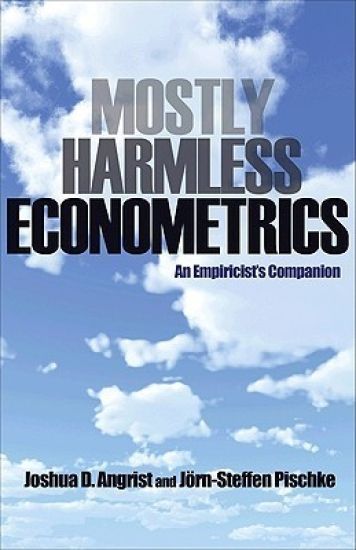
Mostly Harmless Econometrics

Mostly Harmless Econometrics

Joshua D. Angrist; Jörn-Steffen Pischke

Princeton University Press
2009
nidottu
The core methods in today's econometric toolkit are linear regression for statistical control, instrumental variables methods for the analysis of natural experiments, and differences-in-differences methods that exploit policy changes. In the modern experimentalist paradigm, these techniques address clear causal questions such as: Do smaller classes increase learning? Should wife batterers be arrested? How much does education raise wages? Mostly Harmless Econometrics shows how the basic tools of applied econometrics allow the data to speak. In addition to econometric essentials, Mostly Harmless Econometrics covers important new extensions--regression-discontinuity designs and quantile regression--as well as how to get standard errors right. Joshua Angrist and Jorn-Steffen Pischke explain why fancier econometric techniques are typically unnecessary and even dangerous. The applied econometric methods emphasized in this book are easy to use and relevant for many areas of contemporary social science. * An irreverent review of econometric essentials * A focus on tools that applied researchers use most * Chapters on regression-discontinuity designs, quantile regression, and standard errors * Many empirical examples * A clear and concise resource with wide applications
Mastering 'Metrics

Mastering 'Metrics

Joshua D. Angrist; Jörn-Steffen Pischke

Princeton University Press
2014
nidottu
Applied econometrics, known to aficionados as 'metrics, is the original data science. 'Metrics encompasses the statistical methods economists use to untangle cause and effect in human affairs. Through accessible discussion and with a dose of kung fu-themed humor, Mastering 'Metrics presents the essential tools of econometric research and demonstrates why econometrics is exciting and useful. The five most valuable econometric methods, or what the authors call the Furious Five--random assignment, regression, instrumental variables, regression discontinuity designs, and differences in differences--are illustrated through well-crafted real-world examples (vetted for awesomeness by Kung Fu Panda's Jade Palace). Does health insurance make you healthier? Randomized experiments provide answers. Are expensive private colleges and selective public high schools better than more pedestrian institutions? Regression analysis and a regression discontinuity design reveal the surprising truth. When private banks teeter, and depositors take their money and run, should central banks step in to save them? Differences-in-differences analysis of a Depression-era banking crisis offers a response. Could arresting O. J. Simpson have saved his ex-wife's life? Instrumental variables methods instruct law enforcement authorities in how best to respond to domestic abuse. Wielding econometric tools with skill and confidence, Mastering 'Metrics uses data and statistics to illuminate the path from cause to effect. * Shows why econometrics is important* Explains econometric research through humorous and accessible discussion* Outlines empirical methods central to modern econometric practice* Works through interesting and relevant real-world examples
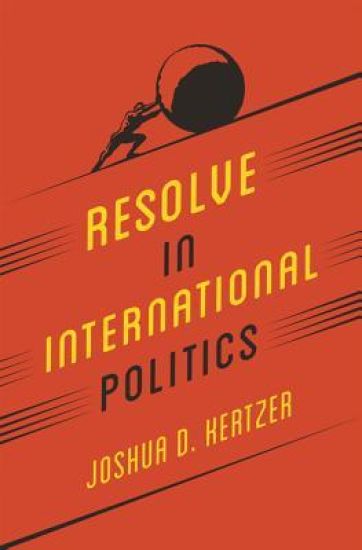
Resolve in International Politics

Resolve in International Politics

Joshua D. Kertzer

PRINCETON UNIVERSITY PRESS
2016
sidottu
Why do some leaders and segments of the public display remarkable persistence in confrontations in international politics, while others cut and run? The answer given by policymakers, pundits, and political scientists usually relates to issues of resolve. Yet, though we rely on resolve to explain almost every phenomenon in international politics--from prevailing at the bargaining table to winning on the battlefield--we don't understand what it is, how it works, or where it comes from. Resolve in International Politics draws on a growing body of research in psychology and behavioral economics to explore the foundations of this important idea. Joshua Kertzer argues that political will is more than just a metaphor or figure of speech: the same traits social scientists and decision-making scholars use to comprehend willpower in our daily lives also shape how we respond to the costs of war and conflict. Combining laboratory and survey experiments with studies of great power military interventions in the postwar era from 1946 to 2003, Kertzer shows how time and risk preferences, honor orientation, and self-control help explain the ways leaders and members of the public define the situations they face and weigh the trade-offs between the costs of fighting and the costs of backing down. Offering a novel in-depth look at how willpower functions in international relations, Resolve in International Politics has critical implications for understanding political psychology, public opinion about foreign policy, leaders in military interventions, and international security.
Resolve in International Politics

Resolve in International Politics

Joshua D. Kertzer

Princeton University Press
2018
pokkari
Why do some leaders and segments of the public display remarkable persistence in confrontations in international politics, while others cut and run? The answer given by policymakers, pundits, and political scientists usually relates to issues of resolve. Yet, though we rely on resolve to explain almost every phenomenon in international politics—from prevailing at the bargaining table to winning on the battlefield—we don't understand what it is, how it works, or where it comes from. Resolve in International Politics draws on a growing body of research in psychology and behavioral economics to explore the foundations of this important idea.Joshua Kertzer argues that political will is more than just a metaphor or figure of speech: the same traits social scientists and decision-making scholars use to comprehend willpower in our daily lives also shape how we respond to the costs of war and conflict. Combining laboratory and survey experiments with studies of great power military interventions in the postwar era from 1946 to 2003, Kertzer shows how time and risk preferences, honor orientation, and self-control help explain the ways leaders and members of the public define the situations they face and weigh the trade-offs between the costs of fighting and the costs of backing down.Offering a novel in-depth look at how willpower functions in international relations, Resolve in International Politics has critical implications for understanding political psychology, public opinion about foreign policy, leaders in military interventions, and international security.