Kirjojen hintavertailu. Mukana 11 627 220 kirjaa ja 12 kauppaa.

Kirjahaku

Etsi kirjoja tekijän nimen, kirjan nimen tai ISBN:n perusteella.

1000 tulosta hakusanalla Judith M. Taylor

Freudian Analysts/Feminist Issues

Freudian Analysts/Feminist Issues

Judith M. Hughes

Yale University Press
1999
sidottu
In this important book Judith M. Hughes makes a highly original case for conceptualizing gender identity as potentially multiple. She does so by situating her argument within the history of psychoanalysis.Hughes traces a series of conceptual lineages, each descending from Freud. In the study Helene Deutsch, Karen Horney, and Melanie Klein occupy prominent places. So too do Erik H. Erikson and Robert J. Stoller. Among contemporary theorists Carol Gilligan and Nancy Chodorow are included in Hughes’s roster.In each lineage Hughes discerns an evolutionary narrative: Deutsch tells a story of retrogression; Erikson names his epigenesis, and Gilligan continues in that vein; Horney’s discussion recalls sexual selection; Stoller’s and Chodorow’s theorizing brings artificial selection to mind; and finally in Klein’s work Hughes sees a story of natural selection and adds to it her own notion of multiple gender identities.
Nehru

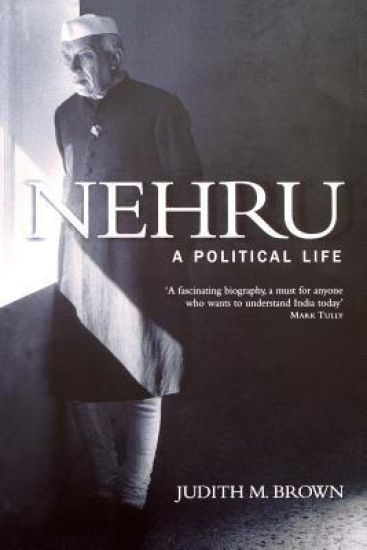
Nehru

Judith M. Brown

Yale University Press
2005
pokkari
The first Prime Minister of India after independence from British rule, Jawaharlal Nehru (1889-1964) was a major architect of India as a nation state. His dedication to politics led to imprisonment, a deeply disturbed family life, and eventually to nearly two decades in power. This compelling biography depicts the phases of Nehru's life and shows how each phase reflected ongoing developments in Indian politics. Drawing on new sources Judith M. Brown offers the most complete and penetrating account of Nehru yet written. The book also provides an array of insights into the complexity of constructing a new nation state in the aftermath of imperial rule. 'Brown's fine biography shows vividly how much the subcontinent and its first leader have in common.' Philip Ziegler, 'Literary Review' 'an absorbing, scrupulously researched and convincing assessment of one of the most important political figures of the 20th century.' Katherine Frank, 'New Statesman' 'A superb book, Judith Brown catches the spirit of Nehru's times as well as his own tribulations and achievements.' Wm. Roger Louis, University of Texas at Austin Judith M. Brown is Beit Professor of Commonwealth History, University of Oxford, and professorial fellow of Balliol College, Oxford.
Endangered Peoples of Oceania

Endangered Peoples of Oceania

Judith M. Fitzpatrick

Greenwood Press
2000
sidottu
The peoples of Oceania are struggling to be economically independent and autonomous while maintaining their distinctive cultural traditions. Each chapter in Endangered Peoples of Oceania: Struggles to Survive and Thrive is devoted to a specific people, including a cultural overview of their history, subsistence strategies, social and political organization, and religion and world view; threats to their survival; and their response to these threats. A section entitled Food for Thought poses questions that encourage a personal engagement with the experience of these peoples, and a resource guide suggests further reading and lists films and videos as well as pertinent organizations and web sites. As the curriculum expands to include more multicultural and indigenous peoples, this unique volume will be valuable to both students and teachers.
Religious Scandals

Religious Scandals

Judith M. Buddenbaum

Greenwood Press
2009
sidottu
This volume looks at headline-grabbing scandals involving American religious figures from the 19th century to the present, showing how the media and society in general reacted to these controversies. Religious Scandals brings together real-life controversies involving men and women of faith, from the media frenzy over the 1811 New York blasphemy case of People v. Ruggles that shaped American law for well over 100 years to the 2008 government raid on the fundamentalist Mormon Yearning for Zion community in Texas. Religious Scandals focuses on two types of subjects: religious figures whose lapses put them at the center of scandals involving sex, money, or crime; and those who scandalized their fellow citizens by acting out according to their own religious beliefs. Together, these stories—some familiar, some little known—offer a fascinating portrait of American religious culture, as well insights into the role of the media in religious scandals, constitutional protections of religious freedom, and the overriding issue of public curiosity versus individual privacy.
NEHRU

NEHRU

JUDITH M. BROWN

TAYLORFRANCIS
2019
nidottu
Judith Brown explores Nehru as a figure of power and provides an assessment of his leadership at the head of a newly independent India with no tradition of democratic politics.
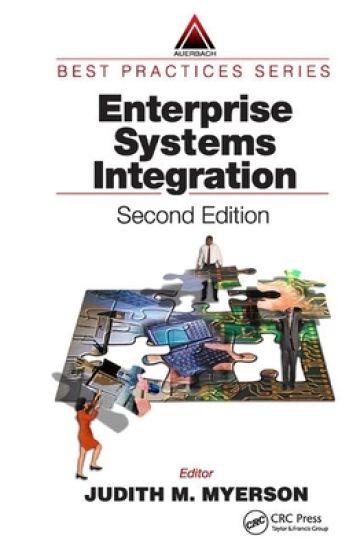
Enterprise Systems Integration

Enterprise Systems Integration

Judith M. Myerson

CRC Press
2019
nidottu
The convergence of knowledge, technology, and human performance which comprises today's enterprise allows creative business process design. Thus, an organization can create new and innovative ways to service customers or to do business with suppliers and make itself a leader in its field. This capability relies on a successful strategy that integrates the enterprise. Enterprise Systems Integration, Second Edition continues to provide you with the business insight and the technical know-how that ensures successful systems integration. The book combines the perspectives, knowledge, and experience of more than 70 experts in the various areas that involve enterprise integration. Their expertise ranges from hands-on experience with technology and project management to the higher-level issues of business and management strategy. Each chapter examines an issue or technology relevant to today's enterprise. Collectively, these chapters span the range of enterprise computing and systems integration. Once armed with the strategy and technologies, you must successfully deploy ERP systems within budget and on time. In addition, you must be able to integrate them into the rest of the enterprise. Still, ERP software does not make up the full picture of today's enterprise. Legacy systems, e-commerce and other Web-based systems, client/server applications, networks and communications systems, data warehousing, and integrated databases enter into the mix. Enterprise Systems Integration, Second Edition paints a comprehensive picture of the technologies that comprise today's enterprise and shows you how to make them work together.
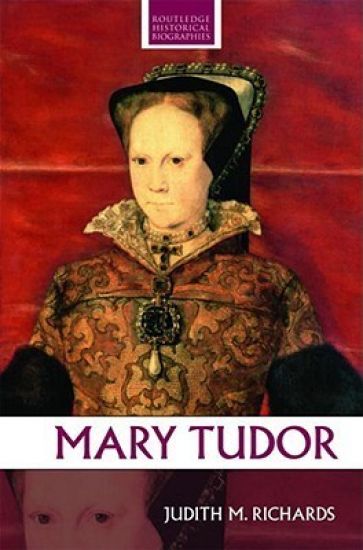
Mary Tudor

Mary Tudor

Judith M. Richards

Routledge
2008
sidottu
Mary Tudor is often written off as a hopeless, twisted queen who tried desperately to pull England back to the Catholic Church that was so dear to her mother, and sent many to burn at the stake in the process. In this radical re-evaluation of the first 'real' English queen regnant, Judith M. Richards challenges her reputation as 'Bloody Mary' of popular historical infamy, contending that she was closer to the more innovative, humanist side of the Catholic Church.Richards argues persuasively that Mary, neither boring nor basically bloody, was a much more hard-working, 'hands on', and decisive queen than is commonly recognized. Had she not died in her early forties and failed to establish a Catholic succession, the course of history could have been very different, England might have remained Catholic and Mary herself may even have been treated more kindly by history.This illustrated and accessible biography is essential reading for all those with an interest in one of England's most misrepresented monarchs.
Mary Tudor

Mary Tudor

Judith M. Richards

Routledge
2008
nidottu
Mary Tudor is often written off as a hopeless, twisted queen who tried desperately to pull England back to the Catholic Church that was so dear to her mother, and sent many to burn at the stake in the process. In this radical re-evaluation of the first 'real' English queen regnant, Judith M. Richards challenges her reputation as 'Bloody Mary' of popular historical infamy, contending that she was closer to the more innovative, humanist side of the Catholic Church.Richards argues persuasively that Mary, neither boring nor basically bloody, was a much more hard-working, 'hands on', and decisive queen than is commonly recognized. Had she not died in her early forties and failed to establish a Catholic succession, the course of history could have been very different, England might have remained Catholic and Mary herself may even have been treated more kindly by history.This illustrated and accessible biography is essential reading for all those with an interest in one of England's most misrepresented monarchs.
Guilt and Its Vicissitudes

Guilt and Its Vicissitudes

Judith M. Hughes

Routledge
2007
sidottu
How do psychoanalysts explain human morality?Guilt and Its Vicissitudes: Psychoanalytic Reflections on Morality focuses on the way Melanie Klein and successive generations of her followers pursued and deepened Freud's project of explaining man's moral sense as a wholly natural phenomenon.With the introduction of the superego, Freud laid claim to the study of moral development as part of the psychoanalytic enterprise. At the same time he reconceptualized guilt: he thought of it not only as conscious, but as unconscious as well, and it was the unconscious sense of guilt that became a particular concern of the discipline he was founding. As Klein saw it, his work merely pointed the way. Judith M. Hughes argues that Klein and contemporary Kleinians went on to provide a more consistent and comprehensive psychological account of moral development. Hughes shows how Klein and her followers came to appreciate that moral and cognitive questions are complexly interwoven and makes clear how this complexity prompted them to extend the range of their theory.Hughes demonstrates both a detailed knowledge of the major figures in post-war British psychoanalysis, and a keen sensitivity to the way clinical experience informed theory-building. She writes with vigor and grace, not only about Freud and Klein, but also about such key thinkers as Riviere, Isaacs, Heimann, Segal, Bion and Joseph. Guilt and Its Vicissitudes speaks to those concerned with the clinical application of psychoanalytic theory and to those interested in the contribution psychoanalysis makes to understanding questions of human morality.
Guilt and Its Vicissitudes

Guilt and Its Vicissitudes

Judith M. Hughes

Routledge
2007
nidottu
How do psychoanalysts explain human morality?Guilt and Its Vicissitudes: Psychoanalytic Reflections on Morality focuses on the way Melanie Klein and successive generations of her followers pursued and deepened Freud's project of explaining man's moral sense as a wholly natural phenomenon.With the introduction of the superego, Freud laid claim to the study of moral development as part of the psychoanalytic enterprise. At the same time he reconceptualized guilt: he thought of it not only as conscious, but as unconscious as well, and it was the unconscious sense of guilt that became a particular concern of the discipline he was founding. As Klein saw it, his work merely pointed the way. Judith M. Hughes argues that Klein and contemporary Kleinians went on to provide a more consistent and comprehensive psychological account of moral development. Hughes shows how Klein and her followers came to appreciate that moral and cognitive questions are complexly interwoven and makes clear how this complexity prompted them to extend the range of their theory.Hughes demonstrates both a detailed knowledge of the major figures in post-war British psychoanalysis, and a keen sensitivity to the way clinical experience informed theory-building. She writes with vigor and grace, not only about Freud and Klein, but also about such key thinkers as Riviere, Isaacs, Heimann, Segal, Bion and Joseph. Guilt and Its Vicissitudes speaks to those concerned with the clinical application of psychoanalytic theory and to those interested in the contribution psychoanalysis makes to understanding questions of human morality.
Elizabeth I

Elizabeth I

Judith M. Richards

Routledge
2011
nidottu
Elizabeth I was Queen of England for almost forty-five years. The daughter of Henry VIII and Ann Boleyn, as an infant she was briefly accepted as her father’s heir. After her mother was executed at her father’s command she was declared illegitimate and led a sometimes scandalous existence until her accession to the throne at the age of twenty-five. Elizabeth oversaw a vibrant age of exploration and literature and established herself, the "Virgin Queen", a national icon that lives on in the popular imagination. But Elizabeth was England’s second female monarch, and was greatly influenced by the experiences and mistakes of the reign of her half-sister, Mary I, before her. During her reign, Elizabeth had to perform a complicated balancing act in religious matters. As religious wars raged in Europe, Elizabeth herself a moderate Protestant, had to manage an inherited Catholic realm and the demands of zealous Protestants. The importance of such familiar features of Elizabeth’s reign as the presence in England of Mary Queen of Scots and her enduring efforts to take the throne, the Spanish armada, and the origins of English colonial expansion beyond the British archipelago all receive fresh attention in this engaging book. This new biography sheds light on Elizabeth’s early life, influences and on her personal religious beliefs as well as examining her reign, politics and reassesses Elizabeth’s reluctance to marry, a matter for which she has been much praised, but which is here judged one of the second queen regnant’s more problematic decisions. Judith M. Richards takes an objective and rounded view of Elizabeth’s whole life and provides the perfect introduction for students and general readers alike.
Elizabeth I

Elizabeth I

Judith M. Richards

Routledge
2011
sidottu
Elizabeth I was Queen of England for almost forty-five years. The daughter of Henry VIII and Ann Boleyn, as an infant she was briefly accepted as her father’s heir. After her mother was executed at her father’s command she was declared illegitimate and led a sometimes scandalous existence until her accession to the throne at the age of twenty-five. Elizabeth oversaw a vibrant age of exploration and literature and established herself, the "Virgin Queen", a national icon that lives on in the popular imagination. But Elizabeth was England’s second female monarch, and was greatly influenced by the experiences and mistakes of the reign of her half-sister, Mary I, before her. During her reign, Elizabeth had to perform a complicated balancing act in religious matters. As religious wars raged in Europe, Elizabeth herself a moderate Protestant, had to manage an inherited Catholic realm and the demands of zealous Protestants. The importance of such familiar features of Elizabeth’s reign as the presence in England of Mary Queen of Scots and her enduring efforts to take the throne, the Spanish armada, and the origins of English colonial expansion beyond the British archipelago all receive fresh attention in this engaging book. This new biography sheds light on Elizabeth’s early life, influences and on her personal religious beliefs as well as examining her reign, politics and reassesses Elizabeth’s reluctance to marry, a matter for which she has been much praised, but which is here judged one of the second queen regnant’s more problematic decisions. Judith M. Richards takes an objective and rounded view of Elizabeth’s whole life and provides the perfect introduction for students and general readers alike.
In Praise of Good Business

In Praise of Good Business

Judith M. Bardwick

John Wiley Sons Inc
1998
pokkari
Drawing on her experience as a psychologist specializing in management psychology and as a consultant to the Fortune 500, the author shows how to create more productive and self-reliant employees in a super-competitive global economy. 50,000 first printing. $60,000 ad/promo.
Preventing Identity Theft in Your Business

Preventing Identity Theft in Your Business

Judith M. Collins

John Wiley Sons Inc
2005
sidottu
Preventing Identity Theft in Your Business is a reliable guide to help protect companies, their customers, and their employees from the growing problem of identity theft. Real-life examples show managers and executives how to identify business, customer, and employee identity theft, how these crimes are committed, how best to prevent them, and overall, develop an honest company culture. It also covers how to manage this threat in business reorganizations such as mergers, acquisitions, globalization, and outsourcing.
Reshaping the Psychoanalytic Domain

Reshaping the Psychoanalytic Domain

Judith M. Hughes

University of California Press
1990
pokkari
Tracing the line of succession from Sigmund Freud, through Melanie Klein to Fairbairn and Winnicott, Judith Hughes demonstrates the internal development of the British school of psychoanalysis and the coherence of its legacy. Both lay reader and professional will find the book illuminating.
Gandhi and Civil Disobedience

Gandhi and Civil Disobedience

Judith M. Brown

Cambridge University Press
2008
pokkari
Mahatma Gandhi's lengthy Indian career was of central importance in the development of Indian politics and the changing relationship of the British raj and its subjects. But the extent of his political influence and his role varied considerably at different times. This book is an analysis, based on new material, of the phase between 1928 and 1934 when Gandhi was leader of a continental campaign of civil disobedience against the Raj. During this time Gandhi emerged from the comparative political quiescence which had followed his initial rise to prominence in 1920 as architect of a campaign of non-cooperation with the Raj. He resumed a crucial role as leader of the Congress movement against the British. At the peak of his political influence he negotiated a 'pact' with the Viceroy by which the civil disobedience campaign – most graphically illustrated in the famous Salt March to Dandi – was suspended.
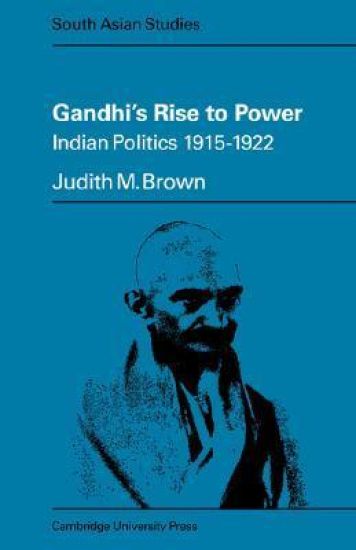
Gandhi's Rise to Power

Gandhi's Rise to Power

Judith M. Brown

Cambridge University Press
1974
pokkari
Dr Brown presents a political study of the first clearly defined period in Mahatma Gandhi's Indian career, from 1915 to 1922. The period began with Gandhi's return from South Africa as a stranger to Indian politics, witnessed his dramatic assertion of leadership in the Indian National Congress of 1920 and ended with his imprisonment by the British after the collapse of his all-India civil disobedience movement against the raj. Focusing on Gandhi, this book nevertheless investigates the changing nature of Indian politics. It aims to study precisely what Gandhi did, on whom he relied for support, how he interacted with other nationalist leaders and how he saw his own role in Indian public life. Unlike the usual interpretation of Gandhi's rise to power as based on a charismatic appeal to the Indian masses, this study argues that his influence depended on a capacity to generate a network of lesser leaders, or subcontractors, who would organise their constituencies for him, whether these were caste, communal or economic groups or whole areas.
The Theology of the Johannine Epistles

The Theology of the Johannine Epistles

Judith M. Lieu

Cambridge University Press
1991
sidottu
The Johannine Epistles have long been recognised as contributing a vital element to the theology of the New Testament. Usually it is to the Gospel that the reader turns first in order to explore that contribution; the First Epistle is treated as a supplement, while 2 and 3 John - on account of their brevity - receive little attention. This book allows the Epistles to speak for themselves, and shows that they sound a distinctive note within Johannine theology, in particular, and the thought of the New Testament, in general. Dr Lieu carefully outlines their most important theological themes (comprising, for example, tensions-in-unity between confidence and imperative, individual and community, and faith and tradition) which - when understood in their original setting - are seen to have rich potential for the continuing theology of the Church. By focusing on the Johannine Epistles in their proper context and in their own right, the author of this book thus provides a timely reassessment of the substantial theological contribution they have to make.
The Theology of the Johannine Epistles

The Theology of the Johannine Epistles

Judith M. Lieu

Cambridge University Press
1991
pokkari
The Johannine Epistles have long been recognised as contributing a vital element to the theology of the New Testament. Usually it is to the Gospel that the reader turns first in order to explore that contribution; the First Epistle is treated as a supplement, while 2 and 3 John - on account of their brevity - receive little attention. This book allows the Epistles to speak for themselves, and shows that they sound a distinctive note within Johannine theology, in particular, and the thought of the New Testament, in general. Dr Lieu carefully outlines their most important theological themes (comprising, for example, tensions-in-unity between confidence and imperative, individual and community, and faith and tradition) which - when understood in their original setting - are seen to have rich potential for the continuing theology of the Church. By focusing on the Johannine Epistles in their proper context and in their own right, the author of this book thus provides a timely reassessment of the substantial theological contribution they have to make.
Global South Asians

Global South Asians

Judith M. Brown

Cambridge University Press
2006
pokkari
By the end of the twentieth century some nine million people of South Asian descent had left India, Bangladesh or Pakistan and settled in different parts of the world, forming a diverse and significant modern diaspora. In the early nineteenth century, many left reluctantly to seek economic opportunities which were lacking at home. This is the story of their often painful experiences in the diaspora, how they constructed new social communities overseas and how they maintained connections with the countries and the families they had left behind. It is a story compellingly told by one of the premier historians of modern South Asia, Judith Brown, whose particular knowledge of the diaspora in Britain and South Africa gives her insight as a commentator. This is a book which will have a broad appeal to general readers as well as to students of South Asian and colonial history, migration studies and sociology.