Kirjojen hintavertailu. Mukana 11 699 587 kirjaa ja 12 kauppaa.

Kirjahaku

Etsi kirjoja tekijän nimen, kirjan nimen tai ISBN:n perusteella.

1000 tulosta hakusanalla Karl F Reinhold

History as a Visual Art in the Twelfth-Century Renaissance

History as a Visual Art in the Twelfth-Century Renaissance

Karl F. Morrison

Princeton University Press
2016
sidottu
Karl Morrison discusses historical writing at a turning point in European culture: the so-called Renaissance of the twelfth century. Why do texts considered at that time to be masterpieces seem now to be fragmentary and full of contradictions? Morrison maintains that the answer comes from ideas about art. Viewing histories as artifacts made according to the same aesthetic principles as paintings and theater, he shows that twelfth-century authors and audiences found unity not in what the reason read in a text but in what the imagination read into it: they prized visual over verbal imagination and employed a circular, or nuclear, spectator-centered perspective cast aside in the Renaissance of the fourteenth and fifteenth centuries. Twelfth-century writers assimilated and transformed a tradition of the conceptual unity of all the arts and attributed that unity to the fact that art both conceals and discloses. Recovering that tradition, especially the methods and motives of concealment, provides extraordinary insights into twelfth-century ideas about the kingdom of God, the status of women, and the nature of time itself. It also identifies a strain in European thought that had striking affinities to methods of perception familiar in Oriental religions and that proved to be antithetic to later humanist traditions in the West. Originally published in 1990. The Princeton Legacy Library uses the latest print-on-demand technology to again make available previously out-of-print books from the distinguished backlist of Princeton University Press. These editions preserve the original texts of these important books while presenting them in durable paperback and hardcover editions. The goal of the Princeton Legacy Library is to vastly increase access to the rich scholarly heritage found in the thousands of books published by Princeton University Press since its founding in 1905.

I Am You

I Am You

Karl F. Morrison

Princeton University Press
2016
sidottu
Important trends in contemporary intellectual life celebrate difference, divisiveness, and distinction. Speculative writing increasingly highlights "hermeneutic gaps" between human beings, their histories, and their hopes. In this book Karl Morrison identifies an alternative to this disruption. He explores for the first time the entire legacy of thought revolving around the challenging claim "I am you"--perhaps the most concise possible statement of bonding through empathy. Professor Morrison shows that the hope for thoroughgoing understanding and inclusion in another's world view is central to the West's moral/intellectual tradition. He maintains that the West may yet escape the fatal flaw of casting that hope in paradigms of sexual and aesthetic dominance--examples of empathetic participation inspired by hunger for power, as well as by love. The author uses diverse sources: in theology ranging from Augustine to Schleiermacher, in art from the religious art of the Christian Empire to post-Abstractionism, and in literature from Donne to Joyce, Pirandello, and Mann. In this work he builds on the thought of two earlier books: Tradition and Authority in the Western Church: 300-1140 (Princeton, 1969) and The Mimetic Tradition of Reform in the West (Princeton, 1982). "I Am You" goes beyond their themes to the inward act that, according to tradition, consummated the change achieved by mimesis: namely, empathetic participation. Originally published in 1988. The Princeton Legacy Library uses the latest print-on-demand technology to again make available previously out-of-print books from the distinguished backlist of Princeton University Press. These editions preserve the original texts of these important books while presenting them in durable paperback and hardcover editions. The goal of the Princeton Legacy Library is to vastly increase access to the rich scholarly heritage found in the thousands of books published by Princeton University Press since its founding in 1905.

The Mimetic Tradition of Reform in the West

The Mimetic Tradition of Reform in the West

Karl F. Morrison

Princeton University Press
2016
sidottu
Ancient writers distinguished between art and style, arguing that free imitation was a critical strategy that freed artists from servile copying of objects and blind submission to rules of style. In this study Karl F. Morrison explores the far-reaching consequences of this distinction Originally published in 1982. The Princeton Legacy Library uses the latest print-on-demand technology to again make available previously out-of-print books from the distinguished backlist of Princeton University Press. These editions preserve the original texts of these important books while presenting them in durable paperback and hardcover editions. The goal of the Princeton Legacy Library is to vastly increase access to the rich scholarly heritage found in the thousands of books published by Princeton University Press since its founding in 1905.

Tradition and Authority in the Western Church, 300-1140

Tradition and Authority in the Western Church, 300-1140

Karl F. Morrison

Princeton University Press
2016
sidottu
Beginning with the conversion of Constantine in 312 and the establishment of the Christian Empire, the book continues through the Middle Ages up to the publication of Gratian's Decretum, the great, systematic book of Church law which transformed the idea of tradition into legal concepts. Throughout this period the hierarchy was called upon to deal with such fundamental questions as the nature of tradition and the extent of its authority, the infallibility of the pope, and the proper role of the laity in defining dogma. Originally published in 1969. The Princeton Legacy Library uses the latest print-on-demand technology to again make available previously out-of-print books from the distinguished backlist of Princeton University Press. These editions preserve the original texts of these important books while presenting them in durable paperback and hardcover editions. The goal of the Princeton Legacy Library is to vastly increase access to the rich scholarly heritage found in the thousands of books published by Princeton University Press since its founding in 1905.

Two Kingdoms

Two Kingdoms

Karl F. Morrison

Princeton University Press
2016
sidottu
The Two Kingdoms treats a major achievement of the Carolingian "Renaissance," Frankish ecclesiology, and the influence of 9th-century ecclesiology upon contemporary political thought. Dr. Morrison focuses particularly on the argument that, in this world, government was divided between the earthly kingdom and the kingdom of the Church. Originally published in 1964. The Princeton Legacy Library uses the latest print-on-demand technology to again make available previously out-of-print books from the distinguished backlist of Princeton University Press. These editions preserve the original texts of these important books while presenting them in durable paperback and hardcover editions. The goal of the Princeton Legacy Library is to vastly increase access to the rich scholarly heritage found in the thousands of books published by Princeton University Press since its founding in 1905.

Economic Development Finance

Economic Development Finance

Karl F. Seidman

SAGE Publications Inc
2004
sidottu
"Incredible. What a major contribution, just to pull together the diverse array of information out there about development finance into one volume. I consider this book an 'education' for the lay reader, and a fabulous resource for the practitioner of development finance." –Dr. Rhonda Phillips, AICP, CED, University of Florida"This is the most comprehensive and best-written economic development text in the market. This would be a good text for a graduate level course and would work well with a one-semester teaching plan. . . The main strength of the book is the author's ability to summarize concepts, programs, and institutions and then draw from them issues, lessons, and challenges." –John S. Strong, School of Business, College of William and Mary Economic Development Finance is a comprehensive and in-depth presentation of private, public, and community financial institutions, policies and methods for financing local and regional economic development projects. The treatment of policies and program models emphasizes their applications and impact, key design and management issues, and best practices. A separate section addresses critical management issues for development finance programs: program and product design, the lending and investment process, and capital management. Case studies are included throughout the book to help readers develop their skills and apply policies and tools to real practice issues. A glossary of finance terms is also included.Economic Development Finance provides a foundation for students and professionals in the technical aspects of business and real estate finance and surveys the full range of policies, program models, and financing tools used in economic development practice within the United States. Learn more economic development strategies on Karl F. Seidman's Web site at www.kfsconsulting.com
Forbidden Animation

Forbidden Animation

Karl F. Cohen

McFarland Co Inc
2004
pokkari
Tweety Bird was colored yellow because censors felt the original pink made the bird look nude. Betty Boop's dress was lengthened so that her garter didn't show. And in recent years, a segment of Mighty Mouse was dropped after protest groups claimed the mouse was actually sniffing cocaine, not flower petals. These changes and many others like them have been demanded by official censors or organized groups before the cartoons could be shown in theaters or on television. How the slightly risque gags in some silent cartoons were replaced by rigid standards in the sound film era is the first misadventure covered in this history of censorship in the animation industry. The perpetuation of racial stereotypes in many early cartoons is examined, as are the studios' efforts to stop producing such animation. This is followed by a look at many of the uncensored cartoons, such as Lenny Bruce's Thank You Mask Man and Ralph Bakshi's Fritz the Cat. The censorship of television cartoons is next covered, from the changes made in theatrical releases shown on television to the different standards that apply to small screen animation. The final chapter discusses the many animators who were blacklisted from the industry in the 1950s for alleged sympathies to the Communist Party.
Faulkner and the Politics of Reading

Faulkner and the Politics of Reading

Karl F. Zender

Louisiana State University Press
2002
sidottu
With this study Karl F. Zender offers fresh readings of individual novels, themes, and motifs while also assessing the impact of recent politicised interpretations on our understanding of Faulkner's achievement. Sympathetically acknowledging the need to decenter the canon, Zender's searching interrogation of current theory clears a breathing space for Faulkner and his readers between the fustier remnants of New Criticism and the excesses of post-structuralism.Each chapter opens with a balanced presentation of the genuine gifts contemporary theory has bestowed on our comprehension of a particular novel or problem in Faulkner criticism and then proceeds with a groundbreaking reading. ""The Politics of Incest"" challenges older psychoanalytic interpretations of Faulkner's use of the incest motif, and ""Faulkner's Privacy"" defends the novelist's difficulty or ""reticence"" as an aesthetic resistance against the rude candor of deregionalized and depersonalized culture. Subsequent chapters take up the volatile issues of Faulkner's representations of women and of African Americans, and a close reading of the classic ""Barn Burning"" critiques the current tendency to blur the concepts of patriarchy and paternity. The elegiac final chapter, ""Where is Yoknapatawpha County?"" draws on a comparison with John Updike's Pennsylvania fiction and a reading of Joan Williams's The Wintering to explore Faulkner's disinclination to represent the quotidian realities of southern life in his later novels. Zender shows that Faulkner's stylistic withdrawal attempts to ""transform into beauty"" his alienation from the postwar world and his fear of aging. That Faulkner and the Politics of Reading itself recovers and gives new luster to Faulkner's beauty will surely please, in the author's words, ""those readers . . . for whom literature is less a mechanism of social change than a source of pleasure."" The originality of its critical vision will inspire Faulkner scholars, students of American literature, and general readers.
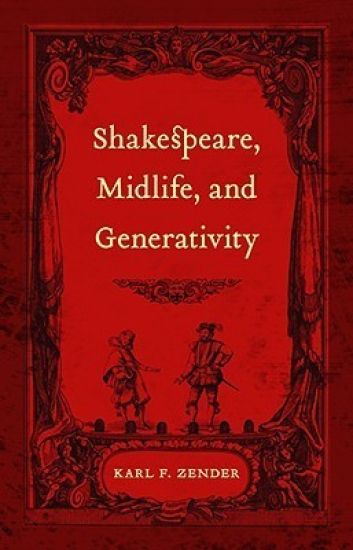
Shakespeare, Midlife, and Generativity

Shakespeare, Midlife, and Generativity

Karl F. Zender

Louisiana State University Press
2008
sidottu
The life expectancy in Shakespearean times averaged only about twenty-five to thirty-five years, but those who survived the illnesses of infancy and childhood could look forward to a long life with nearly the same level of confidence as someone living now. But even so long ago, some faced conflicts in their middle and later years that remain familiar today. In Shakespeare, Midlife, and Generativity, Karl F. Zender explores William Shakespeare's depictions of middle age by examining the relationships between middle-aged parents -- mainly fathers -- and their children in five of his greatest plays. He finds that the middle-aged characters in King Lear, Macbeth, Antony and Cleopatra, The Winter's Tale, and The Tempest -- much like their modern counterparts -- experience a fear of aging and debility.Representations of middle age occur throughout the Shakespearean canon, in forms ranging from Jaques' ""seven ages"" speech in As You Like It to the emphasis -- almost an obsession -- in many plays on relations between the generations. Lear, Zender shows, tries to forestall the approach of old age with a fantasy of literal rebirth in his relationship with Cordelia. Macbeth depicts an even more urgent struggle against midlife decline, while in Antony and Cleopatra, Shakespeare portrays two characters in midlife crisis who attempt to redefine their identities by memorializing their former status and power, now lost. Drawing on Erik Erikson's theory of generativity -- a midlife shift from advancing one's own career to aiding a younger generation -- Zender explores the difficulties Shakespeare's characters face as they transfer power and authority to their children and others in the next generation. Paying careful attention to the plays' moral and ethical implications, he demonstrates how Shakespeare's innovative depiction of the midlife experience focuses on internal psychological understanding rather than external actions such as ceremony and ritual.Illuminating and engaging, Shakespeare, Midlife, and Generativity offers a fresh analysis of several of Shakespeare's most important plays and explores a profound, centuries-old perspective on the challenges inherent in middle age.
Shakespeare and Faulkner

Shakespeare and Faulkner

Karl F. Zender

Louisiana State University Press
2021
sidottu
Shakespeare and Faulkner: Selves and Others explores the moral and ethical dilemmas that characters face inside themselves and in their interactions with others in the works of these two famed authors. Karl F. Zender's characterological study offers insightful, critically rigorous, and at times quite personal analyses of the complicated figures who inhabit several major Shakespeare plays and Faulkner novels. The two parts of this book-the first of which focuses on the English playwright, the second on the Mississippi novelist-share a common methodology in that they originate in Zender's history as a teacher of and writer on the two authors, who until now he generally approached separately. He emphasizes the evolving insights gleaned from reading these authors over several decades, situating their texts in relation to shifting trends in criticism and highlighting the contemporary relevance of their works. The final chapter, an extended discussion of Faulkner's Intruder in the Dust, attempts something unusual in Zender's critical practice: It relies less on the close textual analysis that characterizes his previous work and instead explores the intersections between events depicted in the novel and his own life, both as a child and as an adult. Shakespeare and Faulkner speaks to the power of literature as a form of pleasure and of consolation. With this work of engaged and thoughtful scholarly criticism, Zender reveals the centrality of storytelling to human beings' efforts to make sense both of their journey through life and of the circumstances in which they live.
Faulkner and the Politics of Reading

Faulkner and the Politics of Reading

Karl F. Zender

LOUISIANA STATE UNIVERSITY PRESS
2023
pokkari
With this study Karl F. Zender offers fresh readings of individual novels, themes, and motifs while also assessing the impact of recent politicized interpretations on our understanding of Faulkner's achievement. Sympathetically acknowledging the need to decenter the canon, Zender's searching interrogation of current theory clears a breathing space for Faulkner and his readers between the fustier remnants of New Criticism and the excesses of post-structuralism.Each chapter opens with a balanced presentation of the genuine gifts contemporary theory has bestowed on our comprehension of a particular novel or problem in Faulkner criticism and then proceeds with a groundbreaking reading. "The Politics of Incest" challenges older psychoanalytic interpretations of Faulkner's use of the incest motif, and "Faulkner's Privacy" defends the novelist's difficulty or "reticence" as an aesthetic resistance against the rude candor of deregionalized and depersonalized culture. Subsequent chapters take up the volatile issues of Faulkner's representations of women and of African Americans, and a close reading of the classic "Barn Burning" critiques the current tendency to blur the concepts of patriarchy and paternity. The elegiac final chapter, "Where is Yoknapatawpha County?" draws on a comparison with John Updike's Pennsylvania fiction and a reading of Joan Williams's The Wintering to explore Faulkner's disinclination to represent the quotidian realities of southern life in his later novels. Zender shows that Faulkner's stylistic withdrawal attempts to "transform into beauty" his alienation from the postwar world and his fear of aging. That Faulkner and the Politics of Reading itself recovers and gives new luster to Faulkner's beauty will surely please, in the author's words, "those readers . . . for whom literature is less a mechanism of social change than a source of pleasure." The originality of its critical vision will inspire Faulkner scholars, students of American literature, and general readers.
Conversion And Text

Conversion And Text

Karl F. Morrison

University of Virginia Press
1992
nidottu
Interpreting three conversion accounts, Morrison accents the categorical difference between the experience of conversion and written narratives about it. He explains why experience and text can only be related to each other in fictive ways. The accounts are sample cases taken from different periods in Western history. The earliest and most famous, by Augustine of Hippo is from north Africa under the late Roman Empire. The next was written by Herman-Judah, a Jew who lived in Cologne in the 12th century, in the shadow of crusading pogroms. It is the first known autobiographical account of a conversion after Augustine's "Confessions". The English translation in this book will make the text accessible to many readers for the first time. The latest account, by Constantine Tsatsos, president of the Hellenic Republic, is from 20th century Athens. Unlike the others, it is not autobiographical. By this and other contrasts, it highlights issues of criticism raised by the other two studies. In working out his critical case studies, Morrison raises such questions as whether one can assume that a conversion actually occurred because there is a text about it, and if so, whether one can accept the narrative as a historically accurate description of events. Taking the texts as imaginative renderings into words of experiences that could not be expressed, he examines what the authors suppressed as well as what they told, and their guiding motives. He presents the narratives as deliberate fabrications calculated to achieve specific objectives. "For all three writers", Morrison writes in his preface, "concealment was a condition of the experience and the narrative of conversion. Despite their extreme differences, the hermeneutic project of conversion remained thinkable for them all because of metaphor, defined by tradition with a repertory of meanings...As writers, they took for granted the difference between what was called conversion and a fictive tale about it". The companion volume "Understanding Conversion", outlines the critical framework for the method applied in "Conversion and Text".
Legacies of the Sword

Legacies of the Sword

Karl F. Friday; Seki Humitake

University of Hawai'i Press
1997
nidottu
Western scholars and educators are generally far less familiar with the samurai in his original-and, ostensibly, primary-role as warrior and masters of arms than in his other functions as landowner, feudal lord, literature, or philosopher. Yet, any attempt to comprehend fully the samurai without considering his military abilities and training (bugei) is futile. With verve and wit, Karl Friday combines the results of nearly two decades of fieldwork and archival research to examine samurai martial culture from a broad perspective: as a historical phenomenon, as a worldview, and as a system of physical, spiritual, and moral education.
Winnetou

Winnetou

Karl F. May; Richard H. Cracroft

Washington State University Press
1999
pokkari
Karl May's German-language novel of the American West has been a perennial favorite in Europe since its release in 1892. The story of the German-born frontiersman Old Shatterhand and his Apache companion Winnetou in the western plains and mountains has been reprinted innumerable times, made into films and plays, and has inspired musical compositions. Today in Germany, Old West enthusiasts by the tens of thousands attend outdoor "Karl May" festivals each summer. Yet, despite Karl May's immense popularity in Europe, this prolific author of adventure fiction is virtually unknown in the United States and Canada.May's writing has shaped a European vision of the post-Civil War American West--one uniquely Teutonized by his prolific pen. Interestingly enough, May did not visit the United States until late in life, in 1908--long after his most popular western stories were published.In the WSU Press edition, David Koblick's excellent translation and abridgment puts the best known novel by Karl May into the hands of an English speaking audience. In addition, an introduction by Koblick and an insightful foreword by Richard H. Cracroft of Brigham Young University provide cultural and historical perspectives on the Karl May phenomenon.
The Oil Prince

The Oil Prince

Karl F. May; Albert W. Bork

Washington State University Press
2003
pokkari
Karl May's works have shaped a uniquely European version of the post-Civil war American West. Rarely out of print since the late 1890s, his beloved novels are a true phenomenon in Europe and have been adapted for the stage, movies, and comic books. Translated from German by Herbert Windolf, this action-packed "travel" tale is set in the late 1860s in Old Arizona where danger abounds and survival is dependent on having the fastest draw and the sharpest wits. In The Oil Prince May created another multicultural adventure full of excitement, villainy, and courage-sprinkled throughout with a Germanic twinkle of comic relief. This Teutonic take on the Wild West features May's revered hero, Old Shatterhand, his Apache blood brother Chief Winnetou, ruthless bandits, Indian tribes on the warpath, a naive band of German immigrants, and a dangerous crook ("the Oil Prince") who intends to con a fortune from a gullible banker. It was first published as a book in the German language in 1897 and is a companion piece to Winnetou, translated by David Koblick and published by the WSU Press in 1999.Selected as a Best of the Best from the University Presses by the American Association of School Librarians
Apostolic Doctrine And Practice

Apostolic Doctrine And Practice

Karl F Smith; Howard Collier

Alpha Omega Publishing Company
2018
sidottu
Daunted by the single conflict which leads to division and separation among Christians, Bishop Karl F. Smith asked the question, "today, will Jesus recognize the church He established since the Day of Pentecost?" Why are there so many different denominations amongst Christian worshippers? Apostolic Doctrine and Practice is Bishop Smith's bold and honest message about the state of God's church and how far Christians have drifted away from the original landmark of the faith once delivered unto the saints.After many years of serving in ministry, Bishop Smith has witnessed firsthand the division among Christians under the banner of denomination. Jesus said, a house divided against itself cannot stand. Is Christ divided? Smith challenges all Christians to be more attentive to the Savior's words and take heed to the work he entrusted into the hands of his apostles. So, with pen in hand, he embarked on a journey that would challenge the core of our theology. In these powerful pages are the words and scriptures Jesus lovingly laid on her heart. Words of reassurance, comfort, and hope. Words that would draw us back to the power of the Holy Spirit and heighten our senses about the importance of practicing the doctrine of the apostles of Jesus Christ.