Kirjojen hintavertailu. Mukana 11 244 527 kirjaa ja 12 kauppaa.

Kirjahaku

Etsi kirjoja tekijän nimen, kirjan nimen tai ISBN:n perusteella.

1000 tulosta hakusanalla Kenneth Lambert

Kenneth Tynan

Kenneth Tynan

Dominic Shellard

Yale University Press
2012
pokkari
The first in-depth biography of theater genius Kenneth Tynan, looking behind the celebrity myth to show how Tynan’s eloquence and fervor helped change the course of theater in Britain and America Kenneth Tynan (1927–1980) lived one of the most intriguing theater lives of his century. A brilliant writer, critic, and agent provocateur, he made friends or enemies of nearly every major actor, playwright, impresario, and movie mogul of the 1950s, ‘60s, and ‘70s. He wrote for the Evening Standard, the Observer, and the New Yorker; served eleven years as dramaturg for Britain’s newly formed National Theatre, and spent his final years in Los Angeles. This biography offers the first complete appraisal of Tynan’s powerful contribution to post-war British theater, set against the context of the fifties, sixties, and seventies and his own turbulent life. Dominic Shellard highlights Tynan’s writings of 1952–1963, when the coruscating young critic came to prominence. He discusses how Tynan took his place at the vanguard of the new realist movement, helped to establish subsidized theater, fought censorship, and assisted in the creation of such groundbreaking theatrical phenomena as Oh Calcutta! in1970. The book reveals both the public and private Tynan, an outspoken, explicit, and sometimes savage critic who became one of the most influential theater figures of the twentieth century.
Kenneth Leighton

Kenneth Leighton

Carolyn J. Smith

Praeger Publishers Inc
2004
sidottu
Kenneth Leighton, best known for his organ and sacred choral music, was a composer of great depth and talent who wrote a significant body of works. Many of those works were written for large orchestras and a significant number of pieces of chamber music were composed for a variety of instrument groupings, as well as for instrumental solos. Anyone interested in 20th-century music as well as British and Scottish Cathedral music will find a wealth of works listed with a description of each.Kenneth Leighton, best known for his organ and sacred choral music, was a composer of great depth and talent who wrote a significant body of works. Many of those works were written for large orchestras and a significant number of pieces of chamber music were composed for a variety of instrument groupings, as well as for instrumental solos. Anyone interested in 20th-century music as well as British and Scottish Cathedral music will find a wealth of works listed with a description of each.This volume begins with a brief biography of Leighton and is followed by an alphabetical listing of works and performances. Also included is a discography and a bibliography of articles, reviews, books, and dissertations. The last section is a chronological list of compositions. Smith helps us to realize that Kenneth Leighton was an extraordinary composer of 20th-century music with a varied body of works and also a virtuoso pianist of some note.
Kenneth Burke

Kenneth Burke

Stephen Bygrave

Routledge
1993
sidottu
Kenneth Burke: Rhetoric and Ideology is a lucid and accessible introduction to a major twentieth-century thinker those ideas have influenced fields as diverse as literary theory, philosophy, linguistics, politics and anthropology. Stephen Bygrave explores the content of Burke's vast output of work, focusing especially on his preoccupation with the relation between language, ideology and action. By considering Burke as a reader and writer of narratives and systems, Bygrave examines the inadequacies of earlier readings of Burke and unfolds his thought within current debates in Anglo-American cultural theory. This is an excellent re-evaluation of Burke's thought and valuble introduction to the impressive range of his ideas.
Kenneth Burke

Kenneth Burke

Stephen Bygrave

Routledge
2015
nidottu
Kenneth Burke: Rhetoric and Ideology is a lucid and accessible introduction to a major twentieth-century thinker those ideas have influenced fields as diverse as literary theory, philosophy, linguistics, politics and anthropology. Stephen Bygrave explores the content of Burke's vast output of work, focusing especially on his preoccupation with the relation between language, ideology and action. By considering Burke as a reader and writer of narratives and systems, Bygrave examines the inadequacies of earlier readings of Burke and unfolds his thought within current debates in Anglo-American cultural theory. This is an excellent re-evaluation of Burke's thought and valuble introduction to the impressive range of his ideas.
Kenneth Burke on Myth

Kenneth Burke on Myth

Lawrence Coupe

Routledge
2014
nidottu
Kenneth Burke--rhetorician, philosopher, linguist, sociologist, literary and music critic, crank--was one of the foremost theorists of literary form. He did not fit tidily into any philosophical school, nor was he reducible to any simple set of principles or ideas. He published widely, and is probably best known for two of his classic works, A Rhetoric of Motive and Philosophy ofLiterary Form. His observations on myth, however, were never systematic, and much of his writing on literary theory and other topics cannot be fully understood without fleshing out his thoughts on myth and mythmaking.
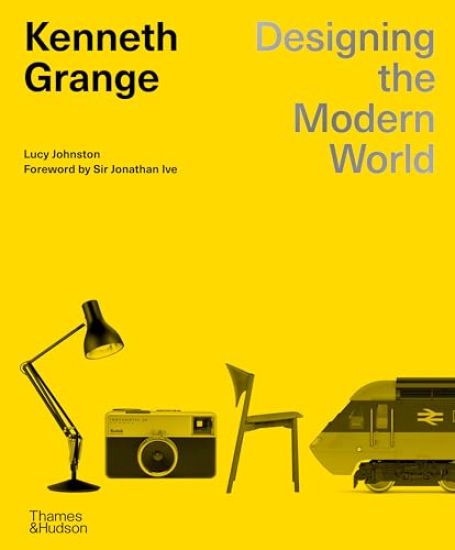
Kenneth Grange

Kenneth Grange

Lucy Johnston; Sir Jonathan Ive

THAMES HUDSON LTD
2024
sidottu
The definitive celebration of the work, life and times of Sir Kenneth Grange (born 1929), one of the most revered, innovative and influential industrial designers of the modern age. 'You may not know the name Kenneth Grange, but you'll almost certainly know his work. He has designed just about everything' The Guardian The work of renowned design pioneer Sir Kenneth Grange (born 1929) has touched the lives of almost every consumer worldwide and has had a lasting influence on today’s younger designers, from Sir Jonathan Ive, Jasper Morrison and Marc Newson to Thomas Heatherwick and the founding brothers of Joseph Joseph. For decades, Grange’s iconic products – including the InterCity 125 train for British Rail, the TX1 London black taxi, domestic appliances for Kenwood, lighting for Anglepoise, cameras for Kodak, pens for Parker and post boxes for Royal Mail, among many others – have been at the centre of tastemaking and key to the establishment of Britain’s worldwide post-war reputation as an influential hub of design excellence. Based on a series of in-depth discussions between Grange and design specialist Lucy Johnston, and her exclusive access to his extensive archive, this illuminating book explores Grange’s biography and work as seen through his eyes, illustrated with sketches, letters, scale models and product photographs. The story is set in its social, political and creative context, introducing the figures who have inspired, commissioned and worked alongside Grange as his designs transformed Britain and the world and helped to shape our modern-day consumer culture.
Kenneth Burke

Kenneth Burke

Robert Wess

Cambridge University Press
1996
sidottu
Kenneth Burke, arguably the most important American literary theorist of the twentieth century, helped define the theoretical terrain for contemporary literary and cultural studies. His perspectives were literary and linguistic, but his influences ranged across history, philosophy, and the social sciences. In this important and original study Robert Wess traces the trajectory of Burke’s long career and situates his work in relation to postmodernity. His study is both an examination of contemporary theories of rhetoric, ideology, and the subject, and an explanation of why Burke failed to complete his Motives trilogy. Burke’s own critique of the ‘isolated unique individual’ led him to question the possibility of unique individuation, a strategy which anticipated important elements of postmodern concepts of subjectivity. Robert Wess’s study is both a timely and judicious exposition of Burke’s massive oeuvre, and a crucial intervention in current debates on rhetoric and human agency.
Kenneth Burke

Kenneth Burke

Robert Wess

Cambridge University Press
1996
pokkari
Kenneth Burke, arguably the most important American literary theorist of the twentieth century, helped define the theoretical terrain for contemporary literary and cultural studies. His perspectives were literary and linguistic, but his influences ranged across history, philosophy, and the social sciences. In this important and original study Robert Wess traces the trajectory of Burke’s long career and situates his work in relation to postmodernity. His study is both an examination of contemporary theories of rhetoric, ideology, and the subject, and an explanation of why Burke failed to complete his Motives trilogy. Burke’s own critique of the ‘isolated unique individual’ led him to question the possibility of unique individuation, a strategy which anticipated important elements of postmodern concepts of subjectivity. Robert Wess’s study is both a timely and judicious exposition of Burke’s massive oeuvre, and a crucial intervention in current debates on rhetoric and human agency.
Kenneth Grahame

Kenneth Grahame

Alison Prince

Faber Faber
2009
pokkari
The Wind in the Willows needs no introduction - children have enjoyed the exploits of its characters for generations. Few would guess that its author, Kenneth Grahame, was a tortured soul. Marriage to the predatory Elspeth Thomson, when both seemed destined for the single life, was a shared fantasy of invented truth. Out of that union came a catastrophically spoiled son, 'mouse', for whom that greatest of children's stories was written. It was the child's tragedy that he was sucked into the unreality of his parents' lives and did not survive it, ending his life in suicide.Alison Prince brings her own highly acclaimed expertise as a children's writer to this remarkably perceptive biography of Kenneth Grahame. Drawing on hitherto unpublished material she uncovers layer upon layer of Grahame's personality to reveal the truth behind the myth of this intriguing man, 'the tortured soul of Mr Toad'.'Alison Prince describes the grim story of Grahame's marriage and fatherhood squarely and sensitively.' Independent'A meaty, well-constructed biography.' Allan Massie Daily Telegraph
Collected Papers of Kenneth J. Arrow

Collected Papers of Kenneth J. Arrow

Kenneth J. Arrow

Harvard University Press
1984
sidottu
Unlike the papers of some other great economists, those of Kenneth Arrow are being read and studied today with even greater care and attention than when they first appeared in the journals. The publication of his collected papers will therefore be welcomed by economists and other social scientists and in particular by graduate students, who can draw from them the deep knowledge and the discernment in selection of scientific problems that only a master can offer. The author has added headnotes to certain well-known papers, describing how he came to write them.In this first volume, Arrow takes up the basic question of whether collective choices can be made in such a way as to reflect individual preferences. The seminal 1950 paper that opens the volume shows that given certain reasonable conditions that social choices must satisfy to reflect individual preferences, it is impossible to make a choice among all sets of alternatives without violating some of the conditions. The subsequent papers extend, deepen, and clarify these results and examine the concept of justice, both in the abstract and in economic models. The volume also contains searching critiques of the theories of justice of John Rawls and Robert Nozick.
Collected Papers of Kenneth J. Arrow

Collected Papers of Kenneth J. Arrow

Kenneth J. Arrow

The Belknap Press
1984
sidottu
Unlike the papers of some other great economists, those of Kenneth Arrow are being read and studied today with even greater care and attention than when they first appeared in journals. This publication of his collected papers, to be completed in seven topical volumes, will be welcomed by economists and other social scientists and in particular by graduate students, who can draw from them the deep knowledge and taste in the selection of scientific problems that only a master can offer.This volume is concerned with the foundations of neo-classical economic analysis. General equilibrium is a theory of prices in which all of the actions of the economic agents in an economy are determined simultaneously and in a decentralized fashion. The price system, determined in competitive markets, guides actions for both firms and individual consumers. All of the complex interrelations of the economy are distilled into the determination of this price system.In these papers, Arrow examines the conditions under which such a price system would exist. He also clarifies the conditions under which the system can or cannot achieve an optimum. In the latter case, when “market failures” are present, he shows the role of a benevolent government in helping to overcome the induced inefficiencies.
Collected Papers of Kenneth J. Arrow

Collected Papers of Kenneth J. Arrow

Kenneth J. Arrow

Harvard University Press
1984
sidottu
Unlike the papers of some other great economists, those of Kenneth Arrow are being read and studied today with even greater care and attention than when they first appeared in the journals. The publication of his collected papers will therefore be welcomed by economists and other social scientists and in particular by graduate students, who can draw from them the deep knowledge and the discernment in selection of scientific problems that only a master can offer. The author has added headnotes to certain well-known papers, describing how he came to write them.The third volume of Kenneth Arrow's Collected Papers concerns the basic concept of rationality as it applies to an economic decision maker. In particular, it addresses the problem of choice faced by consumers in a multicommodity world and presents specific models of choice useful in economic analysis. It also discusses choice models under uncertainty, giving the basic theory and critiques of this theory based on experimental evidence and applications. Among the major papers are "Alternative Approaches to the Theory of Choice in Risk-Taking Situations," a masterly survey of subjective probability and choice theory, and "The Theory of Risk Aversion," an exposition of the theory of choice under uncertainty.
Collected Papers of Kenneth J. Arrow

Collected Papers of Kenneth J. Arrow

Kenneth J. Arrow

Harvard University Press
1984
sidottu
Unlike the papers of some other great economists, those of Kenneth Arrow are being read and studied today with even greater care and attention than when they first appeared in the journals. The publication of his collected papers will therefore be welcomed by economists and other social scientists and in particular by graduate students, who can draw from them the deep knowledge and the discernment in selection of scientific problems that only a master can offer. The author has added headnotes to certain well-known papers, describing how he came to write them.This volume begins with Arrow's papers on statistical decision theory, which served as a foundation for his work on the economics of information. As he writes in his preface, "Statistical method was an example for the acquisition of information. In a world of uncertainty, it was no great leap to realize that information is valuable in an economic sense." The later, applied papers, which operationalize the theory of the early ones, include essays on the demand for information, the economic value of screening devices, and the effect of incomplete information on the structure of organizations, futures markets, and insurance.
Collected Papers of Kenneth J. Arrow

Collected Papers of Kenneth J. Arrow

Kenneth J. Arrow

Harvard University Press
1985
sidottu
Unlike the papers of some other great economists, those of Kenneth Arrow are being read and studied today with even greater care and attention than when they first appeared in the journals. The publication of his collected papers will therefore be welcomed by economists and other social scientists and in particular by graduate students, who can draw from them the deep knowledge and the discernment in selection of scientific problems that only a master can offer. The author has added headnotes to certain well-known papers, describing how he came to write them.The study of production is central to economic theory, and capital and its accumulation are two of the most interesting aspects of the modern production process. Capital may take the form of inventories of inputs, inventories of outputs, or machines and other fixed goods. The essential and unique aspect of all types of capital is that it must be accumulated as the result of prior stages of the production process. This gives the dynamic theory of production a recursive structure that can be exploited by economic analysis. The optimization of production under recursive conditions lends itself to general mathematical methods of dynamic programming and optimal control theory. This is the main theme of the essays included in this fifth volume of Kenneth Arrow's Collected Papers.
Collected Papers of Kenneth J. Arrow

Collected Papers of Kenneth J. Arrow

Kenneth J. Arrow

Harvard University Press
1985
sidottu
Unlike the papers of some other great economists, those of Kenneth Arrow are being read and studied today with even greater care and attention than when they first appeared in the journals. The publication of his collected papers will therefore be welcomed by economists and other social scientists and in particular by graduate students, who can draw from them the deep knowledge and the discernment in selection of scientific problems that only a master can offer. The author has added headnotes to certain well-known papers, describing how he came to write them.Although economic theory has been Kenneth Arrow's comparative advantage as well as his special interest, from time to time he has turned his attention to applied problems, often with unexpected results. A request from the Ford Foundation to write a survey of health economics led to his famous paper, "Uncertainty and the Welfare Economics of Medical Care," which raised for the first time many issues in the economics of information, particularly what are now called incentive compatibility issues. Other fruitful papers included in this volume deal with racial discrimination, the cost of oil imports, health insurance, environmental resources, and urban economics. Arrow's main interest in studying these disparate problems has been their potential source for new theory as well as their policy applications.
Kenneth Burke

Kenneth Burke

Jeffrey W. Murray

University Press of America
2002
nidottu
Kenneth Burke: A Dialogue of Motives employs the philosophy of ethics of Emmanuel Levinas to develop a uniquely dramatistic philosophy of ethics. Jeffrey Murray analyzes Kenneth Burke's A Grammar of Motives and A Rhetoric of Motives and offers the notion of "a dialogue of motives" as a completion of Burke's proposed trilogy and as a supplement to Burke's own tools for rhetorical criticism.