Kirjojen hintavertailu. Mukana 11 529 391 kirjaa ja 12 kauppaa.

Kirjahaku

Etsi kirjoja tekijän nimen, kirjan nimen tai ISBN:n perusteella.

1000 tulosta hakusanalla Kenneth R Taylor

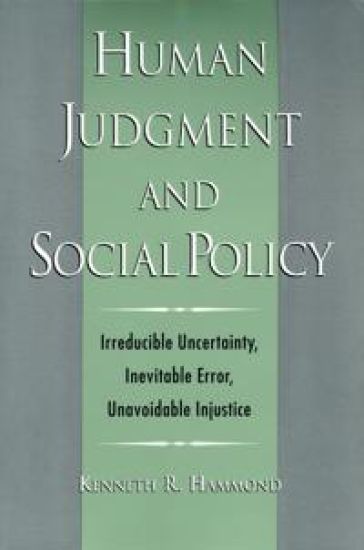
Human Judgment and Social Policy

Human Judgment and Social Policy

Kenneth R. Hammond

Oxford University Press Inc
2000
nidottu
From the O.J. Simpson verdict to peace-making in the Balkans, the critical role of human judgment--complete with its failures, flaws, and successes--has never been more hotly debated and analyzed than it is today. This landmark work examines the dynamics of judgment and its impact on events that take place in human society, which require the direction and control of social policy. Research on social policy typically focuses on content. This book concentrates instead on the decision-making process itself. Drawing on 50 years of empirical research in decision theory, Hammond examines the possibilities for wisdom and cognitive competence in the formation of social policies, and applies these lessons to specific examples, such as the space shuttle Challenger disaster and the health care debate. Uncertainly, he tells us, can seldom be fully eliminated; thus error is inevitable, and injustice for some unavoidable. But the capacity for make wise judgments increases to the extent that we understand the potential pitfalls and their origin. The judgment process for example involves an ongoing rivalry between intuition and analysis, accuracy and rationality. The source of this tension requires an examination of the evolutionary roots of human judgment and how these fundamental features may be changing as our civilization increasingly becomes an information and knowledge-based society. With numerous examples from law, medicine, engineering, and economics, the author dramatizes the importance of judgment and its role in the formation of social policies which affect us all, and issues the first comprehensive examination of its underlying dynamics.
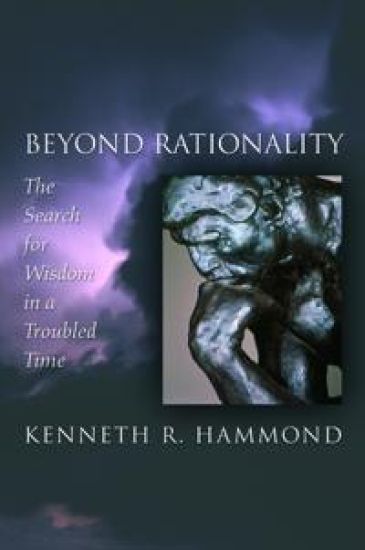
Beyond Rationality

Beyond Rationality

Kenneth R. Hammond

Oxford University Press Inc
2007
sidottu
Ken Hammond has spent over a half-century analysing judgment and decision-making. His long-time focus has been on the dichotomy between judgment theories of correspondence (working to achieve empirical accuracy) and coherence (aiming for rationality and consistency) and the political consequences that can come from not understanding which of these theories people are following. In Beyond Rationality Hammond sums up his work and illustrates it with penetrating case studies on topics such as why Kennedy and Khruschev misunderstood each other, Colin Powell's misjudgments, the modes of thought on the Supreme Court, and much, much more. Hammond has changed the way academics think about decision making; with this book, he aims to show a larger audience why mistaken judgments happen, how to make better decisions, and how to understand the thought modes operating in the political process.
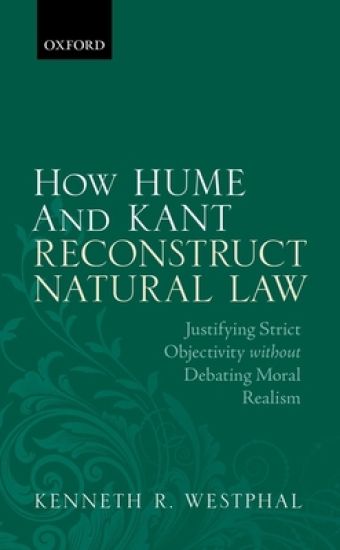
How Hume and Kant Reconstruct Natural Law

How Hume and Kant Reconstruct Natural Law

Kenneth R. Westphal

Clarendon Press
2016
sidottu
Kenneth R. Westphal presents an original interpretation of Hume's and Kant's moral philosophies, the differences between which are prominent in current philosophical accounts. Westphal argues that focussing on these differences, however, occludes a decisive, shared achievement: a distinctive constructivist method to identify basic moral principles and to justify their strict objectivity, without invoking moral realism nor moral anti-realism or irrealism. Their constructivism is based on Hume's key insight that 'though the laws of justice are artificial, they are not arbitrary'. Arbitrariness in basic moral principles is avoided by starting with fundamental problems of social coördination which concern outward behaviour and physiological needs; basic principles of justice are artificial because solving those problems does not require appeal to moral realism (nor to moral anti-realism). Instead, moral cognitivism is preserved by identifying sufficient justifying reasons, which can be addressed to all parties, for the minimum sufficient legitimate principles and institutions required to provide and protect basic forms of social coördination (including verbal behaviour). Hume first develops this kind of constructivism for basic property rights and for government. Kant greatly refines Hume's construction of justice within his 'metaphysical principles of justice', whilst preserving the core model of Hume's innovative constructivism. Hume's and Kant's constructivism avoids the conventionalist and relativist tendencies latent if not explicit in contemporary forms of moral constructivism.
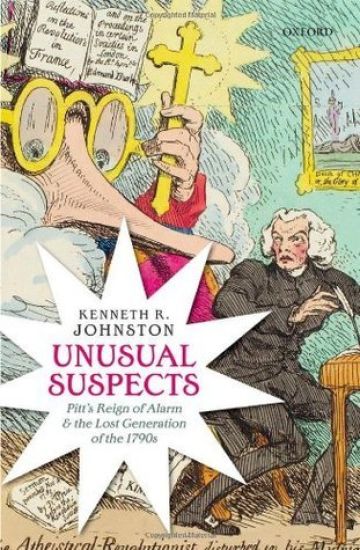
Unusual Suspects

Unusual Suspects

Kenneth R. Johnston

Oxford University Press
2013
sidottu
Robespierre's Reign of Terror spawned an evil little twin in William Pitt the Younger's Reign of Alarm, 1792-1798. Terror begat Alarm. Many lives and careers were ruined in Britain as a result of the alarmist regime Pitt set up to suppress domestic dissent while waging his disastrous wars against republican France. Liberal young writers and intellectuals whose enthusiasm for the American and French revolutions raised hopes for Parliamentary reform at home saw their prospects blasted. Over a hundred trials for treason or sedition (more than ever before or since in British history) were staged against 'the usual suspects' - that is, political activists. But other, informal, vigilante means were used against the 'unusual suspects' of this book: jobs lost, contracts abrogated, engagements broken off, fellowships terminated, inheritances denied, and so on and on. As in the McCarthy era in 1950s America, blacklisting and rumor-mongering did as much damage as legal repression. Dozens of 'almost famous' writers saw their promising careers nipped in the bud: people like Helen Maria Williams, James Montgomery, William Frend, Gilbert Wakefield, John Thelwall, Joseph Priestley, Dr. Thomas Beddoes, Francis Wrangham and many others. Unusual Suspects tells the stories of some representative figures from this largely 'lost' generation, restoring their voices to nationalistic historical accounts that have drowned them in triumphal celebrations of the rise of English Romanticism and England's ultimate victory over Napoleon. Their stories are compared with similar experiences of the first Romantic generation: Coleridge, Wordsworth, Southey, Lamb, Burns, and Blake. Wordsworth famously said of this decade, 'bliss was it in that dawn to be alive, but to be young was very heaven!' These young people did not find it so-and neither, when we look more closely, did Wordsworth.
Theater of Acculturation

Theater of Acculturation

Kenneth R. Stow

University of Washington Press
2001
pokkari
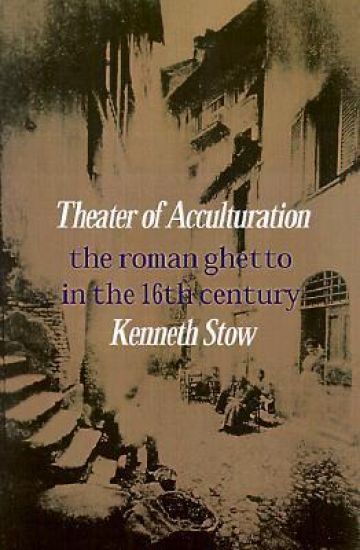
Generations of tourists visiting Rome have ventured into the small section between the Tiber River and the Capitoline Hill whose narrow, dark streets lead to the charming Fountain of the Tortoises, the brooding mass of the Palazzo Cenci, and some of the best restaurants in the city. This was the site of the Ghetto, within whose walls the Jews of Rome were compelled to live from 1555 until 1870. Kenneth Stow, leading authority on Italian Jews, probes Jewish life in Rome in the early years of the Ghetto.Jews had been residents of Rome since before the days of Julius Caesar, but the 16th century brought great challenges to their identity and survival in the form of Ghettoization. Intended to expedite conversion and cultural dissolution, the Ghetto in fact had an opposite effect. The Jews of Rome developed a subculture, or microculture, that ensured continuity. In particular, they developed a remarkably effective legal network of rabbinic notaries, who drew public documents such as contracts, took testimony, and arranged for disputes to go to arbitration. The ability to settle disputes relating to marriage, divorce, inheritance, and other internal matters gave Jews the illusion that they, rather than the papal vicar, were running their own affairs.Stow applies his concept of "social theater" to illuminate the role-playing that Jews adopted as a means of survival within the dominant Christian environment. He also touches briefly on Jewish culture in post-Emancipation Rome, elsewhere in Europe, and in America, and points the way toward a comparison with the acculturational strategies of other minorities, especially African Americans.
Theater of Acculturation

Theater of Acculturation

Kenneth R. Stow

University of Washington Press
2015
sidottu
Generations of tourists visiting Rome have ventured into the small section between the Tiber River and the Capitoline Hill whose narrow, dark streets lead to the charming Fountain of the Tortoises, the brooding mass of the Palazzo Cenci, and some of the best restaurants in the city. This was the site of the Ghetto, within whose walls the Jews of Rome were compelled to live from 1555 until 1870. Kenneth Stow, leading authority on Italian Jews, probes Jewish life in Rome in the early years of the Ghetto.Jews had been residents of Rome since before the days of Julius Caesar, but the 16th century brought great challenges to their identity and survival in the form of Ghettoization. Intended to expedite conversion and cultural dissolution, the Ghetto in fact had an opposite effect. The Jews of Rome developed a subculture, or microculture, that ensured continuity. In particular, they developed a remarkably effective legal network of rabbinic notaries, who drew public documents such as contracts, took testimony, and arranged for disputes to go to arbitration. The ability to settle disputes relating to marriage, divorce, inheritance, and other internal matters gave Jews the illusion that they, rather than the papal vicar, were running their own affairs.Stow applies his concept of "social theater" to illuminate the role-playing that Jews adopted as a means of survival within the dominant Christian environment. He also touches briefly on Jewish culture in post-Emancipation Rome, elsewhere in Europe, and in America, and points the way toward a comparison with the acculturational strategies of other minorities, especially African Americans.
William Henry Harrison

William Henry Harrison

Kenneth R. Stevens

Greenwood Press
1998
sidottu
Although William Henry Harrison died a month after becoming President, he lived a full and accomplished life before assuming the presidency. As a member of Congress, he sponsored legislation dividing the Northwest Territory. As governor of the Indiana Territory, he led a movement to suspend the provisions of the Northwest Ordinance and earned a reputation for acquiring large land cessions from the Indian tribes, winning the affection of white settlers and the animosity of Native Americans. Serving as brigadier general during the War of 1812, he then served in the Ohio legislature and the U.S. Senate, and was named minister to Colombia. This bibliography provides a guide to the literature on his extensive career.
Disarming States

Disarming States

Kenneth R. Rutherford

Praeger Publishers Inc
2010
sidottu
This book provides a detailed history of the global movement to ban anti-personnel landmines (APL), marking the first case of a successful worldwide civil society movement to end the use of an entire category of weapons. In March 1995, Belgium became the first state to pass a domestic anti-personnel landmine ban. In December 1997, 122 states joined Belgium in signing the comprehensive Mine Ban Treaty, also known as the Ottawa Treaty. The movement to ban landmines became a turning point in global politics that continues to influence policy and strategy decisions regarding weapon use today. Disarming States: The International Movement to Ban Landmines describes how non-government organizations (NGOs) brought the landmine issue to international attention by forming the International Campaign to Ban Landmines (ICBL). The author presents new information gleaned from interviews and intensive research conducted around the world. The critical role of mid-size states—such as Austria, Canada, and Switzerland—recruited to back the movement's goals is examined. The book concludes by examining how NGOs affect the international political agenda, especially in seeking legal prohibitions on weapons and changes in states' behaviors.
Year Book of Medicine, 2016

Year Book of Medicine, 2016

Kenneth R. DeVault; Renee Garrick; Michael R. Gold; Nancy M. Khardori; Derek LeRoith; Janet R. Maurer; Amanda M. Sammut

Elsevier - Health Sciences Division
2016
sidottu
The Year Book of Medicine brings you abstracts of the articles that reported the year's breakthrough developments in medicine, carefully selected from more than 500 journals worldwide. Expert commentaries evaluate the clinical importance of each article and discuss its application to your practice. Chapters include Rheumatology; Infectious Disease; Hematology and Oncology; Kidney, Water, and Electrolytes; Pulmonary Disease; Heart and Cardiovascular Disease; The Digestive System; and Endocrinology, Diabetes, and Metabolism.
Image-Guided Interventions

Image-Guided Interventions

Kenneth R. Thomson

Saunders
2020
sidottu
Completely revised to reflect recent, rapid changes in the field of interventional radiology (IR), Image-Guided Interventions, 3rd Edition, offers comprehensive, narrative coverage of vascular and nonvascular interventional imaging-ideal for IR subspecialists as well as residents and fellows in IR. This award-winning title provides clear guidance from global experts, helping you formulate effective treatment strategies, communicate with patients, avoid complications, and put today's newest technology to work in your practice. Offers step-by-step instructions on a comprehensive range of image-guided intervention techniques, including discussions of equipment, contrast agents, pharmacologic agents, antiplatelet agents, and classic signs, as well as detailed protocols, algorithms, and SIR guidelines. Includes new chapters on Patient Preparation, Prostate Artery Embolization, Management of Acute Aortic Syndrome, Percutaneous Arterial Venous Fistula Creation, Lymphatic Interventions, Spinal and Paraspinal Nerve Blocks, and more. Employs a newly streamlined format with shorter, more digestible chapters for quicker reference. Integrates new patient care and communication tips throughout to address recent changes in practice. Highlights indications and contraindications for interventional procedures, and provides tables listing the materials and instruments required for each. Features more than 2,300 state-of-the-art images demonstrating IR procedures, full-color illustrations of anatomical structures and landmarks, and video demonstrations online. 2014 BMA Medical Book Awards Highly Commended in Radiology category! Enhanced eBook version included with purchase. Your enhanced eBook allows you to access all of the text, figures, and references from the book on a variety of devices.
The Dysfunctional Congress?

The Dysfunctional Congress?

Kenneth R Mayer; David T Canon

Routledge
2019
sidottu
This book introduces students to an argument using rational choice theories to explain what happens when individuals come together to make collective decisions, emphasising on the collective dilemma concept that provides a framework for thinking about how reform proposals would affect Congress.
The Dysfunctional Congress?

The Dysfunctional Congress?

Kenneth R Mayer; David T Canon

Routledge
2021
nidottu
This book introduces students to an argument using rational choice theories to explain what happens when individuals come together to make collective decisions, emphasising on the collective dilemma concept that provides a framework for thinking about how reform proposals would affect Congress.
Kant’s Critical Epistemology

Kant’s Critical Epistemology

Kenneth R. Westphal

Routledge
2020
sidottu
This book assesses and defends Kant’s Critical epistemology, and the rich yet neglected resources it provides for understanding and resolving fundamental issues regarding human experience, perceptual judgment, empirical knowledge and cognitive sciences.Kenneth Westphal first examines Kant’s methods and strategies for examining human sensory-perceptual experience, and then examines Kant’s central, proper, and subtle attention to judgment, and so to the humanly possible valid use of concepts and principles to judge particulars we confront. This provides a comprehensive account of Kant’s anti-Cartesianism, the integrity of his three principles of causal judgment, and Kant’s account of disciminatory perceptual-motor behaviour, including both sensory reafference and perceptual affordances. Westphal then defends the significance of Kant’s subtle and illuminating account of causal judgment for three main philosophical domains: history and philosophy of science, theory of action and human freedom, and philosophy of mind.Kant’s Critical Epistemology will appeal to researchers and advanced students interested in Kant and the relations of his thought to contemporary philosophical debates and to the sciences of the mind.
Kant’s Critical Epistemology

Kant’s Critical Epistemology

Kenneth R. Westphal

TAYLOR FRANCIS LTD
2022
nidottu
This book assesses and defends Kant’s Critical epistemology, and the rich yet neglected resources it provides for understanding and resolving fundamental issues regarding human experience, perceptual judgment, empirical knowledge and cognitive sciences.Kenneth Westphal first examines Kant’s methods and strategies for examining human sensory-perceptual experience, and then examines Kant’s central, proper, and subtle attention to judgment, and so to the humanly possible valid use of concepts and principles to judge particulars we confront. This provides a comprehensive account of Kant’s anti-Cartesianism, the integrity of his three principles of causal judgment, and Kant’s account of disciminatory perceptual-motor behaviour, including both sensory reafference and perceptual affordances. Westphal then defends the significance of Kant’s subtle and illuminating account of causal judgment for three main philosophical domains: history and philosophy of science, theory of action and human freedom, and philosophy of mind.Kant’s Critical Epistemology will appeal to researchers and advanced students interested in Kant and the relations of his thought to contemporary philosophical debates and to the sciences of the mind.
Sun, Earth and Sky

Sun, Earth and Sky

Kenneth R. Lang

Springer-Verlag New York Inc.
2006
sidottu
This Second Edition of Sun, Earth and Sky updates the popular text by providing comprehensive accounts of the most recent discoveries made by five modern solar spacecraft during the past decade. Their instruments have used sound waves to peer deep into the Sun’s inner regions and measure the temperature of its central nuclear reactor, and extended our gaze far from the visible Sun to record energetic outbursts that threaten Earth. Breakthrough observations with the underground Sudbury Neutrino Observatory are also included, which explain the new physics of ghostly neutrinos and solve the problematic mismatch between the predicted and observed amounts of solar neutrinos. This new edition of Sun, Earth and Sky also describes our recent understanding of how the Sun’s outer atmosphere is heated to a million degrees, and just where the Sun’s continuous winds come from. As humans we are more intimately linked with our life-sustaining Sun than with any other astronomical object, and the new edition therefore provides modern interpretations of ozone depletion and global warming that are related to both the Sun and to human activities. Written in a light and friendly style, this lavishly illustrated book introduces the Sun and its physics, and describes all aspects of the Sun’s interaction with us on Earth.
A Companion to Astronomy and Astrophysics

A Companion to Astronomy and Astrophysics

Kenneth R. Lang

Springer-Verlag New York Inc.
2006
nidottu
Astronomy and Astrophysics is a comprehensive, fundamental, up-to-date reference book. It is filled with vital information and basic facts for amateur astronomers and professional astrophysicists, and for anyone interested in the Universe, from the Earth and other planets to the stars, galaxies and beyond. Although serious and thorough, the language, and ideas will attract the general reader, as well as students and professionals. Astronomy and Astrophysics consists of two main parts, a Timeline and a Dictionary. The Timeline is a concise history, arranged chronologically, which provides the complete story of cosmic discovery from early Chinese and Greek astronomy to the latest findings of modern astrophysics and robotic spacecraft. It provides a sense of destination and flow in our growing awareness of the Universe. Each entry in the unfolding narrative is written in a concise, light and friendly style that will be appreciated by all, without being weighted down with incomprehensible specialized terms. The story of science is one of individuals, as well as discoveries and ideas. So our Timeline includes the people who have made major scientific contributions that are related to astronomy, and astrophysics. The Dictionary defines all terms and acronyms that deal with our celestial science, from important concepts to individual objects and space missions. It is arranged alphabetically and complemented by numerous tables of fundamental data for bright cosmic objects, including the celestial coordinates required to observe them. Line drawings are also used to forcefully compact a scientific insight, with clear labels and captions. An exceptionally thorough Index cross-references concepts, discoveries and individuals in both the Timeline and Dictionary. The combined result is a unique, comprehensive, stand-alone reference volume in which the reader can quickly locate information, while also discovering new and unexpected knowledge.
Parting the Cosmic Veil

Parting the Cosmic Veil

Kenneth R. Lang

Springer-Verlag New York Inc.
2006
sidottu
Parting the Cosmic Veil describes our gradual awareness of a vast, previously concealed Universe. It is a story of expanding horizons and the discovery of invisible worlds, made possible with new technology and novel telescopes that have broadened our range of perception and sharpened our vision. Spacecraft have carried men to the Moon, and traveled throughout the Solar System, obtaining close-up views that have transformed the moons and planets from moving points of light to fascinating, diverse worlds. Modern technology has also enabled the detection of giant planets around other stars, taking us one step closer to the possible detection of life outside the Earth. Astronomers have used telescopes, operating at the visible wavelengths that we see with our eye, to reveal the true extent of the Milky Way and discover billions of remote galaxies that are rushing away from us in an expanding Universe. Each of these galaxies contains billions of stars wheeling around their massive central hub. Radio waves and X-rays, which lie beyond the range of visual perception, are used to detect a violent Universe, from exploding stars to gamma ray bursts and the Big Bang itself, with the associated discoveries of pulsars, black holes and quasars. Radio astronomers have also shown that the dark spaces between the stars contain vast tracts of cold hydrogen atoms and a host of molecules. Dark invisible matter has been discovered residing outside the shining stars and galaxies, outweighing them all. And a mysterious dark energy has also been found, which fills the nooks and crannies of seemingly empty space. The Cosmos is evolving, participating in ongoing processes of creation, destruction, and re-birth. But even though we are pushing the boundaries of knowledge closer to an understanding of the origins and destinies, of either the Universe or Life, the ultimate answers to these grand questions still lie hidden behind the Cosmic Veil.
Real Analysis and Applications

Real Analysis and Applications

Kenneth R. Davidson; Allan P. Donsig

Springer-Verlag New York Inc.
2009
sidottu
This new approach to real analysis stresses the use of the subject with respect to applications, i.e., how the principles and theory of real analysis can be applied in a variety of settings in subjects ranging from Fourier series and polynomial approximation to discrete dynamical systems and nonlinear optimization. Users will be prepared for more intensive work in each topic through these applications and their accompanying exercises. This book is appropriate for math enthusiasts with a prior knowledge of both calculus and linear algebra.
The Hidden Wordsworth

The Hidden Wordsworth

Kenneth R. Johnston

WW Norton Co
2013
nidottu
In this fascinating account, Kenneth R. Johnston portrays a Wordsworth different in crucial ways from the one the poet intended us to know. Taking advantage of unprecedented access to archives, family papers, and letters, he reveals the poet's complex relationship with his sister Dorothy; the full story of the affair with his French mistress, Annette Vallon; and his surprisingly close connections to both radical reformers and the political establishment of his day, including members of the newly formed British Secret Service in England and Germany. The Hidden Wordsworth also explores the poet's intense and often destructive relations with a cluster of young writers, leading up to his friendship with Samuel Taylor Coleridge. This brilliantly insightful biography breaks through the carefully crafted but frequently misleading accounts of his youth Wordsworth created in his conservative later years. The Hidden Wordsworth reveals the radical young poet whose powerful intellect revolutionized English poetry. Winner of the 1998 Jean Baracelli Prize from the American Conference on Romanticism; shortlisted for the James Tait Black biography prize (UK); a New York Times Notable Book of the Year. "Full of fresh information, fresh insights, and fresh intelligent critical readings of the poetry."—Stephen M. Parrish, editor, The Cornell Wordsworth