Kirjojen hintavertailu. Mukana 11 342 296 kirjaa ja 12 kauppaa.

Kirjahaku

Etsi kirjoja tekijän nimen, kirjan nimen tai ISBN:n perusteella.

1000 tulosta hakusanalla Larry G. Murphy

Defending the Good Society

Defending the Good Society

Larry G Johnson

Anvil House Publishers LLC
2020
pokkari
Defending the Good Society - The Assault on Order, Justice, and Freedom The good society is inhabited by a people who have constructed and maintain a high degree of moral and social order founded upon and held together by the glue of eternal truths, norms, human universals, mores and traditions, distant voices of the past, and most importantly faithfulness to God and the prescriptions of the Bible. In such a society will be found a high degree of order, justice, and freedom. It is at this point that many non-Christians who approve of and value the attributes and provisions of the good society will reject the God of the Bible as the fountain of truth from which the good society must draw its pattern and sustenance. But that cannot be as will be shown throughout this book. Any source other than God's perfect truth as shown in His creation and revelation to the ancient Israelites and first century Christians is less than perfect. Over the course of time, that source will be revealed as flawed and inevitably lead to disorder and disintegration of any society based on imperfect truth. I ask that that the skeptic continue reading and reserve judgment on this point until the end of the book. This book's hypothesis is that the ongoing efforts to destroy the good society are a consequence of applied humanism as it is imposed on the everyday life of Americans in the grip of forced equality. The dominant humanistic concept of forced equality is disintegrative because of its nature and presents not only a false philosophy and view of the world but is doing significant if not fatal damage to American society and the world. From these premises and perspective, the author has titled this book Defending the Good Society - The Assault on Order, Justice, and Freedom.
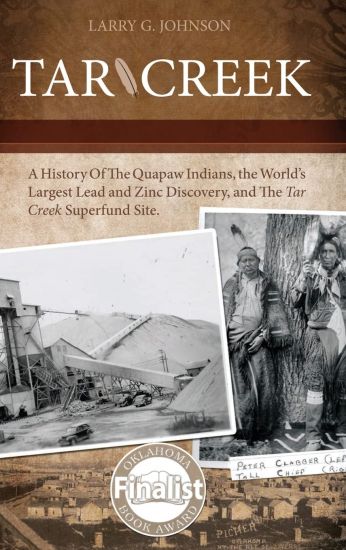
Tar Creek

Tar Creek

Larry G Johnson

Anvil House Publishers LLC
2017
sidottu
Tar Creek - A History of The Quapaw Indians, the World's Largest Lead and Zinc Discovery, and The Tar Creek Superfund Site. When this book was conceived, it was intended as a straightforward recounting of the story of the world's greatest discovery of lead and zinc located in the far northeast corner of Oklahoma. I soon realized that this 1915 discovery was strongly linked to prior as well as current events and that those events should be a part of the story. Because of the interconnectedness of the present with the past, the story grew and quickly encompassed the Quapaw Indians and their ancient history, the founding of the United States, the Louisiana Purchase, the transition of Oklahoma and Indian Territories to statehood, the discovery and mining of lead and zinc in the Tri-State region, and the making of the oldest and largest environmental Superfund site in America. This book does not claim to do justice to any of these topics but attempts to tell an interesting story from a perspective not seen before. Parts of the book deal with grand themes and momentous events. Other chapters deal with the mundane and minutia of life in frontier mining camps. As time progresses, some of the events and players in our story rise to prominence and then recede into obscurity. Other seemingly insignificant actions and events create ripples that become waves that become tsunamis that etch a lasting mark on the shores of history. The discovery of lead and zinc deposits in 1915 on the Quapaw Reservation at Picher, Oklahoma, serves as the focal point of the book. Several events and links to the past preceding the discovery are chronicled. Events and actions from that discovery to the present are also noted. One might visually describe this story as an hourglass with the discovery of lead and zinc at Picher as the skinny neck through which all of the interconnected acts and events preceding the discovery (the top half of the hourglass) are slowly moving toward (causing or impacting) that discovery. The bottom half of the hourglass is literally the fallout from the discovery or, as one might put it, the repercussions ninety years later. Larry G. Johnson
Revelation for Laymen Third Edition

Revelation for Laymen Third Edition

Larry G. Morgan

Independently Published
2019
nidottu
A book about the Bible is about the last kind of book I ever thought I'd write. And the last book of the Bible I thought I'd write about is the book Revelation. Most people feel like the book of Revelation is too full of symbols and symbolism to be adequately understood. I was of this opinion also. After reading the book, I decided that it would be helpful to the average person if a shorter version of the most important verses and actions were created. That is what I have tried to do in Revelation for Laymen. I have made extensive use of references to interpret the scripture as well as some of my own input. As a result, I believe I have a book that the average Bible scholar will find interesting and useful. At least, some of my friends who are ministers have said it is so. I hope you find my book both interesting and helpful as you study Revelation.
Systematics of the South American Marsupial Family Caenolestidae
This work has been selected by scholars as being culturally important, and is part of the knowledge base of civilization as we know it. This work was reproduced from the original artifact, and remains as true to the original work as possible. Therefore, you will see the original copyright references, library stamps (as most of these works have been housed in our most important libraries around the world), and other notations in the work.This work is in the public domain in the United States of America, and possibly other nations. Within the United States, you may freely copy and distribute this work, as no entity (individual or corporate) has a copyright on the body of the work.As a reproduction of a historical artifact, this work may contain missing or blurred pages, poor pictures, errant marks, etc. Scholars believe, and we concur, that this work is important enough to be preserved, reproduced, and made generally available to the public. We appreciate your support of the preservation process, and thank you for being an important part of keeping this knowledge alive and relevant.
Review of the Prothylacyninae, an Extinct Subfamily of South American "dog-like" Marsupials
This work has been selected by scholars as being culturally important, and is part of the knowledge base of civilization as we know it. This work was reproduced from the original artifact, and remains as true to the original work as possible. Therefore, you will see the original copyright references, library stamps (as most of these works have been housed in our most important libraries around the world), and other notations in the work.This work is in the public domain in the United States of America, and possibly other nations. Within the United States, you may freely copy and distribute this work, as no entity (individual or corporate) has a copyright on the body of the work.As a reproduction of a historical artifact, this work may contain missing or blurred pages, poor pictures, errant marks, etc. Scholars believe, and we concur, that this work is important enough to be preserved, reproduced, and made generally available to the public. We appreciate your support of the preservation process, and thank you for being an important part of keeping this knowledge alive and relevant.
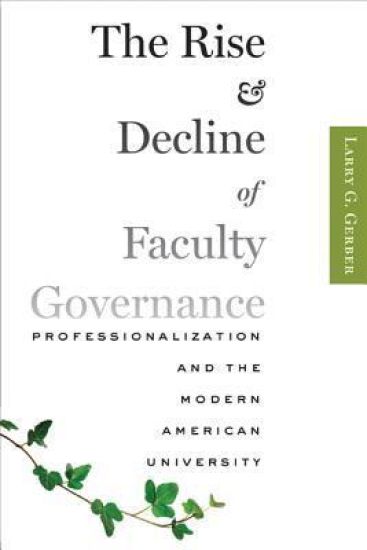
The Rise and Decline of Faculty Governance

The Rise and Decline of Faculty Governance

Larry G. Gerber

Johns Hopkins University Press
2014
sidottu
The Rise and Decline of Faculty Governance is the first history of shared governance in American higher education. Drawing on archival materials and extensive published sources, Larry G. Gerber shows how the professionalization of college teachers coincided with the rise of the modern university in the late nineteenth century and was the principal justification for granting teachers power in making educational decisions. In the twentieth century, the efforts of these governing faculties were directly responsible for molding American higher education into the finest academic system in the world. In recent decades, however, the growing complexity of "multiversities" and the application of business strategies to manage these institutions threatened the concept of faculty governance. Faculty shifted from being autonomous professionals to being "employees." The casualization of the academic labor market, Gerber argues, threatens to erode the quality of universities. As more faculty become contingent employees, rather than tenured career professionals enjoying both job security and intellectual autonomy, universities become factories in the knowledge economy. In addition to tracing the evolution of faculty decision making, this historical narrative provides readers with an important perspective on contemporary debates about the best way to manage America's colleges and universities. Gerber also reflects on whether American colleges and universities will be able to retain their position of global preeminence in an increasingly market-driven environment, given that the system of governance that helped make their success possible has been fundamentally altered.