Kirjojen hintavertailu. Mukana 11 342 296 kirjaa ja 12 kauppaa.

Kirjahaku

Etsi kirjoja tekijän nimen, kirjan nimen tai ISBN:n perusteella.

1000 tulosta hakusanalla Lawrence R. Samuel

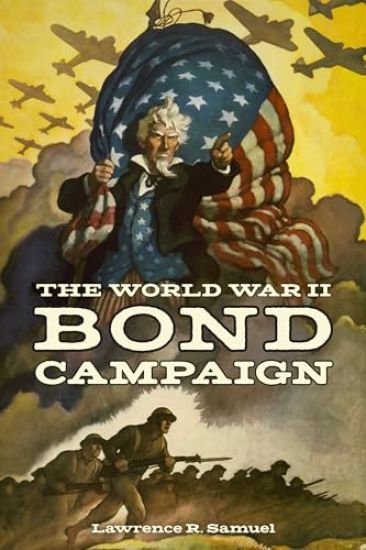
The World War II Bond Campaign

The World War II Bond Campaign

Lawrence R. Samuel

FORDHAM UNIVERSITY PRESS
2025
sidottu
How America's greatest marketing triumph in World War II shaped race, ethnicity, and class in modern America The World War II Bond Campaign is a history of the World War II bond drive led by the federal government, an effort called the most successful marketing operation in history. By the war's end, some 85 million Americans had spent $186 billion in an unprecedented outpouring of patriotism that contributed to the military victory and the prosperity of the following decades. The FDR administration used bonds to raise capital to support the war and promote national unity within the context of the nation's increasingly pluralistic society as the "melting pot" theory was retired. African Americans, Euro-Americans, and labor union members enthusiastically bought bonds to express national loyalty but also to demonstrate racial, ethnic, or class pride, a reflection of their dualistic or "hyphenated" identities. Drawing on various primary sources, The World War II Bond Campaign illustrates how the Treasury Department's multicultural marketing strategies tapped into Americans' aspirations alongside their patriotic impulses. Citizens of all social and economic backgrounds eagerly responded to what can be seen as the selling of America, making the subject an ideal lens to view national identity at a critical moment in the country's history. The author contends that the drive's success helped pave the way for the emergence of both the civil rights movement and the vigorous consumer culture of the postwar years.
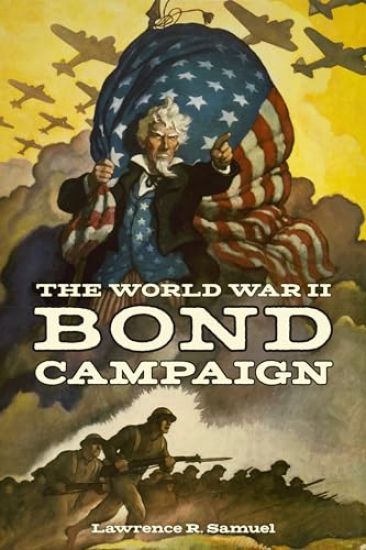
The World War II Bond Campaign

The World War II Bond Campaign

Lawrence R. Samuel

FORDHAM UNIVERSITY PRESS
2025
pokkari
How America's greatest marketing triumph in World War II shaped race, ethnicity, and class in modern America The World War II Bond Campaign is a history of the World War II bond drive led by the federal government, an effort called the most successful marketing operation in history. By the war's end, some 85 million Americans had spent $186 billion in an unprecedented outpouring of patriotism that contributed to the military victory and the prosperity of the following decades. The FDR administration used bonds to raise capital to support the war and promote national unity within the context of the nation's increasingly pluralistic society as the "melting pot" theory was retired. African Americans, Euro-Americans, and labor union members enthusiastically bought bonds to express national loyalty but also to demonstrate racial, ethnic, or class pride, a reflection of their dualistic or "hyphenated" identities. Drawing on various primary sources, The World War II Bond Campaign illustrates how the Treasury Department's multicultural marketing strategies tapped into Americans' aspirations alongside their patriotic impulses. Citizens of all social and economic backgrounds eagerly responded to what can be seen as the selling of America, making the subject an ideal lens to view national identity at a critical moment in the country's history. The author contends that the drive's success helped pave the way for the emergence of both the civil rights movement and the vigorous consumer culture of the postwar years.
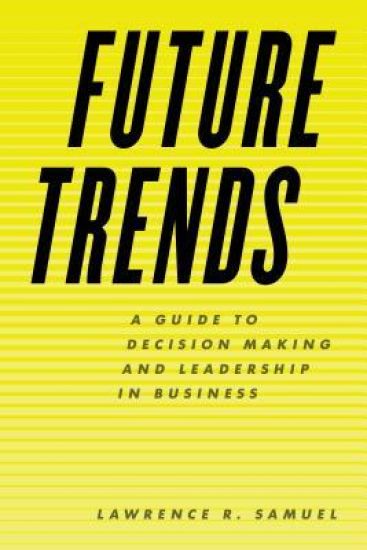
Future Trends

Future Trends

Lawrence R. Samuel

Rowman Littlefield
2018
sidottu
Future Trends: A Guide to Decision Making and Leadership in Business is the first and only book to link a decision-making and leadership platform to trends pointing to the future. By identifying sixty global, long-term trends and detailing how businesspeople can leverage them in both the short- and long-term, the book provides readers with a powerful body of knowledge unavailable anywhere else. In Future Trends, consultant and futurist Larry Samuel: ·Identifies sixty significant and opportunistic global, long-term trends; ·Details how businesspeople can leverage each trend in both the short- and long-term via a decision-making and leadership platform; ·Helps readers be recognized as a trusted source and “go-to” person in their respective field by becoming more fluent in the future; ·Takes a 360-degree, holistic view of tomorrow by examining cultural, economic, political, social, scientific, and technological trends; ·Steers clear from here-today-gone-tomorrow things and experiences that comprise most glimpses into the emerging cultural landscape Future Trends is divided into six sections covering Cultural Trends, Economic Trends, Political Trends, Social Trends, Scientific Trends, and Technological Trends. Each section includes ten trends that indicate where the world is heading. Many futurists focus on technology, forgetting the fact that the ways in which people actually live their lives are shaped by many other factors. Future Trends thus takes a 360-degree, holistic view of tomorrow, offering readers a fuller understanding of life on Earth over the next couple of decades.
Happiness in America

Happiness in America

Lawrence R. Samuel

Rowman Littlefield
2018
sidottu
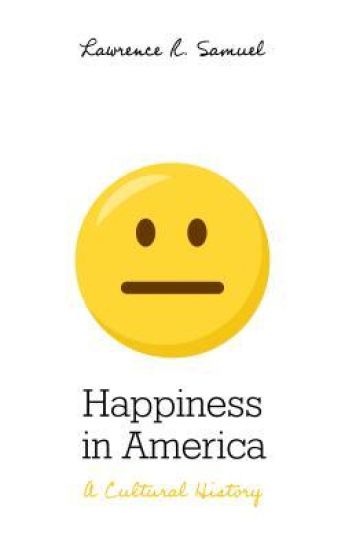
Much interest currently revolves around happiness in America, so much so that one could reasonably argue that there is a “happiness movement” afoot. The wide range of arenas in which happiness intersects reflects the subject’s centrality in everyday life in America these past one hundred years. Happiness in America charts the course of happiness within American culture over the past century, and concludes that most Americans have not had success becoming appreciably happier people despite considerable efforts to do so. Rather than follow a linear path, happiness has bobbed and weaved over the decades, its arc or trajectory a twisting and unpredictable one. Happiness has also both shaped and reflected our core values, with its expression at any given time a key indicator of who we are as a people. The book thus adds a missing and valuable piece to our understanding of American culture. Beyond serving as the definitive guide to happiness in this country, Happiness in America offers readers a provocative argument that challenges standard thinking. Despite popular belief, Americans have never been a particularly happy people. Our perpetual (and futile) search for happiness indicates widespread dissatisfaction and discontent with life in general, something that will come as a surprise to many. The image of Americans as a happy-go-lucky people is thus more mythology than reality, an important finding rooted in the inherent flaws of consumer capitalism. Our competitive and comparative American Way of Life has not proven to be an especially good formula for happiness, Samuel argues, with external signs of success unlikely to produce appreciably happier people. Given these findings, he suggests readers consider abandoning their pursuit of happiness and instead seek out greater joy in life.
The American Teacher

The American Teacher

Lawrence R. Samuel

BLOOMSBURY PUBLISHING PLC
2024
sidottu
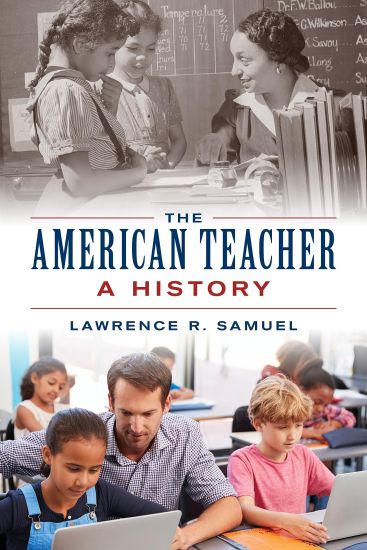
The American Teacher: A History is, as the title makes clear, a history of teachers in the United States. Supported by hundreds of research studies done over the years as reported in scholarly journals, the book fills a niche in the history of education, sociology, gender studies, and the United States as a whole. K-12 teachers and, to a lesser extent, college/university teachers, are discussed in the work which travels through the past century. Told chronologically and divided into ten decades, The American Teacher sheds light on the important role that teachers have played in this country over the last one hundred years. The subject is parsed through the voices of educators, intellectuals, and journalists who have weighed in on its many different dimensions from the 1920s right up to today. The American teacher is a key site of race, gender, and class, we learn from a survey of its history, revealing some of the tensions embedded in our constructed social divisions. Controversy has always surrounded teachers in the United States, making them a fascinating subject to explore in depth.The “schoolteacher” has long served as a principal player in American culture, making The American Teacher a kind of character study that distinguishes fact from fiction. Rather than a research study itself, the work draws on the most important scholarship that has been completed over the years. The work is a big, sweeping picture of the history of American teachers that is designed to complement more academic books that take a more in-depth analysis of unique topics with original research. And in place of focusing on a particular topic, the book examines the threads that have connected issues such as gender and economic status over time. In short, The American Teacher is a synthetic, narrative-driven study that brings together in one place the essential research in the field. And like any good history, the book shows how mining the stuff of everyday life serves as the richest way to learn more about a group of people at a particular time and in a particular place.
Literacy in America

Literacy in America

Lawrence R. Samuel

BLOOMSBURY PUBLISHING PLC
2024
sidottu
Literacy in America: A Cultural History of the Past Century is a history of literacy in the United States over the last one hundred years. Told chronologically and supported by hundreds of research studies done over the years as reported in scholarly journals, the work sheds new light on the important role that literacy and reading in general have played in this country since the 1920s. The subject is parsed through the voices of educators, intellectuals, and journalists who have weighed in on its many different dimensions. Literacy is a key site of race, gender, and class, offering insights related to the social and economic inequities that are embedded in our institutions. The primary argument of Literacy in America is that literacy, as a major part of education, has functioned as a means of social control of children, with authority figures dictating which reading material is acceptable and which is not. Literacy has also operated as a vehicle of citizenship for Americans of all ages, and as a symbol of the responsibilities of democracy. With its ambitious scope, the strives to be a seminal guide to literacy in America and add to our understanding of everyday life in the United States.Most interesting, perhaps, is the twisting, unpredictable journey of literacy since the end of World War I, when I argue that the subject’s modern era began. Rather than follow a straight line, both the perception and reality of reading swerved over the years, offering a trajectory that makes for a compelling narrative for anyone interested in American cultural and social history. Controversy of some kind has often surrounded literacy in the United States, this alone making it a fascinating source of interest to explore in detail.
Tudor City: Manhattan's Historic Residential Enclave

Tudor City: Manhattan's Historic Residential Enclave

Lawrence R. Samuel

History Press Library Editions
2019
sidottu
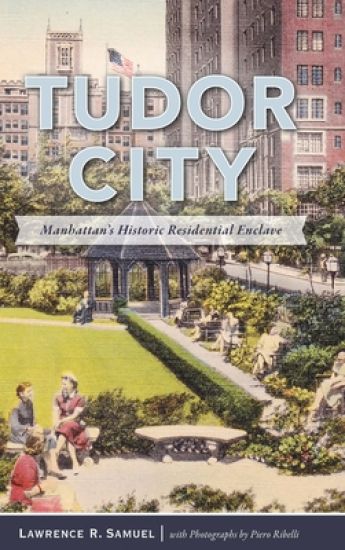
On the east side of Midtown Manhattan, next to the United Nations, sits the massive apartment complex Tudor City. An architectural masterpiece created by developer Fred F. French during the Roaring Twenties, Tudor City was the first residential skyscraper complex in the world. It brought middle-class lifestyle to center city. Tudor City has parks, shops and restaurants and even once had a mini-golf course. Developers and preservationists battled over the site in the 1970s and 1980s, with a notable cast of characters including Governor Nelson Rockefeller, Mayor John Lindsay and Representative Ed Koch. The city designated the area a historic district. Author and resident Lawrence R. Samuel charts the ninety-year history of New York's Tudor City.
The American Way of Life

The American Way of Life

Lawrence R. Samuel

Fairleigh Dickinson University Press
2017
sidottu
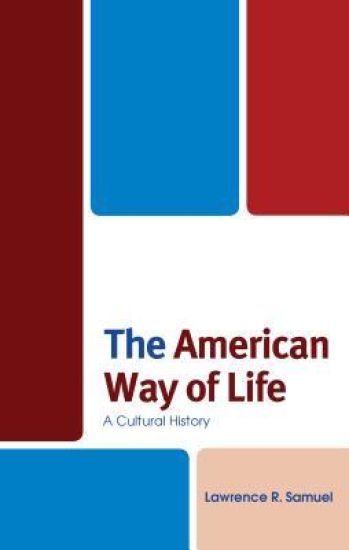
Telling the full story of the American Way of Life (or more simply the American Way) in the United States over the course of the last century reveals key insights that add to our understanding of American culture. Lawrence R. Samuel argues that since the term was popularized in the 1930s, the American Way has served as the primary guiding mythology or national ethos of the United States. More than that, however, this work shows that the American Way has represented many things to many people, making the mythology a useful device for anyone wishing to promote a particular agenda that serves his or her interests. A consumerist lifestyle supported by a system based in free enterprise has been the ideological backbone of the American Way, but the term has been attached to everything from farming to baseball to barbecue. There really is no single, identifiable American Way and never has been—it becomes clear after tracing its history—making it a kind of Zelig of belief systems. If our underlying philosophy or set of values is amorphous and nebulous, then so is our national identity and character, Samuel concludes, implying that the meaning of America is elastic and accommodating to many interpretations. This unique thesis sets off this work from other books and helps establish it as a seminal resource within the fields of American history and American studies.
The American Way of Life

The American Way of Life

Lawrence R. Samuel

Fairleigh Dickinson University Press
2019
nidottu
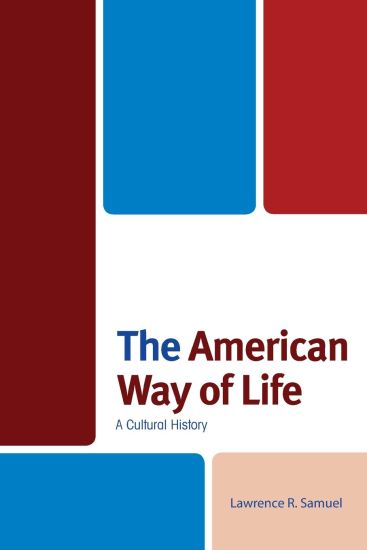
Telling the full story of the American Way of Life (or more simply the American Way) in the United States over the course of the last century reveals key insights that add to our understanding of American culture. Lawrence R. Samuel argues that since the term was popularized in the 1930s, the American Way has served as the primary guiding mythology or national ethos of the United States. More than that, however, this work shows that the American Way has represented many things to many people, making the mythology a useful device for anyone wishing to promote a particular agenda that serves his or her interests. A consumerist lifestyle supported by a system based in free enterprise has been the ideological backbone of the American Way, but the term has been attached to everything from farming to baseball to barbecue. There really is no single, identifiable American Way and never has been—it becomes clear after tracing its history—making it a kind of Zelig of belief systems. If our underlying philosophy or set of values is amorphous and nebulous, then so is our national identity and character, Samuel concludes, implying that the meaning of America is elastic and accommodating to many interpretations. This unique thesis sets off this work from other books and helps establish it as a seminal resource within the fields of American history and American studies.
Making Miami

Making Miami

Lawrence R Samuel

ROWMAN LITTLEFIELD
2025
nidottu
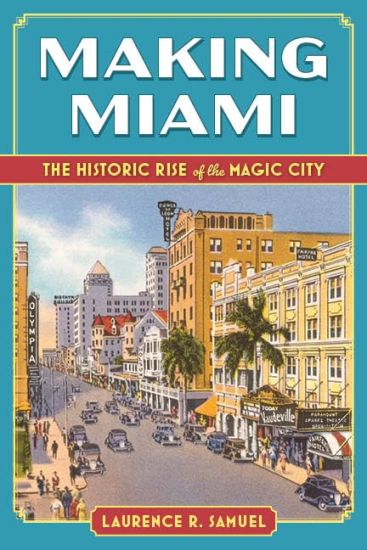
Making Miami takes a deep dive into the history, growth, and development of the city not just in terms of real estate but also a number of other topics, including the expansion of a transportation and infrastructural network; tourism; the natural ecosystem and threats from residential, recreational, and industrial development; and issues of race, class, ethnicity, immigration, and nationality.The history of Miami unfolds chronologically, revealing how real estate has consistently fueled its growth. The narrative begins in the Roaring Twenties, when substantial investments flooded into Florida, sparking a land boom that attracted both investors and new residents. The decades of the 1920's and 30's transformed Miami from a sleepy southern town into the unique city it is today. As the Great Depression cast its shadow, a handful of bold developers took center stage, creating the iconic art deco district of South Beach. The active World War II years saw Miami become a home for many servicemen and servicewomen stationed there. Postwar challenges in the 1960s and 1970s tested the city's resilience, as the economic engine sputtered and urban strife reshaped its fabric. However, the 1980s marked a construction renaissance for Miami, driven by funds from sometimes questionable sources. Despite occasional setbacks, Miami's real estate market is once again thriving, drawing people from far and wide to visit or make it their home.
Air Conditioning for Houses in California; C351

Air Conditioning for Houses in California; C351

H. S. (Hayden Samuel) 1910- Gordon; R. L. (Russell Lawrence) 1904- Perry

Hassell Street Press
2021
nidottu
This work has been selected by scholars as being culturally important and is part of the knowledge base of civilization as we know it.This work is in the public domain in the United States of America, and possibly other nations. Within the United States, you may freely copy and distribute this work, as no entity (individual or corporate) has a copyright on the body of the work.Scholars believe, and we concur, that this work is important enough to be preserved, reproduced, and made generally available to the public. To ensure a quality reading experience, this work has been proofread and republished using a format that seamlessly blends the original graphical elements with text in an easy-to-read typeface.We appreciate your support of the preservation process, and thank you for being an important part of keeping this knowledge alive and relevant.