Kirjojen hintavertailu. Mukana 11 342 296 kirjaa ja 12 kauppaa.

Kirjahaku

Etsi kirjoja tekijän nimen, kirjan nimen tai ISBN:n perusteella.

1000 tulosta hakusanalla Lewis Allen

The Wages of Sin

The Wages of Sin

Peter Lewis Allen

University of Chicago Press
2002
nidottu
Near the end of the century, a new and terrifying disease arrives suddenly from a distant continent. Infecting people through sex, it storms from country to country, defying all drugs and medical knowledge. The deadly disease provokes widespread fear and recrimination; medical authorities call the epidemic "the just rewards of unbridled lust"; a religious leader warns that "God has raised up new diseases against debauchery." The time was the 1490s; the place, Europe; the disease, syphilis; and the religious leader was none other than John Calvin. Throughout history, Western society has often viewed sickness as a punishment for sin. It has failed to prevent and cure diseases—especially diseases tied to sex—that were seen as the retribution of a wrathful God. The Wages of Sin, the remarkable history of these diseases, shows how society's views of particular afflictions often heightened the suffering of the sick and substituted condemnation for care. Peter Allen moves from the medieval diseases of lovesickness and leprosy through syphilis and bubonic plague, described by one writer as "a broom in the hands of the Almighty, with which He sweepeth the most nasty and uncomely corners of the universe." More recently, medical and social responses to masturbation in the eighteenth and nineteenth centuries and AIDS in the twentieth round out Allen's timely and erudite study of the intersection of private morality and public health. The Wages of Sin tells the fascinating story of how ancient views on sex and sin have shaped, and continue to shape, religious life, medical practice, and private habits.
Only Yesterday

Only Yesterday

Frederick Lewis Allen

John Wiley Sons Inc
1997
nidottu
Only Yesterday Hailed as a classic even when it was first published in 1931, Only Yesterday remains one of the most vivid and precise accounts of the volatile stock market and the heady boom years of the 1920's. A vibrant social history that is unparalleled in scope and accuracy, it artfully depicts the rise of post - World War I prosperity, the catalytic incidents that led to the Crash of 1929, and the devastating economic decline that ensued—all set before a colorful backdrop of flappers, Al Capone, the first radio, and the "scandalous" rise of skirt hemlines. Now, this mesmerizing chronicle is reintroduced to offer readers of today an unforgettable look at one of the most dynamic periods of America's past. With a novelist's eye for detail and a historian's attention to the facts, Frederick Lewis Allen tells a story that will ignite your imagination as its rich pageant of characters and events comes alive. Peppering his narrative with actual stock quotes and financial news, Allen tracks the major economic trends of the decade and explores the underlying causes of the Crash. Here are fresh accounts of Harding's oil scandals and the growth of the automobile industry, as well as the decline of the family farm, the Coolidge prosperity, and the long bull market of the late twenties. Allen's virtual hour-by-hour account of the Crash itself, told from multiple perspectives with mounting suspense, is as gripping as anything you are likely to read in fiction. In addition to his power as a storyteller, Allen was a living witness to the events he describes; there is a thrilling you-are-there feeling about the unfolding history. After a brief "return to normalcy" following the War, the pace of life in America quickly escalated to a full gallop. New forces were being unleashed: prosperity with serious inflation, larger-than-life figures such as J. Pierpont Morgan and Henry Ford, and the Big Red Scare of the early twenties. Allen documents the new inventions, fads, and scandals as they affected the daily life of the country, including the impact of Freud and Einstein, Prohibition and Al Capone, Babe Ruth and Jack Dempsey, the trial of Sacco and Vanzetti, and the shocking changes in manners and morals. In Only Yesterday we hear America talking to itself from coast to coast, furiously debating its own rapidly evolving destiny. An engaging narrative that describes the harried, often tumultuous events of Wall Street in the twenties, as well as the infectious spirit of the times, Only Yesterday is not only a compelling account of years gone by, but a true classic that will be appreciated for years to come. "When this fascinating social history of America in the 1920's was first published in 1931, the twenties were indeed Only Yesterday. But, as Mr. Allen makes clear, they were so much more than the clich— would have it. . . . Frederick Allen's marvelous book brings back an exciting time in the life of the nation. I am quite sure you will enjoy reading it as much as Mr. Allen and I enjoyed living it." —from the Foreword by Roy R. Neuberger. Recognized as a classic even when it was first published in 1931, Only Yesterday is a fascinating and revealing chronicle of the volatile stock market and heady boom years of the 1920's. Written by an esteemed historian who witnessed firsthand the explosive atmosphere and events of the time, this compelling narrative takes its place as one of the most important and invaluable contributions to investment literature. Acclaim for Only Yesterday "Marvelously absorbing . . . Only Yesterday tells the story of the 1920's from the collapse of Wilson and the New Freedom to the collapse of Wall Street and the New Era." —Stuart Chase, Books. "A perfectly grand piece of historical record and synthetic journalism." —Fanny Butcher, Chicago Tribune. "A style that is verve itself . . . Besides telling the story of the bull market in fine perspective, Mr. Allen presents the first coherent account that we have seen of the oil scandals that will eventually make the Harding regime match that of President Grant and the Crédit Mobilier story in the history books of the future." —John Chamberlain, The New York Times.
Unkind Words

Unkind Words

Irving Lewis Allen

Praeger Publishers Inc
1990
sidottu
In this extensive study of ethnic labeling in the United States' popular speech and usage, Irving Lewis Allen explores the major traditional themes behind the making of ethnic slurs. Viewing U.S. slang as a reflection of social diversity, rapid change, and the complexity of U.S. society, Allen puts forth a special insight into the social workings of American culture, both past and present. The book offers an overview of the major traditional themes used in the development of ethnic slurs as well as the most recent fads of covert and devious slurring with codewords and various kinds of sly word games. Unkind Words delivers its message with unusual clarity, that too often shoddy language shapes our thinking about the politics of ethnicity. Divided into two parts, the book begins with a detailed study of the older and more traditional slurs in American vernacular. These words the author terms fighting words, which, when dropped, often raised fists in schoolyards and barrooms. The book uncovers the origins of these slurs--few are heard in today's public discourse--and places them in a word museum where the reader can view the foolish viciousness of a cultural past. In one chapter, the author singles out the derogatory labels that have been applied specifically to women and reveals slurs that originate in both gender and ethnic conflict. The second part of the book focuses on labels that have appeared in the last few decades, often more genteel and less confrontational. While more subtle than their forerunners, these words often serve the same old psychological and social needs to stereotype and express hostility. Anyone interested in ethnic identity in the United States, in the workings of a plural society, or the origins and uses of American ethnic slurs, will find Unkind Words fascinating reading.
The Big Change

The Big Change

Frederick Lewis Allen

Routledge
2017
sidottu
Frederick Lewis Allen was one of the pioneers in social history. Best known as the author of Only Yesterday, Allen originated a model of what is sometimes called instant history, the reconstruction of past eras through vivid commentary on the news, fashions, customs, and artifacts that altered the pace and forms of American life. The Big Change was Allen's last and most ambitious book. In it he attempted to chart and explain the progressive evolution of American life over half a century. Written at a time of unprecedented optimism and prosperity, The Big Change defines a transformative moment in American history and provides an implicit and illuminating perspective on what has taken place in the second half of the twentieth century.Allen's theme is the realization, in large measure, of the promise of democracy. As against the strain of social criticism that saw America as enfeebled by affluence and conformity, Allen wrote in praise of an economic system that had ushered in a new age of well being for the American people. He divides his inquiry into three major sections. The first, 'The Old Order,' portrays the turn-of-the-century plutocracy in which the federal government was largely subservient to business interests and the gap between rich and poor portended a real possibility of bloody rebellion. 'The Momentum of Change' graphically describes the various forces that gradually transformed the country in the new century: mass production, the automobile, the Great Depression and the coming of big government, World War II and America's emergence as a world power. Against this background, Allen shows how the economic system was reformed without being ruined, and how social gaps began to steadily close.The concluding section, 'The New America,' is a hopeful assessment of postwar American culture. Allen's analysis takes critical issue with many common perceptions, both foreign and domestic, of American life and places remaining social problems in careful perspective. As William O'Neill remarks in his introduction to this new edition, The Big Change is both a deep and wonderfully readable work of social commentary, a book that gains rather than loses with the years.
Harper's Magazine, 1850-1950: A Centenary Address

Harper's Magazine, 1850-1950: A Centenary Address

Frederick Lewis Allen

Literary Licensing, LLC
2013
sidottu
Harper's Magazine, 1850-1950: A Centenary Address is a book written by Frederick Lewis Allen, which provides a comprehensive overview of the history of Harper's Magazine. The book is a centennial tribute to the magazine, which was founded in 1850 and had become a prominent publication in American literature and journalism by 1950. The book covers the magazine's evolution over the years, from its early days as a literary and cultural journal to its emergence as a leading voice in American politics and society. Allen traces the magazine's history through the contributions of its many notable writers and editors, including Mark Twain, Henry James, Theodore Roosevelt, and Norman Mailer. The book also explores the magazine's influence on American society and culture, including its coverage of major historical events such as the Civil War, World War I, and the Great Depression. Allen examines the magazine's role in shaping public opinion on important issues such as race relations, women's rights, and environmentalism.Overall, Harper's Magazine, 1850-1950: A Centenary Address is a comprehensive and engaging account of the history of one of America's most influential magazines. It provides readers with a fascinating glimpse into the evolution of American literature, journalism, and culture over the course of a century.This scarce antiquarian book is a facsimile reprint of the old original and may contain some imperfections such as library marks and notations. Because we believe this work is culturally important, we have made it available as part of our commitment for protecting, preserving, and promoting the world's literature in affordable, high quality, modern editions, that are true to their original work.
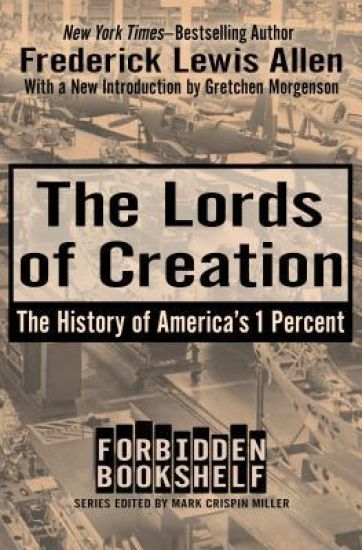
The Lords of Creation

The Lords of Creation

Frederick Lewis Allen

Open Road Media
2017
pokkari
A “stimulating” account of the capitalists who changed America in the late 19th and early 20th centuries, setting the stage for the 1929 crash and Great Depression (Kirkus Reviews). In the decades following the Civil War, America entered an era of unprecedented corporate expansion, with ultimate financial power in the hands of a few wealthy industrialists who exploited the system for everything it was worth. The Rockefellers, Fords, Morgans, and Vanderbilts were the “lords of creation” who, along with like-minded magnates, controlled the economic destiny of the country, unrestrained by regulations or moral imperatives. Through a combination of foresight, ingenuity, ruthlessness, and greed, America’s giants of industry remolded the US economy in their own image. They established their power and authority, ensuring that they—and they alone—would control the means of production, transportation, energy, and commerce—creating the conditions for the stock market collapse of 1929 and the Great Depression that followed. As modern society continues to be affected by wealth inequality and cycles of boom and bust, it’s as important as ever to understand the origins of financial disaster, and the policies, practices, and people who bring them on. The Lords of Creation, first published when the catastrophe of the 1930s was still painfully fresh, is a fascinating story of bankers, railroad tycoons, steel magnates, speculators, scoundrels, and robber barons. It is a tale of innovation and shocking exploitation—and a sobering reminder that history can indeed repeat itself.
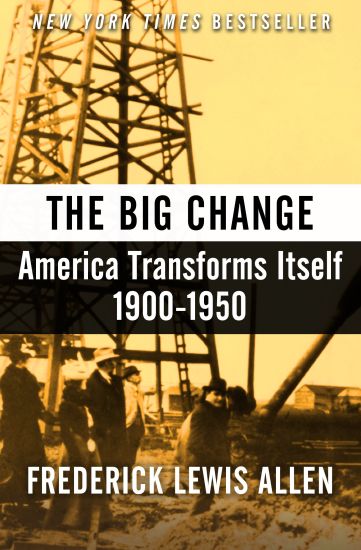
The Big Change

The Big Change

Frederick Lewis Allen

Open Road Media
2021
pokkari
The New York Times–bestselling history of the first half of the twentieth century—five decades that transformed America—from the author of Only Yesterday. During the first fifty years of the twentieth century, the United States saw two world wars, a devastating economic depression, and more social, political, and economic changes than in any other five-decade period before. Frederick Lewis Allen, former editor of Harper’s magazine, recounts these years—spanning World War I, the Progressive Era, the Great Depression, World War II, and the early Cold War—in vivid detail, from the fashions and customs of the times to major events that changed the course of history. Politically, the United States grew into its own as a global superpower during these years, even as domestic developments altered the everyday lives of its citizens. The introduction of the automobile, mass production, and organized labor changed the way Americans lived and worked, while innovations like penicillin and government regulation of food safety contributed to an increase in average life expectancy from forty-nine years in 1900 to sixty-eight years in 1950. With the development of a strong, centralized government, a thriving middle class, and widespread economic prosperity, the nation emerged from the Second World War transformed in virtually every way. Richly informative and delightfully readable, The Big Change is an indispensable volume charting the many changes that ushered in our contemporary age.