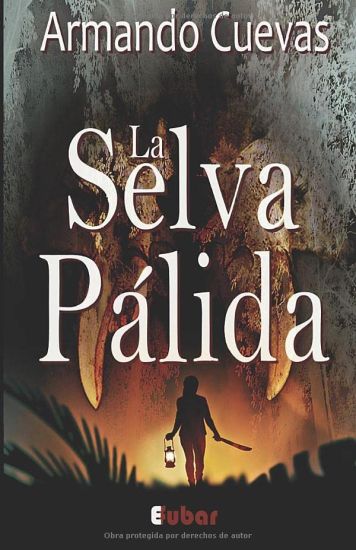
Del autor de "Fubarbundy" (TOP 100 Ciencia Ficci n) y "Expedici n Atticus" (Finalista de los Premios ERIGINAL BOOKS y TOP 100 Acci n y Aventuras), llega ahora "La Selva P lida", un thriller de lectura adictiva que te llevar hasta la ex tica Guatemala donde vivir s, entre sus coloridas ciudades y sus intrincadas junglas, una inquietante aventura llena de misterio y suspense.LO QUE OPINAN LOS LECTORES: M.B.Vigo (TOP 1000 comentaristas): "Armando Cuevas es imprescindible en la novela de aventuras""La trama de Selva P lida bebe de las mil y una teor as conspiratorias que tan a la orden del d a est n y yo, como fiel seguidora de ellas, me ha gustado ver la particular visi n de los hechos que se recrean en esta historia.""Una lectura que podemos recomendar a los amantes de la lectura en general, pero m s encarecidamente a aquellos que disfrutan con una buena historia de aventuras a caballo entre Julio Verne y la Jungla de Cristal."Isabel M: "Recomendada""La selva p lida es una mezcolanza de thriller, aventuras y algo de ciencia ficci n, por qu no decirlo. Sobretodo imperan los sentimientos. Una madre con una vida anodina que curiosamente despierta a la realidad tras la muerte de su hijo. La vida nos pone a prueba y Julia tiene que afrontar la suya. Averiguar la verdad y encontrar su camino. Si de algo estoy segura es de que no te aburrir s."Rochel: "No podr a ser mejor""Una novela de acci n y aventura pasando por un thriller, donde Armando Cuevas demuestra ser un maestro de la aventura."Betty: "Muy buen libro de aventuras"Camilo: "Una historia original y muy entretenida"Diana"...me lo he pasado "pipa". Una lectura fluida, que te mantiene en tensi n en cada cap tulo. Algunos gui os cinematogr ficos que suman, nunca restan."Jos ngel Valadar: "Fenomenal""Una aventura digna de cualquier pel cula, emocionante hasta el final."Moonck: "Amena, divertida, estimulante y trepidante""Un libro trepidante, que te lleva de p gina en p gina, acompa ando a los protagonistas, en una carrera hacia un descubrimiento inesperado. Mezcla aventuras, humor y thriller en un solo libro que cuesta dejar de leer. Solo faltan las palomitas."Gineshh: "Muy entretenida""...lo he le do en un pis-pas y lo recomiendo a todo el mundo."SINOPSISJulia es una mujer divorciada que vive en Madrid y trabaja como maestra. Un d a recibe la terrible noticia de que su hijo, al que cre a viviendo con su padre en Miami, ha aparecido devorado por un jaguar en mitad de la Selva Maya. Confundida, rota de dolor, pero sin tiempo para duelos, volar hasta Ciudad de Guatemala para asistir al entierro. All sabr cosas de su hijo que desconoc a, y comenzar a sospechar que su muerte no ha sido debida a un desgraciado accidente, sino a algo relacionado con su trabajo en unos misteriosos laboratorios. A partir de ese momento, Julia vivir una realidad perturbadora; adentr ndose en un mundo oscuro y siniestro lleno de inquietantes revelaciones, enga os, conspiraciones, esp as y asesinatos. Un mundo que pondr a prueba su valor y determinaci n, y al que deber adaptarse si desea descubrir toda la verdad sobre la muerte de su hijo. Si quieres saber m s sobre el autor y sus libros puedes visitar: Facebook: armandocuevasescritorTwitter: @darcuca
Title: Mademoiselle Ixe di Lanoe Falconer. (Traduzione di Aster.) La Mano dello spettro di Wilkie Collins. (Traduzione di Lida Cerracchini.) (Seconda edizione.).Publisher: British Library, Historical Print EditionsThe British Library is the national library of the United Kingdom. It is one of the world's largest research libraries holding over 150 million items in all known languages and formats: books, journals, newspapers, sound recordings, patents, maps, stamps, prints and much more. Its collections include around 14 million books, along with substantial additional collections of manuscripts and historical items dating back as far as 300 BC.The GENERAL HISTORICAL collection includes books from the British Library digitised by Microsoft. This varied collection includes material that gives readers a 19th century view of the world. Topics include health, education, economics, agriculture, environment, technology, culture, politics, labour and industry, mining, penal policy, and social order. ]+++The below data was compiled from various identification fields in the bibliographic record of this title. This data is provided as an additional tool in helping to insure edition identification: ++++ British Library Falconer, Mary Elizabeth Hawker; 1895. 274 p.; 8 . 012634.r.17.
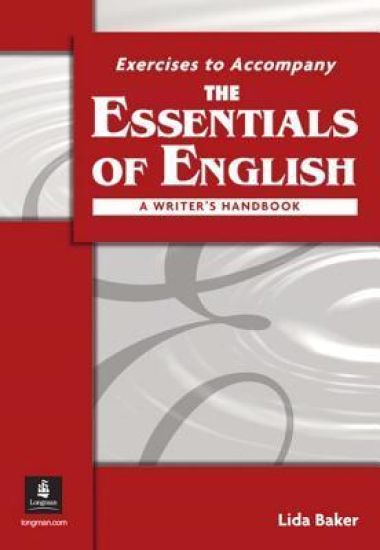
The Essentials of English Workbook provides additional exercise items for every practice section in The Essentials of English. From grammar and punctuation to the creation of essays and business letters, The Essentials of English: A Writer's Handbook is a must-have reference tool for today's writer. As easy to use as a dictionary, this handbook is designed specifically for non-native English speakers.
At Home With ABC is full of learning activities for young children to do at home. Children, from 3 years old, can practice saying and writing the alphabet, from a to z. Each page gives a letter and asks the child to trace it and write it independently. The fun illustrations encourage using a pencil in a controlled way which develops pencil grip and improves letter formation. The activities encourage children to learn alphabetical order, to recognize lower case letters, and to know the names of each letter and its sound. Useful tips support adults so that they can encourage learning gently - plus there are more than enough funky stickers to reward your child as they complete each activity! This book is ideal to build confidence in literacy for a child's first years at school.
Following Joseph Stalin's death in 1953, the Soviet Union experienced a dramatic resurgence in cinematic production. The period of the Soviet Thaw became known for its relative political and cultural liberalization; its films, formally innovative and socially engaged, were swept to the center of international cinematic discourse. In The Cinema of the Soviet Thaw, Lida Oukaderova provides an in-depth analysis of several Soviet films made between 1958 and 1967 to argue for the centrality of space—as both filmic trope and social concern—to Thaw-era cinema. Opening with a discussion of the USSR's little-examined late-fifties embrace of panoramic cinema, the book pursues close readings of films by Mikhail Kalatozov, Georgii Danelia, Larisa Shepitko and Kira Muratova, among others. It demonstrates that these directors' works were motivated by an urge to interrogate and reanimate spatial experience, and through this project to probe critical issues of ideology, social progress, and subjectivity within post–Stalinist culture.
Following Joseph Stalin's death in 1953, the Soviet Union experienced a dramatic resurgence in cinematic production. The period of the Soviet Thaw became known for its relative political and cultural liberalization; its films, formally innovative and socially engaged, were swept to the center of international cinematic discourse. In The Cinema of the Soviet Thaw, Lida Oukaderova provides an in-depth analysis of several Soviet films made between 1958 and 1967 to argue for the centrality of space—as both filmic trope and social concern—to Thaw-era cinema. Opening with a discussion of the USSR's little-examined late-fifties embrace of panoramic cinema, the book pursues close readings of films by Mikhail Kalatozov, Georgii Danelia, Larisa Shepitko and Kira Muratova, among others. It demonstrates that these directors' works were motivated by an urge to interrogate and reanimate spatial experience, and through this project to probe critical issues of ideology, social progress, and subjectivity within post–Stalinist culture.
This delightful collection of ancient fables, gathered from Aesop and other sources, has been a classroom classic since 1910. Brimming with stories of talking animals and crafty men and women, these lessons in moral instruction will be an invaluable resource for you to share with your own children or grandchildren. Certain to entertain as well as teach the moral and ethical lessons that will last a lifetime.
This book explores the interactions between social policy and migration in China. Using a theoretical framework of institutional economics, Lida Fan’s discussion examines migration regulations, household registration, social welfare and insurance, employment, education, housing, medical care and industrial strategies with a view to answering the following questions:What was/is the role of social policy in migration before and after the reform period? What are the impacts of migration on the regional redistribution of human capital as a major source of regional development? What are the determinants of interprovincial migration? How can we better understand migration related policies using a social justice perspective? What migration policy options are available to achieve desired social consequences such as mitigating inequality and improving the well-being of the most disadvantaged peoples?In posing and answering these questions the book traces the vicissitude of the formation of the household registration system (hukou) and other policies accompanying the hukou system since the beginning of the People’s Republic of China. The author concludes with proposals for institutional change in China’s migration policy, advocating the desirability of social justice perspectives and its feasibility in the current socio-economic structure.
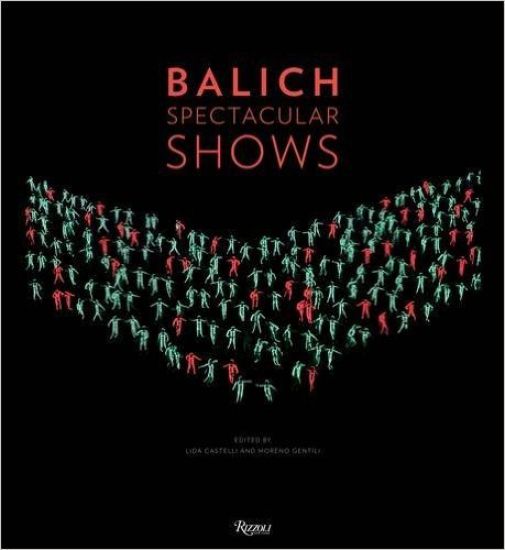
This book showcases the mix of daring acrobatics, beautiful costuming, stunning visuals, and dynamic choreography that make Marco Balich's events nothing less than awe-inspiring. A magnificent visual journey presenting over ten years of high-profile shows and ceremonies staged by Marco Balich, this beautifully illustrated book features his dramatic and moving work on events across the world. Projects such as the recent Olympic ceremonies and the America's Cup World Series reveal insight into the qualities of a large-scale event designer and the work of a team that has helped him astound millions of people. The book also features special contributions by Isabel Allende, Sophia Loren, Yoko Ono, Alessandro Del Piero, and Roberto Bolle.