Kirjojen hintavertailu. Mukana 11 244 527 kirjaa ja 12 kauppaa.

Kirjahaku

Etsi kirjoja tekijän nimen, kirjan nimen tai ISBN:n perusteella.

667 tulosta hakusanalla Lucretius

Lucretius

Lucretius

Claudia Schindler

BRILL
2022
nidottu
Lucretius' De rerum natura, written around 55 BCE, ranks among the most influential texts in Roman literature. The poet's vision of a world made of atoms, his mockery of the fear of death and the gods, and fervent advocacy of the mortality of the soul over many centuries incensed his critics on one hand, and on the other earned him a devoted following. This volume provides an introduction to the oldest completely preserved Latin didactic poem and to the most important research questions concerned with the text.
Lucretius De Rerum Natura
The Oxford Classical Texts, or Scriptorum Classicorum Bibliotheca Oxoniensis, are renowned for their reliability and presentation. The series consists of a text without commentary but with a brief apparatus criticus at the front of each page. There are now over 100 volumes, representing the greater part of classical Greek and Latin literature. The aim of the series remains that of including the works of all the principal classical authors. Although this has been largely accomplished, new volumes are still being published to fill the remaining gaps, and old editions are being revised in the light of recent research or replaced.
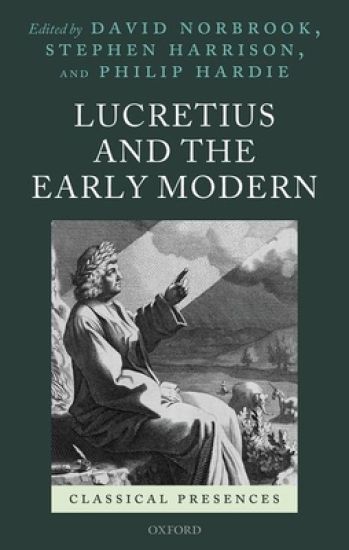
Lucretius and the Early Modern

Lucretius and the Early Modern

Oxford University Press
2015
sidottu
The rediscovery in the fifteenth century of Lucretius' De rerum natura was a challenge to received ideas. The poem offered a vision of the creation of the universe, the origins and goals of human life, and the formation of the state, all without reference to divine intervention. It has been hailed in Stephen Greenblatt's best-selling book, The Swerve, as the poem that invented modernity. But how modern did early modern readers want to become? This collection of essays offers a series of case studies which demonstrate the sophisticated ways in which some readers might relate the poem to received ideas, assimilating Lucretius to theories of natural law and even natural theology, while others were at once attracted to Lucretius' subversiveness and driven to dissociate themselves from him. The volume presents a wide geographical range, from Florence and Venice to France, England, and Germany, and extends chronologically from Lucretius' contemporary audience to the European Enlightenment. It covers both major authors such as Montaigne and neglected figures such as Italian neo-Latin poets, and is the first book in the field to pay close attention to Lucretius' impact on political thought, both in philosophy - from Machiavelli, through Hobbes, to Rousseau - and in the topical spin put on the De rerum natura by translators in revolutionary England. It combines careful attention to material contexts of book production and distribution with close readings of particular interpretations and translations, to present a rich and nuanced profile of the mark made by a remarkable poem.
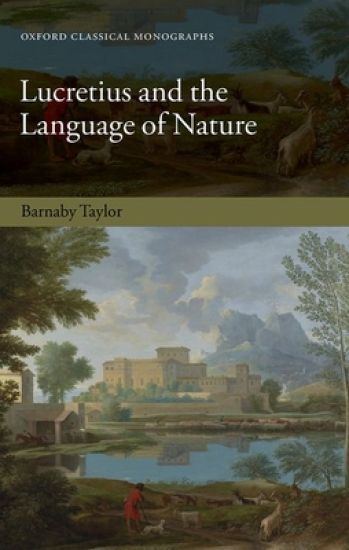
Lucretius and the Language of Nature

Lucretius and the Language of Nature

Barnaby Taylor

Oxford University Press
2020
sidottu
Lucretius' Epicurean poem De Rerum Natura ('On the Nature of Things'), written in the middle of the first century BC, made a fundamental and lasting contribution to the language of Latin philosophy. The style of De Rerum Natura is like nothing else in extant Latin: at once archaic and modern, Romanizing and Hellenizing, intimate and sublime, it draws on multiple literary genres and linguistic registers. This book offers a study of Lucretius' linguistic innovation and creativity. Lucretius is depicted as a linguistic trailblazer, extending and augmenting the technical language of Latin in order to describe the Epicurean universe of atoms and void in all its complexity and sublimity. A detailed understanding of the Epicurean linguistic theory brings with it a greater appreciation of Lucretius' own language. Accordingly, this book features an in-depth reconstruction of certain core features of Epicurean linguistic theory. Elements of Lucretius' style discussed include his attitudes to, and use of, figurative language (especially metaphor); his explorations, both explicit and implicit, of Latin etymology; his uses of Greek; and his creative deployment of compounds and prefixed words. His practice is related throughout not only to the underlying Epicurean theory but also to contemporary Roman attitudes to style and language. The result is a new reading of one of the greatest and most difficult works to survive from the Roman world.
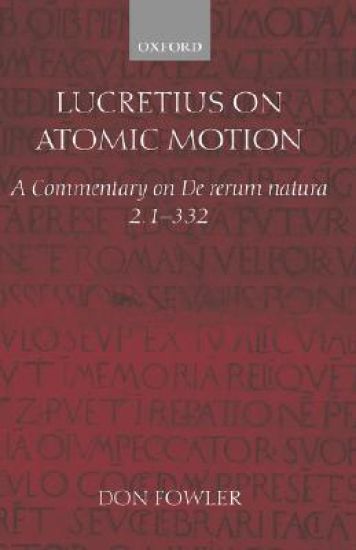
Lucretius on Atomic Motion

Lucretius on Atomic Motion

Don Fowler

Oxford University Press
2002
sidottu
Lucretius' theory of atomic motion is one of the most difficult and technical parts of De rerum natura, and, for that reason, has hitherto been neglected by commentators. This is the first commentary to take account of the remarkable discoveries and re-evaluations in the field of Hellenistic philosophy over the past fifty-five years, which have been stimulated by the publication of many more Epicurean fragments from Herculaneum. The philosophical aspects of the poem cannot, however, be separated from the literary features.. The late Don Fowler possessed rare and unrivalled expertise in both the workings of Latin poetry and the intricacies of Epicurean philosophy. His commentary, therefore, sets new standards for Lucretian studies in its awesome command both of the literary, philological, and philosophical background to the poem, and of the relevant modern scholarship. The detailed notation, the clear interpretations of Greek philosophical terminology, and the systematic contextualization of Lucretius within the entire Graeco-Roman cultural tradition enable the reader to achieve a profound understanding of the great complexity of this text. Lucretius on Atomic Motion makes an exceptional contribution to the history of the Latin poetic language (for which Lucretius is of fundamental and innovative importance), yet, at the same time, manages to be a tool of interpretation of the Graeco-Latin philosophical debate which infuses Lucretius' verse. Don Fowler's commentary will be invaluable not only to Lucretian specialists but also to the whole world of classical scholarship.
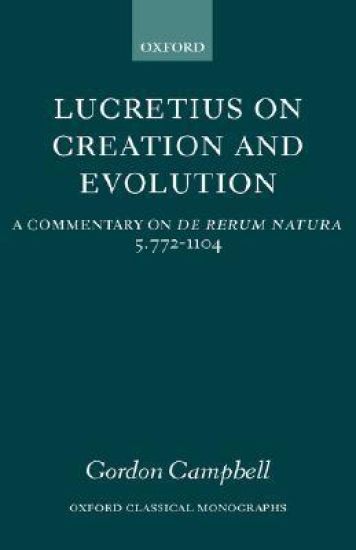
Lucretius on Creation and Evolution

Lucretius on Creation and Evolution

Gordon Campbell

Oxford University Press
2003
sidottu
Lucretius' account of the origin of life, the origin of species, and human prehistory is the longest and most detailed account extant from the ancient world. It gives an anti-teleological mechanistic theory of zoogony and the origin of species that does away with the need for any divine aid or design in the process, and accordingly it has been seen as a forerunner of Darwin's theory of evolution. This commentary locates Lucretius in both the ancient and modern contexts, and treats Lucretius' ideas as very much alive rather than as historical concepts. The recent revival of creationism makes this study particularly relevant to contemporary debate, and indeed, many of the central questions posed by creationists are those Lucretius attempts to answer.
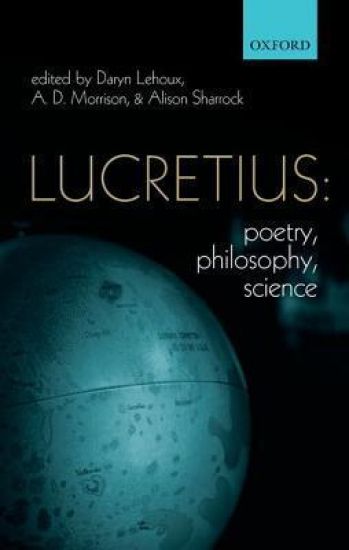
Lucretius: Poetry, Philosophy, Science
Lucretius' didactic masterpiece De Rerum Natura (On the Nature of Things) is one of the most brilliant and powerful poems in the Latin language, a passionate attempt at dispelling humanity's fear of death and its enslavement by false beliefs about the gods, and a detailed exposition of Epicurean atomist physics. For centuries, it has raised the question of whether it is primarily a poem or primarily a philosophical treatise, which also presents scientific doctrine. The current volume seeks to unite the three disciplinary aspects - poetry, philosophy, and science - in order to offer a holistic response to an important monument in cultural history. With ten original essays and an analytical introduction, the volume aims not only to combine different approaches within single covers, but to offer responses to the poem by experts from all three scholarly backgrounds. Philosophers and scholars of ancient science look closely at the artistic placement of individual words, while literary critics explore ethical matters and the contribution of Lucretius' poetry to the argument of the poem. Topics covered include death and grief, evolution and the cosmos, ethics and politics, perception, and epistemology.
Lucretius Comedy: What are we to believe now?
Story of the Play - The play opens with Tom Lehrer National Brotherhood Week, and becomes a challenging but respectful comedy of the interactions on what religion means to life in the world. Google is an active power in the story. Bill ex accountant and Karen (ex WHO) after 30 years of marriage are on vacation to see old friends in Marseille. Bill is depressed by age, pain and memory loss, and has lost his belief in the Catholic Church, and plans a rapid EXIT this year. Suddenly he believes in Lucretius, that all religions are illusions. He believes that religions cause conflict and should be abandoned, nationalized or controlled. So Bill decided to promote Lucretius and plan to put off EXIT until next year. Karen decides on a plan to change Bill's mind and protect the family!! With dramatic interactions with different religions: Christianity, Islam, Judaism, Hinduism, Buddhism etc. and even capitalism and communism. All opposed to Bill. So many alternatives. The result will surprise you.
Lucretius and the Bat with Blue Eyes

Lucretius and the Bat with Blue Eyes

Andrea Moro

MIT PRESS LTD
2025
nidottu
A novel reading of De rerum natura through the lens of neurolinguistics. In the poem De rerum natura, written in the first century BC, Lucretius set out to explain the atomic theory of the universe and the triumph of reason over superstition to a Roman audience. In Lucretius and the Bat with Blue Eyes, a collection and critical translation of every passage on language in this great classic, renowned neurolinguist and novelist Andrea Moro explores the role of the human language and specifically the generative capacity of the alphabet to reach this goal. In Moro's reading, De rerum natura treats the birth of language as a case study in distinguishing humans from other animals, anticipating some key concepts of the theory of evolution, in both Darwinian and molecular terms. The book considers the major commentaries on Lucretius's work, both ancient and modern, and concludes by looking at a recently discovered letter by Descartes that addresses the idea of a "perfect language." Focusing on a challenging yet highly poetic text and grounded in the ideas of neuroscience and linguistics, Moro's book is also a deeply personal document ultimately addressing the role of reason on contrasting human suffering.
Lucretius and the Transformation of Greek Wisdom

Lucretius and the Transformation of Greek Wisdom

David N. Sedley

Cambridge University Press
2003
pokkari
This book is designed to appeal both to those interested in Roman poetry and to specialists in ancient philosophy. In it David Sedley explores Lucretius' complex relationship with Greek culture, in particular with Empedocles, whose poetry was the model for his own, with Epicurus, the source of his philosophical inspiration, and with the Greek language itself. He includes a detailed reconstruction of Epicurus' great treatise On Nature, and seeks to show how Lucretius worked with this as his sole philosophical source, but gradually emancipated himself from its structure, transforming its raw contents into something radically new. By pursuing these themes, the book uncovers many unrecognised aspects of Lucretius' methods and achievements as a poetic craftsman.
Lucretius and the Transformation of Greek Wisdom

Lucretius and the Transformation of Greek Wisdom

David N. Sedley

Cambridge University Press
1998
sidottu
This book is designed to appeal both to those interested in Roman poetry and to specialists in ancient philosophy. In it David Sedley explores Lucretius’ complex relationship with Greek culture, in particular with Empedocles, whose poetry was the model for his own, with Epicurus, the source of his philosophical inspiration, and with the Greek language itself. He includes a detailed reconstruction of Epicurus’ great treatise On Nature, and seeks to show how Lucretius worked with this as his sole philosophical source, but gradually emancipated himself from its structure, transforming its raw contents into something radically new. By pursuing these themes, the book uncovers many unrecognised aspects of Lucretius’ methods and achievements as a poetic craftsman.
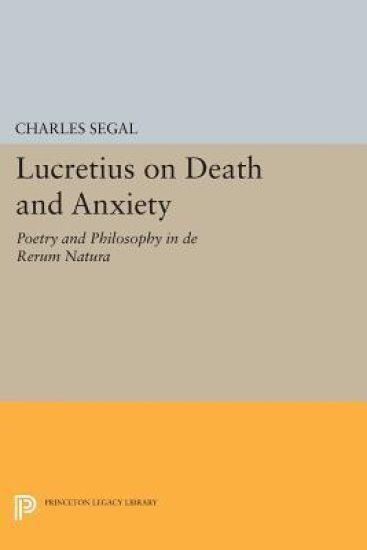
Lucretius on Death and Anxiety

Lucretius on Death and Anxiety

Charles Segal

Princeton University Press
2014
pokkari
In a fresh interpretation of Lucretius's On the Nature of Things, Charles Segal reveals this great poetical account of Epicurean philosophy as an important and profound document for the history of Western attitudes toward death. He shows that this poem, aimed at promoting spiritual tranquillity, confronts two anxieties about death not addressed in Epicurus's abstract treatment--the fear of the process of dying and the fear of nothingness. Lucretius, Segal argues, deals more specifically with the body in dying because he draws on the Roman concern with corporeality as well as on the rich traditions of epic and tragic poetry on mortality. Segal explains how Lucretius's sensitivity to the vulnerability of the body's boundaries connects the deaths of individuals with the deaths of worlds, thereby placing human death into the poem's larger context of creative and destructive energies in the universe. The controversial ending of the poem, which describes the plague at Athens, is thus the natural culmination of a theme developed over the course of the work. Originally published in 1990. The Princeton Legacy Library uses the latest print-on-demand technology to again make available previously out-of-print books from the distinguished backlist of Princeton University Press. These editions preserve the original texts of these important books while presenting them in durable paperback and hardcover editions. The goal of the Princeton Legacy Library is to vastly increase access to the rich scholarly heritage found in the thousands of books published by Princeton University Press since its founding in 1905.
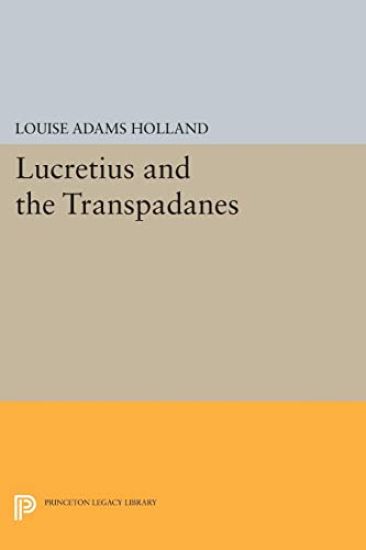
Lucretius and the Transpadanes

Lucretius and the Transpadanes

Louise Adams Holland

Princeton University Press
2015
pokkari
In the absence of tape recordings from antiquity, we have a limited knowledge of how classical Latin prose or verse sounded as it was rendered orally. Yet we do know that the spoken word varied greatly from place to place, regardless of how much uniformity the written language maintained. Louise Adams Holland considers the geographical basis for these linguistic differences, and advances new arguments for the origin of Lucretius. She shows that he came from the same area of northern Italy--the Transpadane--as Catullus and Virgil, not from Rome, as the majority of his critics have contended. Originally published in 1979. The Princeton Legacy Library uses the latest print-on-demand technology to again make available previously out-of-print books from the distinguished backlist of Princeton University Press. These editions preserve the original texts of these important books while presenting them in durable paperback and hardcover editions. The goal of the Princeton Legacy Library is to vastly increase access to the rich scholarly heritage found in the thousands of books published by Princeton University Press since its founding in 1905.