Kirjahaku
Etsi kirjoja tekijän nimen, kirjan nimen tai ISBN:n perusteella.
1000 tulosta hakusanalla Manfred Sack

It is more than a hundred years since Manfred von Richthofen, the ‘Red Baron’, was killed in combat on the Western Front. Yet this gallant fighter pilot is probably as well known today as he was his lifetime. Beginning in 1916, when his lethal skills were first realised, his image proved a godsend to his country’s propaganda machine. There, far above the misery of life in the trenches, was a shooting star of unimaginable potency to help pacify a weary nation that was now beginning to believe that the war was no longer necessary or the losses justified. And so, an image of chivalry was conjured up and exploited with little regard of the cost of this to an increasingly war weary man. _Manfred von Richthofen: The Red Baron and the High Price of Glory_ draws on many sources, some previously untapped, including interviews with pilots he fought alongside and against, official documents held in collections around the world and the work of three noted Great War historians, two of whom began their work in the 1920s, all now dead but who left a rich legacy of research for us to explore. In addition, there are interviews with fifty or so pilots from the Second World War, who went through much that von Richthofen experienced above the Western Front and could speak with authority about the effects of continuous combat flying on aviators. This is the story of how a young cavalry officer eager to serve his country became a pilot and then, when success beckoned, had his life taken over by a very skilled group of publicists, writers, photographers and artists. Every element of his life was picked over, dissected and revealed to an ever-growing and intrusive audience. If he had simply been a celebrity – royalty, an actor or politician – this attention might have been accepted, but he was a front line pilot daily courting death, leading many other men in a constant life or death struggle. So here we have a man severely stressed by war, then stripped of his privacy and any opportunity to rest. Inevitably, some might say, he became another victim of a bloody war, but even in death the exploitation continued and was then re-awakened a decade or so later by the Nazi’s to help promote an even bloodier war.
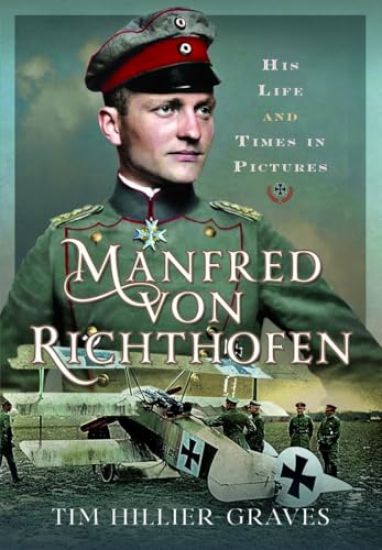
It is more than a hundred years since the First World War fighter ace Manfred von Richthofen was killed in combat on the Western Front. By then, due to a strange twist of fate, his name was becoming as well known in Britain, France and the USA as it was in Germany. Following the outbreak of war in 1914, von Richthofen initially served as a calvary reconnaissance officer. Such a role was soon diminished by the stagnation of trench warfare, and so von Richthofen volunteered for aircrew duties. From June to August 1915 he flew as an observer over the Eastern Front, before transferring to the Western Front. From there he progressed to pilot training. Von Richthofen’s first confirmed victory occurred on 17 September 1916, by which time he had transferred from two-seater reconnaissance aircraft to single-seater fighters. After achieving his sixteenth ‘kill’, the up and coming fighter ace was awarded the Pour le Mérite in January 1917, this being highest military honour in Germany at the time and informally known as ‘The Blue Max’. That same month, he assumed command of Jasta 11, by which time a legend surrounding his name was becoming firmly established. His life and deeds as a fighter pilot were so convincingly sold by a highly polished and quite ruthless propaganda machine that it created an image of knightly virtue and courage that has fame has lasted to this day and, indeed, shows no sign of lessening. And yet this phenomenon owes much to the fact that he was a highly successful killer of Allied airmen in a war of extreme violence where gallantry, if practised at all, was rarely done so. Kill or be killed became their mantra for survival. Beginning in late 1916, when his lethal skills were first realised, his carefully nurtured image proved a godsend to a war weary nation soon to face defeat and ignominy. Far above the misery of life in the trenches was created a shooting star of unimaginable potency which was then exploited with little regard of the personal cost to this increasingly war weary young man. This unique photographic record not only charts his life in great detail, but also places it in a much wider historical context, so giving it greater meaning and potency. He didn’t live or fight his battles in a small exclusive bubble, but in the full glare of military and public scrutiny both of which, although essential to the German cause, allowed him no rest or privacy as he struggled to survive. The Red Baron’s life was one of great endeavour and sacrifice which broke down national and political barriers so allowing us to consider the achievements of an undoubted hero and the period in which he lived. This fresh photographic assessment of von Richthofen’s life and times offers us a rare view of all that made him famous and the events that surrounded his rise to fame.
Manfred, a Dramatic Poem.
George Gordon Byron
British Library, Historical Print Editions
2011
pokkari

Manfred, a Dramatic Poem. Second Edition
George Gordon Byron
British Library, Historical Print Editions
2011
pokkari

Manfred Swarovski, Petitioner, V. United States. U.S. Supreme Court Transcript of Record with Supporting Pleadings
Richard H Kuh; Wade H McCree
Gale Ecco, U.S. Supreme Court Records
2011
pokkari

Manfred; The Lament Of Tasso; Beppo; Mazeppa; The Morgante Maggiore Of Pulci; The Prophecy Of Dante; Occasional Pieces
Lord Byron George Gordon
Literary Licensing, LLC
2014
nidottu

Title: Manfred Symphony, Op. 58 Composer: Pyotr Ilyich Tchaikovsky Original Publisher: Jurgenson The complete Manfred Symphony, arranged for Piano 4 Hands by Tchaikovsky and Aleksandra Hubert, as originally published by Jurgenson in 1886. Performer's Reprints are produced in conjunction with the International Music Score Library Project. These are out of print or historical editions, which we clean, straighten, touch up, and digitally reprint. Due to the age of original documents, you may find occasional blemishes, damage, or skewing of print. While we do extensive cleaning and editing to improve the image quality, some items are not able to be repaired. A portion of each book sold is donated to small performing arts organizations to create jobs for performers and to encourage audience growth.
Manfred Symphony: Piano 1
V. a. Bryullov; Nikolay Lenz; Pyotr Ilyich Tchaikovsky
Createspace Independent Publishing Platform
2015
nidottu

Manfred Symphony: Piano 2
V. A. Bryullov; Nikolay Lenz; Pyotr Ilyich Tchaikovsky
Createspace Independent Publishing Platform
2015
nidottu
Title: Manfred Symphony for 2 Pianos, 8 Hands, Op. 58 Composer: Pyotr Ilyich Tchaikovsky Original Publisher: Jurgenson The Piano 2 part to Tchaikovsky's Manfred Symphony, as arranged for 2 Pianos, 8 Hands, and originally published by Jurgenson. Performer's Reprints are produced in conjunction with the International Music Score Library Project. These are out of print or historical editions, which we clean, straighten, touch up, and digitally reprint. Due to the age of original documents, you may find occasional blemishes, damage, or skewing of print. While we do extensive cleaning and editing to improve the image quality, some items are not able to be repaired. A portion of each book sold is donated to small performing arts organizations to create jobs for performers and to encourage audience growth.
Manfred: poème dramatique en trois actes
George Gordon Byron
Createspace Independent Publishing Platform
2015
nidottu
Bourrel de remords apr s avoir tu celle qu'il aimait, Manfred vit seul comme un maudit au coeur des Alpes. Il invoque les esprits de l'univers, et ceux-ci lui offrent tout, except la seule chose qu'il d sire, l'oubli. Il essaie alors, mais en vain, de se jeter du haut d'un pic lev . Il visite ensuite la demeure d'Ahriam, mais refuse de se soumettre aux esprits du mal, leur enjoignant d' voquer les morts. Enfin lui appara t Astart , la femme qu'il a aim e puis tu e par son treinte ( My embrace was fatal... I loved her and destroy'd her ). R pondant son invocation, Astart lui annonce sa mort pour le lendemain. Au moment pr dit apparaissent des d mons pour s'emparer de lui, mais Manfred leur d nie tout pouvoir sur sa personne. Pourtant, peine sont-ils apparus qu'il meurt. La situation de Manfred deviendra l'un des poncifs favoris composant le portrait de l'homme fatal du romantisme.

Manfred: A dramatic poem is a poem written in 1816-1817 by Lord Byron. It contains supernatural elements, in keeping with the popularity of the ghost story in England at the time. It is a typical example of a Romantic closet drama. Manfred is a Faustian noble living in the Bernese Alps. Internally tortured by some mysterious guilt, which has to do with the death of his most beloved, Astarte, he uses his mastery of language and spell-casting to summon seven spirits, from whom he seeks forgetfulness. The spirits, who rule the various components of the corporeal world, are unable to control past events and thus cannot grant Manfred's plea. For some time, fate prevents him from escaping his guilt through suicide. Byron wrote this "metaphysical drama", as he called it, after his marriage to Annabella Millbanke failed because of a scandal due to charges of sexual improprieties and an incestuous affair between Byron and his half-sister, Augusta Leigh. Attacked by the press and ostracised by London society, Byron fled England for Switzerland in 1816 and never returned. At the time, he was living at the Villa Diodati in Switzerland. Because Manfred was written immediately after this, and because it regards a main character tortured by his own sense of guilt for an unmentionable offence, some critics consider it to be autobiographical, or even confessional. 2] The unnamed but forbidden nature of Manfred's relationship to Astarte is believed to represent Byron's relationship with his half-sister Augusta. Most of Manfred was written on a tour through the Bernese Alps in September 1816. The third act was rewritten in February 1817 since Byron was not happy with its first version.

Timmon, unable to shake off the experience of his mother's hatred for him, turns what's left of the desert store over to Susan Sugar Diamond, and hides out at his friend Gordon's estate. Everyone that loves him knows that something has to be done to shake him out of the depression he is in. Just past a year later, a note and a deed arrive in the mail, and Timmon heads out to Colorado. He doesn't know it yet, but a showdown is brewing with his mother in which Timmon will finally have to face both his mother's history and her hate for him, and the immense love he never knew she was capable of.

Having moved from jazz, Blues and R'n'B to out-and-out pop in his various 1960s bands, keyboard player Manfred Mann went back to the drawing board in 1971 with a new quartet, Manfred Mann's Earth Band, and the intention of focusing on progressive rock. With a repertoire that leant partly on radical rearrangements of songs by Bob Dylan and then Bruce Springsteen, largely instrumental epics that borrowed from Gustav Holst's The Planets suite, and improvisations based around the interplay between Manfred's newly-acquired moog synthesiser and the lead guitar of Mick Rogers, who left in 1975 but later returned, they soon built up a formidable live reputation throughout much of Europe (particularly in Germany) and America. Apart from the Holst-inspired 'Joybringer', a top ten hit in 1973, British success was slow in coming, until a cover version of Springsteen's 'Blinded by the Light' and its parent album The Roaring Silence three years later took their status to a new level on both sides of the Atlantic. This book examines the nine albums, fluctuating fortunes and various line-up changes from what was to be their best and most prolific decade.

Manfred Macmillan
Carleton Bulkin; Brian James Baer; Jirí Karásek Ze Lvovic
Michigan Publishing Services
2024
nidottu
Decadence meets gothic in Manfred Macmillan (1907), a carefully constructed tale of doppelgangers, magical intrigue, and the rootless scion of a noble house. This annotated, first-ever English translation presents an early queer novel long unavailable except in the original Czech. Author Jirí Karásek ze Lvovic (1871–1951) was a major cultural figure in his native Bohemia and cultivated ties with fellow artists from across Central Europe. In their extensive scholarly introduction, translator Carleton Bulkin and translation scholar Brian James Baer situate the novel within longer histories of gay literature, fascinations with the occult, and the cultural and linguistic politics of so-called peripheral European nations. They persuasively frame Karásek as a queer author and cultural disruptor in the fin de siècle Habsburg space. Karasék rejected Czech translations of ancient Greek writers that bowdlerized gay themes, and he personally and vigorously defended Oscar Wilde in print, both on the grounds of artistic freedom and of private morality. He also published a cycle of homoerotic poems under the title Sodom, confiscated by the Austrian authorities but republished in 1905 and repeatedly afterward. A colonized subject, a literary decadent, and a sexual outlaw, Karasék’s complex responses to his own marginalization can be traced through his fantastically strange novel trilogy Three Magicians. As the first volume in that series, Manfred Macmillan is a gorgeous, compelling, and important addition to expanding canons of LGBTQI+ literature.

Fleeing his evil family, Timmon moves into the desert store at ten years old. Timmon is double Sighted. Timmon's palate is impeccable, his sense of smell keen. He is a calm, positive soul, surviving under an evil Shadow. He is beloved by all the desert store. Timmon's father and brothers are in prison for life. His mother, who is Sighted, and his four sisters, who are not, despise Timmon's Sighted Goodness, and actively want to see him dead. In a final confront, his sisters and mother and her new partner, Vance Romaine, use their hatred and psychic abilities to destroy everything around the desert store. Then they flee to the haunted, evil Dolly Manfred mansion in Colorado, built long ago by an evil ancestor of Mina's. A year later, Timmon is summoned to Gitwell, Colorado, to look a a new property he was mysteriously deeded. He know nothing about where his mother is and doesn't want to. The pain of what happened at the desert store is is still too much. Gifted in different ways, two wounded your men, Beck and Shem, are led to Gitwell. Timmon, Shem, and Beck have no idea that the reclamation and redemption of their lost, bruised childhoods await them in a mighty, tender moment of convergence at the edge of what might be the flattest field in the world.The edge of that field lies at the end of Lou Cornfield's innocent little cottage and the evil ancient mansion, Manfred's Folly, a mile away as the crow flies. This is not your usual shallow, feel good romance book, all neat and tidy, tied up in a formulated package. This is a story about a fight between good and evil, about three others and their sons' battles for redemption and forgiveness. Building intensity and depth from the first page, the story leads the reader through the characters' lives to a stunning ending of forgiveness and redemption. This is a book that takes a different look at love and how it operates in our world.

Manfred: Poème Dramatique Lara: Conte (Éd.1856)
Lord George Gordon Byron
Hachette Livre - BNF
2012
pokkari

Manfred: le gant de Conradin / par Emile MoreauDate de l'edition originale: 1886Ce livre est la reproduction fidele d'une oeuvre publiee avant 1920 et fait partie d'une collection de livres reimprimes a la demande editee par Hachette Livre, dans le cadre d'un partenariat avec la Bibliotheque nationale de France, offrant l'opportunite d'acceder a des ouvrages anciens et souvent rares issus des fonds patrimoniaux de la BnF.Les oeuvres faisant partie de cette collection ont ete numerisees par la BnF et sont presentes sur Gallica, sa bibliotheque numerique.En entreprenant de redonner vie a ces ouvrages au travers d'une collection de livres reimprimes a la demande, nous leur donnons la possibilite de rencontrer un public elargi et participons a la transmission de connaissances et de savoirs parfois difficilement accessibles.Nous avons cherche a concilier la reproduction fidele d'un livre ancien a partir de sa version numerisee avec le souci d'un confort de lecture optimal. Nous esperons que les ouvrages de cette nouvelle collection vous apporteront entiere satisfaction.Pour plus d'informations, rendez-vous sur www.hachettebnf.fr