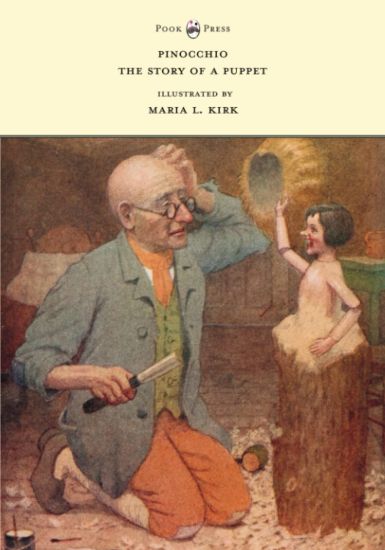
Follow Pinocchio, a wooden puppet, on his adventure to become a real boy. The mischievous marionette must learn how to be good for his wish to come true. This beloved tale, filled with fairies, talking crickets and man-eating fish, has been described as one of the greatest works of Italian literature of all time. "Pinocchio", originally published in 1883, is the perfect bookshelf addition for collectors of fairy tales and lovers of children's stories. Carlo Collodi (1826 - 1890) was an Italian author best remembered for his children's stories. He translated fairy tales as well as writing his own, the most notable being Charles Perrault's French tale, 'I Racconti delle Fate' (1875).
Dinah Maria Craik born Dinah Maria Mulock, also often credited as Miss Mulock or Mrs. Craik) (20 April 1826 - 12 October 1887) was an English novelist and poet.Mulock was born at Stoke-on-Trent to Dinah and Thomas Mulock and raised in Newcastle-under-Lyme, Staffordshire, where her father was then minister of a small independent non-conformist congregation. Her childhood and early youth were much affected by his unsettled fortunes, but she obtained a good education from various quarters and felt called to be a writer. She came to London about 1846, much at the same time as two friends, Alexander Macmillan and Charles Edward Mudie. Introduced by Camilla Toulmin to Westland Marston, she rapidly made friends in London, and found great encouragement for the stories for the young. In 1865 she married George Lillie Craik a partner with Alexander Macmillan in the publishing house of Macmillan & Company, and nephew of George Lillie Craik. They adopted a foundling baby girl, Dorothy, in 1869. At Shortlands, near Bromley, Kent, while in a period of preparation for Dorothy's wedding, she died of heart failure on 12 October 1887, aged 61. Her last words were reported to have been: "Oh, if I could live four weeks longer but no matter, no matter " Her final book, An Unknown Country, was published by Macmillan in 1887, the year of her death. Dorothy married Alexander Pilkington in 1887 but they divorced in 1911 and she went on to marry Captain Richards of Macmine Castle. She and Alexander had just one son John Mulock Pilkington. John married Freda Roskelly and they had a son and daughter.
""Mary Was Her Life: The Story Of A Nun, Sister Maria Teresa Quevedo, 1930-1950"" is a biographical account written by Mary Pierre Tirrell. The book tells the story of Sister Maria Teresa Quevedo, a nun who lived from 1930 to 1950. The book explores Sister Maria Teresa's life, from her early years as a young girl in Spain to her decision to become a nun and her time spent in the convent. The book details the challenges and struggles that Sister Maria Teresa faced in her life, including her battle with tuberculosis and her eventual death at a young age. Throughout the book, Tirrell provides a detailed and intimate portrait of Sister Maria Teresa, painting a vivid picture of her life and legacy as a devoted nun. The book is a moving tribute to a remarkable woman and a testament to the power of faith and devotion in the face of adversity.This scarce antiquarian book is a facsimile reprint of the old original and may contain some imperfections such as library marks and notations. Because we believe this work is culturally important, we have made it available as part of our commitment for protecting, preserving, and promoting the world's literature in affordable, high quality, modern editions, that are true to their original work.
Helen Maria Hunt Jackson, born Helen Fiske (October 15, 1830 - August 12, 1885), was an American poet and writer who became an activist on behalf of improved treatment of Native Americans by the U.S. government. She described the adverse effects of government actions in her history A Century of Dishonor (1881). Her novel Ramona (1884) dramatized the federal government's mistreatment of Native Americans in Southern California after the Mexican-American War and attracted considerable attention to her cause. Commercially popular, it was estimated to have been reprinted 300 times and most readers liked its romantic and picturesque qualities rather than its political content.The novel was so popular that it attracted many tourists to Southern California who wanted to see places from the book.She was born Helen Maria Fiske in Amherst, Massachusetts, the daughter of Nathan Welby Fiske and Deborah Waterman Vinal Fisk. Helen's father was a minister, author, and professor of Latin, Greek, and philosophy at Amherst College. She had two brothers, both of whom died soon after birth, and a sister Anne. They were raised as Unitarian.Anne became the wife of E. C. Banfield, a federal government official who served as Solicitor of the United States Treasury. The girls lost their mother in 1844, when Helen was fifteen. Three years later their father died. He had provided financially for Helen's education and arranged for an uncle to care for her. Fiske attended Ipswich Female Seminary and the Abbott Institute, a boarding school in New York City run by Reverend J.S.C. Abbott. She was a classmate of Emily Dickinson, also from Amherst; Emily became a renowned poet. The two corresponded for the rest of their lives, but few of their letters have surviveed.In 1852 at age 22, Fiske married U.S. Army Captain Edward Bissell Hunt. They had two sons, one of whom, Murray Hunt, died as an infant in 1854 of a brain disease. In 1863, her husband died in a military accident. Her second son Rennie Hunt died of diphtheria in 1865. Hunt traveled widely. In the winter of 1873-1874 she was in Colorado Springs, Colorado at the resort of Seven Falls, seeking rest in hopes of a cure for tuberculosis, which was often fatal before the invention of antibiotics. (See Tuberculosis treatment in Colorado Springs).While in Colorado Springs, Hunt met William Sharpless Jackson, a wealthy banker and railroad executive. They married in 1875 and she took the name Jackson, under which she was best known for her later writings.Helen Hunt began writing after the deaths of her family members. She published her early work anonymously, usually under the name "H.H."Ralph Waldo Emerson admired her poetry and used several of her poems in his public readings. He included five of them in his Parnassus: An Anthology of Poetry (1880). Over the next two years, she published three novels in the anonymous No Name Series, including Mercy Philbrick's Choice and Hetty's Strange History.She also encouraged a contribution from Emily Dickinson to A Masque of Poets as part of the same series
Grab This Deal For The Comics Artist In Your Life For Less Than $10See that girl always doodling and dreaming up stories and plots? She's gonna LOVE the What Happens Next Comic Book For Budding Artists edition, created especially for young artists between 9 and 14 years of age.Bokkaku Dojinshi has created this book as a 6 by 9 inch, perfect pocket book form. Plenty of different templates to explore as well as loads of room to keep track of plot ideas.There is even space for special expression studies of the main characters so the budding artist hits the right emotion in her images every single time.This book is perfect for: mangagraphic novelsSunday funniesanimefan fictionParents and teachers love What Happens Next Comics series for these reasons: helps speech developmentincreases literacydevelops a sense of sequencecreates confidencedevelops an appreciation for artboots creativityOnce you get this book, notice how handy it is - perfect pocket book size means no bulky bags on summer trips or lazy afternoons under a willow tree. All you need is your pencil and ink pen Can't wait to see what you make of your And then... comic book
Maria Edgeworth (1 January 1768 - 22 May 1849) was a prolific Anglo-Irish writer of adults' and children's literature. She was one of the first realist writers in children's literature and was a significant figure in the evolution of the novel in Europe. She held advanced views, for a woman of her time, on estate management, politics and education, and corresponded with some of the leading literary and economic writers, including Sir Walter Scott and David Ricardo. Early life: Maria Edgeworth was born at Black Bourton, Oxfordshire. She was the second child of Richard Lovell Edgeworth (who eventually fathered 22 children by four wives) and Anna Maria Edgeworth; Maria was thus an aunt of Francis Ysidro Edgeworth. She spent her early years with her mother's family in England, until her mother's death when Maria was five. When her father married his second wife Honora Sneyd in 1773, she went with him to his estate, Edgeworthstown, in County Longford, Ireland. Maria was sent to Mrs. Lattafi re's school in Derby after Honora fell ill in 1775. After Honora died in 1780 Maria's father married Honora's sister Elizabeth (then socially disapproved and legally forbidden from 1833 until the Deceased Wife's Sister's Marriage Act 1907). Maria transferred to Mrs. Devis's school in London. Her father's attention became fully focused on her in 1781 when she nearly lost her sight to an eye infection. Returning home at the age of 14, she took charge of her many younger siblings and was home-tutored in law, Irish economics and politics, science, and literature by her father. She also started her lifelong correspondences with learned men, mainly members of the Lunar Society. She became her father's assistant in managing the Edgeworthstown estate, which had become run-down during the family's 1777-1782 absence; she would live and write there for the rest of her life. With their bond strengthened, Maria and her father began a lifelong academic collaboration "of which she was the more able and nimble mind." Present at Edgeworthstown was an extended family, servants and tenants. She observed and recorded the details of daily Irish life, later drawing on this experience for her novels about the Irish. She also mixed with the Anglo-Irish gentry, particularly Kitty Pakenham (later the wife of Arthur Wellesley, 1st Duke of Wellington), Lady Moira, and her aunt Margaret Ruxton of Black Castle. Margaret supplied her with the novels of Anne Radcliffe and William Godwin and encouraged her in her writing. Though Maria Edgeworth spent most of her childhood in England, her life in Ireland had a profound impact on both her thinking and views surrounding her Irish culture. Fauske and Kaufman conclude, " She] used her fiction to address the inherent problems of acts delineated by religious, national, racial, class based, sexual, and gendered identities." Edgeworth used works such Castle Rackrent and Harrington to express her feelings on controversial issues............... Richard Lovell Edgeworth (31 May 1744 - 13 June 1817) was an Anglo-Irish politician, writer and inventor.Biography Edgeworth was born in Pierrepont Street, Bath, England, great-grandson of Sir Salathiel Lovell through his granddaughter, Jane Lovell. A Trinity College, Dublin and Oxford alumnus, he is credited for creating, among other inventions, a machine to measure the size of a plot of land. He also made strides in the developing educational methods. He anticipated the caterpillar track with an invention that he played around with for forty years but that he never successfully developed. 3] He described it as a "cart that carries its own road". He was married four times, including both Honora Sneyd and Frances Beaufort, older sister of Francis Beaufort of the Royal Navy. The two men installed a telegraph line for Ireland. Richard Lovell Edgeworth was a member of the Lunar Society.....