
Kirjahaku
Etsi kirjoja tekijän nimen, kirjan nimen tai ISBN:n perusteella.
1000 tulosta hakusanalla Mark Hanlon


The book provides an interpretation which shows that Solomon's Song is not eulogising human love but expressing the great king's love for his beloved Lord. In making available to mankind his innermost yearnings, Solomon reveals that though he had enjoyed many deeply mystical experiences of the inner world of Spirit, the ultimate union had proven beyond his grasp in that lifetime.

This work is an interpretation of John Bunyan's epic book 'The Pilgrim's Progress' as the path every wayfaring man must one day journey along to reach his Celestial Home.
This book is concerned with developing an in-depth understanding of contemporary political and spatial analyses of cities. In the three-part development of the book’s overall argument or premise, the reader is taken in Part I through a range of contemporary critical and political understandings of urban securitizing. This is followed by an historical urban landscape of emerging liberalism and neo-liberalism, in nineteenth-century Britain and twentieth-century United States, respectively. These case-study historical chapters enable the introduction of key political issues that are more critically assayed in Parts II and III. With Part II, the reader is introduced in depth to a series of spatial analyses undertaken by Michel Foucault that have been crucial for especially late-twentieth and twenty-first century urban theory and political geography. With Part III the full ramifications of a paradigmatic shift are explored at the level of rethinking territory, population and design. This book is timely and useful for readers who want to develop a stronger understanding of what the book’s researchers term a new political paradigm in urban planning, one ultimately governed by global economic forces that define the end of probability.
This book is concerned with developing an in-depth understanding of contemporary political and spatial analyses of cities. In the three-part development of the book’s overall argument or premise, the reader is taken in Part I through a range of contemporary critical and political understandings of urban securitizing. This is followed by an historical urban landscape of emerging liberalism and neo-liberalism, in nineteenth-century Britain and twentieth-century United States, respectively. These case-study historical chapters enable the introduction of key political issues that are more critically assayed in Parts II and III. With Part II, the reader is introduced in depth to a series of spatial analyses undertaken by Michel Foucault that have been crucial for especially late-twentieth and twenty-first century urban theory and political geography. With Part III the full ramifications of a paradigmatic shift are explored at the level of rethinking territory, population and design. This book is timely and useful for readers who want to develop a stronger understanding of what the book’s researchers term a new political paradigm in urban planning, one ultimately governed by global economic forces that define the end of probability.
The Public Benefit of Energy Efficiency to the State of Washington
Mark Bernstein; Chris Pernin; Sam Loeb; Mark Hanson
RAND
2002
pokkari
Addresses the public benefits of improvements in energy efficiency to the economy of Washington state. Under the sponsorship of the Energy Foundation, a partnership of major foundations interested in sustainable energy, the authors estimated energy efficiency using measures of energy intensity that have been controlled for sectoral composition and energy prices, among other factors. They then used this estimate to address the public benefits of energy efficiency improvements in the industrial and commercial sectors to Washington state's economy from 1977 to 1997. The study also predicts the potential future impact of continued improvements in energy efficiency. The authors found that declines in energy intensity have been associated with increased economic growth, improved air quality, and direct benefits to Washington residents. Future increases in energy intensity, however, could reverse these achievements. In addition, they point out that, although energy-efficient programs at the household level provide very real benefits for low-income consumers, the federal Low-Income Home Energy Assistance Program does not fully serve Washington's eligible population.(MP) The authors estimated energy efficiency by means of energy intensity measures controlled for sectoral composition and energy prices, among other factors. Using this estimate, they address the public benefits of energy efficiency improvements in the industrial and commercial sectors to Washington state's economy from 1977 to 1997. They found that declines in energy intensity have been associated with increased economic growth, improved air quality, and direct benefits to Washington residents. (MP)
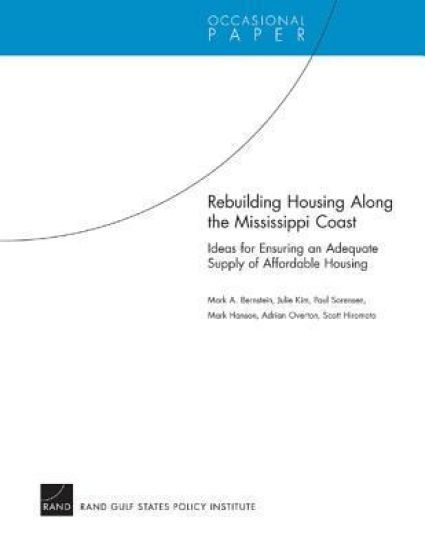
Rebuilding Housing Along the Mississippi Coast
Mark A. Bernstein; Julie Kim; Paul Sorensen; Mark Hanson; Adrian Overton
RAND
2006
pokkari
In October 2005, RAND researchers went to Mississippi to help the Governor's Commission on Recovery, Rebuilding, and Renewal and the Affordable Housing Subcommittee of the Infrastructure Issues Committee. They identified policy and implementation options that could help local communities address affordable-housing issues. They considered challenges in providing affordable housing and strategies for dealing with those challenges.
Nutrition and Lifestyle for Pregnancy and Breastfeeding
Peter Gluckman; Mark Hanson; Chong Yap Seng; Anne Bardsley
Oxford University Press
2014
nidottu
Explaining the practical implications of new discoveries in 'life-course biology', Nutrition and Lifestyle for Pregnancy and Breastfeeding is an informed resource on factors that affect offspring development. The impact of parental lifestyle and behavioural choices influence not only fetal development and birth outcomes, but also postnatal development, yet guidance on appropriate diet, behaviour, and exposures during pregnancy is often confusing and contradictory. With accessible explanations of the latest scientific research, and clear summaries and recommendations, this book is a valuable and authoritative guide for all levels of health care providers. The authors provide an overview of the background evidence, highlighting the importance of lifestyle choices prior to and during pregnancy. In-depth discussions of nutritional and lifestyle factors that impact on pregnancy and offspring outcomes are based on the latest research and exploration of key scientific studies. Nutrition and Lifestyle for Pregnancy and Breastfeeding is a manual offering both scientific and clinical evidence to empower health care providers and ensure they have the information necessary to confidently care for prospective and new parents.
'Why are we losing the war against obesity and chronic disease?' This is the simple question Peter Gluckman and Mark Hanson ask, exploring the dominant myth that the exploding epidemic of obesity, heart disease, and diabetes can be tackled by focusing on adult life styles. Addressing the flawed approach of the weight-loss industry, they explain why a continued focus simply on diet and exercise will fail. Highlighting the implications of the growing burden of these problems in the developing world, they show that the scientific enterprise ignores the reality of the social, cultural, and biological determinants that make different populations and people respond differently to living in the modern nutritionally rich world. Gluckman and Hanson review the overwhelming scientific evidence that much of the problem emerges in early life and even before birth, identifying that to address these issues requires considering development in two dimensions - a life course approach and addressing the developmental challenges of countries emerging through the socioeconomic transition. Asking why the major global bodies and vested interests fail to consider these dimensions and continue with failed approaches, they conclude by discussing the complex interactions between health and the food industry, and suggest that the food industry must be co-opted as an ally in this battle, providing a clear pathway forward.
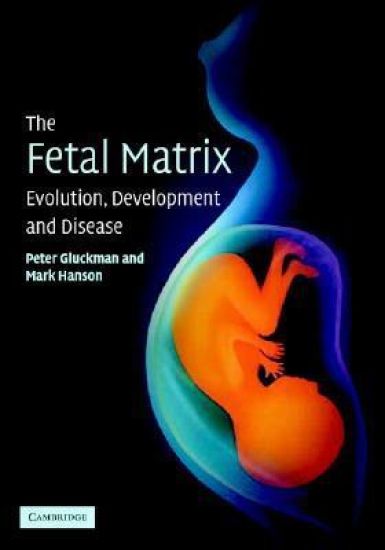
The Fetal Matrix: Evolution, Development and Disease
Peter Gluckman; Mark Hanson
Cambridge University Press
2004
pokkari
New discoveries reveal how crucial interactions which determine our destiny occur before birth, when our genes interact with their environment as the embryo and fetus develop. These processes - in the matrix of the womb - are evolutionary echoes of mechanisms which allowed our hunter-gatherer ancestors to survive. These exciting insights into predictive adaptive responses suggest new ways of protecting the health of the fetus, infant and adult. If inappropriate they can trigger obesity, diabetes and heart disease, formerly thought to result solely from adult lifestyle. The new concepts in this book are crucial to understanding the daunting public health burden in societies undergoing rapid transition from poverty to affluence. They add an important new dimension to evolutionary theory. Synthesising developmental biology, evolutionary history, medical science, public health and social policy, this is a ground-breaking and fascinating account by two of the world’s leading pioneers in this important emerging field.
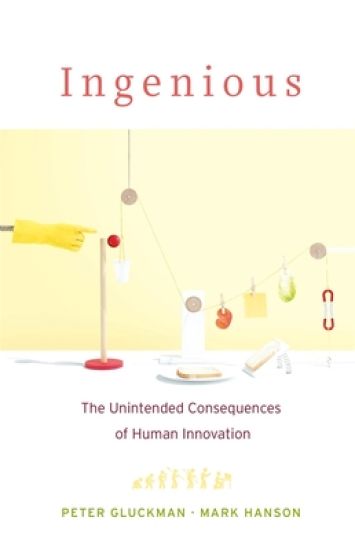
As humans evolved, we developed technologies to modify our environment, yet these innovations are increasingly affecting our behavior, biology, and society. Now we must figure out how to function in the world we’ve created.Over thousands of years, humans have invented ingenious ways to gain mastery over our environment. The ability to communicate, accumulate knowledge collectively, and build on previous innovations has enabled us to change nature. Innovation has allowed us to thrive.The trouble with innovation is that we can seldom go back and undo it. We invent, embrace, and exploit new technologies to modify our environment. Then we modify those technologies to cope with the resulting impacts. Gluckman and Hanson explore what happens when we innovate in a way that leads nature to bite back. To provide nourishment for a growing population, humans developed methods to process and preserve food; but easy access to these energy-dense foods results in obesity. To protect ourselves from dangerous pathogens we embraced cleanliness and invented antibiotics, which has led to rising rates of autoimmune diseases and antibiotic-resistant bacteria. More recently, our growing dependence on the internet and social media has been linked to mental health concerns and declining social cohesion. And we are only at the beginning of the digital transformation that will influence every part of our existence. Our ingenuity has not only changed our world—it has changed us.Focusing on immediate benefits, we rarely pause to consider the longer-term costs of innovation. Yet we are now starting to see how our choices affect the way our brains develop and our bodies function. The implications are profound. Ingenious opens our eyes to the dangers we face and offers solutions we cannot ignore.
Post-Katrina Recovery of the Housing Market Along the Mississippi Gulf Coast
Kevin F. McCarthy; Mark Hanson
RAND
2007
pokkari
Principles of Evolutionary Medicine
Peter Gluckman; Alan Beedle; Tatjana Buklijas; Felicia Low; Mark Hanson
Oxford University Press
2016
sidottu
Evolutionary science is critical to an understanding of integrated human biology and is increasingly recognised as a core discipline by medical and public health professionals. Advances in the field of genomics, epigenetics, developmental biology, and epidemiology have led to the growing realisation that incorporating evolutionary thinking is essential for medicine to achieve its full potential. This revised and updated second edition of the first comprehensive textbook of evolutionary medicine explains the principles of evolutionary biology from a medical perspective and focuses on how medicine and public health might utilise evolutionary thinking. It is written to be accessible to a broad range of readers, whether or not they have had formal exposure to evolutionary science. The general structure of the second edition remains unchanged, with the initial six chapters providing a summary of the evolutionary theory relevant to understanding human health and disease, using examples specifically relevant to medicine. The second part of the book describes the application of evolutionary principles to understanding particular aspects of human medicine: in addition to updated chapters on reproduction, metabolism, and behaviour, there is an expanded chapter on our coexistence with micro-organisms and an entirely new chapter on cancer. The two parts are bridged by a chapter that details pathways by which evolutionary processes affect disease risk and symptoms, and how hypotheses in evolutionary medicine can be tested. The final two chapters of the volume are considerably expanded; they illustrate the application of evolutionary biology to medicine and public health, and consider the ethical and societal issues of an evolutionary perspective. A number of new clinical examples and historical illustrations are included. This second edition of a novel and popular textbook provides an updated resource for doctors and other health professionals, medical students and biomedical scientists, as well as anthropologists interested in human health, to gain a better understanding of the evolutionary processes underlying human health and disease.
Principles of Evolutionary Medicine
Peter Gluckman; Alan Beedle; Tatjana Buklijas; Felicia Low; Mark Hanson
Oxford University Press
2016
nidottu
Evolutionary science is critical to an understanding of integrated human biology and is increasingly recognised as a core discipline by medical and public health professionals. Advances in the field of genomics, epigenetics, developmental biology, and epidemiology have led to the growing realisation that incorporating evolutionary thinking is essential for medicine to achieve its full potential. This revised and updated second edition of the first comprehensive textbook of evolutionary medicine explains the principles of evolutionary biology from a medical perspective and focuses on how medicine and public health might utilise evolutionary thinking. It is written to be accessible to a broad range of readers, whether or not they have had formal exposure to evolutionary science. The general structure of the second edition remains unchanged, with the initial six chapters providing a summary of the evolutionary theory relevant to understanding human health and disease, using examples specifically relevant to medicine. The second part of the book describes the application of evolutionary principles to understanding particular aspects of human medicine: in addition to updated chapters on reproduction, metabolism, and behaviour, there is an expanded chapter on our coexistence with micro-organisms and an entirely new chapter on cancer. The two parts are bridged by a chapter that details pathways by which evolutionary processes affect disease risk and symptoms, and how hypotheses in evolutionary medicine can be tested. The final two chapters of the volume are considerably expanded; they illustrate the application of evolutionary biology to medicine and public health, and consider the ethical and societal issues of an evolutionary perspective. A number of new clinical examples and historical illustrations are included. This second edition of a novel and popular textbook provides an updated resource for doctors and other health professionals, medical students and biomedical scientists, as well as anthropologists interested in human health, to gain a better understanding of the evolutionary processes underlying human health and disease.

Balancing Environment and Development
Lloyd Dixon; Paul Sorensen; Martin Wachs; Myles Collins; Mark Hanson
RAND
2008
pokkari
The Western Riverside County Multiple Species Habitat Conservation Plan mitigates development effects on 146 plant and animal species by establishing a 500,000-acre conservation reserve. This monograph examines land-acquisition strategies and costs, revenue adequacy and potential new funding sources, the plan's habitat-conservation goals, and whether the plan has streamlined transportation and development permitting processes.

Mila Malone, Cat Detective: The Mysterious Dr. Merrill Merkel
Mark Jeffrey Hanson
Createspace Independent Publishing Platform
2012
nidottu
Mila Malone is the world's only Cat Detective and specializes in "Solving the Unsolvable". This book is about the disappearance of Dr. Merrill Merkel and Mila's efforts to find him. Mila Malone, Cat Detective is the first of a series of stories created to entertain and educate. The clever, engaging characters combine with themes that illustrate problem-solving practices, goal-setting methods and numerous other concepts and principles not taught in the traditional education system. Each book also has a bonus section that highlights the underlying story line, thus providing a helpful discussion aid that may be put into action whenever you wish.


Drosophila Immunity Handbook
Hannah Westlake; Mark A Hanson; Bruno Lemaitre
Presses Polytechniques et Universitaires Romandes
2025
nidottu
Explores the genetics of Drosophila, or fruit flies, to further the study of immunity. Animals possess efficient mechanisms for detecting and neutralizing infection. The application of Drosophila genetics, or the genetics of fruit flies, to the study of these mechanisms has generated insights into insect immunity and uncovered general principles of animal host defense. Although it is difficult to summarize the sheer number of studies published on Drosophila immunity in recent years, the Drosophila Immunity Handbook aims to provide an overview of recent research trends, challenges, and discoveries in immunity through the lens of Drosophila. This overview introduces scientists to the sophisticated fly immune system, highlights exciting recent findings in the field, and pushes new horizons of research by contextualizing existing research and discovering exciting avenues to explore. These studies have shown that Drosophila have multiple defense “modules” that can be deployed in a coordinated response against distinct pathogens, using physical barriers such as epithelia and chitin, production of reactive oxygen species, antimicrobial factors, blood clotting, the melanization reaction, and complex cellular responses. Metabolic reprogramming also fuels the immune system and effectively combats pathogens, as do symbiont-mediated immunity, disease tolerance mechanisms, and behavioral immunity. The research presented here reveals broader roles of the immune system beyond infection, notably in disease pathologies such as neurodegeneration or cancer. This remarkable animal model has ultimately given us a better understanding of the multiple roles of the immune system at the organismal level.