Kirjojen hintavertailu. Mukana 11 342 296 kirjaa ja 12 kauppaa.

Kirjahaku

Etsi kirjoja tekijän nimen, kirjan nimen tai ISBN:n perusteella.

1000 tulosta hakusanalla Mark Hendricks

Forty-Nine Long Lost Arban Duets For Trombone (...that Arban never wrote!)

Forty-Nine Long Lost Arban Duets For Trombone (...that Arban never wrote!)

Mark Hendricks

Createspace Independent Publishing Platform
2015
nidottu
The original studies written by J.B. Arban that are the basis for these forty-nine duets are among the most assigned, practiced, played, and reviewed by all brass players - beginner, intermediate, advanced, and pro alike. But there were never duets based on them... until now Practicing and playing them with your friends, students, and colleagues will yield tremendous benefits for all involved. You can even play these with trumpet players, they have their own edition also. Here's just a few suggestions for using these classic studies as duets: - Actually schedule a time each week to play duets. We all need to have ensembles to play and perform in, and a duet is the easiest to organize - it's just you and your duet partner. Or add a third player to make things even more fun (plus this makes sure you are resting properly by having only two of you play while the third is resting). - As you play, be listening closely to yourself and your duet partner to match the attack, tone, phrasing, articulations, dynamics, and intonation to create a truly musical experience. Don't just play notes - always make music - Be sure to practice and play both parts. Each player will benefit from playing the 1st and 2nd parts. Have the 2nd part player follow the musical example of the 1st part player, then switch parts for more "follow the leader" practice. - After perfecting duets 19-37 as single tongue duets, speed up the tempo and use double tongue or triple tongue for even more fun. - These duets are also great for practicing sight reading, transposition, building endurance, increasing range by transposing them into higher keys, and playing rhythmically. - Practice slowly at first - work for even tone and rhythm, then speed up as you can play cleanly. Always REST as much as you play to avoid overdoing your practicing Get your copy now and start playing them Mark Hendricks MPHmusic.com

All The Notes And More for Trombone: 70 Studies In Each Of The 12 Tonalities To Develop And Maintain Tone, Tonguing, Technique, Flexibility, Endurance
ALL THE NOTES AND MORE is designed to help you develop and maintain your tone, tonguing, technique, flexibility, endurance, range, and more no matter what styles you play. In it you will practice and master all kinds of scales and arpeggios in all ranges of your instrument. They are the necessary building blocks of music, and all top performers have them ingrained into their playing so they can perform at the highest levels of musicianship. Here's just a few suggestions for using these studies: - Always play with a great sound. No matter whether you're playing high or low, fast or slow...always listen to yourself closely to play with a great sound. That's what others are hearing, make them say... "Oh what a sound " ...when you play. - It is never possible to play these studies too slowly. However it is possible to play them too fast. By playing slow, you can listen closely to the fundamentals of playing to make adjustments that make playing the studies quicker much easier and more musical. As you play, be listening closely to yourself so that each note has a pleasing sound. - Don't just play notes - always make music - When learning a study, you may wish to start with the last measure, play it a few times until you are comfortable with it, then back up one measure and play the last two measures. Then practice the last three measures. Repeat this strategy until you are at the beginning of the study. This way you will have lots of practice finishing strong. - Always use various articulations for the studies. Examples: all slurred, all tongued, slur four, slur two tongue two, tongue two slur two, multiple tonguing and on and on. Mix it up as you play through a tonality, it will help you keep your embouchure fresh and mind alert. - When first going through the studies, you may want to spend a week, or a month, on learning a tonality. After you have learned all the tonalities, you may want to review one tonality a day split up into a few different practice sessions to maintain your level of playing. - ALTERNATE METHOD (recommended) - start with study #1 in the C tonality, play it. Then play #1 in the F tonality, then #1 in Bb, then #1 in Eb, and so on all the way through the 12 tonalities. When learning the studies do this for a week (or two) on each study and you will master it in all tonalities. Then proceed to study #2 and use the same system to learn it in all 12 tonalities. Continue through all the studies in this manner. Always vary the articulations you use throughout your practice session of these studies. - For younger players, play to the top of your range then skip notes to pick-up the pattern and continue to the end. - Practice slowly at first - work for even tone and rhythm, then speed up as you can play cleanly. - Always REST as much as you play to avoid overdoing your practicing By Mark Hendricks More info at www.MPHmusic.com
All The Notes And More for Saxophone: 70 Studies In Each Of The 12 Tonalities To Develop And Maintain Tone, Tonguing, Technique, Flexibility, Enduranc
ALL THE NOTES AND MORE is designed to help you develop and maintain your tone, tonguing, technique, flexibility, endurance, range, and more no matter what styles you play. In it you will practice and master all kinds of scales and arpeggios in all ranges of your instrument. They are the necessary building blocks of music, and all top performers have them ingrained into their playing so they can perform at the highest levels of musicianship. Here's just a few suggestions for using these studies: - Always play with a great sound. No matter whether you're playing high or low, fast or slow...always listen to yourself closely to play with a great sound. That's what others are hearing, make them say... "Oh what a sound " ...when you play. - It is never possible to play these studies too slowly. However it is possible to play them too fast. By playing slow, you can listen closely to the fundamentals of playing to make adjustments that make playing the studies quicker much easier and more musical. As you play, be listening closely to yourself so that each note has a pleasing sound. - Don't just play notes - always make music - When learning a study, you may wish to start with the last measure, play it a few times until you are comfortable with it, then back up one measure and play the last two measures. Then practice the last three measures. Repeat this strategy until you are at the beginning of the study. This way you will have lots of practice finishing strong. - Always use various articulations for the studies. Examples: all slurred, all tongued, slur four, slur two tongue two, tongue two slur two, and on and on. Mix it up as you play through a tonality, it will help you keep things interesting and your mind alert. - When first going through the studies, you may want to spend a week, or a month, on learning a tonality. After you have learned all the tonalities, you may want to review one tonality a day split up into a few different practice sessions to maintain your level of playing. - ALTERNATE METHOD (recommended) - start with study #1 in the C tonality, play it. Then play #1 in the F tonality, then #1 in Bb, then #1 in Eb, and so on all the way through the 12 tonalities. When learning the studies do this for a week (or two) on each study and you will master it in all tonalities. Then proceed to study #2 and use the same system to learn it in all 12 tonalities. Continue through all the studies in this manner. Always vary the articulations you use throughout your practice session of these studies. - For advanced players, you will want to expand the studies into the altissimo register by playing them up an octave. - Practice slowly at first - work for even tone and rhythm, then speed up as you can play cleanly. By Mark Hendricks - More info at www.MPHmusic.com
American Labor and Economic Citizenship

American Labor and Economic Citizenship

Mark Hendrickson

Cambridge University Press
2013
sidottu
Once viewed as a distinct era characterized by intense bigotry, nostalgia for simpler times and a revulsion against active government, the 1920s have been rediscovered by historians in recent decades as a time when Herbert Hoover and his allies worked to significantly reform economic policy. Mark Hendrickson both augments and amends this view by studying the origins and development of New Era policy expertise and knowledge. Policy-oriented social scientists in government, trade union, academic and nonprofit agencies showed how methods for achieving stable economic growth through increased productivity could both defang the dreaded business cycle and defuse the pattern of hostile class relations that Gilded Age depressions had helped to set as an American system of industrial relations.
American Labor and Economic Citizenship

American Labor and Economic Citizenship

Mark Hendrickson

Cambridge University Press
2015
pokkari
Once viewed as a distinct era characterized by intense bigotry, nostalgia for simpler times and a revulsion against active government, the 1920s have been rediscovered by historians in recent decades as a time when Herbert Hoover and his allies worked to significantly reform economic policy. Mark Hendrickson both augments and amends this view by studying the origins and development of New Era policy expertise and knowledge. Policy-oriented social scientists in government, trade union, academic and nonprofit agencies showed how methods for achieving stable economic growth through increased productivity could both defang the dreaded business cycle and defuse the pattern of hostile class relations that Gilded Age depressions had helped to set as an American system of industrial relations.
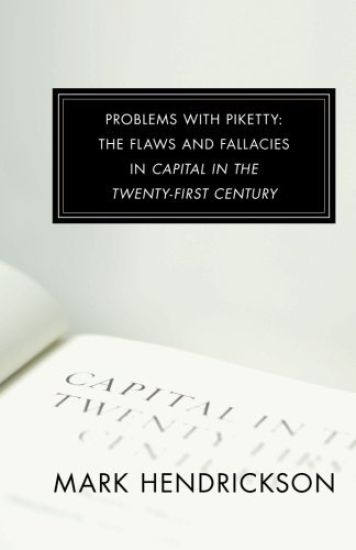
Problems with Piketty: The Flaws and Fallacies in Capital in the Twenty-First Century

Problems with Piketty: The Flaws and Fallacies in Capital in the Twenty-First Century

Mark Hendrickson

Createspace Independent Publishing Platform
2014
nidottu
"Should be read by every scholar, writer, activist..."--Ron Paul, former U.S. Congressman "I love it.]" A "masterful dissection." "Fantastic "--Dr. Arthur Laffer If you have read or even heard about Capital in the Twenty-First Century-economist Thomas Piketty's egalitarian treatise-you owe it to yourself to read Hendrickson's powerful critique. Hendrickson combines extensive knowledge, mature wisdom, common sense, and a rare ability to render complex subjects clear and easily understood. Problems with Piketty shows us the grim consequences of egalitarian policies; exposes the flaws and explodes the fallacies in Piketty's book; and presents a stirring defense of free enterprise. Far more than just a corrective to Capital's many errors, Problems with Piketty works well as a stand-alone teaching tool. Thanks to a detailed Table of Contents, its multiple lessons are easy to find. You may find yourself referring to this book for years to come. "A serious and thorough analysis..."--Fr. Robert Sirico, Acton Institute "A classic for our time."--Dr. Yuri Maltsev, Author of Requiem for Marx "Highly readable...a yeoman's job"--Walter Williams, John E. Olin Distinguished Professor of Economics, George Mason University
Vulnerability and Marginality in Human Services

Vulnerability and Marginality in Human Services

Mark Henrickson; Christa Fouché

Routledge
2020
nidottu
Vulnerability has traditionally been conceived as a dichotomised status, where an individual by reason of a personal characteristic is classified as vulnerable or not. However, vulnerability is not static, and most, if not all, people are vulnerable at some time in their lives. Similarly, marginality is a social construct linked to power and control. Marginalised populations are relegated to the perimeters of power by legal and political structures and limited access to resources. Neither are fixed or essential categories.This book draws on international research and scholarship related to these constructs, exploring vulnerability and marginality as they intersect with power and privilege. This exploration is undertaken through the lenses of intimacy and sexuality to consider vulnerability and marginality in the most personal of ways. This includes examining these concepts in relation to a range of professions, including social work, psychology, nursing, and allied health. A strong emphasis on the fluidity and complexity of vulnerability and marginality across cultures and at different times makes this a unique contribution to scholarship in this field.This is essential reading for students and researchers involved with social work, social policy, sociology, and gender and sexuality studies.
All Animals Poo and We Do Too

All Animals Poo and We Do Too

Mark Hendriksen

Austin Macauley Publishers
2023
nidottu
All Animals Poo & We Do Too is a book for parents and their kids to enjoy, learn and laugh about together. If you like: Animals Poop Jokes Laughing Fascinating Facts & Fun Rhymes and Badgers that eat Sausages "Now, here's a bit of Badger news, they're sausage shaped, a Badger's poos, But if you go to barbecues, that's not the sausage I would choose " Then this book is for you - buy it immediately. "This book has more information on the subject than any encyclopaedia. Everyone must read this important book and share its fabulous facts. (Just not at the breakfast table)." Terry Deary. Award-winning author, Horrible Histories.