
Kirjahaku
Etsi kirjoja tekijän nimen, kirjan nimen tai ISBN:n perusteella.
1000 tulosta hakusanalla Mark Schier
Defining the term Gnosis and its relationship to Gnosticism, this book indicates why Gnosis may be preferable and sketches out the main problems. It then treats the sources, both those in the church fathers and heresiologists, and the more recent Nag Hammadi finds. It goes on to discuss early forms of Gnosis in antiquity, Jewish and Christian (New Testament) and the early Gnostics; the main representatives of Gnosis, especially Valentinus and Marcion; Manichaeism as the culmination and end-point of Gnosis; ancient communities of Gnostics; and finally Gnosis in antiquity and the present.
Defining the term Gnosis and its relationship to Gnosticism, this book indicates why Gnosis may be preferable and sketches out the main problems. It then treats the sources, both those in the church fathers and heresiologists, and the more recent Nag Hammadi finds. It goes on to discuss early forms of Gnosis in antiquity, Jewish and Christian (New Testament) and the early Gnostics; the main representatives of Gnosis, especially Valentinus and Marcion; Manichaeism as the culmination and end-point of Gnosis; ancient communities of Gnostics; and finally Gnosis in antiquity and the present.
Gnosis: An Introduction
Christoph Markschies
Continuum International Publishing Group Ltd.
2017
nidottu
This introduction to gnosis by Christoph Markschies combines clarity with a huge wealth of learning. Markschies defines the term gnosis and its relationship to 'Gnosticism', indicating why gnosis is preferable and sketches out the main problems. He then introduces sources, both those in the Church Fathers and the more recent Nag Hammadi finds. Next, Markschies provides an overview of the early forms of 'gnosis' in antiquity, Jewish and Christian (New Testament) and the early gnostics. This is followed with an outline of the main representatives and key figures of Gnosis, especially Valentinus and Marcion. Finally Markschies explains how Manichaeism was the culmination and end-point of gnosis and introduces readers to ancient communities of 'gnostics'; and finally 'gnosis' in antiquity and the present. For this new edition the text has been updated throughout, and an additional chapter provides an overview of the most recent scholarship. There is also a useful chronological table and an annotated select bibliography.
Gnosis: An Introduction
Christoph Markschies
Continuum International Publishing Group Ltd.
2017
sidottu
This introduction to gnosis by Christoph Markschies combines clarity with a huge wealth of learning. Markschies defines the term gnosis and its relationship to 'Gnosticism', indicating why gnosis is preferable and sketches out the main problems. He then introduces sources, both those in the Church Fathers and the more recent Nag Hammadi finds. Next, Markschies provides an overview of the early forms of 'gnosis' in antiquity, Jewish and Christian (New Testament) and the early gnostics. This is followed with an outline of the main representatives and key figures of Gnosis, especially Valentinus and Marcion. Finally Markschies explains how Manichaeism was the culmination and end-point of gnosis and introduces readers to ancient communities of 'gnostics'; and finally 'gnosis' in antiquity and the present. For this new edition the text has been updated throughout, and an additional chapter provides an overview of the most recent scholarship. There is also a useful chronological table and an annotated select bibliography.
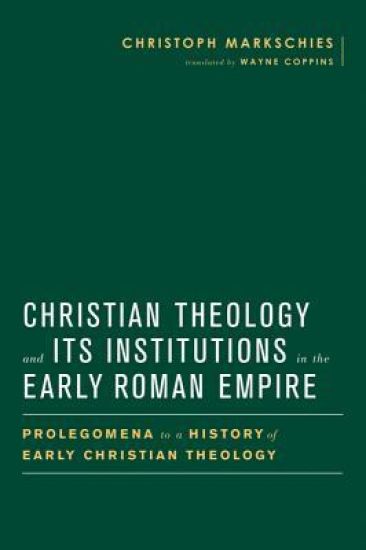
Christian Theology and Its Institutions in the Early Roman Empire
Christoph Markschies
Baylor University Press
2015
sidottu
Tension between unity and diversity plagues any attempt to recount the development of earliest Christianity. Explanations run the gamut - from asserting the presence of a fully formed and accepted unity at the beginning of Christianity to the hypothesis that understands orthodox unity as a later imposition upon Christianity by Rome. In Christian Theology and Its Institutions in the Early Roman Empire, Christoph Markschies seeks to unravel the complex problem of unity and diversity by carefully examining the institutional settings for the development of Christian theology. Specifically, Markschies contends that theological diversity is closely bound up with institutional diversity.Markschies clears the ground by tracing how previous studies fail to appreciate the critical role that diverse Christian institutions played in creating and establishing the very theological ideas that later came to define them. He next examines three distinct forms of institutional life - the Christian institutions of (higher) learning, prophecy, and worship - and their respective contributions to Christianity's development. Markschies then focuses his attention on the development of the New Testament canon, demonstrating how different institutions developed their own respective "canons", while challenging views that assign a decisive role to Athanasius, Marcion, or the Gnostics. Markschies concludes by arguing that the complementary model of the "identity" and "plurality" of early Christianity is better equipped to address the question of unity and diversity than Walter Bauer's cultural Protestant model of "orthodoxy and heresy" or the Jesuit model of the "inculturation" of Christianity.Not for sale in Europe.
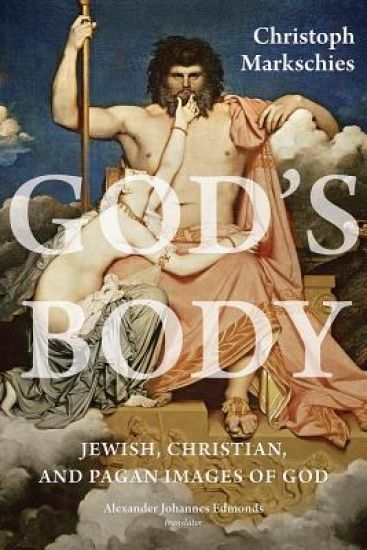
God is unbounded. God became flesh. While these two assertions are equally viable parts of Western Christian religious heritage, they stand in tension with one another. Fearful of reducing God's majesty with shallow anthropomorphisms, philosophy and religion affirm that God, as an eternal being, stands wholly apart from creation. Yet the legacy of the incarnation complicates this view of the incorporeal divine, affirming a very different image of God in physical embodiment.While for many today the idea of an embodied God seems simplistic - even pedestrian - Christoph Markschies reveals that in antiquity, the educated and uneducated alike subscribed to this very idea. More surprisingly, the idea that God had a body was held by both polytheists and monotheists. Platonic misgivings about divine corporeality entered the church early on, but it was only with the advent of medieval scholasticism that the idea that God has a body became scandalous, an idea still lingering today.In God's Body Markschies traces the shape of the divine form in late antiquity. This exploration follows the development of ideas of God's corporeality in Jewish and Greco-Roman traditions. In antiquity, gods were often like humans, which proved to be important for philosophical reflection and for worship. Markschies considers how a cultic environment nurtured, and transformed, Jewish and Christian descriptions of the divine, as well as how philosophical debates over the connection of body and soul in humanity provided a conceptual framework for imagining God. Markschies probes the connections between this lively culture of religious practice and philosophical speculation and the christological formulations of the church to discover how the dichotomy of an incarnate God and a fleshless God came to be. By studying the religious and cultural past, Markschies reveals a Jewish and Christian heritage alien to modern sensibilities, as well as a God who is less alien to the human experience than much of Western thought has imagined. Since the almighty God who made all creation has also lived in that creation, the biblical idea of humankind as image of God should be taken seriously and not restricted to the conceptual world but rather applied to the whole person.
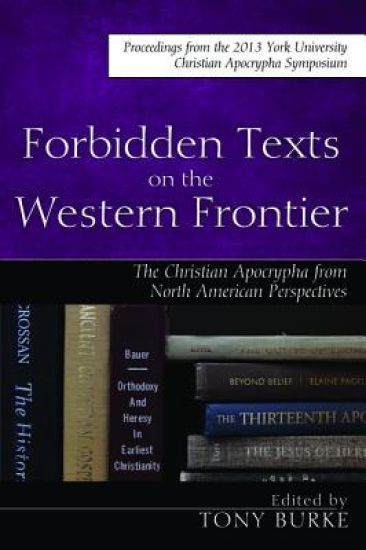
Forbidden Texts on the Western Frontier: The Christian Apocrypha in North American Perspectives
Christoph Markschies
Cascade Books
2015
pokkari
Forbidden Texts on the Western Frontier: The Christian Apocrypha in North American Perspectives
Christoph Markschies
Cascade Books
2015
sidottu

In this volume, Christoph Markschies presents a collection of papers on Origen, the Christian theologian from Alexandria (died approx. 254 AD), who is regarded as the first Christian thinker to work in a rigorous and systematic philosophical manner. The papers in the volume treat philological problems presented by Origen's texts, examine theological ideas he developed, and consider the parts played by Eusebius, the Church historian, and Ambrosius, Bishop of Milan, who as two key theologians from the fourth century continued the traditions established by Origen in both East and West.
Eine neuere Gesamtdarstellung der Berliner Theologischen Fakultät vor 1945, die wissenschaftlichen Ansprüchen genügt, fehlt. Bausteine für eine solche Geschichte liefert anhand von Beiträgen zu zentralen Theologen wie Schleiermacher, Harnack und Lietzmann der vorliegende Band. Die Geschichte der Berliner Theologie wird durchgängig im Kontext der Entwicklungen an der Universität und in der Preußischen Akademie der Wissenschaften präsentiert, so dass beispielsweise auch die Brüder Humboldt oder klassische Altertumswissenschaftler wie Werner Jaeger in den Blick kommen. Dazu werden unbekannte Bilder und Texte aus privaten Nachlässen erstmals veröffentlicht. Auf diese Weise fällt neues Licht auf theologische und (kirchen-)politische Orientierungen, das Verhalten in den unterschiedlichen gesellschaftlichen Systemen und organisatorische Weichenstellungen, die teilweise bis heute fortwirken.

Es ist unbestritten, daß sich die Trinitätstheologie im 4. Jahrhundert entscheidend veränderte und in dieser Zeit auf zwei Konzilien eine Gestalt dieser Theologie normiert wurde, die bis in die Gegenwart die christliche Rede über den dreieinen Gott tief prägt. Freilich ist nicht nur umstritten, ob diese Form dem biblischen Befund gerecht wird, sondern inzwischen auch unklar, ob sie vor dem neuzeitlichen Wahrheitsbewußtsein noch verantwortet werden kann. Außerdem gilt der Prozeß, der in der Spätantike zur konziliar normierten Trinitätstheologie führte, gegenwärtig vielen als ein kaum mehr durchschaubares Durcheinander von theologischen Positionen und politischen Aktionen.In den vorliegenden Untersuchungen möchte Christoph Markschies durch präzise historische Informationen und Analysen maßgeblicher Texte dieser Situation abhelfen und neue Antworten auf die bekannten Fragen zur Diskussion stellen. Die Texte sind in den letzten Jahren an teils entlegenen Orten veröffentlicht worden, wurden jedoch für die erneute Publikation durchgängig überarbeitet. Dabei stellt der Autor die Vorgeschichte der konziliar normierten Trinitätstheolgoie ebenso dar wie ihre Entwicklung im 4. Jahrhundert. Weiter werden in Auseinandersetzung mit aktueller Literatur neue Vorschläge dafür vorgelegt, was man unter 'nizänischer' und 'neunizänischer Trinitätstheologie' verstehen kann. Besonderes Gewicht legt Christoph Markschies auf die Rekonstruktion der inneren systematischen Logik des historischen Prozesses, ohne dabei außertheologische Faktoren wie politische Interessen zu vernachlässigen.
Kaiserzeitliche christliche Theologie und ihre Institutionen
Christoph Markschies
Mohr Siebeck
2009
nidottu
Christoph Markschies zeigt, daß die antike christliche Theologie stets mit Blick auf ihren spezifischen institutionellen Kontext verstanden werden muß: So hatte beispielsweise der Kanon biblischer Schriften bei Apokalyptikern, freien Lehrern, in der Schule des Origenes oder in den verschiedenen Liturgien nicht nur einen unterschiedlichen Umfang, sondern auch eine unterschiedliche Funktion.
Im vorliegenden Band führt Christoph Markschies seine Studien zur Geschichte der "Valentinianischen Gnosis", einer der einflussreichsten Schulen der sogenannten christlichen Gnosis, fort. Während sich der erste Band von 1993 mit den Fragmenten und Überlieferungen des angeblichen Schulgründers, des stadtrömischen christlichen Theologen Valentinus (2. Jh. n.Chr.) beschäftigte, geht es in diesem zweiten Band um den ebenfalls in Rom lehrenden christlichen Theologen Ptolemaeus, der gern als zweites Schulhaupt nach dem Gründer wahrgenommen wird. Durch eine sorgfältige Analyse seines beim spätantiken Bischof Epiphanius von Salamis überlieferten Brief an die römische Matrone Flora und eines angeblich seine Lehre zusammenfassenden Referats beim kaiserzeitlichen Bischof Irenaeus von Lyon wird ein eigenständiger christlicher Denker der hohen Kaiserzeit erkennbar, der in Auseinandersetzung mit anderen Autoren seiner Zeit und Anknüpfung an sie Probleme zu lösen versuchte, die sich einem Christen stellten, der auf dem Niveau zeitgenössischer Popularphilosophie dachte. Ein ausführlicher Kommentar zum Brief und seinem Kontext samt einer Einleitung in das Referat seiner Lehren wird ergänzt durch verschiedene Untersuchungen zur Frühgeschichte der nach Valentinus benannten Richtung christlichen Denkens, die schon in der Antike der sogenannten "Erkenntnis" ("Gnosis") zugeordnet wurde. Im Ergebnis der sorgfältigen philologischen, ideen- und institutionengeschichtlichen Untersuchungen zeigt sich, dass höchstwahrscheinlich weder Valentinus noch Ptolemaeus nach dem Zeugnis ihrer erhaltenen Texte als Urheber der sogenannten Valentinianischen Gnosis in Anspruch genommen werden dürfen, sondern ihre stadtrömischen Schüler in der zweiten Hälfte des zweiten Jahrhunderts.
Hellenisierung Des Christentums: Geschichte Und Bedeutung Eines Umstrittenen Konzepts
Christoph Markschies
Evangelische Verlagsanstalt
2013
nidottu
Mit 'Hellenisierung des Christentums' wird meist eine Transformation des Christentums durch die hellenistisch-romische Kultur im globalisierten Imperium Romanum bezeichnet. Christoph Markschies analysiert die Geschichte des Begriffs und die damit verbundenen, hochst unterschiedlichen Definitionen wie Vorstellungen, informiert uber die teilweise vollkommen vergessenen Vorgeschichten (beispielsweise im franzosischen Renaissancehumanismus) und macht am Ende einen Vorschlag, wie der Begriff heute trotz einer nicht unproblematischen Vorgeschichte noch sinnvoll verwendet werden kann.
Christoph Markschies führt mit diesem Buch in die Technik und zugleich in den Sinn kirchengeschichtlicher Arbeit ein. Dazu stellt er u.a. durch Merksätze, Beispiele, Abbildungen und Kontrollfragen die historischen Arbeitsmethoden vor. Er gibt Hinweise auf wichtige Quellen und Quellengattungen samt der Erschließung dieses Materials und erläutert schließlich den Weg zur historischen Darstellung. Es folgen Ratschläge für die Anfertigung der entsprechenden Pro-/Hauptseminar- bzw. Examens-/Diplomarbeiten. Literaturangaben und ausführliche Register runden das Buch ab.