Kirjojen hintavertailu. Mukana 11 244 527 kirjaa ja 12 kauppaa.

Kirjahaku

Etsi kirjoja tekijän nimen, kirjan nimen tai ISBN:n perusteella.

1000 tulosta hakusanalla Marshall Alfred

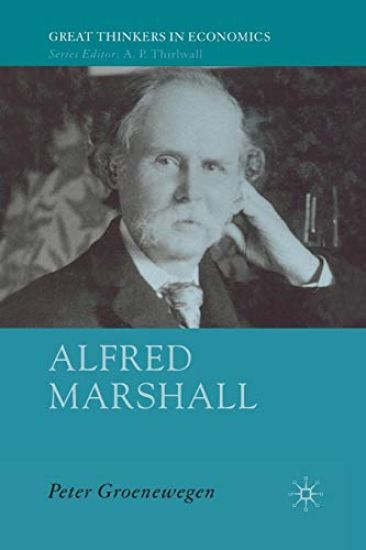
Alfred Marshall

Alfred Marshall

P. Groenewegen

Palgrave Macmillan
2007
nidottu
This succinct overview of Marshall's life and work as an economist sets his major economic contributions in perspective, by looking at his education, his travel, his teaching at Cambridge, Oxford and Bristol, his policy views as presented to government inquiries and his political and social opinions.
Alfred Marshall

Alfred Marshall

P. Groenewegen

Palgrave Macmillan
2007
sidottu
This succinct overview of Marshall's life and work as an economist sets his major economic contributions in perspective, by looking at his education, his travel, his teaching at Cambridge, Oxford and Bristol, his policy views as presented to government inquiries and his political and social opinions.
Alfred Marshall’s Lectures to Women

Alfred Marshall’s Lectures to Women

Edward Elgar Publishing Ltd
1995
sidottu
The Lectures to Women given by Alfred Marshall at Cambridge in 1873, which focus on the effects of working conditions on man's character and prospects, are unique in their content and purpose. They offer insight into a radical period in Marshall's life of which relatively little is known.This new critical edition makes the Lectures, which have sometimes been referred to by Marshallian scholars, available to a wider body of historians of economic thought. Based on Mary Paley Marshall's original notes, corrected by Marshall himself, the Lectures are supplemented by Marshall's lecture outlines. Some contemporary and related texts are also published here including a paper on the future of the working classes from the same year and Marshall's exchange of articles with the trade unionist John Holmes in 1874 known as the Bee-Hive debate. A contextualised commentary on the lectures is provided by Rita McWilliams Tullberg, Ernesto Biagini and Tiziano Raffaelli who adopt three lines of enquiry respectively: the lectures as part of the movement for higher education for women in the Victorian era, the lectures as indicative of Marshall's stand vis-a-vis the political-ideological framework of the time and the lectures as an indicator of Marshall's methodological tendencies concerning the study of social phenomena.
Minor Marshallians and Alfred Marshall

Minor Marshallians and Alfred Marshall

Peter Groenewegen

Routledge
2011
sidottu
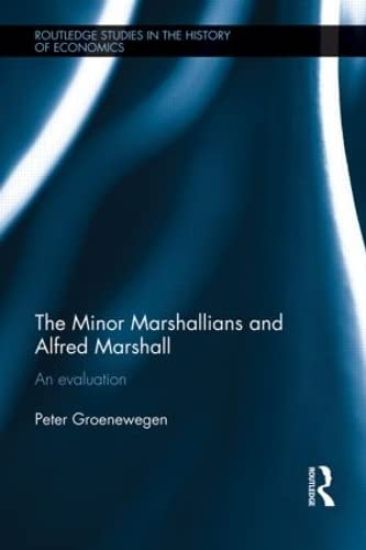
Alfred Marshall, Professor of Economics at Cambridge University (1885-1908), produced a distinguished a distinguished crop of students, many of them leaders in the economics profession in subsequent generations. Pigou, Keynes and Denis Robertson are undoubtedly the most famous of these Marshall ‘pupils’ but there were many more, even if more minor forces in the development of early twentieth century economics. This book intends to examine the major work of ten of these ‘minor’ Marshallians – Sydney John Chapman (1871-1951), John Harold Clapham (1873-1946), Charles Ryle Fay (1884-1961), Alfred William Flux (1867-1942), Frederick Lavington (1881-1927), Walter Thomas Layton (1884-1966), David Huchinson MacGregor (1827-1953), Joseph Shield Nicholson (1850-1927), Charles Percy Sanger (1871-1930) and Gerald Francis Shove (1888-1947), to name them in alphabetical order.The broad aim of this book is to evaluate the more important contributions of these ‘minor’ Marshallians by selective examination of their major economic work. That evaluation has at least two dimensions. First, it focuses on the significance of the author’s individual contributions to the development of twentieth century economic thought. Secondly, it attempts to assess the Marshallian credentials of these contributions in order to indicate how Marshallian in their economics these ‘pupils’ of Marshall’s economics teaching actually stayed.
The Economics of Alfred Marshall (Routledge Revivals)
First published in 1986, The Economics of Alfred Marshall is concerned with the theories of demand, supply, market structure and income distribution which the celebrated author of the Principles of Economics developed while standing on the shoulders of giants. It is thus concerned with hidden assumptions, institutional constraints, tentative conclusions and blurred distinctions; for these are an integral part of the contribution of an economist who warned against spurious over-simplification of that which is inherently complex.The economics of Alfred Marshall appears easy when in fact it is fraught with difficulties. The Economics of Alfred Marshall seeks to explain Marshall’s theories in detail and to evaluate them in depth. The book attempts in that way to help the reader to gain a deeper understanding of an influential thinker whose insights, however difficult, continue to shed a great deal of light on the nature and workings of the economic system.
The Economics of Alfred Marshall (Routledge Revivals)
First published in 1986, The Economics of Alfred Marshall is concerned with the theories of demand, supply, market structure and income distribution which the celebrated author of the Principles of Economics developed while standing on the shoulders of giants. It is thus concerned with hidden assumptions, institutional constraints, tentative conclusions and blurred distinctions; for these are an integral part of the contribution of an economist who warned against spurious over-simplification of that which is inherently complex.The economics of Alfred Marshall appears easy when in fact it is fraught with difficulties. The Economics of Alfred Marshall seeks to explain Marshall’s theories in detail and to evaluate them in depth. The book attempts in that way to help the reader to gain a deeper understanding of an influential thinker whose insights, however difficult, continue to shed a great deal of light on the nature and workings of the economic system.
Centenary Essays on Alfred Marshall

Centenary Essays on Alfred Marshall

Cambridge University Press
2005
pokkari
This collection of twelve original essays commissioned by Britain's Royal Economic Society commemorates the 1990 centennial of the first publication of Alfred Marshall's Principles of Economics, one of the truly seminal works in the history of the subject. Marshall, who lived from 1842 to 1924, was the founder of the Cambridge school of economics and the teacher of John Maynard Keynes. Each of the twelve essays in this volume focuses on some aspect or aspects of Marshall's work, life, or legacy. His magnum opus, the Principles, receives considerable attention, but the discussion is not narrowly restricted to that work - which was in any case only a portion of a larger project, never completed. John Whitaker's essay sets out the detailed history of Marshall's failure to complete the projected second volume of the Principles, and describes the thorny path leading to the publication of Industry and Trade in 1919 and Money Credit and Commerce in 1923.
Centenary Essays on Alfred Marshall

Centenary Essays on Alfred Marshall

Cambridge University Press
1990
sidottu
This collection of twelve original essays commissioned by Britain's Royal Economic Society commemorates the 1990 centennial of the first publication of Alfred Marshall's Principles of Economics, one of the truly seminal works in the history of the subject. Marshall, who lived from 1842 to 1924, was the founder of the Cambridge school of economics and the teacher of John Maynard Keynes. Each of the twelve essays in this volume focuses on some aspect or aspects of Marshall's work, life, or legacy. His magnum opus, the Principles, receives considerable attention, but the discussion is not narrowly restricted to that work - which was in any case only a portion of a larger project, never completed. John Whitaker's essay sets out the detailed history of Marshall's failure to complete the projected second volume of the Principles, and describes the thorny path leading to the publication of Industry and Trade in 1919 and Money Credit and Commerce in 1923.
Minor Marshallians and Alfred Marshall

Minor Marshallians and Alfred Marshall

Peter Groenewegen

Routledge
2015
nidottu
Alfred Marshall, Professor of Economics at Cambridge University (1885-1908), produced a distinguished a distinguished crop of students, many of them leaders in the economics profession in subsequent generations. Pigou, Keynes and Denis Robertson are undoubtedly the most famous of these Marshall ‘pupils’ but there were many more, even if more minor forces in the development of early twentieth century economics. This book intends to examine the major work of ten of these ‘minor’ Marshallians – Sydney John Chapman (1871-1951), John Harold Clapham (1873-1946), Charles Ryle Fay (1884-1961), Alfred William Flux (1867-1942), Frederick Lavington (1881-1927), Walter Thomas Layton (1884-1966), David Huchinson MacGregor (1827-1953), Joseph Shield Nicholson (1850-1927), Charles Percy Sanger (1871-1930) and Gerald Francis Shove (1888-1947), to name them in alphabetical order.The broad aim of this book is to evaluate the more important contributions of these ‘minor’ Marshallians by selective examination of their major economic work. That evaluation has at least two dimensions. First, it focuses on the significance of the author’s individual contributions to the development of twentieth century economic thought. Secondly, it attempts to assess the Marshallian credentials of these contributions in order to indicate how Marshallian in their economics these ‘pupils’ of Marshall’s economics teaching actually stayed.
The Economics of Alfred Marshall

The Economics of Alfred Marshall

Richard Arena

Palgrave Macmillan
2002
sidottu
The Economics of Alfred Marshall brings together a number of leading international scholars for a timely reappraisal of Marshall's contribution to the development of economics. The aims of the contributors are firstly to revisit the work of Alfred Marshall and to investigate the unity of his projects, which contemporary authors often tend to underestimate; and secondly to show how Marshall's approach is not only a subject for historians of economic thought, but may also provide a message that is relevant for the progress of economics.
The Impact of Alfred Marshall’s Ideas

The Impact of Alfred Marshall’s Ideas

Edward Elgar Publishing Ltd
2010
sidottu
`In Alfred Marshall's theory of the human mind, the development of knowledge is conditioned, though not determined, by the context in which it occurs; by a natural extension, so is the interpretation, response to and use of knowledge. That is the organising principle of this book, and no one is better equipped to apply it than the team which produced The Elgar Companion to Alfred Marshall. What we can learn from these studies has wide application in economics - and beyond.'---Brian Loasby, University of Stirling, UK`The team responsible for producing the exemplary Elgar Companion to Alfred Marshall in 2006 has now assembled this complementary volume which contains an equally authoritative collection of studies dealing with the fortuna or intellectual and cultural impact of Marshallian economics in Britain, Europe, North America, Australasia, and Asia. Together the books make an invaluable contribution to the reassessment of Marshall's reputation and the diffusion of his economic ideas.'---Donald Winch, University of Sussex, UKThis is a unique and detailed book which surveys the diffusion and reception of Alfred Marshall's ideas and the ways they have influenced the development of economic science up to the present day.This is an accessible and extremely readable work offering an interesting perspective on the national traditions of economic thought, in both English and non-English speaking countries, as well as on the work of leading economists. As this work demonstrates, the variety of responses elicited by Alfred Marshall's thought testifies to its richness as well as to the plurality of conceptions of the role and tasks of economics in different times and places. This book complements the authors' previous work The Elgar Companion to Alfred Marshall.The Impact of Alfred Marshall's Ideas will appeal to researchers and academics at all levels of economics and especially the history of economic thought.
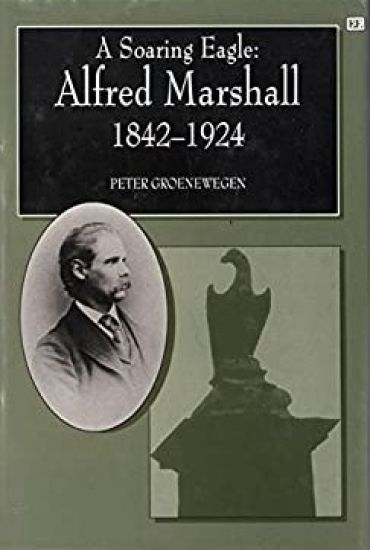
A SOARING EAGLE: Alfred Marshall 1842–1924

A SOARING EAGLE: Alfred Marshall 1842–1924

Peter Groenewegen

Edward Elgar Publishing Ltd
1995
sidottu
Theorist, practitioner, educator and arguably the father of professional economics, Alfred Marshall's life and career have long required a full scale biography to put his work into context and reveal the extent of his influence.Peter Groenewegen's outstanding new book places the major features of Marshall's life and work within the rich institutional setting of late nineteenth and early twentieth century Britain. This biography sheds new light on Marshall's decision to study economics - after dropping mathematics, philosophy and psychology in turn - and the background to his important books, including the Principles of Economics, as well as his government advice over three decades. More than just the life of a major economist, it also deals with economics and mathematics education at Cambridge, contemporary controversies over socialism, imperialism, free trade, eugenics, religious belief, social welfare and the women's movement.As the first biography of Alfred Marshall, A Soaring Eagle contributes to the history of economics, the social sciences and education while also offering a series of insights into Victorian and Edwardian society.
A SOARING EAGLE: Alfred Marshall 1842–1924

A SOARING EAGLE: Alfred Marshall 1842–1924

Peter Groenewegen

Edward Elgar Publishing Ltd
1998
nidottu
Theorist, practitioner, educator and arguably the father of professional economics, Alfred Marshall's life and career have long required a full scale biography to put his work into context and reveal the extent of his influence.Peter Groenewegen's outstanding new book places the major features of Marshall's life and work within the rich institutional setting of late nineteenth and early twentieth century Britain. This biography sheds new light on Marshall's decision to study economics - after dropping mathematics, philosophy and psychology in turn - and the background to his important books, including the Principles of Economics, as well as his government advice over three decades. More than just the life of a major economist, it also deals with economics and mathematics education at Cambridge, contemporary controversies over socialism, imperialism, free trade, eugenics, religious belief, social welfare and the women's movement.As the first biography of Alfred Marshall, A Soaring Eagle contributes to the history of economics, the social sciences and education while also offering a series of insights into Victorian and Edwardian society.
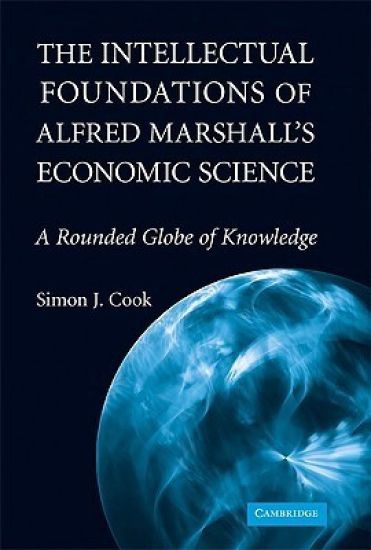
The Intellectual Foundations of Alfred Marshall's Economic Science
This book provides a contextual study of the development of Alfred Marshall's thinking during the early years of his apprenticeship in the Cambridge moral sciences. Marshall's thought is situated in a crisis of academic liberal thinking that occurred in the late 1860s. His crisis of faith is shown to have formed part of his wider philosophical development, which saw him supplementing Anglican thought and mechanistic psychology with Hegel's Philosophy of History. This philosophical background informed Marshall's early reformulation of value theory and his subsequent wide-ranging reinterpretation of political economy as a whole. The book concludes with the suggestion that Marshall's mature economic science was conceived by him as but one part of a wider, neo-Hegelian, social philosophy.
The Intellectual Foundations of Alfred Marshall's Economic Science
This book provides a contextual study of the development of Alfred Marshall's thinking during the early years of his apprenticeship in the Cambridge moral sciences. Marshall's thought is situated in a crisis of academic liberal thinking that occurred in the late 1860s. His crisis of faith is shown to have formed part of his wider philosophical development, which saw him supplementing Anglican thought and mechanistic psychology with Hegel's Philosophy of History. This philosophical background informed Marshall's early reformulation of value theory and his subsequent wide-ranging reinterpretation of political economy as a whole. The book concludes with the suggestion that Marshall's mature economic science was conceived by him as but one part of a wider, neo-Hegelian, social philosophy.