Observera att förlaget som ger ut denna produkt baserar innehållet i sina produkter på fria källor som Wikipedia. Boken är med stor sannolikhet endast ett utdrag ur dessa informationskällor, alltså inte en vanlig bok i den bemärkelsen.
Martti Ahtisaaren (1937-2023) vaikuttava matka evakkopojasta presidentiksi, rauhannobelistiksi ja yhdeksi aikamme suurmiehistä.Miten evakkopojasta kasvoi Suomen tasavallan presidentti ja maailman vaikeimpien kriisien ratkaisija? Mikä oli presidentti Martti Ahtisaaren ajattelun ydin? Mikä ajoi nobelistia vielä iäkkäänäkin matkaamaan parisataa päivää vuodessa rauhan työssä ja miten hän suhtautui kohtaamaansa pahuuteen?Elämäkertaa varten on haastateltu Ahtisaaren keskeisiä yhteistyökumppaneita ja työtovereita sekä läheisiä ja ystäviä niin Suomessa kuin ulkomailla. He arvioivat Ahtisaaren persoonaa, politiikkaa, ratkaisuja, työtä ja vaikutusta, mutta myös Ahtisaaren omia ajatuksia kuullaan läpi matkan.
Merenmaa oli kenties aikansa palkituin kirjailija, joka sai mm. neljä kertaa Valtion palkinnon ja Aleksis Kivi palkinnon.Martti Merenmaa, sanan mestari on Sauli Uhlgrenin 24. proosateos. Hän on julkaissut myös novelleja, esseitä ja runoja monissa antologioissa kuten Erämaailmassa, Elämäntarinassa, Lahden Runomaratonissa ja useissa muissa kulttuurilehdissä.
Hyppää mukaan Martti Lutherin elämään 1500 -luvulle. Kirjailija Miika Aalto saa Martti Lutherin tarinan elämään täysin uudella tavalla. Tämä värikäs, mieleenpainuva ja lämminhenkinen kertomus tempaisee mukaansa niin lapset kuin aikuisetkin.
Martti Ahtisaari, Mara, oli elämästä nauttiva rauhan mies.Suomen kymmenes presidentti ja rauhannobelisti oli arvostetumpi maailmalla kuin koti-Suomessa, missä joutui välillä häpeämättömän ilkkumisen kohteeksi. Elämänsä jännittävimmissä vaiheissa hän välillä antautui jopa suoranaiseen hengenvaaraan.Ahtisaari valittiin ensimmäisenä Suomen presidenteistä suoralla kansanvaalilla, suomettuneisuuden ajan poliitikkojen kauhuksi ohi puolueiden ykkösnimien. Hänestä tuli Euroopan unionin jäseneksi liittyvän maan länsimielinen johtaja.Kuuden vuoden kausi Suomen presidenttinä jäi sittenkin vain sivupoluksi Maran taipaleella. Hänen nimensä muistetaan kunnioittaen muun muasssa Namibiassa, Kosovossa ja Indonesian Acehissa.Tämän kirjallisen muotokuvan ainekset on koottu haastattelemalla Ahtisaaren ystäviä ja muita hänen elämäänsä läheltä seuranneita sekä runsasta lähdeaineistoa tutkimalla.Kirjoittaja Markku Heikkilä on toimitustyön veteraani ja vapaa esiintyjä.
Kirkkohistorian tuntija ja tutkija, tohtori Reijo Arkkila on kirjoittanut mielenkiintoisen teoksen uskonpuhdistaja Martti Lutherista. Kirjassa kerrotaan uskonpuhdistuksen vaiheista. Se paneutuu myös suureen aarteeseen, luterilaiseen uskonoppiin.
This is an open access title available under the terms of a CC BY-NC-ND 4.0 International licence. It is free to read at Oxford Scholarship Online and offered as a free PDF download from OUP and selected open access locations. Ancient Prophecy: Near Eastern, Biblical, and Greek Perspectives is the first monograph-length comparative study on prophetic divination in ancient Near Eastern, biblical, and Greek sources. Prophecy is one of the ways humans have believed to become conversant with what is believed to be superhuman knowledge. The prophetic process of communication involves the prophet, her/his audience, and the deity from whom the message allegedly comes from. Martti Nissinen introduces a wealth of ancient sources documenting the prophetic phenomenon around the ancient Eastern Mediterranean, whether cuneiform tablets from Mesopotamia, the Hebrew Bible, Greek inscriptions, or ancient historians. Nissinen provides an up-to-date presentation of textual sources, the number of which has increased substantially in recent times. In addition, the study includes four analytical comparative chapters. The first demonstrates the altered state of consciousness to be one of the central characteristics of the prophets' public behavior. The second discusses the prophets' affiliation with temples, which are the typical venues of the prophetic performance. The third delves into the relationship between prophets and kings, which can be both critical and supportive. The fourth shows gender-inclusiveness to be one of the peculiar features of the prophetic agency, which could be executed by women, men, and genderless persons as well. The ways prophetic divination manifests itself in ancient sources depend not only on the socio-religious position of the prophets in a given society, but also on the genre and purpose of the sources. Nissinen contends that, even though the view of the ancient prophetic landscape is restricted by the fragmentary and secondary nature of the sources, it is possible to reconstruct essential features of prophetic divination at the socio-religious roots of the Western civilization.
Computer Aided Design (CAD) technology plays a key role in today's advanced manufacturing environment. To reduce the time to market, achieve zero defect quality the first time, and use available production and logistics resources effectively, product and design process knowledge covering the whole product life-cycle must be used throughout product design. Once generated, this intensive design knowledge should be made available to later life-cycle activities. Due to the increasing concern about global environmental issues and rapidly changing economical situation worldwide, design must exhibit high performance not only in quality and productivity, but also in life-cycle issues, including extended producer's liability. These goals require designers and engineers to use various kinds of design knowledge intensively during product design and to generate design information for use in later stages of the product life-cycle such as production, distribution, operation, maintenance, reclamation, and recycling. Therefore, future CAD systems must incorporate product and design process knowledge, which are not explicitly dealt with in the current systems, in their design tools and design object models.
This book presents a critical view of international law as an argumentative practice that aims to 'depoliticise' international relations. Drawing from a range of materials, Koskenniemi demonstrates how international law becomes vulnerable to the contrasting criticisms of being either an irrelevant moralist Utopia or a manipulable façade for State interests. He examines the conflicts inherent in international law - sources, sovereignty, 'custom' and 'world order' - and shows how legal discourse about such subjects can be described in terms of a small number of argumentative rules. This book was originally published in English in Finland in 1989 and though it quickly became a classic, it has been out of print for some years. In 2006, Cambridge was proud to reissue this seminal text, together with a freshly written Epilogue in which the author both responds to critiques of the original work, and reflects on the effect and significance of his 'deconstructive' approach today.
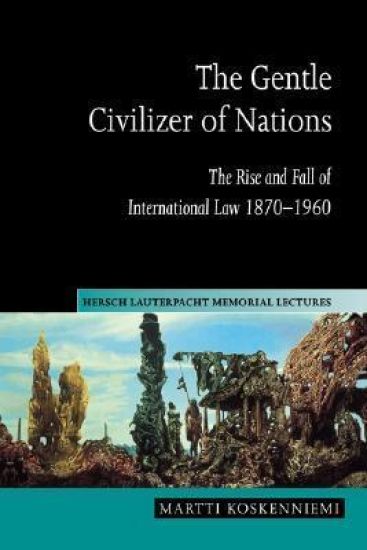
International law was born from the impulse to ‘civilize’ late nineteenth-century attitudes towards race and society, argues Martti Koskenniemi in this fascinating and highly readable study of the rise and fall of modern international law. In a work of immense intellectual scope, Koskenniemi traces the emergence of a liberal sensibility relating to international matters in the late nineteenth century, and its subsequent decline after the Second World War. He combines legal analysis, historical and political critique and semi-biographical studies of key figures (including Hersch Lauterpacht, Carl Schmitt and Hans Morgenthau); he also considers the role of crucial institutions (such as the Institut de droit international and the League of Nations). His discussion of legal and political realism at American law schools ends in a critique of post–1960 ‘instrumentalism’. Along with the book’s other chapters, this provides a unique reflection on the possibility of critical international law today.
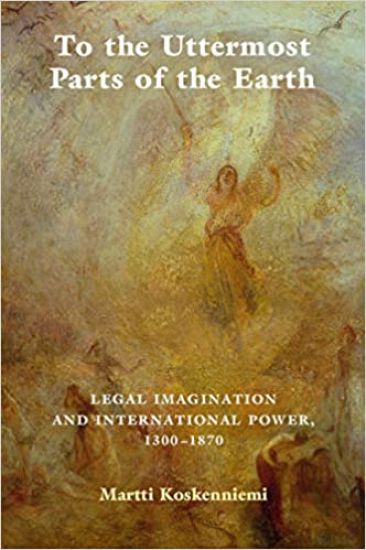
To the Uttermost Parts of the Earth shows the vital role played by legal imagination in the formation of the international order during 1300–1870. It discusses how European statehood arose during early modernity as a locally specific combination of ideas about sovereign power and property rights, and how those ideas expanded to structure the formation of European empires and consolidate modern international relations. By connecting the development of legal thinking with the history of political thought and by showing the gradual rise of economic analysis into predominance, the author argues that legal ideas from different European legal systems - Spanish, French, English and German - have played a prominent role in the history of global power. This history has emerged in imaginative ways to combine public and private power, sovereignty and property. The book will appeal to readers crossing conventional limits between international law, international relations, history of political thought, jurisprudence and legal history.
To the Uttermost Parts of the Earth shows the vital role played by legal imagination in the formation of the international order during 1300–1870. It discusses how European statehood arose during early modernity as a locally specific combination of ideas about sovereign power and property rights, and how those ideas expanded to structure the formation of European empires and consolidate modern international relations. By connecting the development of legal thinking with the history of political thought and by showing the gradual rise of economic analysis into predominance, the author argues that legal ideas from different European legal systems - Spanish, French, English and German - have played a prominent role in the history of global power. This history has emerged in imaginative ways to combine public and private power, sovereignty and property. The book will appeal to readers crossing conventional limits between international law, international relations, history of political thought, jurisprudence and legal history.
This book presents a critical view of international law as an argumentative practice that aims to 'depoliticise' international relations. Drawing from a range of materials, Koskenniemi demonstrates how international law becomes vulnerable to the contrasting criticisms of being either an irrelevant moralist Utopia or a manipulable façade for State interests. He examines the conflicts inherent in international law - sources, sovereignty, 'custom' and 'world order' - and shows how legal discourse about such subjects can be described in terms of a small number of argumentative rules. This book was originally published in English in Finland in 1989 and though it quickly became a classic, it has been out of print for some years. In 2006, Cambridge was proud to reissue this seminal text, together with a freshly written Epilogue in which the author both responds to critiques of the original work, and reflects on the effect and significance of his 'deconstructive' approach today.
Nissinen's award-winning book surveys attitudes in the ancient world toward homoeroticism, that is, erotic same-sex relations. Focusing on the Bible and its cultural environment-Mesopotamia, Greece, Rome, Israel-Nissinen concisely and readably introduces the relevant sources and their historical contexts in a readable way. Homoeroticism is examined as a part of gender identity, i.e., the interplay of sexual orientation, gender identification, gender roles, and sexual practice. In the patriarchal cultures of the biblical world, Nissinen shows, homoerotic practices were regarded as a role construction between the active and passive partners rather than as expressions of an orientation moderns call "homosexuality." Nissinen shows how this applies to the limited acceptance of homoerotic relationships in Greek and Roman culture, as well as to Israel's and the early church's condemnation of any same-sex erotic activity. For readers interested in the ancient world or contemporary debates, Nissinen's fascinating study shows why the ancient texts - both biblical and nonbiblical - are not appropriate for use as sources of direct analogy or argument in today's discussion.
This Major Reference series brings together a wide range of key international articles in law and legal theory. Many of these essays are not readily accessible, and their presentation in these volumes will provide a vital new resource for both research and teaching. Each volume is edited by leading international authorities who explain the significance and context of articles in an informative and complete introduction.
This volume brings together a representative sample of ancient Near Eastern written documents of prophecy from the second and first millennia BCE and provides nonspecialist readers translations, transliterations, and discussions of oracle reports and collections, quotations of prophetic messages in letters and literature, and texts that reference persons with prophetic titles. This second edition includes thirty-four new texts.
Computer Aided Design (CAD) technology plays a key role in today's advanced manufacturing environment. To reduce the time to market, achieve zero defect quality the first time, and use available production and logistics resources effectively, product and design process knowledge covering the whole product life-cycle must be used throughout product design. Once generated, this intensive design knowledge should be made available to later life-cycle activities. Due to the increasing concern about global environmental issues and rapidly changing economical situation worldwide, design must exhibit high performance not only in quality and productivity, but also in life-cycle issues, including extended producer's liability. These goals require designers and engineers to use various kinds of design knowledge intensively during product design and to generate design information for use in later stages of the product life-cycle such as production, distribution, operation, maintenance, reclamation, and recycling. Therefore, future CAD systems must incorporate product and design process knowledge, which are not explicitly dealt with in the current systems, in their design tools and design object models.
Russia may be the last untapped source of potentially disruptive technologies. Its history as a closed, alternate society, in the days of the Cold War, fed an insular culture. Soviet science proved its capabilities, dramatically, with the launch of sputnik. Sakharov developed an original design for his Hydrogen bomb. That alternate universe no longer exists. The world is, instead, connecting, thanks to a web whose origins can be traced to Silicon Valley. When Russia opened in 1991 the only alternative available to Russians interested in launching their ideas into the global village was to immigrate. Many did. Transformational technologies often emerge from fresh perspectives. There are probably more untapped "fresh perspectives" hidden in Russia then anywhere else. Why? Russians have access to the world's technologies, thanks to the West's openness. They are up to date, yet many do not trust their own government to protect their interests, and thus keep brilliant ideas to themselves. Soviet society did not recognize private property. Intellectual property protection is fundamental to value creation and innovation. I first visited Russia in 1991, just as she was opening, and was struck by the unharnessed energy of her people. My background, born in Prague, son of a Finnish diplomat (who participated in post-war reparation negotiations between Finland and Russia) gave me a perspective on what was possible. The book tells of how this optimist was educated in the world of "hard knocks". When I left IBM on my "leap of faith" into Russia I followed what I believed to be a calling. Experiences described in the book forged a business model that I believe addresses the unique challenges and opportunities of the moment. The book tells how I founded companies based on potentially transformational technologies. One offers a treatment and possible prevention of Alzheimer's (Buddha Biopharma OY), another promises an extension of Moore's Law on silicon (Fuzzy Chip). These are not small ideas. My original idea about Finland as a gateway out for Russian ideas was discouraged. Singapore emerged as an alternate location, one respecting IP protection and the "rule of law", while not having any Russia "complex". I take the reader to the far corners of the largest country on earth, during a period in which it experienced great change. Chapters describe numerous locations and technologies discovered there. I have made nothing up. It is my hope the story will develop an image of Russia as a possible source of ""big things" that can be commercialized when combined with the resources of trusted Western partners. I takes the reader through steps needed to build a business, specifying relevant "business lessons" at the conclusion of every chapter. The book may be seen as a teaching tool, a provider of case studies, presented with humor.
A tipping point on the road I hoped would transform an outsider into a millionaire occurred at a lunch in a restaurant on the Boston waterfront silhouetted in the cover photo. A member of Boston's oldest Intellectual property firm was introducing me to investors in a position to support the commercialization of disruptive technologies (described in the appendix). I hurried to the surprise meeting from a grand jury room where I was serving on the "right side" of US law, benefitting from my experience as a convicted criminal in Finland, my father's country. Having arrived in Boston shortly before the Marathon bombing, it took forever to fund companies I had formed based on technologies I had found in Russia, while I continued legal battles in Finland.This "Bannana book" tells the story of how I reached numerous "tipping points", and fortune. It includes reflections on the deterioration of US-Russian relations from the moment Yeltsin literally put his heart into the hands of American surgeons, and provides thoughts on how relations between the two countries may be improved by "bottom-up" collaborations on technology commercialization, for which Boston is in a position of "comparative advantage".The book ends in Washington DC, outside the Trump White House, in a scene worthy of a movie that proves that truth is, indeed, stranger than fiction, and that no good deed goes unpunished.