
Kirjahaku
Etsi kirjoja tekijän nimen, kirjan nimen tai ISBN:n perusteella.
1000 tulosta hakusanalla Melida a. Harris Barrow
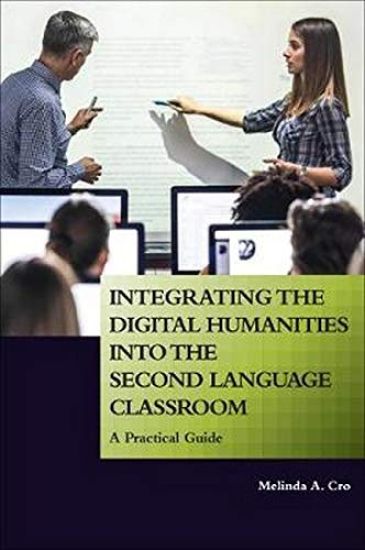
Integrating the Digital Humanities into the Second Language Classroom
Melinda A. Cro
Georgetown University Press
2020
pokkari
Second language classrooms provide unique opportunities for intellectual growth, cognitive skill development, and cultural exchange. In Integrating the Digital Humanities into the Second Language Classroom, Melinda A. Cro makes the case for bringing the digital humanities (DH) into that sphere, strengthening students’ language skills while furthering their critical thinking and research abilities. Written as a practical guide for language instructors new to DH, Cro addresses practitioners’ most common questions: What are the benefits of DH for language learning in particular? How can DH be used at different levels of instruction? What types of DH tools are out there, and what kinds of knowledge must students and teachers bring to the table? Integrating the Digital Humanities into the Second Language Classroom is filled with real-world examples and concrete recommendations, making it an ideal introduction for language teachers intrigued by the potential of DH.
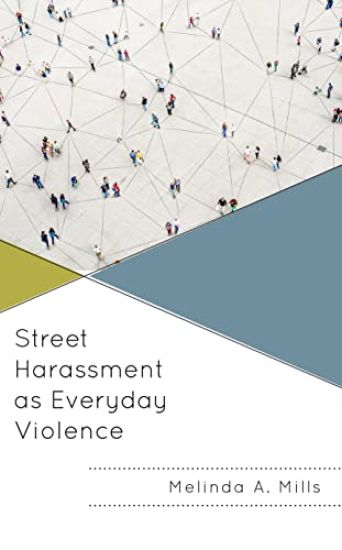
In Street Harassment as Everyday Violence, Melinda A. Mills investigates women’s experiences with street harassment, recognizing this phenomenon as a form of everyday violence. The author follows feminist scholars to consider the ways that silence can potentially, if only partially, protect women from verbally assaultive men who harass women in public. This violence both reveals and conceals itself in the discourses of silence about and during street harassment. It maps onto and reflects the web of violence that proves persistent and difficult to dismantle. This work operates as an initial intervention, by way of recognition of street harassment as a problem that hides in plain sight.

In Street Harassment as Everyday Violence, Melinda A. Mills investigates women’s experiences with street harassment, recognizing this phenomenon as a form of everyday violence. The author follows feminist scholars to consider the ways that silence can potentially, if only partially, protect women from verbally assaultive men who harass women in public. This violence both reveals and conceals itself in the discourses of silence about and during street harassment. It maps onto and reflects the web of violence that proves persistent and difficult to dismantle. This work operates as an initial intervention, by way of recognition of street harassment as a problem that hides in plain sight.
Racial Mixture and Musical Mash-ups in the Life and Art of Bruno Mars
Melinda A. Mills
Rowman Littlefield
2020
sidottu
This book argues that Bruno Mars is uniquely positioned to borrow from his heritage and experiential knowledge as well as his musical talent, performative expertise, and hybrid identities (culturally, ethnically, and racially) to remix music that can create "new music nostalgia." Melinda Mills attends to the ways that Mars is precariously positioned in relation to all of the racial and ethnic groups that constitute his known background and argues that this complexity serves him well in the contemporary moment. Engaging in the performative politics of blackness allows Mars to advocate for social justice by employing his artistic agency. Through his entertainment and the everyday practice of joy, Mars models a way of moving through the world that counters its harsh realities. Through his music and perfomance, Mars provides a way for a reconceptualization of race and a reimagining of the future.

Abortion and the Moral Significance of Merely Possible Persons
Melinda A. Roberts
Springer
2010
sidottu
1.1 Goals 1.1.1 I have two main goals in this book. The first is to give an account of the moral significance of merely possible persons – persons who, relative to a particular 1 circumstance, or possible future or world, could but in fact never do exist. I call that account Variabilism. My second goal is to use Variabilism to begin to address the problem of abortion. 1.1.2 We ought to do the best we can for people. And we consider this obligation to extend to people who are, relative to a world, existing or future. But does it extend to merely possible people as well? And, if it does, then does it extend to making things better for them by way of bringing them into existence? If we say that surely it doesn’t, does that then mean that our obligation to do the best we can for people does not, after all, extend to the merely possible – that the merely p- sible do not matter morally? But if the merely possible do not matter morally, then doesn’t that mean that it would be permissible for us to bring them into miserable existences – and even obligatory to do just that – in the case where bringing the merely possible into miserable existences creates additional wellbeing for existing 1 References to merely possible persons and, later on, to persons who do exist – existing persons

Abortion and the Moral Significance of Merely Possible Persons
Melinda A. Roberts
Springer
2012
nidottu
1.1 Goals 1.1.1 I have two main goals in this book. The first is to give an account of the moral significance of merely possible persons – persons who, relative to a particular 1 circumstance, or possible future or world, could but in fact never do exist. I call that account Variabilism. My second goal is to use Variabilism to begin to address the problem of abortion. 1.1.2 We ought to do the best we can for people. And we consider this obligation to extend to people who are, relative to a world, existing or future. But does it extend to merely possible people as well? And, if it does, then does it extend to making things better for them by way of bringing them into existence? If we say that surely it doesn’t, does that then mean that our obligation to do the best we can for people does not, after all, extend to the merely possible – that the merely p- sible do not matter morally? But if the merely possible do not matter morally, then doesn’t that mean that it would be permissible for us to bring them into miserable existences – and even obligatory to do just that – in the case where bringing the merely possible into miserable existences creates additional wellbeing for existing 1 References to merely possible persons and, later on, to persons who do exist – existing persons
Caracterización florística y estructural del Bosque Chaqueño Serrano
Giorgis Melisa a
Editorial Academica Espanola
2011
pokkari

Propiedades antifungicas de T. dodoneifolia
Franco A. Aguilar; José R. Soberón; Melina A. Sgariglia
Editorial Académica Española
2020
nidottu

Antigribkowye swojstwa T. dodoneifolii
Franco A. Aguilar; Jose R. Soberón; Melina A. Sgariglia
Sciencia Scripts
2020
nidottu
Propriedades antifúngicas da T. dodoneifolia
Franco A. Aguilar; José R. Soberón; Melina A. Sgariglia
Editions Notre Savoir
2020
nidottu

Schimmelwerende eigenschappen van T. dodoneifolia
Franco A. Aguilar; José R. Soberón; Melina A. Sgariglia
Uitgeverij Onze Kennis
2020
nidottu

Proprietà antifungine della T. dodoneifolia
Franco A. Aguilar; José R. Soberón; Melina A. Sgariglia
Edizioni Sapienza
2020
nidottu

Propriétés antifongiques de T. dodoneifolia
Franco A. Aguilar; José R. Soberón; Melina A. Sgariglia
Editions Notre Savoir
2020
nidottu

Anti-fungal properties of T. dodoneifolia
Franco A. Aguilar; José R. Soberón; Melina A. Sgariglia
Our Knowledge Publishing
2020
nidottu

Antimykotische Eigenschaften von T. dodoneifolia
Franco A. Aguilar; José R. Soberón; Melina A. Sgariglia
Verlag Unser Wissen
2020
nidottu
Attribution
Gifford Weary; Melinda A. Stanley; John H. Harvey
Springer-Verlag New York Inc.
2011
nidottu
This book initially was conceived in 1986 by Weary and Harvey as a revi sion and update of their 1981 Perspectives on Attributional Processes (pub lished by Wm. C. Brown," Dubuque, Iowa). However: toe extensive nature of recent work on attributional processes and the opportunity to collabo rate with Melinda Stanley as a coauthor led to a plan to develop a more comprehensive work than the 1981 book. It definitely is an amalgam of our interests in social and clinical psychology. It represents our commitment to basic theoretical and empirical inquiry blended with the applications of ideas and methods to understanding attribution in more naturalistic set tings, and as it unfolds in the lives of different kinds of people coping with diverse problems of living. The book represents a commitment also to the breadth of approach to attribution questions epitomized by Fritz Heider's uniquely creative mind and work in pioneering the area. To us, the attribu tional approach is not a sacrosanct school of thought on the human condi tion. It is, rather, a body of ideas and findings that we find to be highly useful in our work as social (JH and GW) and clinical (GW and MS) psychology scholars. It is an inviting approach that, as we shall describe in the book, brings together ideas and work from different fields in psychology-all concerned with the pervasive and inestimab1e importance of interpretive activity in human experience and behavior.

Sprache und Embodiment
Katharina Kühne; Melinda A. Jeglinski-Mende
Springer-Verlag Berlin and Heidelberg GmbH Co. KG
2023
nidottu
Jahrelang haben Wissenschaftler gedacht, dass wir die gesamte Palette des menschlichen Handelns und Denkens einem einzigen Organ – dem Gehirn – verdanken. Diese Annahmen werden allerdings mehr und mehr zu Gunsten des sogenannten Embodiments ergänzt: Ein Ansatz, der besagt, dass der Körper mit dem Geist/Gehirn als eine Einheit fungiert. In diesem Buch bringen wir Hinweise für verkörperte Sprache zusammen und erläutern, wie die Ergebnisse aus wissenschaftlichen Studien im alltäglichen Leben, wie zum Beispiel im Schulunterricht oder in der Klinik, anwendbar sind.
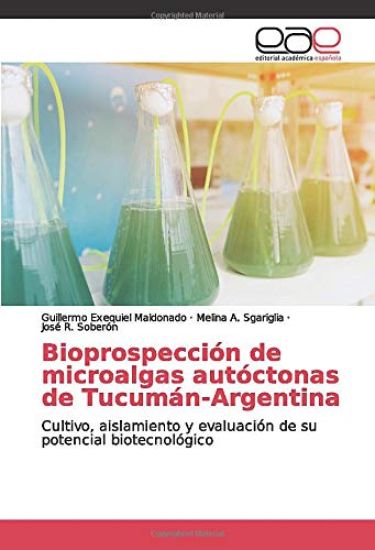
Bioprospección de microalgas autóctonas de Tucumán-Argentina
Guillermo Exequiel Maldonado; Melina A. Sgariglia; José R. Soberón
Editorial Académica Española
2019
nidottu