Kirjojen hintavertailu. Mukana 12 434 333 kirjaa ja 12 kauppaa.

Kirjahaku

Etsi kirjoja tekijän nimen, kirjan nimen tai ISBN:n perusteella.

1000 tulosta hakusanalla Michael Peter Wilson

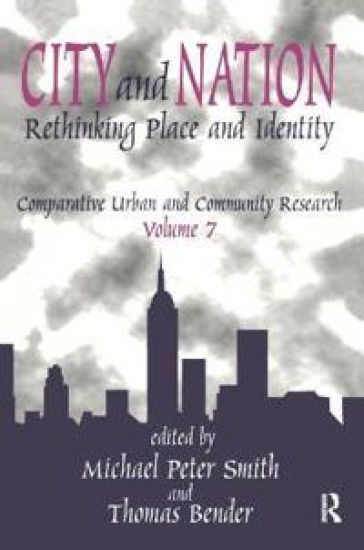
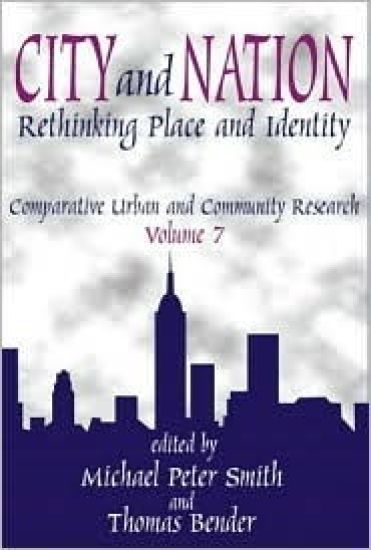
City and Nation

City and Nation

Michael Peter Smith; Thomas Bender

Transaction Publishers
2001
nidottu
This compendium offers a textured historical and comparative examination of the significance of locality or "place," and the role of urban representations and spatial practices in defining national identities. Drawing upon a wide range of disciplines - from literature to architecture and planning, sociology, and history - these essays problematize the dynamic between the local and the national, the cultural and the material, revealing the complex interplay of social forces by which place is constituted and contributes to the social construction of national identity in Asia, Latin America, and the United States. These essays explore the dialogue between past and present, local and national identities in the making of "modern" places. Contributions range from an assessment of historical discourses on the relationship between modernity and heritage in turn-of-the-century Suzhou to the social construction of San Antonio's Market Square as a contested presencing of the city's Mexican past. Case studies of the socio-spatial restructuring of Penang and Jakarta show how place-making from above by modernizing states is articulated with a claims-making politics of class and ethnic difference from below. An examination of nineteenth-century Central America reveals a case of local grassroots formation not only of national identity but national institutions. Finally, a close examination of Latin American literature at the end of the nineteenth century reveals the importance of a fantastic reversal of Balzac's dystopian vision of Parisian cosmo-politanism in defining the place of Latin America and the possibilities of importing urban modernity.

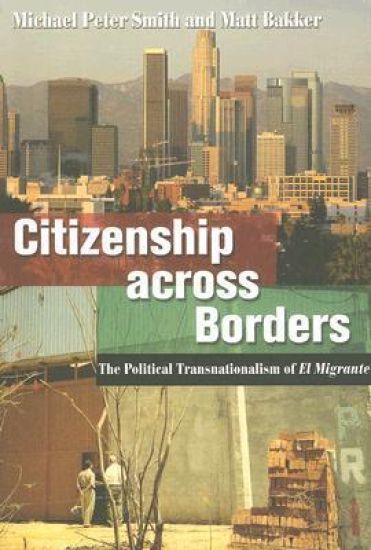
Citizenship across Borders

Citizenship across Borders

Michael Peter Smith; Matt Bakker

CORNELL UNIVERSITY PRESS
2011
muu
political life, the practice of dual citizenship by Mexican migrants actually provides a sense of empowerment that fosters migrants' active civic engagement in American as well as Mexican politics.
Citizenship Across Borders

Citizenship Across Borders

Michael Peter Smith; Matt Bakker

Cornell University Press
2007
pokkari
Michael Peter Smith and Matt Bakker spent five years carrying out ethnographic field research in multiple communities in the Mexican states of Zacatecas and Guanajuato and various cities in California, particularly metropolitan Los Angeles. Combining the information they gathered there with political-economic and institutional analysis, the five extended case studies in Citizenship across Borders offer a new way of looking at the emergent dynamics of transnational community development and electoral politics on both sides of the border. Smith and Bakker highlight the continuing significance of territorial identifications and state policies—particularly those of the sending state—in cultivating and sustaining transnational connections and practices. In so doing, they contextualize and make sense of the complex interplay of identity and loyalty in the lives of transnational migrant activists. In contrast to high-profile warnings of the dangers to national cultures and political institutions brought about by long-distance nationalism and dual citizenship, Citizenship across Borders demonstrates that, far from undermining loyalty and diminishing engagement in U.S. political life, the practice of dual citizenship by Mexican migrants actually provides a sense of empowerment that fosters migrants' active civic engagement in American as well as Mexican politics.
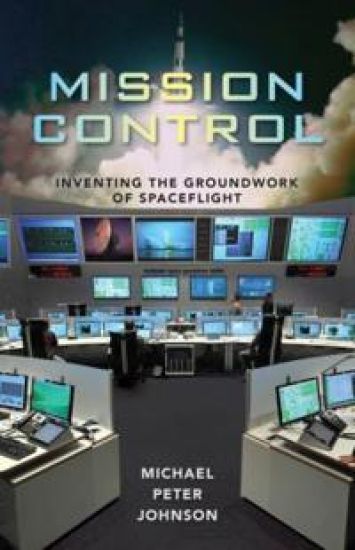
Mission Control

Mission Control

Michael Peter Johnson

University Press of Florida
2015
sidottu
Brave astronauts, flaring rockets, and majestic launches are only one side of the story of spaceflight. Any mission to space depends on years—if not decades—of work by thousands of dedicated individuals on the ground. These are the people whose voices offer a friendly link to Earth in the void of space, whose hands maneuver rovers across the face of planets, and whose skills guide astronauts home. This book is a long-overdue history of three major centers that have managed important missions since the dawn of the space age.In Mission Control, Michael Johnson explores the famous Johnson Space Center in Houston, the Jet Propulsion Laboratory in Pasadena, and the European Space Operations Centre in Darmstadt, Germany—each a strategically designedmicro-environment responsible for the operation of spacecraft and the safety of passengers.Johnson explains the motivations behind the location of each center and their intricate design. He shows how the robotic spaceflight missions overseen in Pasadena and Darmstadt set these centers apart from Houston. He argues that the type of spacecraft and the missions they controlled—not the nations they represented—defined how the centers developed, yet they played vital national roles as space technology became a battleground for international power struggles in the Cold War years and even after.
Explorations in Urban Theory

Explorations in Urban Theory

Michael Peter Smith

Routledge
2017
nidottu
For over three decades, urban theorist Michael Peter Smith has engaged in constructing innovative theories on central research questions in urban studies. This book brings together his views on the state of urban theory, sorting out the changing strengths and weaknesses in the field. Smith refocuses attention on the cultural, social, and political practices of urban inhabitants, particularly the way in which their everyday activities have contributed to the social construction of new ethnic identities and new meanings of urban citizenship. Combining the methods of political economy and transnational ethnography, he encourages us to think about new political spaces for practicing "urban citizenship" by analyzing the connections linking cities to the web of relations to other localities in which they are embedded. Smith systematically analyzes the dynamics of "community power" and "urban change" under new globalizing trends and increased transnational mobility. Expanding on his original conceptualization of "transnational urbanism," he frames urban political life within a wider transnational context of political practice, in which an endless interplay of distinctly situated networks, social practices, and power relations are fought out at multiple scales, in an inexorable politics of inclusion and exclusion.
City and Nation

City and Nation

Michael Peter Smith; Thomas Bender

Routledge
2018
sidottu
This compendium offers a textured historical and comparative examination of the significance of locality or "place," and the role of urban representations and spatial practices in defining national identities. Drawing upon a wide range of disciplines - from literature to architecture and planning, sociology, and history - these essays problematize the dynamic between the local and the national, the cultural and the material, revealing the complex interplay of social forces by which place is constituted and contributes to the social construction of national identity in Asia, Latin America, and the United States. These essays explore the dialogue between past and present, local and national identities in the making of "modern" places. Contributions range from an assessment of historical discourses on the relationship between modernity and heritage in turn-of-the-century Suzhou to the social construction of San Antonio's Market Square as a contested presencing of the city's Mexican past. Case studies of the socio-spatial restructuring of Penang and Jakarta show how place-making from above by modernizing states is articulated with a claims-making politics of class and ethnic difference from below. An examination of nineteenth-century Central America reveals a case of local grassroots formation not only of national identity but national institutions. Finally, a close examination of Latin American literature at the end of the nineteenth century reveals the importance of a fantastic reversal of Balzac's dystopian vision of Parisian cosmo-politanism in defining the place of Latin America and the possibilities of importing urban modernity.
Marginal Spaces

Marginal Spaces

Michael Peter Smith

Routledge
2018
sidottu
The literature on modernist and postmodernist urban development is abundant, yet few researchers have taken up the challenge of studying the areas hi which marginalized people live as sources of resistance to continued modernization. In Marginal Spaces, Michael Smith has assembled case studies combining structural and historical analyses of the moves of powerful social interests to dominate social space, and the tactics and strategies various marginalized social groups employ to reclaim dominated space for their own use. The marginal spaces embodied in the title of this fifth volume of the Comparative Urban and Community Research series include five sites of domination and resistance. A squatters' movement in Ann Arbor, Michigan, resists the adverse consequences of four decades of urban development. A homeless encampment in Chicago engages hi "guerilla architecture" and other moves designed to reconstitute prevailing social constructions of the problem of "homelessness." An antigentrification movement hi the East Village of New York engages hi an ongoing struggle to resist efforts by developers to market their neighborhood as space for luxury condominium development. There is a Public Housing Council organized by African American women hi New Orleans that is resisting both the material regulation of their daily lives and the dominant social construction of public housing as a racially gendered space suitable only for "dependent" women and children of color. Finally, there is a subordinate labor market niche hi California agriculture where indigenous Mixtec peasants from Oaxaca are displacing the more traditional mestizo farm workers, but who are also politically organizing as a transnational grassroots movement, pursuing a binational strategy to alleviate then- economic, political, and cultural marginality. Contributions and contributors include: "House People, Not Cars!" by Corey Dolgon, Michael Kline, and Laura Dresser; "Tranquillity City" by Tahnadge Wright; "Private Redevelopment and the Changing Forms of Displacement hi the East Village of New York" by Christopher Mele; "Resisting Racially Gendered Space" by Alma Young and Jyaphia Christos-Rodgers; and "Mixtecs and Mestizos hi California Agriculture" by Carol Zabin. This volume will be of interest to urban planners, sociologists, and political scientists, especially those with strong interests hi local ethnography and concrete policy.
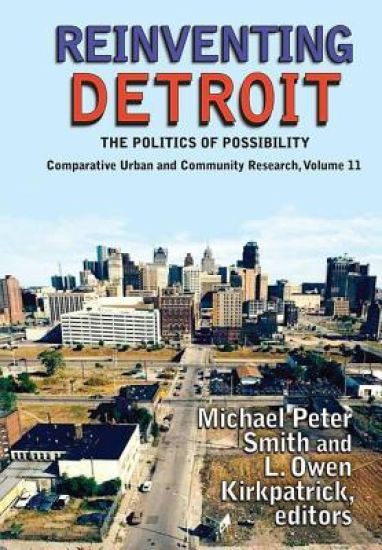
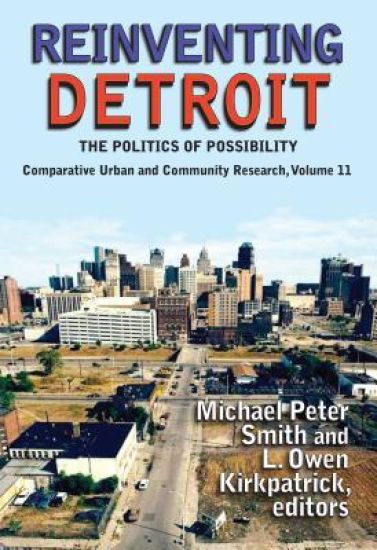
Reinventing Detroit

Reinventing Detroit

Michael Peter Smith

Routledge
2017
sidottu
This book addresses the questions of what went wrong with Detroit and what can be done to reinvent the Motor City. Various answers to the former deindustrialization, white flight, and a disappearing tax base are now well understood. Less discussed are potential paths forward, stemming from alternative explanations of Detroit's long-term decline and reconsideration of the challenges the city currently faces.Urban crisis‘socioeconomic, fiscal, and political has seemingly narrowed the range of possible interventions. Growth-oriented redevelopment strategies have not reversed Detroit's decline, but in the wake of crisis, officials have increasingly funnelled limited public resources into the city's commercial core via an implicit policy of "urban triage." The crisis has also led to the emergency management of the city by extra-democratic entities. As a disruptive historical event, Detroit's crisis is a moment teeming with political possibilities.The critical rethinking of Detroit's past, present, and future is essential reading for both urban studies scholars and the general public.
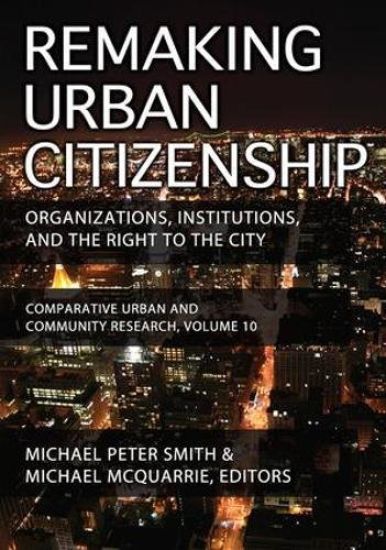
Remaking Urban Citizenship

Remaking Urban Citizenship

Michael Peter Smith

Routledge
2017
sidottu
Due to heightened global migration and transnational mobility, many residents of the world's cities lack national citizenship in the places to which they have moved for work, refuge, or retirement. The disjuncture between citizenship and daily life has led to devolution of claims from national to urban space. Within nation-states characterized by structured inequalities, citizens have not reduced their social differences. This leads increasingly to calls for greater direct involvement of marginalized classes in reshaping the institutions and spaces directly affecting their lives.These concerns cities without citizenship and people without political power inform the agendas of organizations that seek to restructure urban citizenship in more democratic directions. Remaking Urban Citizenship focuses on the uses and limits of such political organizations and coalitions, shows the various ways they pursue expanded rights within the city, and describes the institutional changes necessary to empower global migrants and popular classes as urban citizens.Offering individual or comparative case studies of cities in the United States, Europe, and China, contributions to this volume describe the development of actual practices of organizations working to reinvigorate citizenship at the urban scale. Collectively, they locate institutional forms that help migrants lay claim to their cities, show how migrants can become politically empowered, and identify how they can expand their rights or find other ways to belong.
Transnational Ties

Transnational Ties

Michael Peter Smith

Routledge
2017
sidottu
Cities are key sites of the transnational ties that increasingly connect people, places, and projects across the globe. They provide opportunities and constraints within which transnational actors and networks operate and nodes linking wider social formations traverse national borders. This book brings together a series of richly textured ethnographic studies that suggest new ways to situate and historicize transnationalism, identify new pathways to transnational urbanism, and map the contours of translocal, interregional, and diasporic connections not previously studied. The transnational ties treated in this book truly span the globe, giving concrete meaning to the phrase "globalization from below."How have the contributors to this book conceptualized the wider context informing the conduct of their ethnographically grounded, multi-sited research on the relationship between cities, migration, and transnationalism? Several interrelated contextual dimensions have been singled out as affecting the opportunities and constraints experienced by transnational migrant subjects. Socio-spatially, in several of these chapters, the political economic context now called neoliberal globalization is shown to be a key driving force creating conditions that necessitate, facilitate, or impede migration, foster trans-local economic ties, and create new inter-regional interdependencies--e.g., new South-South and East-East transnational ties.The changing historical context of both migrating groups and the cities and regions they move across are central to the study of the interplay of urban change and migrant transnationalism. The historical particularities of migrant recruitment, migration histories, migratory narratives, and changing gender and class relations all affect the character and geography of transnational migration with an impact on the social structures of community formation. This is a pioneering effort in the Comparative Urban and Community Research series.
Open Architecture

Open Architecture

Michael Peter Steinbusch; Dominik Walcher

Lulu.com
2013
pokkari
Anscheinend sperrt sich die Architektur gegen eine Form der Offenheit, wie sie Software- und Produktentwicklung, Organisation, Politik und weitere Bereiche seit den 90er Jahren vorgemacht haben: Open Source, Open Innovation, Open Design, Open Government. Was r ckschrittlich anmutet, kann aber auch Interesse wecken: Worauf ist diese Hartleibigkeit der Architektur eigentlich zur ckzuf hren? Was sagt sie ber die Architektur aus? Wie stehen deren Chancen, sich zu ffnen? Und was erhofft man sich von einer Open Architecture? Ja: Wo kommt die Frage berhaupt her, und was macht sie heute so (auf-) dringlich?
A Mere Shepherd Boy - Book 1

A Mere Shepherd Boy - Book 1

Michael Peter Thomas-Hall

Austin Macauley Publishers
2024
pokkari
The year was 1,000 BC. Life was fraught with danger. Drought, famine, and sickness were a constant threat. At any moment an enemy could invade. In a little hilltop village, a child was born, the youngest of a tribe of brothers. He was destined to become one of the best-known names in human history. As a child he knew nothing of this. Yet he dreamed And as he led his father's sheep through the wild pastures he looked to the heavens, played his harp, and lifted his voice in spontaneous song. There were predators in those hills, but he was unafraid and full of courage, as if protected from all harm. A natural leader, he won the loyalty and admiration of the other boys in town. He drilled them in war-games, and they shared many adventures. These childhood companions remained faithful to him throughout all the seasons of his life. Through thick and thin they followed him, because of... that special something... that capacity to inspire and to lead, which seemed to come so naturally to him. This is the story of his early years. It lays the foundation - culturally, socially and geographically - for the epic life-journey which lay ahead. His legacy would last forever.
A Mere Shepherd Boy - Book 1

A Mere Shepherd Boy - Book 1

Michael Peter Thomas-Hall

Austin Macauley Publishers
2024
sidottu
The year was 1,000 BC. Life was fraught with danger. Drought, famine, and sickness were a constant threat. At any moment an enemy could invade. In a little hilltop village, a child was born, the youngest of a tribe of brothers. He was destined to become one of the best-known names in human history. As a child he knew nothing of this. Yet he dreamed And as he led his father's sheep through the wild pastures he looked to the heavens, played his harp, and lifted his voice in spontaneous song. There were predators in those hills, but he was unafraid and full of courage, as if protected from all harm. A natural leader, he won the loyalty and admiration of the other boys in town. He drilled them in war-games, and they shared many adventures. These childhood companions remained faithful to him throughout all the seasons of his life. Through thick and thin they followed him, because of... that special something... that capacity to inspire and to lead, which seemed to come so naturally to him. This is the story of his early years. It lays the foundation - culturally, socially and geographically - for the epic life-journey which lay ahead. His legacy would last forever.
Transnational Ties

Transnational Ties

Michael Peter Smith

AldineTransaction
2008
nidottu
Cities are key sites of the transnational ties that increasingly connect people, places, and projects across the globe. They provide opportunities and constraints within which transnational actors and networks operate and nodes linking wider social formations traverse national borders. This book brings together a series of richly textured ethnographic studies that suggest new ways to situate and historicize transnationalism, identify new pathways to transnational urbanism, and map the contours of translocal, interregional, and diasporic connections not previously studied. The transnational ties treated in this book truly span the globe, giving concrete meaning to the phrase "globalization from below."How have the contributors to this book conceptualized the wider context informing the conduct of their ethnographically grounded, multi-sited research on the relationship between cities, migration, and transnationalism? Several interrelated contextual dimensions have been singled out as affecting the opportunities and constraints experienced by transnational migrant subjects. Socio-spatially, in several of these chapters, the political economic context now called neoliberal globalization is shown to be a key driving force creating conditions that necessitate, facilitate, or impede migration, foster trans-local economic ties, and create new inter-regional interdependencies--e.g., new South-South and East-East transnational ties.The changing historical context of both migrating groups and the cities and regions they move across are central to the study of the interplay of urban change and migrant transnationalism. The historical particularities of migrant recruitment, migration histories, migratory narratives, and changing gender and class relations all affect the character and geography of transnational migration with an impact on the social structures of community formation. This is a pioneering effort in the Comparative Urban and Community Research series.
Remaking Urban Citizenship

Remaking Urban Citizenship

Michael Peter Smith

AldineTransaction
2012
nidottu
Due to heightened global migration and transnational mobility, many residents of the world's cities lack national citizenship in the places to which they have moved for work, refuge, or retirement. The disjuncture between citizenship and daily life has led to devolution of claims from national to urban space. Within nation-states characterized by structured inequalities, citizens have not reduced their social differences. This leads increasingly to calls for greater direct involvement of marginalized classes in reshaping the institutions and spaces directly affecting their lives.These concerns—cities without citizenship and people without political power—inform the agendas of organizations that seek to restructure urban citizenship in more democratic directions. Remaking Urban Citizenship focuses on the uses and limits of such political organizations and coalitions, shows the various ways they pursue expanded rights within the city, and describes the institutional changes necessary to empower global migrants and popular classes as urban citizens.Offering individual or comparative case studies of cities in the United States, Europe, and China, contributions to this volume describe the development of actual practices of organizations working to reinvigorate citizenship at the urban scale. Collectively, they locate institutional forms that help migrants lay claim to their cities, show how migrants can become politically empowered, and identify how they can expand their rights or find other ways to belong.
Reinventing Detroit

Reinventing Detroit

Michael Peter Smith

AldineTransaction
2015
nidottu
This book addresses the questions of what went wrong with Detroit and what can be done to reinvent the Motor City. Various answers to the former—deindustrialization, white flight, and a disappearing tax base—are now well understood. Less discussed are potential paths forward, stemming from alternative explanations of Detroit's long-term decline and reconsideration of the challenges the city currently faces.Urban crisis—socioeconomic, fiscal, and political—has seemingly narrowed the range of possible interventions. Growth-oriented redevelopment strategies have not reversed Detroit's decline, but in the wake of crisis, officials have increasingly funnelled limited public resources into the city's commercial core via an implicit policy of "urban triage." The crisis has also led to the emergency management of the city by extra-democratic entities. As a disruptive historical event, Detroit's crisis is a moment teeming with political possibilities.The critical rethinking of Detroit's past, present, and future is essential reading for both urban studies scholars and the general public.
Explorations in Urban Theory

Explorations in Urban Theory

Michael Peter Smith

AldineTransaction
2017
sidottu
For over three decades, urban theorist Michael Peter Smith has engaged in constructing innovative theories on central research questions in urban studies. This book brings together his views on the state of urban theory, sorting out the changing strengths and weaknesses in the field. Smith refocuses attention on the cultural, social, and political practices of urban inhabitants, particularly the way in which their everyday activities have contributed to the social construction of new ethnic identities and new meanings of urban citizenship. Combining the methods of political economy and transnational ethnography, he encourages us to think about new political spaces for practicing "urban citizenship" by analyzing the connections linking cities to the web of relations to other localities in which they are embedded. Smith systematically analyzes the dynamics of "community power" and "urban change" under new globalizing trends and increased transnational mobility. Expanding on his original conceptualization of "transnational urbanism," he frames urban political life within a wider transnational context of political practice, in which an endless interplay of distinctly situated networks, social practices, and power relations are fought out at multiple scales, in an inexorable politics of inclusion and exclusion.