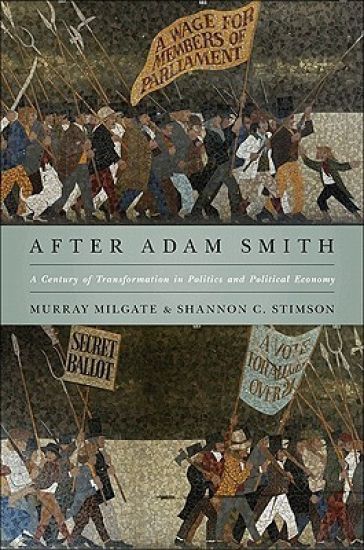
Few issues are more central to our present predicaments than the relationship between economics and politics. In the century after Adam Smith's Wealth of Nations the British economy was transformed. After Adam Smith looks at how politics and political economy were articulated and altered. It considers how grand ideas about the connections between individual liberty, free markets, and social and economic justice sometimes attributed to Smith are as much the product of gradual modifications and changes wrought by later writers. Thomas Robert Malthus, David Ricardo, James Mill, John Stuart Mill, and other liberals, radicals, and reformers had a hand in conceptual transformations that culminated in the advent of neoclassical economics. The population problem, the declining importance of agriculture, the consequences of industrialization, the structural characteristics of civil society, the role of the state in economic affairs, and the possible limits to progress were questions that underwent significant readjustments as the thinkers who confronted them in different times and circumstances reworked the framework of ideas advanced by Smith--transforming the dialogue between politics and political economy. By the end of the nineteenth century an industrialized and globalized market economy had firmly established itself. By exploring how questions Smith had originally grappled with were recast as the economy and the principles of political economy altered during the nineteenth century, this book demonstrates that we are as much the heirs of later images of Smith as we are of Smith himself. Many writers helped shape different ways of thinking about economics and politics after Adam Smith. By ignoring their interventions we risk misreading our past--and also misusing it--when thinking about the choices at the interface of economics and politics that confront us today.
Few deny that the work of economists has often embodied or stimulated significant contributions to political thought. Smith, Keynes, Hayek, and Friedman are good examples. However, the work of the great classical economist David Ricardo is not usually placed in such company. Despite Ricardo's affiliations with philosophical radicals like Bentham and James Mill, the most that previous scholars have been prepared to allow is that if Ricardo spoke to political questions at all, he addressed only economic policy. This book argues forcefully for a revision of that received opinion. Murray Milgate and Shannon Stimson show that Ricardo articulated a distinctive political vision, and that he did so in a novel and sophisticated way by linking arguments for democratic reform with the conclusions of political economy. Ricardian Politics examines compelling but neglected evidence of how Ricardo deployed economic theory to construct a new view of politics. Milgate and Stimson analyze the case he made for a more inclusive political society and for a more representative and democratic government, discuss how his argument was structured by his economics, and explicitly draw out comparisons with Bentham and James Mill. Ricardo wrote at a critical moment, which saw the consolidation of capitalist industry and the emergence of modern democratic political ideology. By attending to the historical context, this book recovers a more accurate picture of his thought, while contributing to the current renewal of research on the relationship between economic and political thought in early nineteenth-century Britain. Originally published in 1991. The Princeton Legacy Library uses the latest print-on-demand technology to again make available previously out-of-print books from the distinguished backlist of Princeton University Press. These editions preserve the original texts of these important books while presenting them in durable paperback and hardcover editions. The goal of the Princeton Legacy Library is to vastly increase access to the rich scholarly heritage found in the thousands of books published by Princeton University Press since its founding in 1905.
Few deny that the work of economists has often embodied or stimulated significant contributions to political thought. Smith, Keynes, Hayek, and Friedman are good examples. However, the work of the great classical economist David Ricardo is not usually placed in such company. Despite Ricardo's affiliations with philosophical radicals like Bentham and James Mill, the most that previous scholars have been prepared to allow is that if Ricardo spoke to political questions at all, he addressed only economic policy. This book argues forcefully for a revision of that received opinion. Murray Milgate and Shannon Stimson show that Ricardo articulated a distinctive political vision, and that he did so in a novel and sophisticated way by linking arguments for democratic reform with the conclusions of political economy. Ricardian Politics examines compelling but neglected evidence of how Ricardo deployed economic theory to construct a new view of politics. Milgate and Stimson analyze the case he made for a more inclusive political society and for a more representative and democratic government, discuss how his argument was structured by his economics, and explicitly draw out comparisons with Bentham and James Mill. Ricardo wrote at a critical moment, which saw the consolidation of capitalist industry and the emergence of modern democratic political ideology. By attending to the historical context, this book recovers a more accurate picture of his thought, while contributing to the current renewal of research on the relationship between economic and political thought in early nineteenth-century Britain. Originally published in 1991. The Princeton Legacy Library uses the latest print-on-demand technology to again make available previously out-of-print books from the distinguished backlist of Princeton University Press. These editions preserve the original texts of these important books while presenting them in durable paperback and hardcover editions. The goal of the Princeton Legacy Library is to vastly increase access to the rich scholarly heritage found in the thousands of books published by Princeton University Press since its founding in 1905.
Alliances and outsourcing are flavors of the month, says the author of this succinct, tightly reasoned book, but how much is known about how to make them succeed? Too many are initiated for the wrong reasons, improperly thought out, and--as quick solutions to difficult problems--they just don't work. Dr. Milgate does not try to sell alliances and outsourcing as options, but instead asks, why consider them at all? And what must you do to get the most out of them, if you decide to proceed? He offers practical advice and illustrates it with real-world case study examples. The result is a lucid, readable advisory for corporate decision makers and a useful classroom aid for their academic colleagues.Never have pressures on corporations to trim down in size been so great. But Dr. Milgate's research shows that corporations' efforts to make themselves lean, to focus on core competencies, and to create mutually advantageous alliances with other corporations have not paid off. The lean organization is clearly the paradigm for business at the start of the new millennium, but how is it achieved? Instead of pure theory, Dr. Milgate offers practical advice and illustrates it with real-world case studies, chosen for their ability to demonstrate best practices in lean organizations and to provide answers to questions that, inevitably, arise repeatedly. He agrees that corporations must focus on the basics and leverage their core competencies up through a range of alliances and outsourcings, toward the goal of creating a best of everything organization. But too many alliances and outsourcing strategies are initiated for the wrong reasons, improperly thought out, and--as quick solutions to difficult problems--they just don't work. Dr. Milgate tells us why and gives us strategic guidance on the critical issues that corporate decision makers must address as they strive to make their organizations as competitive as they must be in order to compete in the new global economy. The result is a succinct, lucid advisory for upper echelon executives and a necessary classroom aid for their academic colleagues.
Drawing on the experiences of companies leading the field in performance measurement, Milgate pinpoints the significant developments that will drive performance measurement into the millennium. This book discards passing trends and focuses on providing in-depth, international coverage of the issues that count. It analyzes and evaluates new and emerging trends, approaches, models, and methodologies. Milgate explains how these techniques and processes work in practice and how they can add clear, bottom-line benefits to your organization.In recent years, business performance measurement has altered beyond recognition. What used to guarantee success for leading companies now barely ensures average performance. Far too often, business performance measurement is a weakness, lacking focus and coherence. New sources of leverage have emerged and new approaches have been introduced. Only those companies that master the new techniques will reach the top of the league. To achieve a competitive edge, companies must reevaluate business performance, its measurement, and the final result. This book shows you how. Drawing on the experiences of companies leading the field in performance measurement, Milgate pinpoints the significant developments that will drive performance measurement into the millennium.This book discards passing trends and focuses on providing in-depth, international coverage of the issues that count. It analyzes and evaluates new and emerging trends, approaches, models, and methodologies. Milgate explains how these techniques and processes work in practice and how they can add clear, bottom-line benefits to your organization.
It's my joy to distill some basics of what it looks like to lead - right where you are at, in a way that's authentic to you.We live in a leadership paradox: In a time that needs leadership more than ever, people are more reluctant than ever to take on the responsibility of leadership. In addition, the average leader in our churches or faith-based organizations doesn't necessarily have the time or desire to pore through shelves of leadership material.To Lead: A Practical Guide for Leaders in Churches and Faith-Based Organizations is Joel Milgate's contribution toward filling that gap.Covering fifteen principles of what it means to lead yourself and to lead others, including practical application sections, this book will inspire and equip you to embrace God's call to lead, to lean into His wisdom and strength to do so, and to remain steadfast in the unfolding adventure of following Jesus into uncharted waters.
During the 1970s, when doctrines like monetarism and new classical macroeconomics ushered in an era of neoliberal economic policymaking, Keynesian economics was pushed aside. It was almost forgotten that when Keynesian thinking had dominated economic policymaking in the middle decades of the twentieth century, it had underwritten postwar economic reconstruction in both Europe and Japan, and was largely responsible for the unprecedented prosperity and stable growth of the 1950s and 1960s. The global financial crisis and recession changed all that. Influential voices in progressive economics circles began to remind us how useful Keynesian ways of thinking could be again, especially in assisting us to come to terms with our economic predicaments. When politicians across the globe were confronted with economic crisis, almost by accident they introduced pragmatic and workable measures that bore all the hallmarks of Keynesianism. This book is about this fall and rise of Keynesian economics. Eatwell and Milgate range widely across the landscape that defines their subject matter. They consider how powerful Keynesian ideas can be when applied to our past and present economic problems. They show how helpful these ideas are in explaining why we came to find ourselves in the mess we are in. They examine where and how the analytical and methodological foundations of conventional macroeconomic wisdom went wrong. They set out a blueprint for an alternative that provides a clearer, more consistent, and more applicable approach to understanding how markets work. They also highlight the interpretive shortcomings that have come to characterize Keynes scholarship itself. They do all of this within the context of a provocative reconsideration of some of the most pressing economic problems that confront financial markets and the global economy today.
2025 Nautilus Book Awards Gold Winner—Business & Leadership2025 Axiom Business Book Award Winner—Business EthicsShortlisted, The Business Book Awards—Leadership Discover a groundbreaking blueprint for the future of business In an era marked by increasing profiteering and inequality, The Ethical Imperative: Leading with Conscience to Shape the Future of Business offers a compelling alternative vision—one where companies champion the collective prosperity of employees, shareholders, and communities. Author Andrew Cooper, a distinguished executive, leverages over twenty academic studies and fifty years of research to challenge the status quo. He exposes the critical threat of public disengagement from businesses and institutions, urging a departure from outdated, profit-only models that harm corporations, consumers, and communities alike. You'll find: Five actionable strategies you can employ immediately to transform your organization into a beacon of trust and social responsibilityTechniques for navigating the age of social media and creating an authentic, honest, and sustainable brandActionable tools to help your organization move beyond exclusively short-term profit-driven models of growth Packed with engaging stories, practical tools, and insights from a seasoned leader determined to revolutionize corporate culture, this book is an essential resource for business managers, executives, entrepreneurs, and anyone aspiring to infuse their commercial endeavors with ethical principles. Join Andrew Cooper in shaping a future where business is synonymous with compassion, equity, and enduring prosperity. The Ethical Imperative is more than a book—it's a movement towards the next phase of corporate evolution. Be part of this transformative journey.American Legacy Book Awards Winner