The princess Arianna continues her journey with the knowledge that she must once again confront her father. With her companion Darwynyen at her side, she sets out to find the great wizard Archemese-but her quest may be complicated by the fact that most believe he is dead. Arianna has faith that the only one who can help her is anything but dead. To make matters worse, they must now deal with a spy who lurks under a veil of deception, and he will stop at nothing to realize his own ambitions. It is her companions, who have sworn their allegiance that will assist her through the future quests she embarks on.
The princess Arianna continues her journey with the knowledge that she must once again confront her father. With her companion Darwynyen at her side, she sets out to find the great wizard Archemese-but her quest may be complicated by the fact that most believe he is dead. Arianna has faith that the only one who can help her is anything but dead. To make matters worse, they must now deal with a spy who lurks under a veil of deception, and he will stop at nothing to realize his own ambitions. It is her companions, who have sworn their allegiance that will assist her through the future quests she embarks on.
A companion book to "The Thirteenth Moon: a Moya Fairwell Adventure", this book catalogs many of the creatures Moya and Fritz discovered on their Journey to the Forest of Worl
Moya and Fritz are back in the sequel to The Thirteenth Moon. Just when they think they can return to a fairly normal life, strange things are happening around town, Cornice is acting oddly, and another scroll appears from the Council of Elders. Their job isn't done yet, and it might get worse before it gets better...
This title is part of Bug Club, the first whole-school reading programme to combine books with an online reading world to teach today's children to read. In this Year 3 Brown A (NC level 3c) fiction short story collection ... Moya is no ordinary child. She is beautiful, gentle - and luck follows her wherever she goes. But is she lucky enough to escape the Little People and an evil queen?
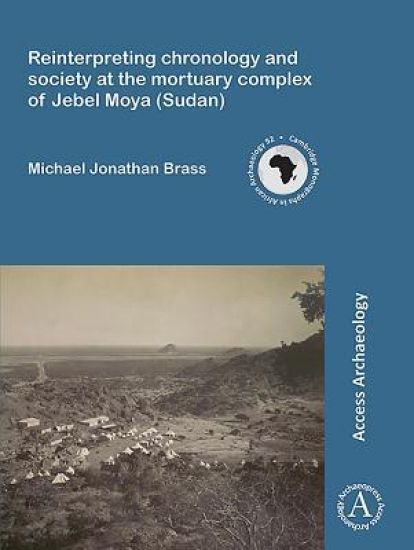
Jebel Moya (south-central Sudan) is the largest known pastoral cemetery in sub- Saharan Africa with more than 3100 excavated human burials. This research revises our understanding of Jebel Moya and its context. After reviewing previous applications of social complexity theory to mortuary data, new questions are posed for the applicability of such theory to pastoral cemeteries. Reliable radiometric dating of Jebel Moya for the first time by luminescence dates is tied in to an attribute-based approach to discern three distinctive pottery assemblages. Three distinct phases of occupation are recognised: the first two (early fifth millennium BC, and the mid-second to early first millennium BC) from pottery sherds, and the third (first century BC - sixth century AD) with habitation and the vast majority of the mortuary remains. Analytically, new statistical and spatial analyses such as cross-pair correlation function and multi-dimensional scaling provide information on zones of interaction across the mortuary assemblages. Finally, an analysis of mortuary locales contemporary with phase three (Meroitic and post-Meroitic periods) from the central Sudan and Upper and Lower Nubia are examined to show how changing social, economic and power relations were conceptualised, and to highlight Jebel Moya’s potential to serve as a chronological and cultural reference point for future studies in south-central and southern Sudan.
La obra de Horacio Castellanos Moya es un referente crucial no sólo para imaginar el pasado y el presente centroamericano, sino para examinar las implicaciones políticas que derivan de la escritura literaria en español en la era neoliberal. El presente volumen reúne el trabajo crítico de 14 académicos de Latinoamérica, Europa y Estados Unidos que abordan la narrativa moyana en sus principales libros a la par de su itinerario biográfico e intelectual: la novela seminal El asco y su celebrada diatriba en contra de El Salvador; las representaciones del militarismo, la guerrilla y la posguerra en novelas como Insensatez, La diáspora y El arma en el hombre; la compleja saga de la familia Aragón, esa genealogía que en más de un modo inscribe el violento proceso histórico de los distintos países de la región. En cada uno de estos ensayos se analiza la tensión irresuelto entre la escritura de ficción, la experiencia de vida del autor, las relaciones del poder geopolítico y la (im)posibilidad de agencia e intervención desde el proyecto literario de Castellanos Moya. Buscamos en un principio cuestionar los límites críticos de su obra en un momento en apariencia post-político, pero al hurgar en los confines de su poética ante lo político, procuramos también señalar las instancias de libertad radical que desde su intervención discursiva articula la ficción. Son éstas, entonces, excursiones hacia la doble vía de la tiranía y la libertad de la ficción de Horacio Castellanos Moya. ~ The work of Horacio Castellanos Moya is a crucial reference not only to imagine Central America's past and present, but also to examine the political implications that derive from literary writing in Spanish in the neoliberal era. This volume brings together the critical work of 14 academics from Latin America, Europe and the United States who address Moya's narrative in his main books along with his biographical and intellectual itinerary: the seminal novel El asco and its celebrated diatribe against El Salvador; the representations of militarism, the guerrilla and the postwar period in novels such as Insansatez, La diaspora and El arma en el hombre; the complex saga of the Aragón family, a genealogy that in more than one way inscribes the violent historical process of the different countries of the region. Each of these essays analyses the unresolved tension between fiction writing, the author's life experience, geopolitical power relations and the (im)possibility of agency and intervention in the literary project of Castellanos Moya. At first, we seek to question the critical limits of his work in an apparently post-political moment, but by delving into the confines of his poetics from a political perspective, we also try to point out the instances of radical freedom that articulates fiction from his discourse. These are, then, excursions towards the double path of tyranny and freedom of Horacio Castellanos Moya's fiction.
In today’s healthcare system the most pervasive and transformational tool is information technology – its efficient use is an essential skill for all health workers. Health Informatics: Transforming Healthcare with Technology discusses health information systems and contains diverse case studies and stories from policy makers, managers, academics, clinicians and those working in outback clinics. The text concludes by pushing the boundaries into genomics and by outlining the future direction of information technology in the healthcare system. Health Informatics is essential reading for students and healthcare workers across all health disciplines and is a valuable resource for those considering implementing health information systems into their practices or institutions. Technology is one of the most pervasive and ubiquitous tools in healthcare today. It is not only transforming healthcare but also the professions within it. This book provides the background and skills necessary to understand the collection, storage, retrieval, communication and optimal use of health-related data, information and knowledge. It addresses a wide range of the most essential and current areas of health informatics and is divided into seven sections.
This intriguing volume examines how the small group communication of Presidents Kennedy and Johnson and their key advisors influenced the decisions to escalate the war in Vietnam from January 1961 to July 1965. Using an historical-critical research method, Moya Ann Ball traces the Vietnam decisions from the combative rhetoric of Kennedy's presidential campaign through the creation of a small group communication culture in the Kennedy administration, which, sustained and reinforced in the Johnson administration, became the motivating force behind the decisions to overtly escalate the war in July 1965. Ball asserts that this small group communication culture was formed by the convergence of such characteristics as the decision-making group's assembly effect, the group's reaction to situational demands, the sharing of dramatic communication, and normative behavior.The analysis is based on primary sources (many of them declassified through the author's efforts) from the Kennedy and Johnson Libraries, and on correspondence and interviews with advisors such as McGeorge Bundy, Robert S. McNamara, Walt W. Rostow, Dean Rusk, and James C. Thomson. Contrary to current literature, Ball uncovers that: Kennedy was not the natural leader of the Vietnam decision-making group, but became the leader in death that he had not been in life; the decision-makers' communication rooted them rhetorically to a combat position from which it seemed impossible to move; Johnson stalled on overt action in Vietnam and, rather than leading his advisors, was led by them; and the decisions to escalate the war emerged in a context of discovery in the Kennedy administration and then were rationalized in a context of justification in the Johnson administration. Vietnam-on-the-Potomac will prove invaluable to communication specialists, political scientists, and historians.